Thursday, April 29, 2010

DUFFIED UP

What an astonishing and misdirected fuss. Gordon Brown, boldly canvassing on the streets of the Lib Dem-held marginal of Rochdale, is caught up in a conversation with Mrs Gillian Duffy who, the press informs us, is a “granny” and a “pensioner” as well as a life-long Labour supporter. It seems a genial enough encounter, at the end of which Mrs Duffy takes Brown’s hand in both of hers. There’s been a slightly sticky moment when she brings up the matter of East European immigrants and wants to know how the foreign students can be afforded, even though her own grandchildren will have such high tuition fees; it emerges later, when Gordon (who’s remembered this detail) asks how old her grandchildren are, that they are still only twelve and ten.

In the privacy of his car, Gordon immediately turns sour, unaware that his radio mic is still on his lapel and broadcasting. He clearly isn’t satisfied with how the encounter went, surrounded as it was by what he later calls a mêlée of press, and, as one is apt to do, he sprays his irritation around, landing some of it on the innocent head of Mrs Duffy, whom he characterises as a “sort of bigoted woman”.

"That was a disaster"

So far, so what? What all changes it and makes it into the greatest political crisis since Suez is that the broadcasters fall over each other to get the overheard grumbling onto air. Not long afterwards, Brown is sitting in a Radio 2 studio for a phone-in and Jeremy Vine takes palpable delight in playing back the recording to Gordon and the world while the PM crumples into a dejected heap. The pundits immediately wheel in, announcing that the general election is over and that Gordon Brown is dead, buried and erased from the official record. Meanwhile, Max Clifford is on the blower to Gillian Duffy, offering his services at very reasonable rates.

This is a farce. Everybody – Cameron, Clegg, the editors of newspapers and broadcasting news, Andrew Rawnsley, you and me – says things that are unguarded, loose, disobliging, unfair and that pass no test of scrutiny when we fondly imagine that we are talking in private. The supposed insult to Mrs Duffy was perpetrated not by the Prime Minister, whose words were intended for no one but those in his car, but by the editors who decided to transmit them to the world, in the spirit of little boys ogling an oblivious woman in a state of undress. I wish Gordon had had the smarts to seize on that as soon as Vine played his trump card, that he had pointed out angrily that he didn’t say what he said for public consumption and that, if he gets back into government, he will instruct MI5 to install recording devices in every office (not forgetting the club) at the BBC so that, whenever anything is said that is confidential, it can be released to the public.

Poor Brown looked so pole-axed that maybe there is yet some sympathy mileage in it, similar to that sparked by the campaign in The Sun to discredit him over his handwriting in a letter to the mother of a killed soldier. But feeling sorry for the man is not much of a basis for an election victory.

"He called me what?"

What I found much more telling and much more of concern was how, in their public conversation, Brown repeatedly tried to steer Mrs Duffy away from actual politics, trying to get her to agree that “it’s nice around here” (not as nice as Fife, Gordon) or asking about her family. I know he doesn’t have much in the way of people skills or small talk ease; indeed, it’s his authenticity and lack of a silver tongue that distinguishes him from the slick slipperiness of David Cameron. After rewarding the latter style in a similar mismatch between John Major and Tony Blair in 1997, you’d think the public would be conclusively wary of a snake-oil salesman this time around. But it doesn’t do to try to avoid discussing issues with voters. The nettle of European immigration has to be grasped, both in word and in deed. None of the leaders wants to grasp it for fear of seeming ... well, bigoted.

Something else I thought ill-judged was Brown’s demeanour after he had come to Mrs Duffy’s house to have a conversation with her, a conservation that I hope will remain private. Perhaps they got on very well, perhaps he found a form of words that satisfied her, perhaps she graciously accepted what I do not doubt was a heart-felt apology. Brown emerged grinning, perhaps with relief, perhaps because he had been charmed. But it made him seem as though he felt he had had a triumph and that looked all wrong.

"I'm a penitent sinner"

None of this amounts to a hill of beans, of course, but you’d think from the coverage that Brown had at least killed somebody with his bare hands. The other parties will have hugged themselves with glee but it would be a mistake for either of their leaders to try to capitalise on it in the leaders’ debate tonight. They know very well to mutter: “There but for the grace of god …”

There remains the larger matter of the morality, responsibility, taste and judgment of the media. How skewed our values have become when an innocent expression of candid frustration is universally condemned while underhand and treacherous opportunism passes unremarked. I think this heartless roasting of the Prime Minister is only one up from Rory Bremner’s stunt, four or five years ago, of contacting Margaret Beckett, then Foreign Secretary, and convincing her that he was really the then Chancellor, one Gordon Brown. I thought that hoax the lowest of the low but this ugly compromising of the PM is nearly as shabby.

And really, does this silly episode, blown out of all proportion, signify when set against our solemn responsibility to elect a new government?

Sunday, April 25, 2010

SLEEPWALKING to DISASTER

I am far from sanguine about May 6th. I suspect the number who have made up their minds that they are definitely not going to vote Labour, even though they yet do not know what they will do, is going to prove decisive. It’s hard to believe that Gordon Brown will still be the prime minister come Ascension Day, which is a week after polling.

The pundits are now agreed that the days following the vote will be filled with horse-trading. I am not so sure. I would not be at all surprised if the Tory vote proved stronger than anticipated, strong enough to form an administration without having to go into a huddle with others. Or if there is a rough three-way split, I fear that Gordon Brown will figure he is justified in trying to cobble something together and will then spend several days in fraught mutual vituperation with other politicians (some of them surviving Labour ministers) before finding himself obliged to slink away abjectly and leave the mess for others to clear up, like Edward Heath did in the days after the first 1974 election.

Clegg as the Lib Dem emblem by Steve Bell 2008

The Tories are arguing hard against a three-way split, with Ken Clarke trying to frighten voters by talk of a hung parliament leading to economic meltdown. (We are at the stage, reached in most election campaigns, when parties try to stampede voters with dire warnings and, simultaneously, complain about smears). But of course “hung parliament” is not on the ballot paper and none of us will knowingly vote for stalemate. This is rather like appeals to the public to “stagger your journey” during transport disruption, as if one can stagger one’s journey all by oneself or, in rush hours on the underground, to “use all available doors”: how will I help to relieve the crush if I rush madly in and out of all the train’s doors one after the other?

Most of us will look at the ballot paper on election day and put our cross against either the representative of the party that we would most like to form the next government or against the representative of the party that we think will either benefit most from tactical voting or do the most damage to the party we hate. Some of us will do this knowing that our vote will be in vain, given that only the winner’s votes count in a first-past-the-post system. If the result is a hung parliament, it will not be by the will of the people so much as by the lack of a party and/or leader dominant in the public’s affections, coupled with the particular character of the way the votes are counted. If Ken Clarke and his mates would rather walk away than join with others to try to make one or more minority parties govern effectively, so be it. Cameron seems a little more circumspect on the matter than some of his lieutenants.

At several elections, the Liberal Democrats and their predecessors in the Liberal Party have dared to believe – and perhaps sometimes even had reason to believe – that they were on the verge of a significant electoral breakthrough. Notoriously, at his party conference in 1981, then leader of the Liberals David Steel, who had formed an alliance with the Social Democrats (a breakaway group from the Labour Party), called on his troops to “go back to your constituencies and prepare for government”. At the general election less than two years later, the Alliance won more than a quarter of the vote but less than one twenty-seventh of the seats, 23 in all.

The sudden rise in polling figures for the Lib Dems in the last ten days will not, I suspect, translate into many seats taken. The party has gained notional support at the expense of both the Tories and Labour, evidently more from the latter, though paradoxically this rise will probably hurt the Tories more.

Cameron the hoodie by David Parkins 2006

It is very hard to see why the rise should have come about. I know it’s because the Lib Dem leader, Nick Clegg, was widely said to have “won” the first of the televised debates; what I don’t understand is why he was so praised for his performance. Coming to it on-line a week late – I was away both on the night of the broadcast and subsequently – I watched in vain for this supposed star quality. I guess it was that most viewers had no sense of what Clegg was like before and were surprised that he was youngish, articulate and didn’t have two heads. As I had listened to him before, none of this knocked me sideways. All I can think is that it was, after all, just as well that the Lib Dems had unceremoniously dumped Ming Campbell because, sound and shrewd though he is, Sir Ming would have seemed even more antediluvian than Gordon Brown, and so David Cameron would have had the younger-than-59 vote all to himself.

In both televised debates so far, Cameron turned out to be unexpectedly ineffectual. In the first round, he barely laid a glove on Brown and left Clegg alone. In the second, he was a little more assertive, save that it came across a bit whiney. This is an objective assessment, not a party one. On a World at One phone-in the day after the second debate, I thought Cameron decisive, smart, nimble-footed, impeccably courteous and even quite sympathetic. If he’s going to make the last telly debate work for him, he’s going to have to up his game in that forum too.

Brown seemed largely in control in the second debate, even risking the odd joke (not always wisely) and riding roughshod over the debating points of the others. This seemed a good strategy but he still did least well in the instant polling so perhaps it is just that large numbers of people have already written him off. In the final debate, I wish he’d do two things. First, he should nail the issue of the increase in National Insurance rates, stop Cameron getting away with calling it “the jobs tax” and make the case for the rise that none of us knows (I certainly don’t), thereby refuting the Tory businessmen who wrote letters in Cameron’s support. As it stands, many viewers must be worrying about what this mysterious “jobs tax” is going to mean for them. The other need is for him to sound an upbeat note. At conference a year or two back, Brown gave a triumphant catalogue of Labour’s achievements in government that had the hall on its feet and gave the lie once and for all to “thirteen wasted years”. He should play that card again in his closing piece on Thursday. I wrote to him to pass on these two suggestions, but I doubt he will get them (in either sense of “get”).

Go Bro by Schrank 2009

Television news and the print media too have gone overboard for the television debates. They have also reinforced the sense that, the Chancellor and his shadows aside, the only politicians who really count are the three party leaders. Given the increasing likelihood that the next half-decade will be under a Conservative government, I think the electorate should have the chance to get a look what is certainly one of the lamest would-be government teams ever set before them. Even if Cameron and Clarke manage to make some sensible decisions between them, the rest will certainly make a hash of it. My prediction is that, by this time next year, the Cameron government will be one of the least popular this nation has ever had. That’ll be small comfort to Lord Brown of Kirkcaldy and Cowdenbeath or Lord Darling of Edinburgh South West.

The emphasis on the battle for 10 Downing Street has squeezed out other aspects of the democratic process as well as other mere ministers and their shadows. I wrote this letter to The Guardian a few days ago: “Dear Sir, I am surprised at your lack of coverage of the important exercise in democracy taking place on May 6th. I refer of course to the local elections in various district and unitary authorities and mayoralties across England and all the English metropolitan and London boroughs. Yours faithfully etc”. Needless to report, the paper has not been pleased to publish it. I begin to wonder if we shall even find out what the local results are this time around.

In the contemporary world, we are told often enough how grave and significant is our democratic right and duty to exercise our voting power. One way and another, however, it seems that the democratic quality of the exercise is being squeezed out of it. Gordon Brown remarked jovially at the start of the second debate that it had the feel of a TV popularity contest and indeed that is just what the whole coverage has. It is the qualities that play well on television – facility, fluency, geniality, bantering without rancour, unflappability -– that increasingly determine the fate of politicians rather than those that used to count – authority, articulacy, forthrightness, reassurance, intellect.

Politicians like Michael Foot, Roy Jenkins, Shirley Williams, Tony Benn, Tony Crosland, John Biffen, Ian Gilmore, Peter Carrington, Ian Mcleod, Jo Grimond, David Penhaligon, Menzies Campbell, John Mackintosh, Bryan Gould, John Smith and others would surely not have thrived in this chat-show culture. It is a culture that values George W Bush over Al Gore or John Kerry, largely because, to many unreflective folk, he seemed like the pleasanter guy to have a beer with. No wonder, then, that Cameron has seemed relatively plausible and that the new kid on the block, Clegg, seems acceptable to large numbers. What a way to run a democracy.

Thursday, April 15, 2010

HOT STREAKS

I am going away for a few days, so this posting is by way of a brief holding operation. I wanted just to record my admiration for two long-running teledramas. I wondered if both Desperate Housewives and Shameless might be outstaying their shared welcome in pushing on to, respectively, a sixth and a seventh series. But both have been in outstanding form lately, each in its own way pulling outrageous stunts with complete confidence and confounding their audiences with clever and – in both cases – very moving resolutions. To turn comedy into tragedy and back again without betraying either form is much harder to do than it looks and the great virtue of both these shows is that the art is concealed by art. Each is now shooting a further series and I for one cannot wait.


Paddy Maguire and Marcia Van Der Camp, a lovely couple

Friday, April 09, 2010

BESTOWING ONE’s KISS

I’m such an election junkie. For at least 18 months, I have been in training for the ritual of sitting up all night on May 6th. Not for me the weary trudge to bed after the Portillo Moment. Unless my crumbling body won’t let me, I shall see it through to the bitter end.

The only election in half a century the results of which I did not sit up for was that of 1979. Election day that year happened to coincide with the first night at the Royal Court of Martin Sherman’s epochal play Bent. I knew Martin, had read the play and, in my then role as a BBC drama producer, had declared that if the Court didn’t make up its mind to commit to a production I would do it on television. The designated stage director, Bob Chetwyn, was also someone I knew – he was (still is) the partner of my old pal Howard Schuman, author of Rock Follies. So there is reason to think that my view carried a little weight in the matter. Anyway, the Court made up its mind, a gang of us supported it on the first night and my reward was that I met there a very sweet young man with whom I began a nice little affair that night. So Margaret Thatcher’s wholly anticipated triumph was, frankly, no contest.


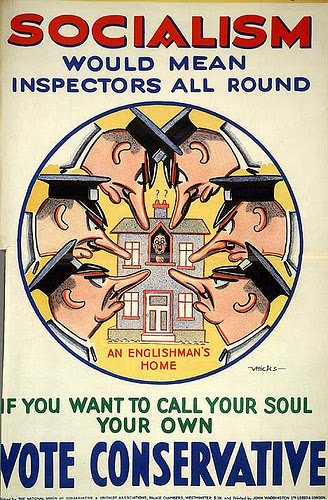
The Tories have often played the fear card

But it’s a big and important deal, putting one’s X on a ballot paper. It was of the 1979 election that the very sweet young man with whom I then shared my flat – a different sweet young man whom I adored and who pitifully died in 1982 – remarked that he had yet to decide to which candidate he was going to give his kiss. I thought that description delicious; deliciously camp too.


Posters for the 1945 election

At that election, our seat (but not my kiss) was won by Hugh Rossi, who went on to be a self-satisfied junior minister under Thatcher. He was finally beaten in 1997 by Barbara Roche who in turn became a junior minister under Blair. She lost to the Liberal Democrat Lynne Featherstone in 2005, by which time we were voting elsewhere, though I had already abandoned Labour for the first time in 2001, adding my kiss to the second largest swing to the Lib Dems in the country at that election. I thought that Blair had taken us to war too often – this was before the second invasion of Iraq and the first (by the West) of Afghanistan – and that the government’s immigration policy, which Roche then administered, was a disgrace. Happily, the local trend was to a liberal rather than a reactionary reaction on this issue.


BBC election studio 1950

My ballot paper in 1997 is not the only one I have ever dropped into the box that added to a winning total but it is rare enough that that has happened. None of us chooses where we live simply in order to take a decisive part in the democratic process (unless we are professional politicians) and it’s a function of wanting to live in relatively salubrious neighbourhoods that one is apt to find oneself represented in parliament by a Conservative. Such has been the case since we abandoned the capital for the West Country, where Labour members are like hen’s teeth. The old non-conformist traditions here, though, ensure that there is unusual strength in the Lib Dem vote.

Our constituency boundaries have been redrawn since the 2005 election. The largest town in the area, which is where the Lib Dem vote has historically been strongest, has become the centre of a new seat and so there must be a real chance that Clegg’s gang will take it. Happily we fall into this new constituency. The rural area that falls within the boundaries of the other new constituency is being contested by the Tory MP who habitually won the old seat and he must be a certainty to retain it. This is despite the torrent of bad publicity he has received, both for cheating on his cancer-stricken wife, like some John Edwards of the shires, and for the shabby nature of his role in the Great Expenses Scandal – he claimed for a Remembrance Sunday wreath: how cheesy is that?


BBC election studio 1966

The comprehensively bad press that the whole House has received over the last twelve months has been expected to influence the electorate’s response and, anticipating as much, an unprecedented tally of members is standing down this time. Some have been pushed rather than jumped, some have feared further humiliation at the ballot box and many Labour backbenchers listened too readily to the extraordinarily persistent consensus from the start of 2008 to the end of 2009 that the Tories were certain to win by a landslide and decided that someone else could lose their seat. The evidence of polling doesn’t especially reinforce the notion that members thought to be corrupt will be disproportionately punished. And of course the punditry’s expectation is now of a much tighter result.


Don't let this happen this time

One consideration that has been overlooked by the media is that the public’s trust in journalists is, if anything, even shallower than that in politicians. As one who worked as a journalist for thirty-odd years, I think the public is right to be sceptical. Asked to trust either Ann Leslie or Jacqui Smith, Alexander Chancellor or Ming Campbell, Simon Heffer or Chris Grayling, I’d take the politico every time. And if a parliamentary committee decided to investigate corruption and expenses-fiddling in newspapers and broadcasting, the results would be even more shocking than the revelations about the politicians, save of course that those revelations would have to be conveyed to the public by the very people being fingered and so the message might be subtly or nor so subtly altered.


John & Norma Major at the 1992 poll

By and large, British politicians are a pretty good advertisement for probity, certainly when compared to those of many other countries. There was an interesting piece in The Guardian this week by Sir Simon Jenkins explaining how Thatcher fatally damaged the Tories as an electoral fighting machine by failing to maintain the local nature of the party’s infrastructure, a system that (Jenkins suggested) was intrinsically corrupt in a Masonic sort of way but nevertheless was mightily effective at keeping the Tories as the dominant political organisation for most of the twentieth century: see
http://www.guardian.co.uk/commentisfree/2010/apr/06/conservatives-david-cameron-weakness-local-level

When I was young and living in the east Midlands, I saw at first hand how the Tories held onto local councils by putting up candidates in local elections as “independents” and thereby fooling the public that they were being represented by people who weren’t answerable to vested interests. There are of course local elections as well on May 6th but don’t hold your breath for any media coverage, even though the London boroughs are involved.

Looking back on elections of the past, I find impressions are very vivid. For the 1959 election, I was centrally involved in the conducting of a mock election at my prep school, simultaneously spearheading the Tory campaign and overseeing the ballot itself – no suggestion of corruption was ever made. I have a movie-like image in my mind of virtually the entire school population chasing me across the quad as I carried off the ballot box to count the votes.

By the 1964 election, I was 17 and rather more sophisticated. Though my chum Tony and I affected to deplore the throwing out of Downing Street after just a year of the erstwhile Earl of Home (pronounced Hume) – “a proper gentleman” we mourned – the prospect of a dynamic new government (“Let’s go with Labour” was the slogan, accompanied by a thumbs-up sign) was exhilarating. Harold Wilson, who had spent the campaign decrying “thirteen wasted years of Tory rule”, embraced “the white heat of technology” and promised a modern, progressive Britain.


Murdoch's boys crow in 1992. Maybe this time they haven't backed the winner

What I most remember of election night was an interview with Wilson’s deputy, the irrepressible George Brown, who addressed an outside broadcast camera at Labour’s Transport House HQ and was plainly quite seriously drunk. Six years later, watching the coverage of Labour’s defeat on a communal telly in a student rooming house, I joined in the sad groan that greeted the news of Brown’s defeat at Belper (where my maternal grandmother was born).

Another election night memory was probably from the previous election, in 1966. The BBC’s studio on that occasion was like the set of some trendy theatre production, all scaffolding and floated platforms. Cliff Michelmore, who was the main presenter, at one point handed over to Sir Robin Day (as he then wasn’t) – who was perched on a platform in the roof of the studio where he interviewed a succession of passing-through politicians – with a reference to the fact that Robin had once stood as a Liberal candidate. White with fury, Day leaned precariously over the scaffolding and bawled “I asked for that not to be mentioned”.

Pinning down the politicians has always been the aim of broadcast coverage of the campaign. The politicians know how to spar with professional journalists but can be thrown by persistent members of the public. The woman who bearded Thatcher during the 1983 campaign on the question of the sinking of the Belgrano sadly didn’t manage to swing the result by putting the PM on the spot but Thatcher never forgave the BBC for letting it happen. So that was a far-reaching consequence.

In 2005, Jeremy Paxman pitched an outrageously improper question to George Galloway who had just squeaked a win for his Respect Party over Oona King in Bethnal Green and Bow: “Are you proud to have thrown a black woman out of parliament, Mr Galloway?” Galloway was as gob-smacked by this as everybody else and mumbled a suitably combative answer in the circumstances. No doubt later – as an esprit de l’escalier – he will have wished he had come up with something along the lines of: “No, any more than I am proud that I am being interviewed by you rather than Zeinab Badawi”.

Politicians can be seen at their best and worst during elections. Having to get out of the Westminster comfort zone can be very good for them. Some of course truly relish campaigning. On The World at One today we heard John Prescott out on the road, not something he needs to do because he too is standing down but there he was being himself as only he could be: “Thank you for your support, son; if one finger means support”. You have to love him.

This election has been hailed as “the most important for a generation”. I have never lived through a single election that wasn’t hailed as “the most important for a generation”. But I hope that this one won’t feature a poor turnout or a significant drift to fringe parties, particularly those with racist and/or little-Englander policies. I hope the flow of results on the night is exciting and sometimes unexpected and that not too many follow the example of some returning officers who have abandoned the traditional count as soon as he polls close in favour of a next-day result. And of course I hope that we do not vote ourselves a majority Tory regime, full of PR types and smug gits. As it happens, my own fortunes have never prospered under a Tory government – the ‘80s and ‘90s were often a desperate time – and I can’t see any other than city fat cats doing well out of the baronet George Osborne’s budgets, nor Hillary Clinton hitting it off anything like as well with Hague as with her adored Miliband. Given the chance, Cameron will destroy our credibility in Europe without having a fallback position to replace that role. It’s a no-brainer. For all his flaws, we need to keep Gordon.

Monday, April 05, 2010

WHITE EARTH, WHITE TERROR

The bloody end of Eugene Terre’Blanche can’t have taken many by surprise, certainly not the followers of Christ who know their man’s words as spoken to Saint Peter and reported in the Matthew Gospel: “All they that take the sword shall perish with the sword” [26:52]. Terre’Blanche certainly took the sword. The son of an officer in the South African Defence Force, a conscription outfit not noted for its progressive implementation of apartheid rule, he joined the South African Police. He rose to become a warrant officer in the Special Guard that protected government ministers. However, he came to feel that the policies of Prime Minister John Vorster were too liberal – ha! – and resigned to join the right-wing break-away movement, the Herstigte Nasionale Party.


In his attractive youth in the South African Police

When he failed to find elective office by this route, he formed his own grouping, the Afrikaner Weerstandsbeweging (known as the AWB), a quasi-military pressure group that he would lead for 37 years. He chose as his group’s symbol a variation on the swastika, donned his bodyguards in black shirts and was always referred to as The Leader (Der Leier in Afrikaans, the precise equivalent of Der Führer). But the AWB was a tuppeny-ha’penny outfit by the standards of most militias. Even the sainted Ken Sara-Wiwa maintained a private army capable of more efficient despatch of renegades and apostates than were the AWB. Though (following the inaugural tarring and feathering of a white liberal academic) his goons were certainly responsible for some deaths in South Africa, Terre’Blanche customarily traded more in menace and bloodcurdling speeches than in systematic violence against perceived enemies of apartheid or civil disobedience in the face of what he claimed was the weakening of white supremacy successively by Vorster and PW Botha.


With fellow AWB stormtroopers

Perhaps Terre’Blanche’s most eye-catching stroke was the 1993 attack he and several hundred supremacists launched on the building where negotiations were in progress to end apartheid and introduce multi-racial elections. Having successfully disrupted the talks, however, the storm-troopers ran out of ideas as to what to do beyond pissing on the floor and painting slogans on the walls. They left with a promise of no legal repercussions and the multi-racial elections went ahead as planned, thereby electing Nelson Mandela as president.

Nick Broomfield’s celebrated 1991 documentary portrait for Channel 4, The Leader, His Driver and the Driver’s Wife, presented a man who worked hard at seeming ferocious but who had little coherent to offer in terms of philosophy or practical politics. This of course is the shortcoming of fundamentalists everywhere. “No surrender” is their cry and armed is their response. We can see this breaking out right across the States just now and truly unnerving it is too. Those barking defiance from the last redoubt are generally absurd creatures and Terre’Blanche played out the absurdity in full measure, strutting around like a Mussolini of the veldt and famously falling off his horse at a parade intended to burnish his legend.


AWB design style

It is the armed ingredient that stops these people existing only in a world of comic operetta. Last week, a middle-aged so-called “born again Christian” and “pro-lifer” was sentenced to fifty years in a Kansas jail for shooting dead a surgeon outside a church. The killer justified his action by calling the surgeon “a baby-killer”. It is the taking of the law into their own hands that is the logical outcome of the decision to bear arms. Just as the regulatory instincts of left-of-centre regimes can, when taken to extremes, turn into oppression so the “freedom” demanded by right-wingers soon gives way to anarchy and the law of the jungle. In that world, weapons are carried for “defence” but of course are used in practice for attack.


Menace and blood-curdling speeches

I do not doubt that there is lawlessness and vengefulness among both black and white communities in South Africa. White farmers clearly do get attacked – murdered, even – simply because they own land. It’s frighteningly easy to imagine a future government in Pretoria instigating a self-defeating campaign to drive the whites from successful farms as Mugabe has done in Zimbabwe with the same result that does no one, black or white, any good.

Equally, the poverty and resentment among poor urban and rural blacks is real and crippling enough. How they must wonder when the bright promise of Mandela is going to transform their little lives. That Terre’Blanche was hacked to death with pangas by young men whom he had cheated of their recompense for labour undertaken seems only too likely, both in terms of his indifference to their entitlement and their resorting to the only remedy they knew. If the murderous cruelties of the years of apartheid are revisited upon those whites who perpetrated them, it is hardly a surprise. Read the novels of the great Nobel laureate JM Coetzee who, with understandable discretion, has uprooted his family and moved to Australia. Among his works, Disgrace, In the Heart of the Country and Life and Times of Michael K provide as compelling a portrait as any of life for both black and white in South Africa.


Careful, Gene, you might fall off

Jacob Zuma – himself a figure of doubtful credibility with his wives, his enthusiasm for public dancing and his constant air of corruption – has a real challenge to keep this show on the road if he does not want his presidency to be remembered primarily for a Football World Cup marked by violence and crime. He has been shrewdly solicitous about the Terre’Blanche murder. He knows that the danger of a backlash is real and frightening and that he must contain it. The dead fool should be soon forgotten and, we must hope, will leave no movement or legacy that can last. But this is a moment to hold our collective breath.


Zapiro cartoon for The Jo'burg Mail & Guardian a year ago: not quite how it turned out

************************************

A most melancholy task that falls to us at this time of year is the removal of dead frogs from our pond. Evidently the females are exhausted and eventually drowned by the over-amorous males, some of whom are found to be still clinging to the corpses when they are netted out. On the night-time walks, I keep the dogs on tight leads and rake the ground with torches to ensure that we step on none of the creatures lurking and croaking to each other in the grass. But the reward of this care is the daytime dumping of bloated bodies over the hedge, as many as six or eight some days. It seems a very unproductive means of courtship. Does anyone have any suggestions as to what might be done another year to ameliorate this carnage?

Wednesday, March 31, 2010

WITHIN the MARGIN of ERROR

I am hugely enjoying the contortions through which the members of the commentariat are putting themselves to make any kind of comment on the recent opinion poll findings. Said pundits decided more than two years ago that Labour “couldn’t” win the next election, that David Cameron was a shoo-in, that the only hope Labour had was to ditch Gordon Brown in favour of David Miliband or Ed Miliband or Alan Johnson or indeed Harriet Harman but even then the party was destined to be out of office for a generation.

They were perfectly categorical about it. As recently as November 28th last year, the main headline on the front page of The Daily Telegraph was: “Tories head for landslide”. Don’t expect to see any paper risk that one again this side of the election. The new conventional wisdom, rapidly agreed in whatever are the modern equivalents of El Vino and The Cheshire Cheese, is that it’s “going to be” a hung parliament (again, the revised result is not in doubt), that the Tories may be the largest party but will fall short of an overall majority.

As JK Galbraith, who coined the term in the first place, once observed: “circumstances have been dealing the conventional wisdom a new series of heavy blows” [The Affluent Society 1958]. That is always the danger in embracing the conventional wisdom. Being conventional, the reading isn’t very imaginative or bold. It heavily depends on what your own waters tell you chiming with what their waters are telling others with whom you are anyway liable to agree. Before long, any other projection of a result that is still weeks away seems merely maverick. Well, for what little it is worth, I have always felt sure that Labour can (I put it no higher) win the election outright. But I’m not going to the wall for it. What would be the point? We will know the actual result soon enough.

And on what ground are these two successive and – their expounders conveniently forget – strikingly different consensuses constructed? Why, on the evidence of a few hundred people asked how they think they will vote, data that is then massaged (“weighted” in the jargon) allegedly to render the respondents more representative.

I have always argued that market research is a pseudo-science, a profoundly misleading exercise, much more likely to elicit the answers that the pollsters want to hear than anything truly accurate on which to build a theory about public opinion. The polling organisations themselves, who always trumpet their methods as if they are inviolate, do all sorts of things that – it seems common sense to me – must skew the findings. Some exclude those who “don’t know” and “wouldn’t say”, as if these two responses are the same and equally irrelevant. Some give more weight to those who say they’ll “definitely” vote, as if such people are more credible and more reliable in their habits than others who perhaps are more realistic.

Some polls ask if people are optimistic or pessimistic about their economic prospects and then translate that directly and most crudely into a judgment on the present government. But if you were a convinced Tory who felt sure that the Tories would win the election, wouldn’t you by definition feel optimistic about the economic prospects? If the main breadwinner in your household had just died, you might well feel pessimistic about the prospects, while not yet knowing how far state benefits might ease the situation. Stark beauty contests are held in these polling exercises: who would make the best prime minister, Brown, Cameron or Clegg? Well, you might think Clegg but vote for Cameron anyway because the Libs Dems don’t stand a chance in your closely-fought constituency. You might think that Michael Gove or Tessa Jowell would actually make the best prime minister and then have to calculate which answer is the one most likely to bring such an event about.

But what folly to parlay even a 16-point lead for the Tories in September into an immutable Tory electoral victory in May. Indeed, if Cameron has, say, a comfortable-looking five-point lead on the morning of the election, there can still be no certainty until the count is done. Furthermore, exit polls after the voting booths closed have proved misleading and even directly wrong in the past. You don’t have to be as old as me to remember the confounded projections of the British elections in 1992 and 2005 or of the US elections in 2000 and 2004. You perhaps do have to be as old as me to remember that neither the 1970 nor the first of the two elections in 1974 turned out quite as billed.

Why anyway is it deemed so necessary to anticipate news rather than reporting it? Why is it so important to all news-gathering organisations – from The Sun to The Independent, from the Today programme to ITV News – to get their unreliable prediction in first? That Polly Toynbee or Nick Robinson discounts the chances of a fourth Labour term in succession has no bearing upon whether such a result will come about, unless significant numbers of voters determine that they will vote to outface these pundits in greater numbers than those who feel they need to take their voting guidance from someone in the public eye.

What you can be sure of is that, following a sensational Brown victory, the media will not be eating humble pie and asking themselves how they could have got it so wrong. Rather, they will be finding new material for speculation and what they are pleased to call analysis: the newly discovered fact that the electorate is – who would have thought it? – unpredictable.

Tuesday, March 23, 2010

NOTHING to HIT BUT the HEIGHTS

Yesterday, Stephen Sondheim turned 80. I’m sure he would agree that this makes him an old feller. Nevertheless, as he belongs to a profession not noted for longevity, it’s a good age. Jerry Ross only lived to be 29, George Gershwin just 38, Lorenz Hart 48, Kurt Weill 50, Frank Loesser 59, Jerome Kern 60, Sondheim’s beloved mentor Oscar Hammerstein II 65, Johnny Mercer 66, Dorothy Fields 68, Leonard Bernstein 72, Noël Coward, Cole Porter and Alec Wilder 73, Cy Coleman 75 and Richard Rodgers and Andy Razaf 77. But Harold Arlen got to 81, Yip Harburg 84, Ira Gershwin 86, Harry Warren and Adolph Green 87, Jule Styne 88, Betty Comden 89, Eubie Blake 96 and the grand old man of all, Irving Berlin, to 101 (not to forget the phenomenal George Abbott who was said to be playing golf every day until just before his death at 107; I saw the incredibly sprightly 1985 revival he directed at 98 in London of Rodgers & Hart’s On Your Toes, for which he wrote the original book in 1936). So there’s still something to aim for.


Mature Sondheim

It’s a curious coincidence that Sondheim shares his birthday with Andrew Lloyd Webber, now 62. In another part of the forest, those Titans of cinematic horror, Vincent Price and Sir Christopher Lee were both born on May 27th, the day after Peter Cushing, though obviously all in different years. Sondheim and Lloyd Webber may both have written many musical plays but within that field that have little in common. They did, however, once and very unexpectedly collaborate. It was for the spectacular charity benefit in honour of Sir Cameron Mackintosh, Hey, Mr Producer!, given in London twelve years ago. In a dropped-in recorded sequence, the two men sat at the piano and performed a satirical pull-together of songs from their respective repertoires for which Sondheim had buffed the lyrics. I particularly enjoyed his reference to “the overwritten music of the night” which Lloyd Webber seemed to take with decent grace.

(Sondheim has a brilliant satirical gift for rewriting the lyrics of others. For Leonard Bernstein’s 70th birthday celebrations in 1988, he twitted his old friend with a version of the Ira Gershwin lyric, ‘The Saga of Jenny’, rewritten of course as ‘The Saga of Lenny’. Where Jenny “would make up her mind”, Sondheim’s Lenny wouldn’t, guying Bernstein’s notorious propensity to spread himself thin. What Sondheim kept in his listeners’ subconscious minds was Bernstein’s notorious sexual ambiguity, about which it would have been disobliging to be explicit, even had Lenny’s formidable nonagenarian mother not been present. Lauren Bacall performed the song with exactly the required insouciance, so that Bernstein was delighted even while deliciously embarrassed).


Sondheim by Hirschfeld

My regular readers will be aware that I have few words to bestow on Lord LW. But my admiration – love, even – for Sondheim’s work knows no bounds. I feel privileged that my life has overlapped with his so that I have been able to follow his development and witness so many of his works when they were new-minted and see again how they have matured. Sondheim’s contribution to American theatre and music is certainly the equal to that of Arthur Miller, Tennessee Williams, Eugene O’Neill, David Mamet, August Wilson, Sam Shepard, Edward Albee, Aaron Copland, Charles Ives, Samuel Barber, Howard Hanson, Walter Piston, Duke Ellington, Elliott Carter and the giants of musical theatre I listed above. He is a great American artist.

Where to begin when urging him upon those who have yet to appreciate fully this extraordinary œuvre? I recall that when I was covering for Time Out the imminent arrival of A Chorus Line in London, the line I was getting from the creators of that epochal show (all, apart from composer Marvin Hamlisch, now dead) was that, great as Sondheim was, they wanted to do something really emotional, which Sondheim’s stuff somehow wasn’t. In particular, Michael Bennett, the incredibly charismatic director and choreographer, who had created the dance numbers for Sondheim’s Company and Follies, told me how passionate he was to tap into emotion. But this was profoundly to confuse emotion with sentiment. I cannot watch any production of middle-period Sondheim (Follies through Sunday in the Park), however humdrum that revival, save through a mist of tears.


Angela Lansbury, Catherine Zeta-Jones in Broadway's current Little Night Music revival

That is not because my heartstrings are being urgently pulled; far from it. The emotional charge comes in quite unexpected places. Take the bracingly spirited number given to Petra the maid, a previously unregarded character, right at the end of A Little Night Music, when the “smiles of a summer night” have all frozen on the faces of the grand figures. Petra has enjoyed a tumble in the grass with a visiting butler, now asleep, and she confides to the audience her lofty yet practical plans: ‘I Shall Marry the Miller’s Son’. She has no doubts about it: “Friday nights, for a bit of fun,/We’ll go dancing”. But that’s for later: “Meanwhile …/It’s a wink and a wiggle/And a giggle in the grass/And I’ll trip the light Fandango./A pinch and a diddle/In the middle of what passes by”. And why not? Because “It’s a very short road/From the pinch and the punch/To the paunch and the pouch and the pension”. So “a girl ought to celebrate what passes by”.

You now know she’s got her head screwed on. Then she lets herself dream: “I shall marry the businessman./Five fat babies and lots of security./Friday nights, if we think we can,/We’ll go dancing”. But still she’s anchored in the present and catching her fun where she may: “It’s not much of a stretch/To the cribs and the croup/And the bosoms that droop and go dry”. And then she starts blissfully to fantasise: “I shall marry the Prince of Wales –/Pearls and servants and dressing for festivals./Friday nights with him all in tails,/We’ll have dancing”. But she’s quickly back in the triumphant present: “There are mouths to be kissed/Before mouths to be fed,/And there’s many a tryst/And there’s many a bed./There’s a lot I’ll have missed/But I’ll not have been dead when I die!/And a person should celebrate everything/Passing by”. And she ends with what, at the song’s outset, seemed hubris and now is seen as a proper, doable ambition: “And I shall marry the miller’s son”.

It’s a marvel of a lyric, driven ahead by the busy three-four rhythm – all the show’s numbers are in waltz tempo – and subtly developing its ideas. I adore the modulation from Petra and her miller’s son going dancing “for a bit of fun” to her and a businessman more cautiously going dancing “if we think we can” to the smart perception that powerful people will “have dancing”. In the first London production, Diane Langton, then in her splendid prime before she became a barrage balloon, sang it with such lusty conviction that you just had to cheer, the tears streaming down your cheeks. I cannot read the lyric now, let alone hear it well sung, without filling up.


Japanese actor Mako in the premiere of Pacific Overtures

Another song that packs an unlooked-for punch comes in Sondheim’s musical about Japan. I was lucky enough to catch Hal Prince’s original production of it on Broadway in 1976 and if I ever see anything on the stage to equal its beauty and enchantment, I’ll eat my hat … indeed, to pick up an idea from another Sondheim show, I’ll finish the hat. Pacific Overtures depicts Japanese society before and after its opening up by the arrival in 1835 of Commodore Matthew Perry and the US fleet. It makes brilliant use of kabuki techniques and, having seen authentic kabuki in Tokyo, I can attest to the skill and respect with which this is done. Sondheim’s score, growing organically out of John Weidman’s book, is dazzling, penetrating, witty, moving and original in equal measure. In the number ‘Please, Hello’, it even contrives pastiches of four other (non-Japanese) composing styles of the period.

But the particularly moving number is ‘Someone in a Tree’, in which an old man remembers, as a boy, watching the signing of the treaty. His child self runs up a tree to recreate the scene – old and young self correct each other charmingly (“He was younger then” … “He was only ten”). The eye witness account is further edited by a guard who was stationed in the cellar of the treaty house and so was able to hear “everything … First I hear a creak and a thump./Now I hear a clink./Then they talk a bit”. These reports, while unreliable, have their own legitimacy: “I’m a fragment of the day./If I weren’t, who’s to say/Things would happen here the way/That they happened here?”

As none of the acres of newsprint expended on the subject got close to achieving, I find that this song from an American musical explicates the phenomenon of the public outpouring at the death of the Princess of Wales, the need for so many people to participate in the event of her death, at least through being part of the mourning: “It’s the fragment, not the day./It’s the pebble, not the stream./It’s the ripple, not the sea/That is happening./Not the building but the beam,/Not the garden but the stone,/Only cups of tea/And history/And someone in a tree!” Some may find Sondheim’s stuff cold but I cannot hear that lyric – or even type it out – without my eyes blurring.


An ancient Buster Keaton in the Funny Thing Happened movie

Another canard about Sondheim is that he’s a nifty lyricist but he can’t write a tune you’ll remember, a notion Sondheim himself guys niftily in the cruelly underrated Merrily We Roll Along when the show producer Joe sings: “That’s great. That’s swell./The other stuff as well./It isn’t every day/I hear a score this strong/But fellas, if I may./There’s only one thing wrong:/There’s not a tune you can hum./There’s not a tune you go bum-bum-bum-di-dum” and he leaves humming a minor key version of Rodgers & Hammerstein’s ‘Some Enchanted Evening’.

Unlike R & H, Sondheim can’t look to a certain movie future to reinforce the familiarity of the songs. Musicals are too expensive for Hollywood these days unless it’s a sure-fire proposition: even Chicago had to be revived on Broadway and sustain a much longer second run before film funding could be found, 27 years after it first opened. The 1950s hit stage shows, West Side Story and Gypsy, for which others wrote the music to Sondheim lyrics, were successfully filmed, especially West Side, which, few remember now, only really became a legendary musical on the back of the movie’s success. Sondheim’s music-and-lyrics show A Funny Thing Happened on the Way to the Forum was made into a lively but not greatly profitable movie by the then trendy Dick Lester, who had the good sense to cast from the rich comic tradition of burlesque and stage comedy as well as silent movies. More recently, Tim Burton’s visually splendid version of Sweeney Todd missed the comedy but caught the grand guignol and preserved a generous proportion of the score. But Hal Prince’s movie of A Little Night Music is largely a dud.


Angela Lansbury, George Hearn in the premiere production of Sweeney Todd

And think on this: Sondheim’s organic scores don’t generate numbers that lift out for pre-opening promotion. They’re of a piece. When you sit down to see the show, you’re usually hearing all the music for the first time. It’s unfamiliar. It’s also relatively demanding. He studied composition with Milton Babbitt – Irving Berlin couldn’t even read music – and his composing is in a clear line of American classical work, through Aaron Copland and Leonard Bernstein yet also informed by a hugely eclectic taste in cultural input. But serious American music has always been cross-fertilised by popular as well as academic forms and the process is two-way. I always tell people that Ned Rorem’s angular art-songs are not at all difficult to grasp if you listen for the relationship to Sondheim numbers and, by association, the Broadway tradition.

Sondheim’s scores richly repay study. He may not write quite as many “tunes you can hum” right off the bat as, say, Jerry Herman but then Herman is apt to write three or four songs over and over again so that they seem familiar at the first hearing. But I could sing Sondheim songs all day, without repetition or consulting a printed score or a recording. His tunes are insidiously attractive, often using the old Noël Coward gambit of bitter-sweetness (a darkling notion set to a charming tune). And the Sondheim songbook is now as well-thumbed as any by the old Broadway masters.


The best performers love to sing his work

I was lucky enough to interview Sondheim 35 years ago when the fifth show for which he had written music as well as lyrics, A Little Night Music, opened in London. Needless to say, I found him charming and fascinating. He gave me a huge part of his afternoon, rehearsing history that I would have already known if I had done my research and making it vivid and vital. It is no surprise to learn how widely he is adored for his generosity and kindness and also for being a riveting teacher.

London played a crucial role in underwriting Sondheim’s claim to be taken seriously. A year after A Little Night Music opened at the Adelphi, David Kernan and Ned Sherrin put together the revue of Sondheim songs that became Side by Side by Sondheim, produced by Cameron Mackintosh. Joined by the great Millicent Martin and by long-time aficionado Julia McKenzie (whom Scott Meek described as having been born to sing Sondheim), they had a big hit that transferred, replete with original cast, to Broadway and has been revived and toured repeatedly ever since. The combination of small overheads and top-drawer material makes it a handy vehicle.


The young master at work

Sondheim’s place in Valhalla is now assured though it took longer than it should have done. His shows were never monster hits like Hello, Dolly!, Fiddler on the Roof, Phantom of the Opera or Les Miserables but performers and directors love to revive them and the fan base is big enough to make such revivals viable if not honey pots.

His youngest show, known variously as Wise Guys, Gold, Bounce and Road Show has been briefly seen in various manifestations in New York, Chicago and Washington over eleven years and its evolution is beginning to rival that of Bernstein’s Candide (to which Sondheim has made his own contribution as sometime lyricist). Like Assassins and Passion, the show’s appeal is more specialised and limited than that of, say, Into the Woods or A Funny Thing Happened. But perhaps like Follies, The Frogs and Sunday in the Park with George it will be more and more valued as it settles into the general consciousness and if it enjoys sympathetic revivals. I hope there will be more Sondheim shows yet. Happy birthday, Maestro!

Sunday, March 21, 2010

To the BOTTOM of the SEE

Today in Catholic churches throughout Ireland, extracts have been read out from a Pastoral Letter of the Holy Father. The letter, an unprecedented document, addresses the entire Catholic communion in Ireland, both severally and as an entity, on the matter of child abuse. That Ratzinger set himself to make this gesture will have cost him dear, I have no doubt. He will also have hoped to draw a definitive line under the matter, at least insofar as it pertains to Ireland, both the North and the Republic. As he knows, however, there is no Catholic mission anywhere in the world that is untouched by these revelations.

The letter has already been minutely examined for text and subtext, for omission and spin, for hostage to fortune and refinement of doctrine. One phrase will certainly resound long after the dregs of today’s communion wine have dried on the chalice: “these sinful and criminal acts”. That begs the question as to whether the church will instigate criminal proceedings. Later, Ratzo advises the bishops to “continue to cooperate with the civil authorities in their area of competence”, a form of words that suggests there is a limit to how welcome will be forthcoming visits by the Gardaí and the Police Service of Northern Ireland.


Wanted for Questioning

Most speculation will attach, no doubt, to the sequence of events, to how much the pontiff knew and how soon. Ratzinger has clearly been tainted by the intelligence that his elder brother Georg is implicated in the revelations about abuse of boy members of the celebrated choir of Regensburg Cathedral School. In a ritual response that has been weakened through overuse by the big cheeses of the church, Georg says he knew nothing of the abuse, indeed that he was “secretly relieved” when physical punishment was formally abandoned at the school thirty years ago. Perhaps he would have been better advised not to keep it secret. Georg Ratzinger was music director and chorus master for thirty years. It is unimaginable that any supposed disciplinary regime was administered without his knowledge.


Georg and Joe Ratzinger

Little brother Joe Ratzinger (Pope Benedict) says in his letter “I have been deeply disturbed by the information which has come to light” and you do fall to wondering to which light he refers, whether it is the light of his own knowledge or the more tiresome light of public scrutiny. Does he pass his own test, as articulated at the close of his remarks addressed to his “brother bishops”: “only decisive action carried out with complete honesty and transparency will restore the respect and good will of the Irish people towards the Church”? Is the Catholic community and the wider world getting “complete honesty and transparency” from Ratzinger?


Ad by Survivors Network of People Abused by Priests in Oregon

I ask because, elsewhere in the letter, he suggests that the Irish people only have themselves to blame: “In recent decades … the Church in your country has had to confront new and serious challenges to the faith arising from the rapid transformation and secularisation of Irish society”. Well, we know what he’s getting at here. He means that sexual abuse is an invention of those bastard Proddies and infidels whose baleful influence has tainted the weaker bethren in the holy church. If only the Catholics had remained the most powerful force in Irish society, none of these little local difficulties would have arisen (or rather, more honestly, come to light).

And we begin to see how weak is Ratzo’s grasp of the essentials in this matter – or perhaps how very far from being candid he really is. Consider the ingredients in this mess to which Ratzo does not care to allude. It’s evident that he piles the blame on rogue priests, whom he refers to more than once as “our confreres”. That’s because he is only willing to acknowledge one kind of abuse, the one from which he can most easily recoil and which he can most easily castigate: sexual abuse.

But there are differing kinds and degrees of abuse that have traumatised and damaged countless children who have had the misfortune to fall into the clutches of the Catholic Church. There is sexual abuse, there is physical abuse (slappings, floggings, imposition of fasting, even degrees of torture) and there is mental and psychological abuse (threats, guilt trips, the hellfire and damnation promised to any who have the gall to ask a question). And in these orders of abuse, all orders of Catholic hierarchy are implicated: patriarchs, archbishops, cardinals, primates, metropolitans, diocesan bishops, apostolics, ordinaries, priests, deacons, pastors and vicars, not to forget abbots, seminarians, teachers in Catholic schools and indeed nuns: the Irish nun, after all, is the proverbial figure of a harridan or harpy.

The point here is that abuse of every kind is founded in a single appetite, the appetite for power. Abusers do it because they can. Their age and/or size and/or authority and/or the hierarchy that sustains them legitimises that abuse somewhere in their warped understanding. That is how abuse becomes institutionalised, almost a tradition, a convention of the institution. There has clearly been a culture of cruelty in the Roman church. That is what Ratzinger can never acknowledge because, as he must see, it strikes at the very core of his community’s belief.


"Anti-gay but sex abuse ok": US newspaper cartoon

Religions – all religions – depend upon a concept that the Roman church uniquely makes explicit, that of infallibility. That the tenets, the doctrine, the texts, the tradition of an organisation are inviolable hands extraordinary power to those who administer that organisation. That power renders their word law. It also implicitly endorses their every action, whatever misgiving may be felt by anyone who perforce must embark upon any query saddled with the crucial disadvantage of expressing apostasy. What hope is there then for the most junior of adherents, a child?

It is the abuse of power over others that expresses itself in all kinds of assault upon the powerless, whether of a choirboy by a sacristan or of a daughter by her father or of an army recruit by a sergeant instructor or of a starlet by a movie producer. “Power” Henry Kissinger observed rather gleefully “is a great aphrodisiac” but Dr K was thinking of consensual sex, not of rape. That power goes to both the head and the genitals is no great revelation in the modern world.


Protest at installation of Bishop of Providence, Rhode Island

Unfortunately for Pope Benedict and other leaders of the deluded, religion doesn’t work if you run it like a democracy or a liberal college or a hippie commune. It is intrinsic to belief that it doesn’t do doubt. That is why I set my face against the establishment of examples of that most contradictory of institutions, the “faith school”. No enterprise, however enlightened and fleet-footed, can bridge the gulf between the two opposed elements in this notion. A school is a home of education, which is a process whereby pupils have their eyes opened, their minds expanded and their well of knowledge deepened. A good teacher takes her pupils to the top of the mountain to point out, laid out below them, all the riches of the land. Faith is a single concept, a check box of answers to questions that the pupils are not encouraged to ask, a process of learning texts by heart and parroting ancient, unexamined responses to a changing world.


John Kelly, US coordinator of Survivors of Child Abuse, with part of his commission's five-volume report

It is the desperate fear that this on-going scandal will fatally erode the Catholic hegemony that unmistakeably peeps through the Pope’s encyclical. To the victims of abuse, he says “I ask you not to lose hope. It is in the communion of the Church that we encounter the person of Jesus Christ”. Well, if you cleave to supernatural delusions you can satisfy them all by yourself, without the mediation of an organisation. Ratzo of course is mindful that many will leave the church without losing the faith and he wants to stem the tide. It’s an unfortunate way of putting it, though. What those victims are most likely to remember is that it was in the communion of the Church that they encountered the person of the devil, the serpent, the Herod, the Pilate, the Judas and the man who passed by on the other side.

One who evidently passed by on the other side big time is now the Primate of All Ireland. As a priest in 1975, Seán Brady was party to the covering up of abuse of boys by the late Father Brendan Smyth, now considered the most prolific known abuser of children in modern Catholic history. One of the boys obliged by Brady and others to sign oaths not to reveal the abuse is suing Brady for compensation. The Cardinal has so far resisted the pressure on him to step down. It fell to him this weekend to read from the letter to his flock at St Patrick’s Cathedral in Armagh. The Pope said of the victims, “you have suffered grievously and I am truly sorry”. Brady read it out as “grieviously”. If he’s a functional illiterate, he certainly shouldn’t be the Primate of All Ireland.


Cardinal Seán Brady

This letter will not be the last of it. Anger in North and South America and Australasia has now been bolstered in Germany, where Chancellor Merkel actually spoke out in the matter. The doughty campaigners in the States, where the Tea Party and other radical movements have fired up civil disobedience among hitherto law-abiding Republican ranks, number among them many Catholics. The Catholic Church across the States has grown used to placards and shouting whenever it steps a stately toe onto the street. Ratzo has his work cut out. In his letter, he cites “one of the contributing factors” to the present unrest as “a misplaced concern for the reputation of the Church and the avoidance of scandal”. But while the likes of Cardinal Brady remain in denial and cannot bring themselves to take responsibility for their own actions and while Benedict himself does not insist on resignations and retribution and an end to all granting of sanctuary to abusers, this boil is not going to get lanced.

Amusingly, the clearest and fullest version of the Pope’s letter I have found is on the Aljazeera in English site. Here is the link:

english.aljazeera.net/.webloc

Wednesday, March 17, 2010

UGH-GLEE

Lord knows I have persevered with Glee. I have watched all eleven episodes of series one that have been shown on British satellite television, several of them twice. There will be two more episodes before the first series hiatus necessitated by US network television’s present policy of commissioning half a series at a time: the remaining nine parts resume on CBS next month, so a time-lag for British viewers is assured.

I certainly would not be viewing so diligently or troubling my readers with the matter, had the show not proved to be such a smash. Its opening half-season won the Best Television Series (Musical or Comedy) at the Golden Globes, over 30 Rock, Entourage, Modern Family and The Office (US version). Of its rivals, 30 Rock won the same award last season, Entourage has been nominated in each of its six years of existence but has never won, The Office (which won in 2003 for its original British manifestation) has been nominated for three of its four seasons without winning and the gloriously funny Modern Family – though in truth nothing like as ground-breaking as its ’70s grandparent Soap – is new like Glee.

More influential on my viewing habits was a phone conversation with a friend whom I shall call Robert. This was early in the run of Glee when I was about to give up on it. Robert is a gay, Jewish, expatriate American who has forgotten more about stage and screen musicals than most people would think it possible to know. He is also pretty damned waspish in his judgments, so when Glee came up in our chat I was braced to be the one who was rather shamefacedly defending it against an onslaught. But the shoe was on the other foot. I found myself the one reaching increasingly for withering scorn and Robert being placatory and forgiving to the show.


Ryan Murphy

In a second conversation on the matter, Robert staggered me by citing two friends whom he had successfully alerted to Glee and snapping at me: “so you’re out of step”. For Pete’s sake. Kinda liking Glee – and I don’t think I make a travesty of Robert’s position if I put his feelings no stronger than that – is not a matter of political correctness. I was instantly reminded of a parallel exchange of emails a few years back with another gay, Jewish, expatriate American of my acquaintance. This was on the subject of the then new Shameless, another drama serial screened on Channel 4 and its satellites, though this one is a British production. Bernard, as I will call him, was unexpectedly antagonistic towards Shameless – “don’t get me wrong,” he protested, “I like Paul Abbott” (he too is in the biz) – and he came out with a putdown of my argument quite as gob-smacking as Robert’s: “well, no one in London likes it”. Sure, Bernard. That’ll be how come the eighth series is shooting as I write, all 22 episodes of it.

But to Glee. The brain behind it is Ryan Murphy whose previous hit show was the most unpleasant thing presently on American television, Nip/Tuck. His new one tells of a high school glee club. These institutions date back some 250 years and have their roots in England where the tradition died out, supplanted by more organised bodies such as municipal choral societies. The American education system has retained the term and some of the form, though not – at any rate in the television version – the habit of singing a cappella. In the serial (and probably in reality too) there is also a significant shot of the “let’s-put-on-a-show-right-here-in-the-barn” side of American showbiz that was crystalised in the 1940s Judy Garland/Mickey Rooney screen musicals.

As that touch of back story suggests, Glee does not exactly turn up new tilth. Essentially, it makes barely any advance on June Allyson and Peter Lawford in Good News in 1947, itself a remake of a 1930 movie that brought a 1927 stage show to the screen. Since then there have been endless variations on the showbiz kids theme, not least the movie, remake and television spin-off of Fame, a short-lived British television serial Britannia High and the Disney Channel franchise High School Musical. Ryan Murphy claims not to have seen the Disneys but someone should tell him that the resemblances are legion. So the form is, you might have thought, bled dry.

Glee has quite a few plot issues to surmount. Apart from the week when the glee club leader’s nemesis figure was absent, every episode’s storyline has hinged on the question of whether the Ohio school’s glee club will survive. Given that the first series runs to 22 episodes and Murphy is negotiating to raise the second to 25, there’s not a lot of tension in these plotlines.

Inevitably there needs to be plenty of soap-opera-ish traffic in the stories but, as many of the inchoate characters are still in their teens, there is a limit to what is available. This would matter less if a consistency of tone and approach were maintained, particularly in the level of realism. For instance, most of the numbers grow from rehearsal, trying out of songs and more-or-less work-in-progress performances. Insofar as these numbers break out of the strict conventions of pseudo-documentary coverage of work (adding orchestration and segueing into finished moves and routines), it’s a perfectly acceptable convention – though it would have been much more interesting (and triumphant if brought off) to go into much more realistic problems of learning and rehearsing and trying-out. The calling up of Hollywood levels of professionalism supposedly to convey the talent of amateur, untrained performers is a convention as old as Hollywood and it’s a missed opportunity that it wasn’t subverted this time.


Matthew Morrison as Will

But beyond that the show goes in for non-naturalistic breaking into song – the car-wash routine in episode three, for instance – which doesn’t occur regularly enough to justify its place. It reads like a loose hand on the tiller, making production decisions based on the moment rather than the big picture. Worse, a show looks undisciplined when it suddenly resorts to conventions that weren’t there from the get-go, such as (here) shifting plot in voice-over. Glee club leader Will and his nemesis Sue are suddenly arguing in v-o and Will then flips the convention further by being made to say “We’re even fighting in our voice-overs”. A programme has to earn the right to throw the rulebook in the air and you don’t achieve that being doggedly conventional up to that point. I’m reminded that Murphy told The New York Daily News last May that “we’re going to keep everything pretty reality-based”. Clearly one man’s reality is another’s intrinsically disordered perception.

Soap opera storylines are historically associated with female characters, of whom Glee has a full complement. Here too, though, the plotting doesn’t maintain a consistent reality. Glee offers simultaneously a secret pregnancy and a fake pregnancy, both expected by the women bearing them to go full term without anyone finding out. The fake pregnancy is indulged by Will’s wife Terri, who manifests a range of pretty much certifiable neuroses yet who seems intended to be – and is certainly played as – a comic character. Terri is clearly not meant to be seen as sympathetic because her erratic and selfish behaviour is a torment to Will, the male lead. The serial keeps signalling that we root for Will to get together with Emma, the school guidance counsellor, herself prey to (no doubt highly amusing) neuroses.

Aside from Emma, who is so flaky, all the adult women and most of the girls in the show are more or less of a nightmare. Four of the adult women so far introduced have suffered a drinking problem, which suggests Murphy has a fixation that he should look at. All in all, this is certainly not a show that does women any favours.


Lea Michele, Cory Monteith as Rachel, Finn

The treatment of “minorities” is yet worse. The founding members of the glee club include Mercedes who is black, Kurt who is gay, Artie who is in a wheelchair and Tina who is oriental. But these are all peripheral characters. The teen storylines concern primarily Rachel, whose immediately clear role is that of a demanding, striving Barbra Streisand, a resemblance given voice to more than once in dialogue, Finn the big sports lunk who is reluctantly shoe-horned into glee and whose steady is Quinn, the cheerleaders’ leader. Quinn’s is the (initially) secret pregnancy – of course, because she’s “president of the celibacy club” – and Finn is the (wrongly) designated father. Finn and Quinn and their daughter … um … Winn? It’s like Maurice and Doris Norris and their son Boris.

But back to the supernumeraries, who might be more interesting if given a hearing. Take Artie: in the pilot, he initially leads a rendition of Frank Loesser’s ‘Sit Down, You’re Rocking the Boat’ and the self-congratulation emanating from the script meeting is deafening. From then on, it becomes crystal clear that Artie is never going to be more than a token figure but it’s actually worse than that because all the physical business with him is quite demeaning, usually effectively rolling him out of the way. And the script keeps reinforcing the unchallenged notion from “bad” characters that disadvantaged people are “losers”.

It’s episode nine before Artie has anything more than two lines and gets (part of) a solo: ‘I’m Dancin’ with Myself’ (think poignant). To get them to understand Artie’s situation better, Will makes the other kids spend a few scenes (only when convenient to the plot) in wheelchairs, so the emphasis on the matter in this episode in practice excludes Artie himself. Nice. But perhaps the worst thing about the figure of Artie is that the actor who plays him is a perfectly able-bodied dancer. How completely shabby.

In episode eleven, the glee gang encounter rival school clubs. One is a sink school, so of course its students and teachers are all black or Hispanic. The other is a deaf school whose teacher seems not to know that he himself is deaf. Yeah, right. Fun-ny. When the deaf choir begin ‘Imagine’, in sign language and brave sprechgesang that they can’t hear, it’s genuinely moving (because genuine) but Murphy can’t bring himself to let it play so the regular principals join in, take over and soon overwhelm it.


"Minorities"

It’s odd how bad art contrives to throw up lines that betray its own lack of awareness and Glee is typical. “The minority students don’t feel they’re being heard” comes up in episode seven, and how true this is of the show itself. At the end of episode eleven, Will promises “no false theatricals” but, oh Will, the damage was done long ago. In a group discussion about celibacy (episode two), the comic relief is ugly, bespectacled and Jewish. “You know?” cries Rachel. “This is a joke”. Yup. Later, this particular “loser” tries to blackmail Rachel into flashing her bra. As we know, ugly people in glasses are so sexually frustrated that they don’t know how to behave.

Another supernumerary is introduced for Will to tell the story in flashback – another non-established convention – of a student who had a crush on him. That she is a conveniently passing character and ugly to boot – she wears glasses! – seems to make it all right for Will to treat her in a way that is callous, cruel, insensitive and stupid, just what a teacher should be doing. Will’s behaviour is offered as acceptable because the girl is “a loser”.

But the whole serial is stiff with examples of grotesquely unprofessional behaviour, usually under gratuitous and convenient coercion: a gynaecologist falsifying his findings, a headmaster buckling to the fear that a ridiculous viral of his appearance on a commercial will be seen by the pupils, a school nurse appointed with no qualifications because Terri fancies doing the job (like you do) so that she can keep an eye on Will. How fortunate that she must have cleared the checks for sexual offences against children.

In the first episode, the stall is set out by Will planting dope on Finn as a means of pressuring him into the club, an act that passes muster on no test of any kind. But if Will’s occasional action is unacceptable in anyone, let alone a teacher, the behaviour of Sue, his sworn enemy, is beyond the bounds throughout. The very opening line of the pilot has her berating her cheerleaders: “You think this is hard? Try being waterboarded, that’s hard”. Later, she cries: “I’m living with hepatitis, that’s hard” and she advises Will “you do with your depressing little group of kids what I did with my wealthy, elderly mother: euthanise them”. Does CBS really think all this is appropriate? Why not have her say: “Try being sued by Dan Rather, that’s hard”?


Jane Lynch plays Sue

Sue gets taken on as a pundit by the local television station. She tells her viewers: “You know, I’m tired of hearing people complain – ‘I’m riddled with disease’ or ‘I was in that tsunami’. To them I say ‘shake it up a bit, get out of your box, even if that box happens to be where you’re living'." Ohio should rise up against this travesty of what it would accept. The line between making fun out of political incorrectness and being gratuitously insensitive is a fine one. In episode six, Emma says of Sue: “I can’t believe she’s allowed to teach at this school”. Indeed. Neither can I.

Jane Lynch who plays Sue is one of the vanishingly few lesbian thespians in Hollywood and the aforementioned Robert seems to think this vests Glee with some special credibility. Well, Ryan Murphy is out gay too but any chance that I might have given the show the benefit of the doubt is stymied by its clumping treatment of gay stuff. The moment you know for sure that Murphy has no sense of what his responsibility is to his own or any other community is that moment in episode eight when you note that all the black boys on the school football team are the homophobic ones. Nice, from every point of view.

Kurt, the gay character, makes his bow singing ‘Mr Cellophone’. We’re asked to believe, by the way, that this son of a car mechanic can afford what he claims is an Alexander McQueen sweater, if you please. Like no showbiz boy since A Chorus Line, he seems to have gender issues alongside his closet issues. When I complained that Kurt was as marginalised as all the other “non-regular” characters, Robert had watched episode four as I had not. “You’ll see” he promised. In that episode, Kurt pretends to his dad that he is interested in football and then – goodness gracious! – is discovered to be a brilliant natural kicker of the ball, is promptly signed to the team on the strength of one four-square kick and goes on to win the next match single-handed. Remarkably, this transformation of his status at the school is never alluded to again.

How depressingly regressive that the only way a gay boy can be accepted in a school in the 21st century is as a closeted jock. Anyway, Kurt turns out in episode eleven to be selfish and treacherous, a point needed in the plotting of relations between Finn and Rachel. Marginal characters only ever have to be consistently sympathetic if they are due to die long before the end. It’s a Hollywood rule.


Chris Colfer plays Kurt

Kurt has a secret crush on Finn. “I don’t know why I find his stupidity charming” he says and nor do we. Finn is pretty damned stupid and not (as played) especially charming. Cory Monteith, cast as Finn, is just an inexpressive dope and, rather crucially, a really terrible mover. It’s bewildering how this boy got the part. Hollywood needs a big, sweet chucklehead every so often but they don’t go on to have useful careers unless they have discernible talent (remember Chris Klein?). Matthew Morrison as glee club teacher Will is a bozo too. Teri Hatcher’s Susan is a bozo but in Desperate Housewives it doesn’t matter because the other three leading women are magnificent, rounded, original creations and they carry Susan with good grace. There’s no one to carry Will so his weakness as both character and performance is cruelly exposed. We’re asked – twice in quick succession – to buy him as a rapper in episode eight. Oh please.

In fact whether the cast can sing is hard to say because the miming gives no unmistakeable sense that each voice we hear is coming from the actor’s mouth. That voice might be an unseen singer, like Marni Nixon or the cruelly treated little girl at the Beijing Olympics. At least with Garland and Rooney and indeed Lawford (painful!) and Allyson there’s no doubt it’s them singing.

That’s the central flavour of Glee for me. It never tastes organic. The plot contrivances are to get us through a problem of filling the commercial hour rather than of building the kind of big, colourful marching parade that a long-running American serial needs to be. So we get the one-episode woodshop teacher who has severed his own thumbs in a dumb accident, evidently present solely to make up the numbers of a short-lived sideline singing group. Then there is the character who dominates episode five, ‘The Rhodes Not Taken’. There was me thinking this was going to be a smart gag about Rhodes Scholarships, the kind you’re used to from my posting titles. But no, the featured guest was one April Rhodes, a washed-up former member of an earlier glee club. No doubt she got her name because CBS owns the Rhodes Electric Piano Company.


Jayma Mays plays Emma

Glee arrives in a strong era of continuing drama on American television. When it invites direct comparison with its seniors, it withers: the episode four scene where Will’s sister-in-law freaks Terri with an unforgivingly frank account of childbirth went up against a similar but far superior scene in Desperate Housewives that week; meanwhile, Emma is the Bernadette Peters role in Glee but Ugly Betty trumps it completely – in the Bernadette Peters role, it has Bernadette Peters.

Mysteriously, the Gleeful Robert doesn’t watch either Ugly Betty or Desperate Housewives (let alone True Blood). Perhaps I need to take a deep breath, brave his certain indignation and inform him that he doesn’t know what he’s talking about