Showing posts with label golf. Show all posts

Monday, May 27, 2013

The KILLING of GARCIA TALKER

“We will have him round every night. We will serve fried chicken”. These dozen words have rocked the febrile world of golf to its proverbial foundations. Can you credit it?

Here’s how they came to be said. Every year, the European Tour (the organisation that manages those events in Europe at which the professionals play) hosts a dinner for players and officials. That this year’s dinner was held at Heathrow suggests that it is not the most elegant event in the social calendar.

Evidently there are speeches and rather less formal shenanigans at these dinners. For aught I know, they have fire-eating and pole-dancers. At any rate, the golfer Sergio Garcia had the mic this year and someone asked whether he would invite Tiger Woods over for a meal during the forthcoming US Open. The subtext to this question was not wholly without mischief because it is no secret that Garcia and Woods are not exactly bosom buddies.


A contrite Señor Garcia

Garcia’s off-the-cuff answer brought a hushed horror to the crowd. People rose from their half-eaten sorbets and left the room in search of smelling salts and brandy. For the next 24 hours, all flights due to land at Heathrow were diverted to Stansted. Tiger Woods is secluded at an exclusive retreat in Beverly Hills where profound shocks are given state-of-the-art treatment. Garcia has been banned from all professional and amateur golf courses for the rest of his life and has been obliged to take up crown-green bowls. The Queen has been informed.

Here’s what my statement would be if I were Garcia. “I love fried chicken. I cook it every week and everyone says mine is the best. Whenever I have a particularly favoured guest, I serve fried chicken. I am told that fried chicken is eaten by black people in the United States. I can tell you that it is also eaten by white people in the States. It is eaten by Europeans in Europe, by Asian people in Asia and by Africans and South Americans in, respectively, Africa and South America. It is nowhere an unusual dish, save perhaps in the Arctic and the Antarctic, where chickens are more difficult to keep.


Fried chicken: this is a Thai version

“At the dinner, I did not mention the fact that Tiger Woods is of mixed race. Indeed, the matter of race never entered the discussion until I was accused of racism. I deny racism. I will not apologise because I have no reason to apologise. If what I said in any way implied that Tiger Woods is of mixed race, so what? This is not a secret about him. It is not racist to say that someone is black or of mixed race. There is never any mention in the British media of Stephen Lawrence wherein he is not described as “the murdered black teenager”. Is that racist?

“Is it racist to suggest that the French drink champagne or that the Jews eat chopped liver? I am a Spaniard. Is it racist every time someone describes me as a Spanish golfer? Would it be thought racist if someone asked whether I would like paella on the European Tour dinner menu? And would it be racist even if I merely laughed and said ‘that’s fine’? I only ask because Tiger Woods has said “it’s long past time to move on and talk about golf”. I agree.


Tiger and Sergio nearly come to blows

“So who are these people who take it upon themselves to be offended on Woods’ behalf? Is any of them black or of mixed race? The management of the European Tour is hardly celebrated across the world as a model of interracial, non-sexist integration. Nor is any other part of the professional golf world. Should we not look at the fact that, after more than a decade and a half at the top of the game, Tiger Woods is still virtually the only top-100 player who is not white? Isn’t that a rather more pertinent question than arguing about whether an informal, unplanned remark gave offence to people whose own circumstances were in no way touched by it?

“If the authorities decide to take any punitive action against me, I shall take legal action against them. I shall also consult my lawyers if any sponsors try to vary my contracts with them. This is a non-issue blown up by the media and by self-important individuals anxious to jump on any bandwagon that permits them to air their own constantly-nurtured sense of outrage. It’s time people grew up”.

*************************************

My regular readers will have noted that the flow has slowed this year. This is largely because I am engaged in writing a book and also – and, as you may imagine, this is apt to interfere with the book-writing too – a new dog has joined our pack, a seven year-old rescue chocolate Labrador, name of Bear.


Bear

Friday, April 08, 2011

TAKE THIS WOMAN

Thirty years ago, I was reviewing television for the weekly trade magazine Broadcast. My benign editor, Pattie Williams, gave me carte blanche to cover whatever I wanted and to arrange the material how it suited me. I soon fell into a pattern of pulling together all the recent dramas in one column, the last few weeks’ documentaries in another, then various current affairs programmes and so on.

The one area I rarely wrote about was outside broadcasts. It is in the nature of OBs that the subject matter is rarely initiated by the television companies. Almost always, OB cameras are present at an event that would be taking place whether the cameras were there or not, most commonly sporting fixtures. Sport anyway makes my teeth hurt – though we’ll sit through quite a bit of BBC2’s coverage of the Masters from Augusta tomorrow and Sunday nights. But in all but the rarest case, OBs are not very interesting televisually, that is to say qua television.

What was supposed to be the beginning of a "fairy tale"

I always tried to write about television in a way that focussed on the medium itself. Hence, when covering those programmes that originated in television – drama, dockos, sitcom and so on – I attended greatly to the distinctions between various directors and producers. I wrote quite as much of how one sees as about what one sees. In sum, what I was really writing about was the medium and its programme-making rather than (as so many critics, supremely Clive James, did) the world seen through the television window. I felt that I was treating my subject rather as a good book critic writes about literature and the writing of books rather than the details of plot in a novel or the niceties of argument deployed in non-fiction.

As the wedding of HRH the Prince of Wales to Lady Diana Spencer loomed, Pattie asked me gently if I planned to write about the coverage. I didn’t need to ponder before I said no and she accepted that with good grace. (I may misremember but I have a feeling that she commissioned someone else to write a one-off piece, to accompany rather than to supplant my own column).

Lady Diana rides into unreality television

A large public event like a royal wedding or a state funeral allows little scope for creative thought on the part of broadcasters unless the Palace itself decides to tinker with the format. So, for the editor in charge of coverage, the line producer and the director(s), it is far more of a logistical than an artistic exercise. Hungry newspapers try to build stories out of which celebs have been dragged in to give their precious views (anyone remotely famous who sounds English but hasn’t already been signed up by an American network for this month’s royal wedding has clearly missed a trick). But in truth there is very little mileage in the story of what television companies plan for their respective broadcasts, save for stuff about the cost.

Quite apart from the event’s lack of interest in purely televisual terms, I found no personal interest in it. My line at the time of the 1981 hullabaloo was: “I’m a Socialist, a republican, a humanist and a homosexual. What is there for me in a royal wedding?”

Royal couple-to-be: pretext for a marketing frenzy

There have been a few of these things in my time. Six months to the day after my birth, HRH Princess Elizabeth married Lieutenant Philip Mountbatten RN. Few of the groom’s relatives attended. All of his sisters were married to Germans so they were not invited so soon after the war. Most of the nation followed the event on the wireless. Those few who owned television sets will have seen a sprinkling of live shots from outside Buckingham Palace and Westminster Abbey. Later in the evening, a compilation of swiftly developed and edited film of the procession was broadcast.

It was not until the coronation of Princess Elizabeth as Queen in 1952 that the BBC had the resources to mount full coverage of the day’s events, including shots inside the Abbey. It was this transmission that established the medium as something everyone wanted to follow. A million sets were sold in the UK that year.

Royal wedding 1947 style

As well as the Prince of Wales, four of Her Majesty’s other relatives have elected to marry on television – and all but one of them (the now widowed Princess Alexandra) to divorce (not on television). The Queen’s youngest child, the Earl of Wessex, had a quiet ceremony at St George’s Chapel, Windsor and also remains wed.

I sat through the televised marriage of Princess Margaret to the trendy photographer Anthony Armstrong-Jones in 1960. We had the day off school and my mother, a great royalist, decreed that watching was mandatory. The thing about it that has stayed with me most vividly is a remark by that swishy old queen Norman Hartnell about his design for the bride’s gown: “All the work is under the dress”. That seemed to me then and still seems a perfect evocation of the art that conceals art.

Serial wedder Henry VIII

Otherwise, I have avoided these atavistic marathons of non-television in which the merest platitude is uttered and then repeated as if a pearl of boundless price. In The Guardian the other day, various writers who think themselves wits were listing the supposedly subversive events that they plan to attend on the day that HRH Prince William plights his troth with Miss Catherine Middleton. How absurd. It’s like refusing to step into a church to look at the impressive Norman architecture because you’re an atheist. If you’re going to attend an anti-street party, you may as well go to a real one. To the question “what are you doing on April 29th?", my answer would be: “I’ve no idea, it’s three weeks away”.

At the Charles’n’Di do, the most interesting nugget was the lack of an invitation issued to the bride’s step-grandmother, that great, quivering pink blancmange of a romantic novelist, Barbara Cartland. No doubt someone advised of the likelihood that she would upstage most of the royal family, if not the Queen Mum herself. That of course would have made it worth a few moments of dipping into.

At the end of my Broadcast review of other (now forgotten) programming, I explained in a brief paragraph why I would not be covering the royal wedding. I ended by observing that “the wedding without Barbara Cartland will be like Hamlet without the Player Queen”. I thought this was a rather adroit witticism that would be repeated widely but it never was. I put that down to the narrow circulation of the magazine. Probably now it will go viral (whatever that means).

Player Queen

Wednesday, October 06, 2010

DRIVEN to DISTRACTION

My partner and I watch almost no sport on television – none at all in situ – and he takes no interest whatever in print coverage of it, whereas I do look at results (mostly where they pertain to teams within the county in which I was raised) and sometimes read about the characters in sport – insofar as there are any characters – who find themselves in positions that can be psychologically compelling … which largely means in practice managers of football teams. As people, players of any sport are deadly dull, only ever interviewed concerning their own performances and rarely showing any insight into their own psyches.

But we make an exception for golf. I’m not entirely sure why. It’s been said that sport played on a green surface is very restful on the eyes, but if that were the cause we would be watching lawn tennis, croquet, snooker and crown bowls too, let alone soccer, rugger and cricket.

Graeme McDowell celebrates the Ryder Cup win and shows what he's made of

My late mother was devoted to playing golf and involved herself deeply in the local club, serving as ladies’ secretary for a quarter of a century. I can remember how she fretted about preparing her first annual report (not that I was much help, a budding scribbler of around ten, though I’m sure I told her she would be fine) and how assured she had grown by the time she delivered her last report. My father never played the game, resented (sometimes openly) her “other life”, but enjoyed being a social member of the club. This was typical of him, never initiating anything himself and taking advantage of those who did, while grumbling about how inconvenienced he imagined – or more likely pretended – he was by the making of the arrangements, even though he didn’t object to enjoying himself in the upshot.

In my early teens, Mum attempted to get me interested in playing golf and I had a lesson or two. Looking back, I suspect that I submitted to this because the club professional, one of whose main tasks was giving lessons, was an absolute dreamboat in his 20s. But I didn’t have much aptitude or application for driving, chipping and putting and it didn’t last. The young pro sadly died in a car accident, one of the first fatalities to be actually caused by one of the then new-fangled seatbelts, the buckle of which pierced his liver.

Ryder Cup WAGs on parade

I sometimes watched golf on television with Mum, as much to enjoy her enthusiasm as to generate any of my own. That certainly wasn’t because of the alleged restfulness of green, for we were watching in black and white. What’s more, the outside broadcast cameras had only a certain range, it being impractical to cable them across thousands of yards at a public event, so the players would in turn disappear from the coverage between, say, the seventh and the thirteenth holes. The greatest consolation was the ripe and cultivated commentary of fruity old Henry Longhurst.

These days, the BBC only has rights to coverage of the Open and highlights of the Masters and the Ryder Cup among the major tournaments. We’re certainly not going to pay for a general sports satellite package just to get a chance to watch the US Open and the PGA, the other majors in men’s golf. And we didn’t watch all of what was available of the Ryder Cup. Being a sport viewer is incredibly time-consuming. Even a game of darts lasts long enough to remind you that you could be reading Proust instead.

Mr & Mrs Corey Pavin show their colours

But what we did see was enthralling enough, or it would have been if the news hadn’t already revealed the results before each day’s highlights began. Yesterday, The Guardian asked its sports section readers if Graeme McDowell should be BBC Sports Personality of the Year and an amazing 88 percent voted ‘yes’ according to today’s result. It fell to McDowell (with his playing partner, fellow Northern Irishman Rory McIlroy) to win the match that clinched the Ryder Cup but, in truth, it might have fallen to any member of the team. Ian Poulter and Luke Donald both accumulated higher match-winning scores than did McDowell – The Guardian named Donald ‘Man of the Match’ – and Lee Westwood was generally deemed to have been the team leader on the course. Most of all, the victory was credited to the non-playing captain, Colin Montgomerie, who put his own demons aside and managed his team with tremendous aplomb. Monty is certainly the most intriguingly complicated character in British golf and more often the victim rather than the begetter of lurid headlines about his private affairs (cf a certain T Woods). I don’t see why a backroom boy shouldn’t be hailed as Personality of the Year but perhaps the rules insist that only players of sports are eligible.
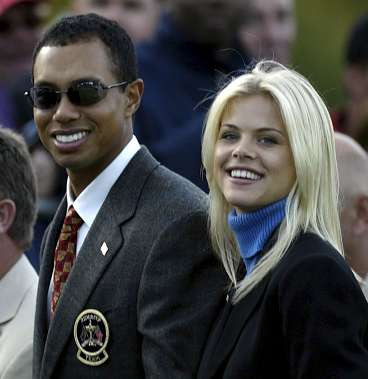
Tiger and Elin before the storm

McDowell of course did win the US Open in June, the first European player to do so in forty years. Even with that win, he is placed only 13th (behind Westwood, Donald and McIlroy) in the current world rankings. Paul Casey, who didn’t automatically qualify for the European Ryder Cup team and wasn’t one of the captain’s three personal picks either, is the third Englishman currently in the world top ten. Yanks make up half the top tier and Woods is still number 1 despite his continuing indifferent form.

American golfers in particular make me wonder why I am remotely interested in the sport. I’m sure that, were I to find myself stuck in a lift with any two of them, I would have opened a vein long before we were rescued. Almost without exception, all professional American golfers are Christian fundamentalist Republicans, though at least, as far as I know, none of them thanks god when he wins, as the German Bernhard Langer was wont to do. But their preferred pastimes are killing animals for ‘sport’ and being gung-ho about the military. The American Ryder Cup captain, Corey Pavin, even called in some US military man to give his team an – in every sense, no doubt – over-the-top pep talk. Pavin used to sport a cloney moustache and we thought he was gay. His independently-minded wife clearly contradicts us. She is Vietnamese, a refugee from the fall of Saigon. Though she may not quite fit the profile of US golf WAGs – virtually all looking like Playboy centrefolds and inclined to the blonde – she has done her share of “glamour” posing.

Craig Stadler, one of the big players of the past ...

This class of air-hostessy, air-headed, cheesecake girls are programmed to gold-dig and golfing pros are a good catch. There will not have been anyone playing in the Ryder Cup who isn’t a millionaire, most of them several times over. Tiger Woods’ ex-wife, Elin Nordegren, is the template for golfing wives (and evidently the possessor of an image that draws much interest, for the presence of her name earlier on this blog has brought it more visitors than any other single search criterion). From what we have glimpsed of the club hostesses, cocktail waitresses and “glamour” models with whom Tiger amused himself during his marriage, his taste in sexual partners is no more sophisticated and no less blowsily obvious than that of his fellow American pros.

... and John Daley, never "in regulation"

Golfers may be a catch financially but few of them are any sort of catch by any other standard. It is a curiosity of golf that fitness is not a given. Indeed, golf is a game that men are apt to take up when they retire. To call some famous golfers “out of shape” would be to treat them kindly. You also certainly don’t need to be good-looking – golf is not a sport that attracts groupies, as far as I am aware (unlike football and tennis). Probably the main reason for Woods’ dominance of the game for so long is that he is one of the very few players actually built like an athlete.
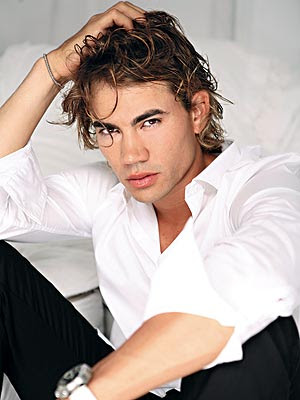
That rare creature, a golfer who looks like a pop star: this is Camilo Villegas

Golfing prowess is down to having accurate vision, the ability to develop and adapt the way you swing the various clubs, the particular strength to hit a ball a long way, the knack of applying spin to a shot and the judgment (and experience) to know which particular club to use in each given circumstance. These gifts are what propel the likes of McIlroy and Rickie Fowler into professional golf at a young age and then into a quick acceptance on the lucrative American tour. Woods – like Jack Nicklaus and Arnold Palmer before him – clearly had these gifts in particular abundance. Those gifts can desert you and your career can go into free fall, especially when you've won a major: think of Ian Baker-Finch, Lee Janzen, David Duval and indeed Corey Pavin. But one hell of a lot of golf playing depends upon luck which is why, once a special player like Woods has lost his dominance, anyone in the field might win a major and why no seeding system is ever going to make sense in golf. The luck comes in many forms – luck with the wind, the bounce, the lie, the camber of any particular part of the green, the knap and condition of the grass, the time of day that you tee off, the relative intrusion of extraneous noise and movement while you address the ball.

Villegas lines up a putt: don't even think about it

It’s a curious world indeed, with all its mysterious jargon: addressing the ball, having the honour, winning 4 and 2, eagle 2, 3 iron, back 9, laying up, holing out, pin high, matchplay, lofted club, plugged, hooked, chip and run, free drop, in regulation, the turn. And a passing glance might suggest that it is played only by old men in bad clothes with equally old men in worse clothes carrying their bags for them. But it’s a game that can turn on a sixpence and which guarantees nothing. Who could forget Nick Faldo winning the 1996 Masters after Greg 'The Great White Shark' Norman gradually squandered a six-stroke lead? Or Tom Watson, rising 60 and always a popular favourite, almost winning a sixth Open championship last year and suddenly losing his way at the last? It’s a very strange game and I find it no less strange that someone like me can be captivated by it.

Sunday, November 29, 2009

GO GET ’IM, TIGER

As my devotees will readily testify, low gossip and idle speculation are unknown to me. But oh boy, how can one resist Tigergate?

Hot off the net is the news of fall-out from the “scandal”: the entire writing team of Late Show with David Letterman have today resigned in protest at the host’s rejection of all their Top Ten list of gags about Tiger Woods and his insistence on penning them himself – his team agree that they are “not funny”. So you see the Tiger Woods “scandal” is a big story.

“What’s Tigergate?” some may ask. Here’s the bare bones of it. Eldrick Tont Woods is the world’s most successful sportsperson in history, certainly if you measure it by income. Of course his sport is an especially lucrative one. Whenever you see men playing golf on television, you can be sure that not one of them is less than a dollar millionaire unless (and golf is one of the few sports where this is still possible) he is an amateur. Well on the way to becoming sport’s first billionaire, Woods has been ranked number one golfer in the world for 575 weeks to date (more than ten years in total) and continuously for nearly four-and-a-half years, despite having been out of action with an injury for eight months during that period.

By no means all of his wealth derives directly from playing golf. Tiger Woods is a highly marketable brand because he is highly popular and brings a huge following to his sport, both on the courses and on worldwide television. He also has always appeared squeaky clean, something PR people look for. Shrewdly, he has subscribed to the writer JM Coetzee’s philosophy of handling public attention: “I don’t perform cartwheels for the media”. It is twelve years since Woods granted an extended interview. He has remained private, aloof and therefore largely untouchable. So he is able to command top dollar for advertisements and endorsements.

This weekend’s incident has blown much of this out of the water. According to the official version, Woods drove his Cadillac Escalade 4x4 out of his driveway shortly before 2.30 on Friday morning. Almost immediately, he collided with a fire hydrant and then a tree. The car’s speed was not sufficient to engage the airbags. Both Woods’ lips were cut in the impact. His wife, Elin Nordegren, following on foot, tried to open the automobile, then smashed a window with a golf club and dragged the semi-conscious Tiger from the vehicle.


Mrs Woods in her modelling days

Police were summoned and determined that “no alcohol was involved in the accident”. How this finding was reached is not revealed. Can you effectively use a breathalyzer on a semi-conscious driver who has lip lacerations? At any rate, by around 3.00 Woods was being treated in hospital from whence he was discharged shortly thereafter. Later on Friday, Nordegren denied police entry to their home, saying that her husband was resting.

The internet duly heaves with theory and rumour about this sequence of events. An already running tale about Tiger and a woman described as a “nightclub hostess” suddenly acquires much greater significance. If that story may be accessed by you and me, it may be accessed by Mrs Woods. She wouldn’t be best pleased, goes the theory.

For what it is worth, I have my own take on this event. It has the merit of tidying up those elements in the official account that seem somewhat unconvincing. First I ask this question: did the cops breathalyze Elin Nordegren? Because, you see, my theory is that she was driving the Cadillac (damn it all, Tiger endorses Buick). She hit a hydrant and then a tree because, you know, she’s a girlie. Oh no, wait, that’s completely wrong (sorry, just twitting my women readers). She hit a hydrant and then a tree because she’d had a couple of bottles of vino. Concerned about her rushing out of the house and jumping in a car, Tiger pursued her on foot. She stepped out of the car, having picked up a stray golf club – I expect David Hockney has paintbrushes lying around in his car too – and slugged him in the face. He fell down. Aghast, she wondered what to do and decided to smash the Cadillac’s window so that she could claim she had done this to release the central locking and pull her husband from the wreck. “There is no blood in the car” screams The Hollywood Gossip site in italics (that’s how I know it was screaming). You bet your ass there’s no blood in the car.


Tiger – he means it

If my theory is what the Irish call bollix, Mrs Woods is free to sue me. I doubt her husband would welcome the further publicity of such a case. After all, while the matter is not sub judice (and it will remain so for at least as long as the Woods decline to talk to the Florida Highway Patrol), we are all free to speculate without prejudicing justice.

Meanwhile, if Tiger Woods still wants to reach that magic figure of a billion dollars, he had better come up with a convincing account of what transpired in the early hours of Friday morning. Otherwise, the endorsements might prefer to go to … um … John Daly.

Saturday, November 14, 2009

To the TOWER with THEM

For anyone asked to speak about popular culture who then launches into a diatribe about something that he calls “Man You”, the Crown Jewels would not be likely – as I understand it – to refer to the treasures kept on semi-public display in the Tower of London and pressed into service for that rare event, a coronation. No, sir. What that dunderhead pictures when he hears the phrase “the Crown Jewels” is a menu of sporting events. Hard to credit, I know. But that is the barrel-bottom-scraping state of our culture.

My devotees will be aware that sport is not one of my subjects; though I am surprised to note how often the words “sport” and “football” and the names of sportspeople appear in the link list on the right of this page. In the narrow and self-regarding world of sport, the phrase “Crown Jewels” apparently has come to refer to a list of events that are considered in some sense “nation-uniting” – like the coronation itself, perhaps – and therefore worthy to be kept available for viewing on free-to-air television rather than being subject to acquisition for exclusive transmission by fee-charging broadcasters (i.e. the non-UK-tax-payer Rupert Murdoch). I couldn’t give a tuppenny damn whether people watch, say, some rugby match on BBC1 or on Sky Sports, always providing that programmes that I want to watch are not delayed, displaced, postponed or cancelled. The most imperilled fixture in the schedules at those times when sports events march all over them is the main evening news bulletin. God help the broadcasters if there is extra time being played in a “vitally important” game of tiddlywinks when news is breaking of the passing of the sovereign (or – worse – Madonna). Some sports producer will certainly be in an agony of indecision as to whether to hold out till the end of the game,

I am only interested in this matter because I am interested in – or, to be more accurate, I used to be interested in – broadcasting policy. Nowadays, British television by and large bores me to tears when it is not appalling me by its vulgarity and speciousness. One of the factors that has destroyed television is its own developing treatment of sport which, in its turn, has destroyed those qualities of sporting prowess and achievement that once could credibly be called honourable.

Permit me to explain. Not so very long ago – in my lifetime, at any rate – much of sport at national and even international level was played by amateurs. The last bastion of amateur sport, the Olympic Games, only fell to the inevitable as recently as the beginning of the 1990s and Olympic boxing is still restricted to non-professionals. In golf, tennis and boxing, “turning pro” remains something that competitors do only after becoming regulars in international competition and the major tournaments in the first two sports continue to reserve a limited entry for non-professionals who are on the verge of crossing over. When I was young, the Wimbledon champion often did not return to defend his or her title because he or she had turned pro during the interim. In 1968, the championships were finally declared open and prize money allowed for the first time. Professionals not seen there for some years promptly returned to the fray.

The professionalizing of sport coincided with its growth in importance to television schedulers. After years of the indefensible duplication of, most notably, the FA Cup Final simultaneously live on BBC and ITV, competition for exclusive coverage rights took hold in earnest. The administrators of the various sports saw that there was a lucrative market here and encouraged competitive bidding. But the innovations and refinements introduced by the broadcasters to make their coverage more exciting and therefore more attractive both to potential audiences and to the owners of the rights had a significant downside.

Action replays, repeated highlights and so-called analysis of incidents and decisions by referees and umpires distorted the natural arc and the internal rhythms of each game, not to say the very nature of the respective sports. What’s more, it undermined deeply the authority of those charged with controlling the players.

And advertisers saw an easy way of reaching huge captive audiences. Gradually, merchandising has swamped all sports, so that leagues and tournaments have to be identified by a brand name, players enter the arena festooned with logos, arenas pulsate with animated advertising and greenswards are painted with logos only readable from camera positions, all specifically designed to draw the eye from the sport itself.

And of course the television and marketing money has raised the salaries and fees that sports stars can command to stratospheric heights. Sport now outbids movie and rock music fame as a means by which working class boys and, to a lesser extent, girls can climb into major wealth. Not surprisingly, then, every sport – there are now no exceptions as far as I am aware – is subject to cheating and financial corruption, some of it on an industrial scale.

The whole culture of sport has been transformed in a couple of generations. Now Sky Sports dictates the day and time when events will take place, in order to maximise its own options for coverage. Never mind if the local fans are inconvenienced or the clubs find fixtures bunching or clashing with other plans. Meanwhile, in many sports, playing for your country is now considered more of a nuisance than an honour. Football managers in particular would rather not risk the limbs of their phenomenally expensive star players in international duty. Indeed, football managers lead the way in systematically undermining the authority of referees. That’ll be the day when Sir Alex Ferguson concedes that the opposing team got an unlucky break.

Predictably enough, the recommendations of the panel – charged to re-examine the Crown Jewels and chaired by former BBC sports journalist and Football Association executive David Davies – have been condemned on all sides. Giles Clarke, chairman of the England and Wales Cricket Board, told The World at One yesterday that cricket would be reduced to “extreme poverty” if the Ashes Tests played in England were obliged to be shown free-to-air. Before Mr Clarke uses such a foolish phrase again, I suggest he make a trip to sub-Saharan Africa. The people there have to eat their cricket bats.

On the other hand, administrators of events like the Derby – which, Davies recommends, should not be considered a “Crown Jewel” – are equally outraged by a sense that they have been downgraded. The fat-arsed executives who sit in offices and count the money brought in by their respective sports want it both ways: they want broadcasters to cough up so much for the rights that every other area of broadcasting is impoverished, but they also want the big audiences that only free-to-air transmission can deliver: evidently 2.4 million watched the 2005 Ashes on Channel 4 but only a bit over half a million paid to see this year’s live coverage on Sky.

How the FAE’s rationalise their two-pronged complaint is that their respective sports “at grass roots” will be the component that is impoverished if Murdoch’s riches are denied them; as if they mention the grass roots at any other juncture. I have a proposal for the seeding of the grass roots in any sport, that could be taken up whatever the outcome of the Crown Jewels proposals. Let every participant in any sporting field, whether player or administrator, who makes more than, say, £75,000 per year from the sport and its associated endorsements pay a levy of, say, 50 percent of earnings into a fund for the sport’s grass roots. I think that’s fair. How many helicopters does Michael Owen need, for Pete’s sake?

*************************************************

Another broadcasting matter currently exercising commentators is that of the kind of so-called joke that gives great offence to certain sectors of the audience. As someone brought up on the traditions of wit, humour, drollery and wordplay, I cannot but find these sorts of “jokes” pretty poor at best. But then I am considerably more radical than those self-proclaimed “edgy” comedians who believe they are … erm … pushing the envelope. After all, I can be offensive without even having to use the dodgy excuse that I am being funny. Unlike that cunt Jimmy Carr.

Monday, July 06, 2009

TOO MUCH of a MURRAY

I knew for certain sure that The Guardian would not run the letter I emailed on Saturday. It went: “73 years of hurt” (front page July 4). Are you serious?

I quite often write to the paper about its sports coverage, which I find both meretricious and ubiquitous. Last summer I complained about the frequency with which both the main illustration on the front page of the paper and the cover-feature of the G2 supplement are sports-related. After all, there’s a dedicated sports section every day, 10 or 12 pages all week and 16 on Mondays. Today it’s the same: the front page has Roger Federer kissing the Wimbledon trophy and some yob of a cricketer is the cover star of G2 and interviewed inside. What do sportspeople ever have to say that can be of interest even to fanatics? “Yeah, I thought I played really well”. Oh, how bloody fascinating …

But clearly The Guardian considers sport a significant part of its appeal and suppresses criticism of either the amount or the tenor of its coverage. Although I regularly point out that the photographs of sportsmen that the paper favours almost never depict them doing the actual sport but instead roaring out aggression or pouring out emotion, nothing changes. Today’s edition carries five shots of Federer but in only one is he playing a stroke.

The “73 years of hurt” line referred to Andy Murray’s defeat in the Wimbledon semi-finals and the fact that Fred Perry won the men’s title as far back as 1936. “N years of hurt” has become sport’s banal way of referring to a period without trophies. Perhaps “N years of uninspired players who make so much money that their appetite for winning is dulled” would be more appropriate.

Why does it matter so much whether Murray wins the title? It’s not as if he’s an Englishman. The Wimbledon venue is formally called The All England Lawn Tennis and Croquet Club. Membership is limited: 375 enjoy the benefit of full participation. Past singles champions and “distinguished servants of the game” (which presumably refers to the game of croquet as well as that of tennis) are invited to join and a further hundred places are reserved for active members elected on an annual basis. The patron of the club, HM the Queen, has not attended the championships since her Silver Jubilee in 1977 when Virginia Wade won the ladies’ singles title, the last singles winner who was English.

As a Scot, Murray must count as a foreigner in the eyes of some of the crustier AELTC members. But really his nationality is irrelevant. He is not playing for his country but as a freelance individual, just like golfers in the Masters or the Open. If he were playing in the Davis Cup or the Ryder Cup or the upcoming Ashes cricket series, one could perhaps better understand some of the nationalistic nonsense that attaches to his progress through the championship. This nonsense is promulgated by the media, both press and broadcasting. Last Monday, Murray’s match under the new Centre Court roof dragged on until 10.45 at night. BBC1 carried it and later crowed about a 12 million audience. I am here to say that not all that audience was watching the tennis. Some of us were waiting with increasing outrage for the 10.00 o'clock News, the start of which was delayed until the match ended, despite the fact that, from 10.00 until 10.30, BBC2 was showing an old episode of Have I Got News for You?, a programme neither significant nor date-tied. It beggars belief that the tennis was not switched to disrupt the BBC2 rather than the BBC1 schedule.

The BBC gives blanket coverage to Wimbledon but has never shown much interest in the other three grand slam tournaments, even before live transmission rights were snapped up by satellite stations. This year just the finals of the French Open were covered on BBC2. By contrast, the Corporation gives a decent showing to those of the golf grand slam events to which it can get the rights – the Open and the Masters – and raises very little fuss about the respective nationalities of the participants. Of course it makes a difference that dozens of players are on the course simultaneously and that golf’s longueurs (walking between shots) do not lend themselves to the continuous following of one or two players. In golf coverage on both sides of the Atlantic, there is a disproportionate amount of interest in Tiger Woods because he is disproportionately gifted compared to the other players: still ranked world number one, even after being out of the game for eight months with an injury. Perhaps it is a relief, though, that he is not a British golfer.

At Wimbledon, one of the women players who went out in the first round was asked at the post-match press conference if she hadn’t “let the country down”. She burst into tears. It’s a pity she didn’t instead tell the stupid journalist to fuck off. As I say, “the country” doesn’t have any stake in what happens at Wimbledon. The supposedly serious media ought to take a more objective approach to sport, including its relative importance in the scheme of things.


One of Andy Murray's lovely ground strokes (from The Guardian website)

Friday, July 04, 2008

ENGLAND OVER-EXPECTS

Hold the front page! There was no picture of Andy Murray on the front page of The Guardian today. Not since Monday has the gangly, scowling, air-fisting Scottish youth with the devoted mum, the modest tennis-playing ability and a curious fixation on his own (very average) bicep, been off the supposedly intelligent paper’s cover.

You might reasonably wonder if anyone else has been playing in the annual fortnight of overpriced and flavourless strawberries and sport that is Wimbledon. Indeed, there have been photographs of and reports about other players. But the word ‘disproportionate’ does rather spring to mind. I counted the pictures of male competitors printed in the paper from the first day, Monday of last week (yes, you’re right, I do have more important things to do, but there are many forms of displacement activity and this happens to be the one I chose today). Including today’s edition, The Guardian has carried 88 shots of male tennis players who were in the draw on Day One. Of those 88 pictures, 27 (including a totally gratuitous one today) have been of Murray, nearly a third. There were 128 players in the Men’s Singles draw and Murray was seeded twelfth. Roger Federer, the top seed and expected to win his sixth title in succession on Sunday, has been depicted in 14 photographs, just over half as many as Murray; Rafael Nadal, the second seed who defeated Murray easily in the quarter finals, has appeared 11 times as an image.

What’s more, Murray has appeared four times on the front page of the paper’s sports section and four times on the front of the main body of the paper. All other male players combined have appeared four times on sports front and just three times on the cover of the paper proper. Even Jamie Murray, Andy’s elder brother and a doubles specialist, has had his face in the paper six times, including once on sports front, and I’m not counting his picture on the column he ‘writes’ for the sports section (I put ‘writes’ in quotes because such columns are frequently ghost-written by an office hack and published over the name of an agreeable ‘celeb’ who likes getting paid for doing nothing). Oh, and there were two pictures of Chris Eaton. Remember him? You probably don’t; he was a very lowly – but British – competitor who survived to the second round as, by definition, did half of all the entrants.

It is a nakedly jingoistic impulse that drives this coverage. Tickets were changing hands for Murray and Nadal’s Centre Court match for £2,000, not because the buyers had suddenly discovered that they were fans of tennis but because they wanted to see a British victory. Had they known anything about tennis, they would have known that the hope was vain. But the press encourages this stupid jingoism, not just with its pictorial bias but also with the kind of stories it chooses to run. “Murray: I’m fit enough to win Wimbledon” was the headline on a sports front story this Monday. No he isn’t. Nadal is far fitter and has a far more mature game, though he’s barely any older than Murray. The Scot, like the Tinman whom he succeeds as Britain’s Vain Hope at Wimbledon, is an also-ran and – face it – he always will be.

Later this year, one of the most jingoistic of the world’s sports events takes place in Ireland, the biennial Ryder Cup, in which a European and an American team compete in match-play golf. A few tournaments ago, on the most recent occasion that the Americans won, there were disgraceful scenes when the winners began celebrating before the last European player had holed out at the 18th, thereby certainly influencing the putt. All nations are jingoistic about sport but none more than the States, where there is no television audience for any sporting event that holds no immediate prospect of an American victory. (Men’s tennis is in historic decline in the USA and so there will have been few takers there for Wimbledon coverage this or any recent year).

Football bores me to tears but I suppose we should take some heart from the interest shown here in the recent Euro tournament, despite the absence of all the British nations’ teams. This speaks of a degree of genuine interest in the game for its own sake, despite the attempts of the press, notably The Guardian, to talk up some alternative nation whose fortunes British viewers might “follow”.

Meanwhile, the closed season transfer market has been characterised as ever by footballers being bought and sold for eye-watering sums by the wealthiest clubs across Europe, regardless of their own national origins. Two or three years back, Arsenal played against a Spanish side in a cup match, where there were only two British players on the pitch and neither was playing for Arsenal. In what sense, then, is Arsenal an English football team? It and its vast new stadium are owned by arabs, its long-serving manager is French and its playing strength speaks in dozens of different languages. What kind of idiot gets ‘patriotic’ about this team’s results? There is barely a team in the premier league of English football that is owned by anybody or any organisation that is British. Liverpool FC no more represents Merseyside than does Paris Hilton. It just spends more time in the area than she does.

From time immemorial, the fan has equated a team’s or a sportsperson’s talent and prospects with its/their nationality, even while – here in Britain, at least – we ruefully subscribe to the notion that we are “good losers”. I’m not very interested in sport but, if I were, I hope I would value it for its beauty and grace at the highest level, irrespective of national boundaries. Nobody objective could really have wanted Andy Murray to beat Rafael Nadal. Apart from any considerations of tennis talent, the Spaniard is so much sexier.