FREEDOM’S JUST ANOTHER WORD for NOTHIN’ LEFT to LOSE
Over several months, most of the postings on this blog have also appeared on a website called London Progressive Journal. This is a non-profit site, freely accessible and free of advertising. It also necessarily pays nothing to its contributors. Writers and contributors generally appear on the site by invitation and either write new pieces for it (which I have done once or twice) or recycle material from other outlets (as I have generally done from this blog and as, for instance, George Monbiot does with his Guardian columns).
Recently, I have come into conflict with the duo who edit the site in their spare time. I thought the issues over which we disagreed were important, especially in a context that calls itself progressive, and so I wrote a piece that attempted to address those issues and submitted it on July 22nd. The editors have declined to engage with the matters I raised and have shown no inclination to publish the piece. So I present it below, on the assumption that it bears some interest beyond the narrow confines of LPJ. I have altered nothing from the original submission, save to add references in square brackets:
‘This is a piece about editorial policy on London Progressive Journal. That you are reading it may indicate that the editors have addressed or are willing to address the issues that I raise herein and the implications of those issues. Of course I cannot know in advance if they will have reproduced it exactly as I submitted it. That you, gentle reader, may know the answer to that question, I will post a comment on the matter once the piece is on-site.
How LPJ works is that postings are submitted, read by the editorial staff and transcribed to suit the technical requirements of the site. These requirements can be frustrating; for instance the site’s program cannot read my iMac’s italics and so I have had to devise a strategy for indicating where I mean words to be italicised that does not confuse the editors or cut across other print conventions. It also means that the text does not go blind onto the site. It is read and processed first and therefore there is scope for the introduction of unintended typos and other errors, for subbing and for other editorialising, even for mischief.
Readers without experience of journalism may not be familiar with the phenomenon of subbing. This is usually the work of an in-house assistant called a sub-editor but, in situations where staffing is tight, the task often falls to editors themselves. The sub-editor goes through the texts of articles, correcting unwonted errors by the writer: typos, spelling mistakes, factual inaccuracies, grammatical infelicities and other obvious blemishes. But the sub also has the power, often exercised, to change the text. This may be necessitated because of pressure on space (if, that is, you believe that the accommodation of surrounding advertisements and/or visual material related to the article’s subject matter is a necessity). It may also come about because the sub thinks he can improve the piece by cutting, by re-shaping, even by rewriting, perhaps because he doesn’t comprehend a particular point being made or thinks he can write better than the columnist or reporter. I have done masses of subbing myself but I never felt that it was any part of the job to alter what the writer wanted to say or how she wished to say it.
Intrusive subbing is one of the banes of the print journalist’s life. During my time as television previewer on The Independent some 25 years ago, I had occasion to make an appeal to the paper’s overall editor because the listings editor – a legendarily dreadful man called Elkan Allan (now deceased) – had broken this particular camel’s back by completely rewriting my preview of a documentary about the treatment of Aids. I had two advantages over Allan in the matter: I knew a lot about Aids and he knew nothing, and I had seen the programme and he had not. “To fit the headline” that he had chosen for the piece – a headline so banal and beside-the-point that I have not remembered it – he had changed everything that I had written, in the process ascribing to my by-line the assertion that Aids is a disease (it is a syndrome), that HIV is a virus (HI is a virus, the V stands for virus) and that Factor-8 is a drug (it is blood plasma). This nonsense made me look like an ignorant fool who had paid no attention to the film that I was previewing.
The editor of The Independent remained carefully noncommittal about what he clearly thought was a little local difficulty, but he also evidently discounted the outrageously untrue slurs that Elkan Allan levelled against me and my work in order to justify his egregious subbing. Nonetheless, Allan departed abruptly within the week and I was duly hailed by the other toilers in the listings section as a hero of the people.
But that’s all by the by. Star names in the press – I might suggest as examples John Pilger and George Monbiot – are not, I think, much troubled by subbing being applied to their much-desired work. It’s more obscure scribblers like me who have to fight for every word.
In the eight months or so that my stuff has been appearing on LPJ, I have had little cause to beef about subbing of the intrusive kind. But my two most recent submissions have raised some issues of editorial control that I think need to be addressed. This site is presented as an open forum and therefore it seems to me only proper to discuss these matters openly.
My most recent submission (last week) was entitled ‘A Word In Your Shell-Like’ [July 17th, below]. The version that was posted had three subbing errors that I quickly pointed out to the editors. But there was also something unprecedented added to the piece: a disclaimer at the bottom. It read: “The opinions expressed in this article are the author’s own and not necessarily those of the LPJ”.
I was completely bemused by this. What had occasioned it? Had I stepped over the line by demurring at Rory Bremner’s hoax? Was it an offence against progressive opinion to suggest that the Freedom of Information Act might make the practical business of government more tricky? Had I strained editorial patience by twitting Kelvin MacKenzie? How was I – or the reader – to tell?
To my email concerning subbing errors, I added this sentence: “As for the disclaimer at the bottom of the piece, I am absolutely hopping mad about it and, feeling as I do at present, am resolved that this will be my last piece for LPJ”.
One of the editors replied thus: “Thank you for your comments. We have made the requested amendments” (actually they have only made one of the three) “but I'm afraid that we won't be budging on the disclaimer below the article.
“We have great respect for your ideas and writing abilities and aim to ensure the LPJ expresses a broad range of opinions from its authors, including those that we, as editors, may personally not agree with.
“I'm afraid that neither of us feels that Assange or Manning is in the wrong and we didn't want to risk our readership feeling that we thought so.
“Hence, in the spirit of free speech - whilst sticking to our editorial policy and opinions - we felt the need to mention that the opinions in the article are the author’s and not necessarily ours. We have done this with articles from time to time, and even gained praise for doing so from authors who respected our decision to maintain our own views whilst allowing freedom of ideas.
“We hope you will reconsider your decision not to submit any further articles to the LPJ” (I have subbed quite a handful of typos and grammatical and other errors out of this email so that the editor may not be publicly embarrassed).
So that’s it. It’s what I wrote about WikiLeaks that has stuck in the editorial craw. You, gentle reader, will not have my piece to hand, so let me repeat the words with which I introduced the subject of WikiLeaks into the argument: “I may have missed something here but I have always struggled to understand the fine moral distinction between the publication of private conversations intercepted by hacking telephones and the publication of private conversations intercepted by a variety of other breaches of the law”.
I think that is a pretty explicit invitation to apologists for Assange and Manning to engage on the matter, to offer an argument that will enlighten me and soothe away my scepticism. To hand my piece to the readers at arm’s length, the other hand holding the editorial nose is, frankly, an insult both to me and to the reader.
It’s worth reacquainting ourselves with the site’s mission statement. LPJ, we are assured, represents “a non-sectarian left wing perspective” and “aims to provide an intelligent, critical and accessible discourse on the key issues”. It “is not affiliated with any political party or lobby group and therefore has no constraints over what it can publish. As such the range of opinion contained within the pages of the journal is relatively diverse”.
So we can be clear from this that the agenda of LPJ is not – or at any rate not necessarily – Marxist-Leninist, not Trotskyite, not Maoist, not anarcho-syndicalist, not libertarian Socialist, not situationist, not impossibilist, not old-Communist and indeed not (not necessarily) Assangist. Nevertheless, the editors do not “want to risk our readership feeling that (the editors think that) … Assange … is in the wrong”.
There is a rather large presumption here. It is presumed that the LPJ readership as a body subscribes to a consensus that the works of WikiLeaks are beyond question and that I alone am out of step with this happy union. Even were that true, by what editorial sleight of hand does my supposed maverick stance put me outside the tent pissing in rather than inside pissing out? Is there no longer any scope for discussion in self-proclaimed progressive circles? Is the sanctity of Julian Assange a fait accompli?
That the opinions expressed in LPJ do not, as a matter of course, chime consistently and unfailingly with those of the editors ought to go without saying. Progressive opinion, like Harold Wilson’s Labour Party, is “broad church”. There is not and cannot be, on a wide-ranging site like LPJ, an orthodoxy about every topic. Nor is progressive opinion a monolith that admits of no discussion or dissent. By all means let the site as a whole carry a disclaimer about all the material carried on it not necessarily reflecting the particular opinions of the editors. But to single out one posting and announce effectively that LPJ thinks it’s rubbish is not to be countenanced. Let one of the editors – or some other contributor, or Julian Assange himself (he is patently kicking his heels at present) – make the case for WikiLeaks in a complementary article. That is the mature and confident editorial response. To disassociate the site from one piece without any word of explanation is, at the very least, a discourtesy to everyone.
But this is the second successive posting of mine that has fallen foul of an editorial decision that greatly troubles me. The earlier piece was called ‘Bad Sight Of The Week’ [June 26th, below]. In it I deployed the word “cunt”. I did not do it gratuitously. I was quoting somebody else who used the word as a generic term for women. As it happens, perhaps as a semi-conscious test, I did use the emphatic “fucking” gratuitously in the piece and that was left alone.
The on-site version showed the quoted word as “c***”. I queried this. I was informed that one of the editors “hates the word”. I did not argue the toss further but it seemed to me to be no argument. There are plenty of words that I dislike for myriad reasons, but we are mature people, and language, in all its variety and multifariousness, is the tool that we use as writers and readers.
For an editor to blank a word because it is “hated” is a subjective and, I rather think, emotional use of editorial power. And – to give a dog a name – it is nothing short of censorship. I imagine that quite of lot of contributors to LPJ would not want to risk our readers feeling that we all thought censorship is acceptable.
These are fit matters for discussion, for god’s sake, not for indisputable editorial fiat. (By the by, I never capitalise the first letter of the term “god” because there is no god and so something that does not exist cannot possess a proper name. In LPJ, the “g” is routinely capitalised without discussion).
It is in the nature of the case that these words will be read by the editors before they are laid before the readers. So I say this to the editors – and I want the readers to know that it was said: do not refuse this contribution. There is no credible ground on which it may be refused. Let there be debate. Engage it yourselves but do it on the site, not out of the view of the readership. Remember that the piece that occasioned this debate was itself about freedom of the press. Do not fall into the trap of replicating the unyielding control over free expression in an open forum that has passed for editing in the capitalist press. It will be a struggle for you to reconcile a stance of intervening editorially in a free discussion with your fear that you may be thought opposed to Assange’s own purported quest to liberate information and open debate.
And I invite readers and other contributors to engage with these matters. Keeping channels open for uncensored debate is the most important function that LPJ can perform’.
P.S.: I no longer submit pieces to London Progressive Journal.
Showing posts with label censorship. Show all posts
Showing posts with label censorship. Show all posts
Sunday, August 05, 2012


Sunday, April 29, 2012
DEREK or LITTLE by LITTLE
By common consent (at least among those like me who lived through it), the ‘golden age’ of broadcasting – at the BBC especially – was that which spanned the 1960s. The St George of this age was the BBC Director-General for very nearly the duration of the decade, Sir Hugh Carleton Greene, younger brother of the novelist Graham. It was Greene’s determination to “open the windows and dissipate the ivory tower stuffiness which still clung to some parts of the BBC” [Greene’s memoir The Third Floor Front, 1969] that characterized the period. The effect lingered into the 1970s.
But Greene’s mission attracted a dragon. Riding out of the West Midlands came Mary Whitehouse, leading the Clean-Up TV Campaign (in those days, only people outside television ever used the expression ‘TV’) and the National Viewers’ and Listeners’ Association. Schooled in the righteous tradition of the Moral Re-Armament (MRA) movement, she was fearless and formidable and she meant business.
 Greene
Sir Hugh appreciated that this was a tricky one to play. He was not about to close the windows again, but to accommodate this force at any level would look as if he were considering it. So he resolutely refused to meet any representative of the CUTVC or the NVLA – in truth, there was only ever the one campaigner who had the gumption to stick her head above the parapet – and, on the rare occasion when he publicly acknowledged the movement’s existence, he scorned it: “These ‘new Populists’ [Prof Richard Hoggart’s term] will attack whatever does not underwrite a set of prior assumptions, assumptions which are anti-intellectual and unimaginative. Superficially this seems like a ‘grass-roots’ movement. In practice it can threaten a dangerous form of censorship – censorship which works by causing artists and writers not to take risks, not to undertake those adventures of the spirit which must be at the heart of every truly creative work”.
The great struggle over ‘censorship’ that engulfed British television in the late 20th century, a struggle that set producers and writers against managers and controllers as well as against the evangelical forces from without, may well now look like a comprehensive rout for the censors. There can be few programmes on any current channel that, were she alive, the woman TC Worsley dubbed Queen Canute would be able to sit through without smelling salts and a standard letter of complaint to hand, just needing the offending title to be inked into the blank space.
And the programmes that she would cordially detest are – and this is what irony truly means – exactly the programmes that Hugh Greene would detest too, were he alive. And (I am happily available to attest to it) they are also indeed the programmes that I detest, for all that I set my face even more firmly against Mrs Mighty Warhorse and her destructive campaign. Each of the three of us would squirm at the gratuitous vulgarity that passes for entertainment everywhere on the ‘TV’ today.
One of the first targets of the movement that called itself The Festival of Light, an evangelical attempt to purify the culture, was my own television play Circle Line, which was transmitted in the first season of ‘Play for Today’ in 1971. Arising from this connection, I had lunch at the home of one of the group’s organizers, Peter Hill I think he was called. He and his wife said grace before the food and played Jim Reeves LPs throughout (it was hard going) but we found quite a bit to agree on about the state of television. It was the remedy that divided us.
In her 1967 book Cleaning Up TV, Mrs Warhorse quotes Gibbon: “When the Athenians finally wanted not to give to society but for society to give to them, when the freedom they most wished for was the freedom from responsibility, then Athens ceased to be free and was never free again”. She and Hugh Greene and I might find quite different uses for the sentiment, but it is one we could all recognize.
Those who say that television can be a force for good in society must also accept the corollary, that it may just as well be a force for ill. Producers and writers are entitled to defend their freedom of expression but they also need to take responsibility for the effects that their expression has. The line between reflecting society (what the programme-makers claim to do and use as a front-line defence against their critics) and shaping society (what their critics claim that they do, as they would say to society’s detriment) is a narrow one. It’s clear that Hugh Greene believed that television did shape society and he wanted it to do so. Offering a confrontation with the received ideas of the time can certainly be a constructive role for television, and I believe it was Greene’s genius to create an environment in which that confrontation could be played out constructively.
Greene’s aperçu about art being (self-)suppressed in a censorious climate alerts us to the nature of the assault launched on the culture generally at this time. For Mrs Warhorse had an inspiration even more formidable than her own sense of disgust: she had ‘the Lord’.
Remember the MRA connection and the evangelical nature of The Festival of Light (of which Warhorse was a co-founder). Her agenda was explicitly Christian. She conducted two high-profile campaigns that were nothing to do with television: her suit against Gay News for publishing what she deemed a ‘blasphemous’ poem, and another against the National Theatre for mounting Howard Brenton’s play, The Romans in Britain. Both these actions were undoubtedly motivated by her righteous homophobia; though, had she actually seen the Brenton instead of merely sending her lackeys, she might have understood that the anal penetration of an Ancient Briton by a Roman centurion enacted in the play was a metaphorical act of rapine rather than anything remotely (homo)sexual. No doubt she and her allies saw ‘perversion’ in Circle Line also. To drive homosexuality back underground was clearly one of the missions of the ‘clean-up’.
 Whitehouse
But a passing reference in her book inadvertently reveals the true nature of her crusade: “There is nothing particularly revolutionary about the idea of viewers’ and listeners’ participation in Broadcasting Services. Other countries have set up associations similar to ours, some more successful than others … In Italy, there are two bodies, one of which is a Left-wing pressure group. The other is the Italian Association of Viewers and Listeners (AIART). This broadly based association, which is well supported financially, conducts public opinion polls, the results of which it publishes from time to time. It runs a quarterly news letter which carries a good deal of correspondence from its members. It organizes meetings at which influential people express their views on television. Each year it holds a three-day conference at which its work and objectives are publicly discussed”.
I am sure that AIART is (or was) an admirable body of upstanding citizens who were industrious to a fault and aired useful arguments. I have no doubt the “Left-wing pressure group” was quite as admirable. Mary Whitehouse had no idea whether it was because she didn’t bother to find out. Despite awarding it a capital L for Left-wing, she dismissed it out of hand. It was ‘left-wing’ and so of no account, either to her or (she was not an imaginative woman) to her readers.
Whitehouse’s agenda was Christian and right wing. She did not wish merely to drive libertarian thinking from broadcasting, her aim was to drive all thinking from broadcasting. Thinking and reasoning are repugnant to right wing religious zealots, who require blind devotion and obedience, not the danger of individuality, dispute and questioning that thought leads to.
And by that measure, she has certainly won the war. Television almost entirely and radio to a degree are intellect-free zones. True, they are largely religion-free zones, taste-free zones and genuine uplift-free zones. The survivors of the “National VALA” (as Whitehouse always self-importantly called it) will bitterly regret that. But they can feel that the crusade has achieved its purpose. It has destroyed television as a reputable cultural and intellectual force.
In my single-channel childhood, the BBC showed programmes of a cultural and intellectual content that would now be deemed too rarefied for BBC4, let alone BBC2 (to which such material was ‘relegated’ after the BBC went twin-channeled in 1964). Academics routinely appeared on the box. Now you search in vain for weighty opinions from the seats of learning, save for those like Mary Beard and David Starkey who have learned how to project themselves as ‘personalities’ or Brian Cox who has the rare advantage in academe of being thought sexy.
Of course, professors appear on science and other soi-disant serious documentaries, but their contributions often suggest that there has been a steep falling-off even at Oxbridge. Take a figure like Professor Mick Aston, he of the West Midlands accent, streaming white hair and perpetual pullover of horizontal, strobing, candy stripes that reinforce his resemblance to a beach ball. His vehicle, Time Team, home of bad hair and worse clothes (or is it bad clothes and worse hair? I can never be sure), is an archaeological dig show of a diverting and nifty kind. But you can’t help feeling that, sat down for a wide-ranging discussion with the likes of AJ Ayer, CEM Joad, Alan Bullock and Jacob Bronowski, Prof Mick would soon flounder. There are few real intellectuals on television now. Teleworld is a place where Stephen Fry passes for a brainbox. Sir Freddie Ayer would have eaten him for breakfast.
If one were looking for a programme that perfectly demonstrated the precipitate decline of British television since 1970, one could hardly have asked for a more complete example than Derek. I do not, of course, refer to Isaac Julien’s rapturous film of that name of 2008, a portrait of Derek Jarman. Rather I mean the 24-minute comedy drama shown on Channel 4 recently. There can be no doubt to whom the responsibility for this programme attaches: writer, director, executive producer and leading actor were all Ricky Gervais, and the credited production company was styled Derek Productions, so we may assume that Gervais conducted the deal that led to C4 bankrolling this – let us call a spade a spade – vanity project.
 Gervais as Derek
The eponym was a worker in a residential home for the elderly. The residents barely registered, save in relation to Derek and then in over-familiar and demeaning terms. The plotting, such as it was, merely served to construct a portrait of Derek’s persona. Unhappily, though, Derek himself was a hand-me-down sketch, a largely unexplored type of inadequacy. Gervais’ preoccupation with inadequacy as a subject is a matter for him and his analyst, but insofar as it dominates his output it is a more serious matter for commissioning editors – it is well past the time when they should be asking more of this talent who appears more interested in revealing his antic spirit in personal appearances than in the more substantial business of hard creative work.
I do not take this line out of any antagonism to Gervais’ work to date or to his handling of his fame. Never knowingly having set eyes on him before, I was completely in tune with The Office from its opening seconds. Its cod-documentary style has become pretty much the default position for television comedy (Come Fly with Me, Modern Family), though this is not to suggest that Gervais invented it: Orson Welles, Woody Allen and Christopher Guest (among others) were there long before.
But just imagine what might have been done with this basic premise by a politically engaged writer or director working in the 1960s or ‘70s: Jeremy Sandford, Nell Dunn, Jim Allen, Trevor Griffiths, Dennis Potter, Howard Brenton, Caryl Churchill, Ken Loach, Alan Clarke, Roy Battersby. What struck me most forcibly about Derek was its lack of what psychologists call affect. To achieve affect – the impact on emotion of ideas – you need ideas. And Derek had none. It was no more than a half-arsed attempt to be simultaneously funny and poignant, saleable purely by being a star vehicle. It exquisitely fulfilled the aim of Mary Whitehouse: it entirely eschewed thought. And that’s just where British television is at.
By common consent (at least among those like me who lived through it), the ‘golden age’ of broadcasting – at the BBC especially – was that which spanned the 1960s. The St George of this age was the BBC Director-General for very nearly the duration of the decade, Sir Hugh Carleton Greene, younger brother of the novelist Graham. It was Greene’s determination to “open the windows and dissipate the ivory tower stuffiness which still clung to some parts of the BBC” [Greene’s memoir The Third Floor Front, 1969] that characterized the period. The effect lingered into the 1970s.
But Greene’s mission attracted a dragon. Riding out of the West Midlands came Mary Whitehouse, leading the Clean-Up TV Campaign (in those days, only people outside television ever used the expression ‘TV’) and the National Viewers’ and Listeners’ Association. Schooled in the righteous tradition of the Moral Re-Armament (MRA) movement, she was fearless and formidable and she meant business.

Sir Hugh appreciated that this was a tricky one to play. He was not about to close the windows again, but to accommodate this force at any level would look as if he were considering it. So he resolutely refused to meet any representative of the CUTVC or the NVLA – in truth, there was only ever the one campaigner who had the gumption to stick her head above the parapet – and, on the rare occasion when he publicly acknowledged the movement’s existence, he scorned it: “These ‘new Populists’ [Prof Richard Hoggart’s term] will attack whatever does not underwrite a set of prior assumptions, assumptions which are anti-intellectual and unimaginative. Superficially this seems like a ‘grass-roots’ movement. In practice it can threaten a dangerous form of censorship – censorship which works by causing artists and writers not to take risks, not to undertake those adventures of the spirit which must be at the heart of every truly creative work”.
The great struggle over ‘censorship’ that engulfed British television in the late 20th century, a struggle that set producers and writers against managers and controllers as well as against the evangelical forces from without, may well now look like a comprehensive rout for the censors. There can be few programmes on any current channel that, were she alive, the woman TC Worsley dubbed Queen Canute would be able to sit through without smelling salts and a standard letter of complaint to hand, just needing the offending title to be inked into the blank space.
And the programmes that she would cordially detest are – and this is what irony truly means – exactly the programmes that Hugh Greene would detest too, were he alive. And (I am happily available to attest to it) they are also indeed the programmes that I detest, for all that I set my face even more firmly against Mrs Mighty Warhorse and her destructive campaign. Each of the three of us would squirm at the gratuitous vulgarity that passes for entertainment everywhere on the ‘TV’ today.
One of the first targets of the movement that called itself The Festival of Light, an evangelical attempt to purify the culture, was my own television play Circle Line, which was transmitted in the first season of ‘Play for Today’ in 1971. Arising from this connection, I had lunch at the home of one of the group’s organizers, Peter Hill I think he was called. He and his wife said grace before the food and played Jim Reeves LPs throughout (it was hard going) but we found quite a bit to agree on about the state of television. It was the remedy that divided us.
In her 1967 book Cleaning Up TV, Mrs Warhorse quotes Gibbon: “When the Athenians finally wanted not to give to society but for society to give to them, when the freedom they most wished for was the freedom from responsibility, then Athens ceased to be free and was never free again”. She and Hugh Greene and I might find quite different uses for the sentiment, but it is one we could all recognize.
Those who say that television can be a force for good in society must also accept the corollary, that it may just as well be a force for ill. Producers and writers are entitled to defend their freedom of expression but they also need to take responsibility for the effects that their expression has. The line between reflecting society (what the programme-makers claim to do and use as a front-line defence against their critics) and shaping society (what their critics claim that they do, as they would say to society’s detriment) is a narrow one. It’s clear that Hugh Greene believed that television did shape society and he wanted it to do so. Offering a confrontation with the received ideas of the time can certainly be a constructive role for television, and I believe it was Greene’s genius to create an environment in which that confrontation could be played out constructively.
Greene’s aperçu about art being (self-)suppressed in a censorious climate alerts us to the nature of the assault launched on the culture generally at this time. For Mrs Warhorse had an inspiration even more formidable than her own sense of disgust: she had ‘the Lord’.
Remember the MRA connection and the evangelical nature of The Festival of Light (of which Warhorse was a co-founder). Her agenda was explicitly Christian. She conducted two high-profile campaigns that were nothing to do with television: her suit against Gay News for publishing what she deemed a ‘blasphemous’ poem, and another against the National Theatre for mounting Howard Brenton’s play, The Romans in Britain. Both these actions were undoubtedly motivated by her righteous homophobia; though, had she actually seen the Brenton instead of merely sending her lackeys, she might have understood that the anal penetration of an Ancient Briton by a Roman centurion enacted in the play was a metaphorical act of rapine rather than anything remotely (homo)sexual. No doubt she and her allies saw ‘perversion’ in Circle Line also. To drive homosexuality back underground was clearly one of the missions of the ‘clean-up’.

But a passing reference in her book inadvertently reveals the true nature of her crusade: “There is nothing particularly revolutionary about the idea of viewers’ and listeners’ participation in Broadcasting Services. Other countries have set up associations similar to ours, some more successful than others … In Italy, there are two bodies, one of which is a Left-wing pressure group. The other is the Italian Association of Viewers and Listeners (AIART). This broadly based association, which is well supported financially, conducts public opinion polls, the results of which it publishes from time to time. It runs a quarterly news letter which carries a good deal of correspondence from its members. It organizes meetings at which influential people express their views on television. Each year it holds a three-day conference at which its work and objectives are publicly discussed”.
I am sure that AIART is (or was) an admirable body of upstanding citizens who were industrious to a fault and aired useful arguments. I have no doubt the “Left-wing pressure group” was quite as admirable. Mary Whitehouse had no idea whether it was because she didn’t bother to find out. Despite awarding it a capital L for Left-wing, she dismissed it out of hand. It was ‘left-wing’ and so of no account, either to her or (she was not an imaginative woman) to her readers.
Whitehouse’s agenda was Christian and right wing. She did not wish merely to drive libertarian thinking from broadcasting, her aim was to drive all thinking from broadcasting. Thinking and reasoning are repugnant to right wing religious zealots, who require blind devotion and obedience, not the danger of individuality, dispute and questioning that thought leads to.
And by that measure, she has certainly won the war. Television almost entirely and radio to a degree are intellect-free zones. True, they are largely religion-free zones, taste-free zones and genuine uplift-free zones. The survivors of the “National VALA” (as Whitehouse always self-importantly called it) will bitterly regret that. But they can feel that the crusade has achieved its purpose. It has destroyed television as a reputable cultural and intellectual force.
In my single-channel childhood, the BBC showed programmes of a cultural and intellectual content that would now be deemed too rarefied for BBC4, let alone BBC2 (to which such material was ‘relegated’ after the BBC went twin-channeled in 1964). Academics routinely appeared on the box. Now you search in vain for weighty opinions from the seats of learning, save for those like Mary Beard and David Starkey who have learned how to project themselves as ‘personalities’ or Brian Cox who has the rare advantage in academe of being thought sexy.
Of course, professors appear on science and other soi-disant serious documentaries, but their contributions often suggest that there has been a steep falling-off even at Oxbridge. Take a figure like Professor Mick Aston, he of the West Midlands accent, streaming white hair and perpetual pullover of horizontal, strobing, candy stripes that reinforce his resemblance to a beach ball. His vehicle, Time Team, home of bad hair and worse clothes (or is it bad clothes and worse hair? I can never be sure), is an archaeological dig show of a diverting and nifty kind. But you can’t help feeling that, sat down for a wide-ranging discussion with the likes of AJ Ayer, CEM Joad, Alan Bullock and Jacob Bronowski, Prof Mick would soon flounder. There are few real intellectuals on television now. Teleworld is a place where Stephen Fry passes for a brainbox. Sir Freddie Ayer would have eaten him for breakfast.
If one were looking for a programme that perfectly demonstrated the precipitate decline of British television since 1970, one could hardly have asked for a more complete example than Derek. I do not, of course, refer to Isaac Julien’s rapturous film of that name of 2008, a portrait of Derek Jarman. Rather I mean the 24-minute comedy drama shown on Channel 4 recently. There can be no doubt to whom the responsibility for this programme attaches: writer, director, executive producer and leading actor were all Ricky Gervais, and the credited production company was styled Derek Productions, so we may assume that Gervais conducted the deal that led to C4 bankrolling this – let us call a spade a spade – vanity project.
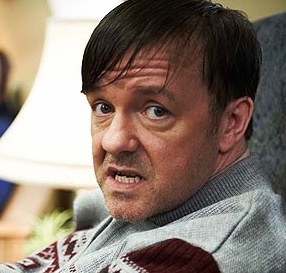
The eponym was a worker in a residential home for the elderly. The residents barely registered, save in relation to Derek and then in over-familiar and demeaning terms. The plotting, such as it was, merely served to construct a portrait of Derek’s persona. Unhappily, though, Derek himself was a hand-me-down sketch, a largely unexplored type of inadequacy. Gervais’ preoccupation with inadequacy as a subject is a matter for him and his analyst, but insofar as it dominates his output it is a more serious matter for commissioning editors – it is well past the time when they should be asking more of this talent who appears more interested in revealing his antic spirit in personal appearances than in the more substantial business of hard creative work.
I do not take this line out of any antagonism to Gervais’ work to date or to his handling of his fame. Never knowingly having set eyes on him before, I was completely in tune with The Office from its opening seconds. Its cod-documentary style has become pretty much the default position for television comedy (Come Fly with Me, Modern Family), though this is not to suggest that Gervais invented it: Orson Welles, Woody Allen and Christopher Guest (among others) were there long before.
But just imagine what might have been done with this basic premise by a politically engaged writer or director working in the 1960s or ‘70s: Jeremy Sandford, Nell Dunn, Jim Allen, Trevor Griffiths, Dennis Potter, Howard Brenton, Caryl Churchill, Ken Loach, Alan Clarke, Roy Battersby. What struck me most forcibly about Derek was its lack of what psychologists call affect. To achieve affect – the impact on emotion of ideas – you need ideas. And Derek had none. It was no more than a half-arsed attempt to be simultaneously funny and poignant, saleable purely by being a star vehicle. It exquisitely fulfilled the aim of Mary Whitehouse: it entirely eschewed thought. And that’s just where British television is at.
Subscribe to:
Posts (Atom)

