I’LL GET MY COAT
Our lane expires in a T-junction with a main road. Before the coming of motorways, this road was the main arterial route to London. Despite the parallel motorway section a few miles to the north, which opened forty years ago this year, the old A road remains busy; indeed its use has discernibly increased in the thirteen years that we have lived here. Just by the turn into our lane is a sign signalling the end of the speed restriction that obtains through the village strung further along the main road. But few drivers restrain themselves until they reach that sign; they put their foot down as soon as they have cleared the identifiable shops. The road seems especially like a racetrack around teatime.
Late yesterday afternoon, a man sauntered down the lane, crossed the main road and weaved through the gateway opposite the end of the lane. This gateway is a sort of fixed kissing gate that allows access to pedestrians and their dogs but thwarts cyclists, prams, wheelchairs and anything of comparable or greater un-manoeuvrability. Beyond it, a small housing estate spreads across a greensward and beyond that is a corner shop, which was the man’s objective.
Having fulfilled his errand, he retraced his steps. As he approached the weave gate, he saw that a cat was ambling ahead of him towards the gateway. It slowed, stopped, sat on its haunches under the lowest bar of the gate and looked around laconically at the man. The man stopped too. He evidently was calculating that to approach the gate might alarm the cat into running ahead. A narrow pathway skirts the road on the gate side (there is none on the far side) but the cat could hardly be relied upon to turn onto that pathway. Cats are more apt to spring forwards and hope for the best.
Rather than be responsible for the cat being squished by a vehicle, the man set off to his right. Between the main road and the little-used ring road around the small estate runs a hedgerow, grown up around a wire fence and punctuated with horse chestnuts. The man paced a few dozens yards until he came to a gap in the hedge where the wire had long been beaten down to allow access. There was still plenty of low growth in the gap and he stepped gingerly for he knew that the stings of nettles, which easily penetrate ankle socks, are especially potent at this time of year.
He then took an extended step towards the roadside pathway but, as he did so, his trailing foot caught in something unyielding – a branch of ivy perhaps or a trailing length of fence wire – and he sprawled forwards. The momentum of the step that he had been in the process of attempting carried him across the pathway and he landed face down half in the road itself. His sudden fall gave no time for the approaching driver to brake or swerve and the vehicle passed over his head, killing him instantly.
I was that man. Apart (clearly) from the last sentence, my account of the incident is as accurate as I am capable of making it. As I fell forwards towards the road, I distinctly thought: “I am going to die now”. As I hit the road, I turned my head towards the oncoming traffic but, amazingly, there was none. I scrambled up. Vehicles passed on the other side of the road – one car tooted at me but I couldn’t tell how to read the toot. Then the traffic stream resumed on the near side including, almost immediately, two juggernauts. Just a few seconds either way would have sealed my fate.
Becoming aware that my left wrist and left knee were both fairly painful and that the left knee of my jeans was slightly torn, I walked slowly and carefully back up the pathway until I was opposite our lane. The cat was nowhere to be seen and, thankfully, was not a flattened mess on the road. I was already thinking about my Dad who died trying to cross a busy road, a victim of his own impatience and the speed of a driver who was fined £120 for his pains. I waited until it was clearly no sort of gamble to cross over.
My partner persuaded me to apply a pack of frozen peas (which we keep for such eventualities) to my knee and to my wrist. The cold diminishes the swelling. It was not until the next day (today) that I noticed that my watch, which has always kept impeccable time, was running ten minutes slow, evidently a product of the knock it must have received. It, like its owner, is lucky not to have been smashed beyond repair.
In the colour magazine of the Saturday edition of The Guardian, called ‘Weekend’, there is a regular questionnaire feature called ‘Q&A’, an exercise based on the so-called ‘Proust Questionnaire’ in Vanity Fair. One of the standing questions is: “What is the closest you’ve come to death?” I always think it’s an absurd question (although, of course, I find all the questions absurd). We walk constantly in death’s shadow. At the edge of a road (or a garden pond or a high window or a river or a cliff), we can be literally one step from oblivion. We are but a bottle of pills or a kitchen knife away. The heart attack, the brain haemorrhage, the murderer or the accident could strike at any moment. Or, like Phil Silvers and Ian Richardson and Sheridan Morley, we could just drift into sleep and never return: merciful for us, horrible for our close ones.
Linda Grant catches this very well in her novel The Clothes on Their Backs: "You take a misstep, you turn your head the wrong way when you cross the road, you gargle with bleach instead of mouthwash, it's just ridiculous the doors that are slightly ajar between life and death. Life's extreme fragility is all around us, as if we are perpetually walking on floors of cracked glass" [p 48, Virago 2008].
Four weeks ago today, there was an incident outside a local community centre. Two men old enough to know better got into an altercation. The older knocked the younger down. In falling, he cracked his skull on the pavement and, as he lay there stunned, he suffered a fatal heart attack. The attacker was detained by the police and later released on bail. The local paper, as the media are apt to do, used the lurid phrase “murder probe”. Clearly, though, manslaughter will be the charge if any is preferred.
The man who died was the local builder, universally known as Micky the Brickie. Round our way, he would have met with few opportunities to work with bricks because almost everything, even the new builds, is fashioned from stone. He might better have been known as Jason the Mason, but Micky was his actual name – he was not of the generation to be called Jason, being only six years younger than me. As the police held onto the body, his family could not bury him for three weeks, plenty of time for everyone to discuss the case. For Micky was indeed known to everybody and, I should have thought, liked by everybody. He was always full of fun and a great talker, with the down side common to that condition that he wasn’t much of a listener. But you forgave him anything because he was instinctively generous. Ours is one of scores of local houses containing some perfectly chosen item or material rescued for recycling and gladly handed over, offers of payment waved away. My partner accounted Micky’s great quality “generosity of spirit” and I think that gets it exactly.
Micky’s death genuinely shocked people because it was sudden and, as his widow remarked, “so unnecessary”. What she was alluding to has subsequently become clearer. It seems that the man who knocked Micky down and who is out on bail was her first husband. This has brought a noisome overtone of soap opera into what had seemed a small but affecting tragedy.
We do walk always in the shadow of death. In the bath this morning, I found myself reminiscing about a trip to Scotland with two pals from university. One of them, John, was an experienced climber. He had scaled several of the major peaks and had lost several friends to the enthusiasm, one of whom (his best friend) fell to his death while roped to John, leaving the survivor the melancholy (and dangerous) task of climbing down into a crevasse to retrieve the body. John was a lovely guy, a big golden bear of a man with a melodious Barnsley accent.
In Scotland, John contemplated the other two of us – Neil, a level-headed geologist, and me, capable sometimes of behaving sensibly – and decided that we could safely drive to Glencoe and go for a clamber. It wasn’t a proper climb but it was strenuous work. We then walked the length of a ridge high above the glen. I no longer recall our route – it’s more than forty years ago – and whether it can have been the legendary Aonach Eagach I somehow doubt, but it was certainly a testing scramble and it took several hours.
At one point the ridge grew very narrow, a row of jagged rocks with a 200-foot drop on either side. Radiating calm, John led the way and we gamely followed, me bringing up the rear. I suddenly managed to trap one leg under the other thigh and was stuck, perched on a sliver of rock and with no space in which to improvise. It occurred me that I was in genuine peril. I saw the others were moving on so I hollered. Neil turned, saw my predicament and started to panic. This, it turned out, was a lifesaver because it forced me to be ice-cool and logical. I lay back, gripped the rock beneath me with both hands, arched my back and lifted my thigh so that I could pull the other leg clear. Then I managed to raise myself to a crouch and inch along until I was on a wider part of the ridge. I saw John’s grinning face up ahead. “All right?” he called. We continued our ridge walk without mishap.
John, I remember, used to fret about my smoking, which was beginning to get heavy. “You know, I’ll be very cross with you if you make yourself ill with cigarettes” he told me one day. After he graduated, he went back to the north and married a woman whom he’d met on the same occasion that Neil and I met her. A few years later, he had surgery for a brain tumour. He and Sue came to London and met up with old pals including me. John showed off the huge scar on his skull that he generally kept covered under a woolly hat. I never saw him again. He died of a recurrence of the tumour. He was 33.
This week, it will be 29 years since I gave up smoking for good. Another friend grew stern with me one day concerning my drinking habits. I was getting through rather too much at the time. He warned me that it might undermine my health. It’s more than 15 years since he died, in his mid-40s from Aids. I don’t make this or any other observation in this posting to, as it were, “score points”. Some of us make our end inevitable by dedicated application: George Best to alcohol, Simon Gray to cigarettes. But for most, the end either comes as the culmination of illness or suddenly with little or no foreshadowing.
As one grows older, inevitably, the proximity of death nudges one more often. It brings no certainties, though, save when it comes wrapped in incurable disease. In his 90s, John Gielgud agreed to a television interview with Jeremy Paxman. In his forthright way, Paxman pressed the great man on his attitude to and preparedness for death. Sir John was visibly distressed to be obliged to contemplate the subject. I wanted him to point out that there was nothing to say that he would not outlive Paxman and that, unless the BBC kept the programme untransmitted until after his death, it was a certainty that some of those watching the interview would pass before Sir John did. And I remember a wonderfully feisty comeback from Katharine Hepburn when asked somewhat imperiously by her interviewer, Barbara Walters: “do you actually own a skirt?” “I’ll wear one to your funeral” Kate shot back. I like to think I too can take that attitude to the grim reaper.
Showing posts with label smoking. Show all posts
Showing posts with label smoking. Show all posts
Sunday, April 03, 2011


Thursday, August 05, 2010
A BEAUTIFUL CORPSE
Le tout Belfast turned out for Alex ‘Hurricane’ Higgins on Monday. The snooker player was found dead in his sheltered accommodation, aged 61. It was the biggest funeral in the city since that of five years ago for another self-destroyer, George Best, then two years younger than Higgins.

The Higgins funeral, an understated affair
I use the term “self-destroyer” advisedly. Higgins’ life was continuously chaotic. Frequently “of no fixed abode” – even at the time he first won the snooker title that is absurdly called “the World Championship” in 1972 – he was an alcoholic, a chain-smoker, frequently involved in fights and domestic violence, totally unreliable and self-centred. It’s a litany that makes Best’s “mere” alcoholism seem rather tame, though Best’s addiction undoubtedly killed him.

Higgins partakes
What is it that propels such a nightmare character into the affections of millions? Is it that we timid, “ordinary” people get a vicarious thrill from some “genius” making all the reckless moves that are ruled out for us by our humdrum circumstances, not least our sense of responsibility to those close to us? Certainly, in all the fields that produce so-called “stars”, the unstable, impossible ones attract a particularly fierce loyalty – Billie Holiday, Charlie Parker, Judy Garland, Lenny Bruce, James Dean, Marilyn Monroe, Elvis Presley, Michael Jackson, Kurt Cobain, Janis Joplin, Jimi Hendrix, Pete Doherty, Amy Winehouse. Maybe that is changing, though. Nobody seems to care much about the dreary and self-pitying Lindsay Lohan, while Mel Gibson has become so nasty in his seeming spiral into personality collapse that nobody extends him any sympathy. And Paul Gascoigne is just a pathetic bore.

Two Belfast bad boys
Back in 1992, a much respected political commentator, Peter Jenkins, died very suddenly. He was only 58. Several of the obituaries I read at the time referred to Jenkins’ liking for “the good life”. This teasing phrase was never explained. Was he a devoted exercise enthusiast who practised various nourishing mystical rituals and lived on a simple, organic diet, giving all his – no doubt substantial – income from journalism to the poor? I rather doubt it. I suspect what “the good life” meant was slap-up meals, fine wines and large cigars. Not a very good life at all, in truth.

Higgins: an example to us all
But self-destructive behaviour is readily mythologised. Two fine writers died recently – Alan Plater and Beryl Bainbridge. Neither was ever without a fag on the go – though Plater was smart at avoiding being photographed smoking – and both died of cancer in their 70s which, these days, you have to count as premature. I am not in a position to say if smoking was responsible for their respective deaths. According to a mutual friend, Plater made a typically wry remark to his doctor: “I bet you’re pissed off that my cancer isn’t smoking-related”. But in his Guardian obituary, Michael Coveney described Plater as “heroically cigarette-smoking”. I simultaneously do and don’t know what that means.

Plater, ciggies out of sight
Objectively, there’s nothing admirable about addictive self-abuse. God knows, we’ve been informed comprehensively enough about the many ways in which smoking can kill us. Of course, secondary smoke does harm too. The entertainer Roy Castle, a life-long non-smoker, died of lung cancer evidently contracted in the smoke-filled clubs where he worked. David Hockney, wholly admirable as a painter, is the most colossal pain in the arse when knocking on about his precious “right” to smoke wherever he likes, never mindful of how that smoking affects others.
Whether or not Alan Plater or Dame Beryl was carried off by their filthy habit, they will have obliged others to ingest their smoke. Alex Higgins was certainly killed by cigarettes and it took a hell of a time. He was diagnosed with throat cancer twelve years ago, having already had mouth cancer twice in the previous four years. His treatment deprived him of all his teeth and, living alone in a caravan, he was unused to looking after himself even in conducive circumstances. It was hardly a noble passing.

Bainbridge and the customary gasper
Death can certainly be romanticised. The most famous painting by Henry Wallis is also one of the most saccharine: The Death of Chatterton. You can bet that his passing looked nothing like that. Nicholas Ray’s movie Knock On Any Door of 1949 grotesquely romanticised juvenile delinquency and put a line into the language: “Live fast, die young and make a good-looking corpse” – it is usually misquoted as “a beautiful corpse”. The myth of the beautiful corpse persists. Five years later, Ray made one of the most mythologizing of all movies, Rebel Without a Cause. The leading young actors in that movie all died young but not beautifully – Natalie Wood drowned, Sal Mineo was murdered and of course James Dean crashed his automobile. Supporting players lived longer. In the last three months both Corey Allen and Dennis Hopper died, the latter one of American cinema’s most self-destructive characters.

The Death of Chatterton
I do not mean to be pious about all this. Disease and illness are lotteries. At any age and in any condition, anyone might contract cancer or indeed any other terminal condition. A much admired dentist in our town collapsed and died while road-running, “doing what he loved doing” in the customary phrase. He was barely 50. His brother and partner in the practice frequently disappears on holiday to pursue his particular passion, mountaineering. Is there a more dangerous hobby? Perhaps only smoking and drinking.

Dennis Hopper in custody
I had a great friend at university, a lovely man called John Furness. He too was a climber. By his early 20s, he had lost several climbing mates on mountain faces, including his best friend: this guy died in a fall while tied to John, who had to make a viciously difficult climb into a crevasse to free himself and retrieve the body. John survived all his climbing scares, only to die of a brain tumour. He was 33. There are no guarantees about our longevity, our survival or our luck.
But I do question the culture that elevates the roaring boy or the car-crash girl. Few of us would last very long in a family or friendship tie with Mickey Rourke or Britney Spears or Charlie Sheen or Joey Barton. Cracking them up as somehow “heroic” suggests that our sense of values is due for a reappraisal.
Le tout Belfast turned out for Alex ‘Hurricane’ Higgins on Monday. The snooker player was found dead in his sheltered accommodation, aged 61. It was the biggest funeral in the city since that of five years ago for another self-destroyer, George Best, then two years younger than Higgins.

The Higgins funeral, an understated affair
I use the term “self-destroyer” advisedly. Higgins’ life was continuously chaotic. Frequently “of no fixed abode” – even at the time he first won the snooker title that is absurdly called “the World Championship” in 1972 – he was an alcoholic, a chain-smoker, frequently involved in fights and domestic violence, totally unreliable and self-centred. It’s a litany that makes Best’s “mere” alcoholism seem rather tame, though Best’s addiction undoubtedly killed him.

Higgins partakes
What is it that propels such a nightmare character into the affections of millions? Is it that we timid, “ordinary” people get a vicarious thrill from some “genius” making all the reckless moves that are ruled out for us by our humdrum circumstances, not least our sense of responsibility to those close to us? Certainly, in all the fields that produce so-called “stars”, the unstable, impossible ones attract a particularly fierce loyalty – Billie Holiday, Charlie Parker, Judy Garland, Lenny Bruce, James Dean, Marilyn Monroe, Elvis Presley, Michael Jackson, Kurt Cobain, Janis Joplin, Jimi Hendrix, Pete Doherty, Amy Winehouse. Maybe that is changing, though. Nobody seems to care much about the dreary and self-pitying Lindsay Lohan, while Mel Gibson has become so nasty in his seeming spiral into personality collapse that nobody extends him any sympathy. And Paul Gascoigne is just a pathetic bore.

Two Belfast bad boys
Back in 1992, a much respected political commentator, Peter Jenkins, died very suddenly. He was only 58. Several of the obituaries I read at the time referred to Jenkins’ liking for “the good life”. This teasing phrase was never explained. Was he a devoted exercise enthusiast who practised various nourishing mystical rituals and lived on a simple, organic diet, giving all his – no doubt substantial – income from journalism to the poor? I rather doubt it. I suspect what “the good life” meant was slap-up meals, fine wines and large cigars. Not a very good life at all, in truth.

Higgins: an example to us all
But self-destructive behaviour is readily mythologised. Two fine writers died recently – Alan Plater and Beryl Bainbridge. Neither was ever without a fag on the go – though Plater was smart at avoiding being photographed smoking – and both died of cancer in their 70s which, these days, you have to count as premature. I am not in a position to say if smoking was responsible for their respective deaths. According to a mutual friend, Plater made a typically wry remark to his doctor: “I bet you’re pissed off that my cancer isn’t smoking-related”. But in his Guardian obituary, Michael Coveney described Plater as “heroically cigarette-smoking”. I simultaneously do and don’t know what that means.

Plater, ciggies out of sight
Objectively, there’s nothing admirable about addictive self-abuse. God knows, we’ve been informed comprehensively enough about the many ways in which smoking can kill us. Of course, secondary smoke does harm too. The entertainer Roy Castle, a life-long non-smoker, died of lung cancer evidently contracted in the smoke-filled clubs where he worked. David Hockney, wholly admirable as a painter, is the most colossal pain in the arse when knocking on about his precious “right” to smoke wherever he likes, never mindful of how that smoking affects others.
Whether or not Alan Plater or Dame Beryl was carried off by their filthy habit, they will have obliged others to ingest their smoke. Alex Higgins was certainly killed by cigarettes and it took a hell of a time. He was diagnosed with throat cancer twelve years ago, having already had mouth cancer twice in the previous four years. His treatment deprived him of all his teeth and, living alone in a caravan, he was unused to looking after himself even in conducive circumstances. It was hardly a noble passing.

Bainbridge and the customary gasper
Death can certainly be romanticised. The most famous painting by Henry Wallis is also one of the most saccharine: The Death of Chatterton. You can bet that his passing looked nothing like that. Nicholas Ray’s movie Knock On Any Door of 1949 grotesquely romanticised juvenile delinquency and put a line into the language: “Live fast, die young and make a good-looking corpse” – it is usually misquoted as “a beautiful corpse”. The myth of the beautiful corpse persists. Five years later, Ray made one of the most mythologizing of all movies, Rebel Without a Cause. The leading young actors in that movie all died young but not beautifully – Natalie Wood drowned, Sal Mineo was murdered and of course James Dean crashed his automobile. Supporting players lived longer. In the last three months both Corey Allen and Dennis Hopper died, the latter one of American cinema’s most self-destructive characters.
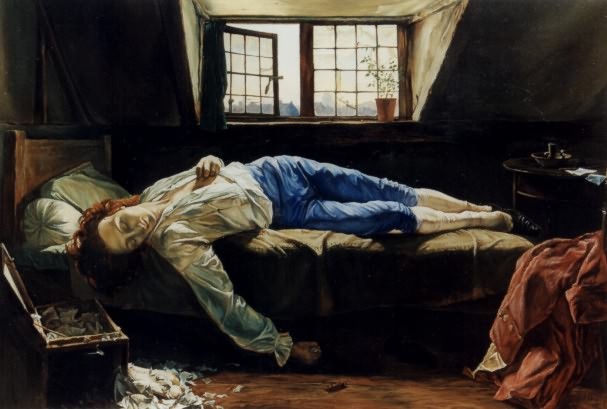
The Death of Chatterton
I do not mean to be pious about all this. Disease and illness are lotteries. At any age and in any condition, anyone might contract cancer or indeed any other terminal condition. A much admired dentist in our town collapsed and died while road-running, “doing what he loved doing” in the customary phrase. He was barely 50. His brother and partner in the practice frequently disappears on holiday to pursue his particular passion, mountaineering. Is there a more dangerous hobby? Perhaps only smoking and drinking.

Dennis Hopper in custody
I had a great friend at university, a lovely man called John Furness. He too was a climber. By his early 20s, he had lost several climbing mates on mountain faces, including his best friend: this guy died in a fall while tied to John, who had to make a viciously difficult climb into a crevasse to free himself and retrieve the body. John survived all his climbing scares, only to die of a brain tumour. He was 33. There are no guarantees about our longevity, our survival or our luck.
But I do question the culture that elevates the roaring boy or the car-crash girl. Few of us would last very long in a family or friendship tie with Mickey Rourke or Britney Spears or Charlie Sheen or Joey Barton. Cracking them up as somehow “heroic” suggests that our sense of values is due for a reappraisal.
Sunday, November 08, 2009
NUTT’s in “MAY NOT” ROW
While I was away in London last week, the most interestingly developing story was that of the sacking by Home Secretary Alan Johnson of Professor David Nutt. A psychiatrist and long-time researcher into alcohol and drug abuse, Nutt was chairman of the Advisory Council on the Misuse of Drugs. The ACMD – no longer 31-strong since others have resigned in sympathy – is an NGO made up of scientists and other experts in the field.
From 1971 (when it was enacted) until 2007, the Misuse of Drugs Act had always followed the ACMD’s recommendations in the way recreational drugs were classified. Indeed, in 2004, the then Home Secretary David Blunkett followed ACMD advice and downgraded cannabis to Class C, carrying lesser sentences for possession and dealing. The so-called drugs czar, Keith Hellawell, disagreed and accordingly resigned. But since Gordon Brown became PM, the ACMD has been sidelined. Former dope-smoker Jacqui Smith restored cannabis to Class B (the then chair of the ACMD, Sir Michael Rawlins, immediately stood down). Then, in February, she overruled the ACMD’s recommendation on ecstasy.
Last month, Prof Nutt wrote a paper, Estimating Drug Harms, for the Centre for Crime and Justice Studies at his academic base, King’s College London. The newspapers picked up on the press release, particularly Nutt’s personal reclassification of various addictive substances, including alcohol and tobacco. That he ranked these respectively fifth and ninth – as against amphetamine at eighth, cannabis eleventh and LSD fourteenth – got the commentators steamed up. It was also brought to the attention of Johnson who duly sacked Nutt by email.
I couldn’t find Nutt’s full list anywhere in the press, so finally called up the CCJS document which you can read here:
http://www.crimeandjustice.org.uk/estimatingdrugharms.html
And here is the table Nutt constructed to reflect his view of the comparative harm that various substances cause:

To read this chart, I suggest copying it onto your desktop and then zooming in
Since his sacking, Nutt has been very visible and very voluble. Clearly he senses a ministry that may be confidently kicked when it is down. He has said that the Brown government has “systematically undermined” the work of the ACMD; that politicians “distort” and “devalue” research evidence (and in this he includes those opposition politicians like Ann Widdecombe and shadow Home Secretary Chris Grayling who have supported Johnson’s action); that ministers drastically overlook the “time-bomb of alcohol”. An ally, former ACMD secretary Jeremy Sare, referred to “pesky irritants like scientific evidence”. Those who will lambast the government with any material they can get have written scornfully of successive Home Secretaries’ self-trumpeted desire for “science-based” decisions that are then disregarded.
If only to be not on the same side as the likes of Melanie Phillips, one would not be attacking David Nutt. But the issues are not clear-cut. Defending his decision, Alan Johnson wrote to The Guardian that Nutt “cannot be both a government adviser and a campaigner against government policy”. On the face of it, that seems reasonable enough. But Johnson also described Nutt’s “horse-riding analogy” – Nutt had earlier pointed out that a hundred people a year die in incidents while on horseback, as against thirty linked to ecstasy – as “a political rather than a scientific point”. Well, so is Johnson’s earlier thrust.
It is understandable if advisers feel angry and frustrated when their advice is not taken. Equally, ministers have to administrate and make policy choices and they cannot be hidebound by the apolitical advice of non-political analysts. How helpful is it for Nutt to compare drugs that are illegal with drugs that are not and are deeply embedded in the culture? If ministers were going to act on all recreational drugs – including nicotine and alcohol – in an equal manner, they would not want to start from where we are. The gradual marginalising of cigarette smoking has been highly controversial and, in some quarters (think David Hockney), very unpopular. What politician would be rash enough to embark on such a path with booze?
But then it seems absurd to many that cannabis, ranked by ministerial fiat as Class B, can attract five years in jail and/or an unlimited fine for, as Nutt puts it, possession of sufficient for one joint. In practice, no one, I would suggest, gets five year for such insignificant possession. But, as a matter of good public policy, the statute book should not be packed with penalties that are never going to be handed down.
And experience and anecdotal evidence supports Nutt’s contention that cannabis is “significantly less harmful than alcohol”. Take into account accidents and incidents and fights that have arisen out of drunkenness, along with the liver disease that is rapidly growing in our booze-sodden culture, and alcohol clearly has many more victims than other – perhaps all other – addictive substances on Nutt’s list.
Do we want recreational drugs decriminalised? Which companies would start to dominate the capital investment in such a new free market? What kind of a culture would develop in Britain if many or all recreational substances were decriminalised before other countries followed suit?
On the other hand, the illicit drug market is a notably nasty one, dominated by laundered money and brutal gangs. Many people who think they are snorting coke are imbibing no such thing. What does it do to your body to ingest Harpic or some other noxious chemical? How damaging is skunk? Maybe a proper commercial trade in these drugs would clean them up.
It is often argued that taking cannabis inevitably “leads on” to hard drugs. I always thought this fallacious. The connection between dope and heroin is simply that they are apt to be offered by the same suppliers because they are both illegal. If cannabis is downgraded, it is in practice psychologically and physically separated from coke and crack and the rest. It cannot be insignificant that, while cannabis was classified as C rather than B, its use among teenagers declined, according to the government’s own figures.
So the whole issue is complicated and prone to the taking of none-too-consistent positions. Nutt told The Observer that he thought the ACMD could well become “unviable”. There have been some resignations among its members but rather fewer than Nutt would probably have hoped for. As the days pass, his martyrdom will be forgotten and Alan Johnson will get on with his other tasks until the election. There are, one feels sure, very few votes in drugs policy.
But there are some interesting ideological ramifications, or so it seems to me. In very broad terms, the left has always favoured regulation, the use of law and governmental powers to protect the vulnerable and keep the rich and powerful in their place. In its extreme form, that becomes state dictatorship and oppressive interference in private matters. The right clings to the free market, deregulation, getting government out of people’s lives, even where some go unsupported to the wall. In its extreme form, this becomes a breakdown of law and the spread of pre-revolutionary anarchy.
Paradoxically, right-wingers are more likely to advocate fierce rules for others, particularly concerning their private lives (sex and drugs, for instance). And people on the left tend to be those who want less regulation in some fields, notably those of recreational drugs (which left-wingers perhaps are more liable to use) and, say, the internet which left-leaning rather than right-leaning libertarians are given to look upon as romantically free and outlawish.
With its stern, son-of-the-manse puritanism (small ‘p’), the Brown government not only wants more regulation of drugs and the internet, it also is almost as deregulatory in instinct, when it comes to capitalism, as the Tories. All of which goes to reinforce the opinion that most of us former Labour-voters have entertained about successive Blair and Brown governments: that (with a few exceptions) it’s been much like living under Thatcher and Major.
While I was away in London last week, the most interestingly developing story was that of the sacking by Home Secretary Alan Johnson of Professor David Nutt. A psychiatrist and long-time researcher into alcohol and drug abuse, Nutt was chairman of the Advisory Council on the Misuse of Drugs. The ACMD – no longer 31-strong since others have resigned in sympathy – is an NGO made up of scientists and other experts in the field.
From 1971 (when it was enacted) until 2007, the Misuse of Drugs Act had always followed the ACMD’s recommendations in the way recreational drugs were classified. Indeed, in 2004, the then Home Secretary David Blunkett followed ACMD advice and downgraded cannabis to Class C, carrying lesser sentences for possession and dealing. The so-called drugs czar, Keith Hellawell, disagreed and accordingly resigned. But since Gordon Brown became PM, the ACMD has been sidelined. Former dope-smoker Jacqui Smith restored cannabis to Class B (the then chair of the ACMD, Sir Michael Rawlins, immediately stood down). Then, in February, she overruled the ACMD’s recommendation on ecstasy.
Last month, Prof Nutt wrote a paper, Estimating Drug Harms, for the Centre for Crime and Justice Studies at his academic base, King’s College London. The newspapers picked up on the press release, particularly Nutt’s personal reclassification of various addictive substances, including alcohol and tobacco. That he ranked these respectively fifth and ninth – as against amphetamine at eighth, cannabis eleventh and LSD fourteenth – got the commentators steamed up. It was also brought to the attention of Johnson who duly sacked Nutt by email.
I couldn’t find Nutt’s full list anywhere in the press, so finally called up the CCJS document which you can read here:
http://www.crimeandjustice.org.uk/estimatingdrugharms.html
And here is the table Nutt constructed to reflect his view of the comparative harm that various substances cause:

To read this chart, I suggest copying it onto your desktop and then zooming in
Since his sacking, Nutt has been very visible and very voluble. Clearly he senses a ministry that may be confidently kicked when it is down. He has said that the Brown government has “systematically undermined” the work of the ACMD; that politicians “distort” and “devalue” research evidence (and in this he includes those opposition politicians like Ann Widdecombe and shadow Home Secretary Chris Grayling who have supported Johnson’s action); that ministers drastically overlook the “time-bomb of alcohol”. An ally, former ACMD secretary Jeremy Sare, referred to “pesky irritants like scientific evidence”. Those who will lambast the government with any material they can get have written scornfully of successive Home Secretaries’ self-trumpeted desire for “science-based” decisions that are then disregarded.
If only to be not on the same side as the likes of Melanie Phillips, one would not be attacking David Nutt. But the issues are not clear-cut. Defending his decision, Alan Johnson wrote to The Guardian that Nutt “cannot be both a government adviser and a campaigner against government policy”. On the face of it, that seems reasonable enough. But Johnson also described Nutt’s “horse-riding analogy” – Nutt had earlier pointed out that a hundred people a year die in incidents while on horseback, as against thirty linked to ecstasy – as “a political rather than a scientific point”. Well, so is Johnson’s earlier thrust.
It is understandable if advisers feel angry and frustrated when their advice is not taken. Equally, ministers have to administrate and make policy choices and they cannot be hidebound by the apolitical advice of non-political analysts. How helpful is it for Nutt to compare drugs that are illegal with drugs that are not and are deeply embedded in the culture? If ministers were going to act on all recreational drugs – including nicotine and alcohol – in an equal manner, they would not want to start from where we are. The gradual marginalising of cigarette smoking has been highly controversial and, in some quarters (think David Hockney), very unpopular. What politician would be rash enough to embark on such a path with booze?
But then it seems absurd to many that cannabis, ranked by ministerial fiat as Class B, can attract five years in jail and/or an unlimited fine for, as Nutt puts it, possession of sufficient for one joint. In practice, no one, I would suggest, gets five year for such insignificant possession. But, as a matter of good public policy, the statute book should not be packed with penalties that are never going to be handed down.
And experience and anecdotal evidence supports Nutt’s contention that cannabis is “significantly less harmful than alcohol”. Take into account accidents and incidents and fights that have arisen out of drunkenness, along with the liver disease that is rapidly growing in our booze-sodden culture, and alcohol clearly has many more victims than other – perhaps all other – addictive substances on Nutt’s list.
Do we want recreational drugs decriminalised? Which companies would start to dominate the capital investment in such a new free market? What kind of a culture would develop in Britain if many or all recreational substances were decriminalised before other countries followed suit?
On the other hand, the illicit drug market is a notably nasty one, dominated by laundered money and brutal gangs. Many people who think they are snorting coke are imbibing no such thing. What does it do to your body to ingest Harpic or some other noxious chemical? How damaging is skunk? Maybe a proper commercial trade in these drugs would clean them up.
It is often argued that taking cannabis inevitably “leads on” to hard drugs. I always thought this fallacious. The connection between dope and heroin is simply that they are apt to be offered by the same suppliers because they are both illegal. If cannabis is downgraded, it is in practice psychologically and physically separated from coke and crack and the rest. It cannot be insignificant that, while cannabis was classified as C rather than B, its use among teenagers declined, according to the government’s own figures.
So the whole issue is complicated and prone to the taking of none-too-consistent positions. Nutt told The Observer that he thought the ACMD could well become “unviable”. There have been some resignations among its members but rather fewer than Nutt would probably have hoped for. As the days pass, his martyrdom will be forgotten and Alan Johnson will get on with his other tasks until the election. There are, one feels sure, very few votes in drugs policy.
But there are some interesting ideological ramifications, or so it seems to me. In very broad terms, the left has always favoured regulation, the use of law and governmental powers to protect the vulnerable and keep the rich and powerful in their place. In its extreme form, that becomes state dictatorship and oppressive interference in private matters. The right clings to the free market, deregulation, getting government out of people’s lives, even where some go unsupported to the wall. In its extreme form, this becomes a breakdown of law and the spread of pre-revolutionary anarchy.
Paradoxically, right-wingers are more likely to advocate fierce rules for others, particularly concerning their private lives (sex and drugs, for instance). And people on the left tend to be those who want less regulation in some fields, notably those of recreational drugs (which left-wingers perhaps are more liable to use) and, say, the internet which left-leaning rather than right-leaning libertarians are given to look upon as romantically free and outlawish.
With its stern, son-of-the-manse puritanism (small ‘p’), the Brown government not only wants more regulation of drugs and the internet, it also is almost as deregulatory in instinct, when it comes to capitalism, as the Tories. All of which goes to reinforce the opinion that most of us former Labour-voters have entertained about successive Blair and Brown governments: that (with a few exceptions) it’s been much like living under Thatcher and Major.
Saturday, September 19, 2009
The ROAD to RECOVERY
The political parties are now competing to look for ways to render more palatable the raising of taxes and the lowering of public spending. Here are some suggestions.
1) Slap a considerable tax hike on alcohol and smoking materials but ring-fence it entirely for the NHS. The tax can be presented as a charge for the “nanny-state” treatment drinkers and smokers will need from the health service in the future. Such targeted taxation is both socially constructive and morally defensible – and rather more effective than the British Medical Association’s advocacy of a ban on advertising and sponsorship. It puts the onus back on the individual to take responsibility for his behaviour. A further range of surcharges might be imposed on fast foods, on food packaging and, eventually, on all processed and perhaps even non-organic foods. Food producers will have an incentive to put themselves in a position where they can demonstrate the healthy nature of their ingredients and processes. This is taxation as organic carrot rather than as resented stick.
2) The government should introduce punitive charges against those whose drunken behaviour necessitates the calling out of emergency services. Specific spot charges for the handling of incidents need not be the thin end of a wedge of general charging for police and/or paramedic services; indeed, voters generally would welcome knowing that they are not having to pay for the clearing up after anti-social indulgence in town centres. This would be a targeted surcharge that would also win a lot of votes.
3) If the courts stopped committing those convicted of non-violent crime to prison, there would be no need for capital expenditure on new gaols. Financial crimes could be countered with swingeing financial penalties over a commensurate number of years (those convicted would have their finances regularly audited by court-appointed accountants). Other white-collar crime, burglary and petty offences could be penalised by rigorous regimes of community service. Incarceration would be reserved for those who are found by the courts to constitute a danger to the public. This way society benefits from – rather than paying the keep of – the supervision of all but its most recalcitrant and antisocial transgressors.
4) Announce an imminent date for the withdrawal of troops from Afghanistan. This would be a popular change of policy. That our occupation of parts of another sovereign state keeps our streets safe from terrorists is a theory, not a fact. Many of us argue that our presence in Islamic countries rather recruits terrorists with a grudge against Britain: “don’t mess with the Moslems” as last week’s convicted would-be airline bomber declared on his suicide video. Nations that do not take it upon themselves to police the world do not, by and large, have a problem with terrorists. But here’s the clincher: we simply can’t afford this monstrous expense. Let the UN take on the task of making the world safe. That’s what it’s for.
5) Then begin scaling down our entire military capacity, starting with Trident. Britain’s present status in the world does not require us to remain armed to the teeth. Maintaining nuclear capacity and a military strength that invites our presence in every international conflict is colossally expensive. We have far greater need for renewed infrastructure, libraries, schools and university places that do not impoverish those that win them. That is what the electorate wants.
6) Bring in a new top tax level of 100 percent for all those remunerated (including supposed bonuses and share options) to the tune of £1million or more per year. In a recession or even not in a recession, nobody has need of more than £1million per year. “Oh,” the city will squeal, “but there will be a haemorrhage of talent to other countries”. To which I have a one-word reply: “Goodbye”. There might be some departures among those who are more interested in raking in the shekels than finding job satisfaction. But frankly the rest of the world is not so short of talent of its own that it would come recruiting here in significant numbers. In any case, few of the city fat cats have demonstrated much in the way of talent in recent years. What the public justly resents is that these titans of business get paid bonuses that make you clench your arse-cheeks even when their businesses are tumbling down the lavatory pan. Had I been a government minister, I would have tendered my resignation because Gordon Brown and Alistair Darling did not make agreed levels of pay restraint a condition of the bank bail-outs that they offered on the tax payers’ behalf.
7) Scrapping the ID cards is a no-brainer and it seems certain to happen whichever party forms the next government. Dismantling much of the surveillance state ought to be on the agenda too. Britain’s infrastructure of surveillance is, as so often noted, the most extensive in the world, yet so many recent cases have shown that the surveillance simply doesn’t work. Whether it is Britain’s tradition of a chronic lack of maintenance skills or the public’s slyness in avoiding being seen while at nefarious activities, the investment is clearly not worth it.
8) I do not favour cutting into the culture of benefits. It always used to be that the left supported benefits even when some people received them who didn’t need them and the right supported cuts in benefits even for people who could not manage without them. But that distinction has become blurred in both directions. New Labour is more ready to let deprived people swing in the wind and the Tories are more anxious at least to give lip service to the welfare state. Better that we risk losing the supposed talent of asset strippers and financial speculators than that we starve a whole class of people that might generate all sorts of talent.
The Chancellor warns of hard choices. These are easy ones.
The political parties are now competing to look for ways to render more palatable the raising of taxes and the lowering of public spending. Here are some suggestions.
1) Slap a considerable tax hike on alcohol and smoking materials but ring-fence it entirely for the NHS. The tax can be presented as a charge for the “nanny-state” treatment drinkers and smokers will need from the health service in the future. Such targeted taxation is both socially constructive and morally defensible – and rather more effective than the British Medical Association’s advocacy of a ban on advertising and sponsorship. It puts the onus back on the individual to take responsibility for his behaviour. A further range of surcharges might be imposed on fast foods, on food packaging and, eventually, on all processed and perhaps even non-organic foods. Food producers will have an incentive to put themselves in a position where they can demonstrate the healthy nature of their ingredients and processes. This is taxation as organic carrot rather than as resented stick.
2) The government should introduce punitive charges against those whose drunken behaviour necessitates the calling out of emergency services. Specific spot charges for the handling of incidents need not be the thin end of a wedge of general charging for police and/or paramedic services; indeed, voters generally would welcome knowing that they are not having to pay for the clearing up after anti-social indulgence in town centres. This would be a targeted surcharge that would also win a lot of votes.
3) If the courts stopped committing those convicted of non-violent crime to prison, there would be no need for capital expenditure on new gaols. Financial crimes could be countered with swingeing financial penalties over a commensurate number of years (those convicted would have their finances regularly audited by court-appointed accountants). Other white-collar crime, burglary and petty offences could be penalised by rigorous regimes of community service. Incarceration would be reserved for those who are found by the courts to constitute a danger to the public. This way society benefits from – rather than paying the keep of – the supervision of all but its most recalcitrant and antisocial transgressors.
4) Announce an imminent date for the withdrawal of troops from Afghanistan. This would be a popular change of policy. That our occupation of parts of another sovereign state keeps our streets safe from terrorists is a theory, not a fact. Many of us argue that our presence in Islamic countries rather recruits terrorists with a grudge against Britain: “don’t mess with the Moslems” as last week’s convicted would-be airline bomber declared on his suicide video. Nations that do not take it upon themselves to police the world do not, by and large, have a problem with terrorists. But here’s the clincher: we simply can’t afford this monstrous expense. Let the UN take on the task of making the world safe. That’s what it’s for.
5) Then begin scaling down our entire military capacity, starting with Trident. Britain’s present status in the world does not require us to remain armed to the teeth. Maintaining nuclear capacity and a military strength that invites our presence in every international conflict is colossally expensive. We have far greater need for renewed infrastructure, libraries, schools and university places that do not impoverish those that win them. That is what the electorate wants.
6) Bring in a new top tax level of 100 percent for all those remunerated (including supposed bonuses and share options) to the tune of £1million or more per year. In a recession or even not in a recession, nobody has need of more than £1million per year. “Oh,” the city will squeal, “but there will be a haemorrhage of talent to other countries”. To which I have a one-word reply: “Goodbye”. There might be some departures among those who are more interested in raking in the shekels than finding job satisfaction. But frankly the rest of the world is not so short of talent of its own that it would come recruiting here in significant numbers. In any case, few of the city fat cats have demonstrated much in the way of talent in recent years. What the public justly resents is that these titans of business get paid bonuses that make you clench your arse-cheeks even when their businesses are tumbling down the lavatory pan. Had I been a government minister, I would have tendered my resignation because Gordon Brown and Alistair Darling did not make agreed levels of pay restraint a condition of the bank bail-outs that they offered on the tax payers’ behalf.
7) Scrapping the ID cards is a no-brainer and it seems certain to happen whichever party forms the next government. Dismantling much of the surveillance state ought to be on the agenda too. Britain’s infrastructure of surveillance is, as so often noted, the most extensive in the world, yet so many recent cases have shown that the surveillance simply doesn’t work. Whether it is Britain’s tradition of a chronic lack of maintenance skills or the public’s slyness in avoiding being seen while at nefarious activities, the investment is clearly not worth it.
8) I do not favour cutting into the culture of benefits. It always used to be that the left supported benefits even when some people received them who didn’t need them and the right supported cuts in benefits even for people who could not manage without them. But that distinction has become blurred in both directions. New Labour is more ready to let deprived people swing in the wind and the Tories are more anxious at least to give lip service to the welfare state. Better that we risk losing the supposed talent of asset strippers and financial speculators than that we starve a whole class of people that might generate all sorts of talent.
The Chancellor warns of hard choices. These are easy ones.
Subscribe to:
Posts (Atom)

