Showing posts with label NHS. Show all posts

Monday, January 16, 2012

A GHOST STORY RETAILED

Act III: BIG TROUBLE

In the previous canto of this lamentation for the independent, individual retailer, I limned the way department stores have been subsumed into uniform chains, like Debenhams and House of Fraser. But some of these chains are not all that they seem. For instance, BHS, Burton, Topshop, Dorothy Perkins and others have been herded together under the ownership of that ornament on the British scene Philip Green, knighted for his services to tax avoidance, and his fellow entrepreneur and wife, Tina. This is where liberal capitalism leads: a handful of billionaires who decide everything that the marketplace will trade, just as Marx anticipated.

JK Galbraith expounded the privileged position of captains of industry more than fifty years ago. He was writing of a very different sort of economy, driven by productive rather than service industries. The billionaires with whose reputations he had grown up in North America – Henry Ford, EH Harriman, Andrew Carnegie, John D Rockefeller, JP Morgan, William Randolph Hearst – had generally either made things (automobiles, railroads, steel) or constructed enabling empires (oil, personal banking, publishing).

The Romford branch of Sainsbury's, more than a century ago

“Without question,” wrote Galbraith, “the individual with the greatest stake in the present economic goals is the businessman – more precisely, perhaps, the important business executive. If production is of preoccupying importance he, as the man with the traditional and established right to the title of producer, will be the dominant figure in the social constellation. Society will accord him prestige appropriate to the role he plays; what may well be less important, he will be able, without difficulty or criticism, to command an income that is related to his prestige. As production has increasingly monopolized our economic attitudes, the business executive has grown in esteem. So long as inequality was a matter of serious concern the tycoon had, at best, an ambiguous position. He performed a function of obvious urgency. But he was also regularly accused of taking far too much for his services. As concern for inequality has declined, this reaction has disappeared. The businessman is no longer subject to a serious challenge of any sort” [The Affluent Society, 1958].

Prof Galbraith’s description of inequality as being formerly “a matter of serious concern” refers to a now far-distant time. Socialism was effectively dead in the USA by the end of the 1930s, in Britain by the end of the 1950s and in Galbraith’s native Canada by the mid-1960s. And now of course production no longer has any monopoly on the economy either side of the Atlantic. These days, a producer is usually understood to be someone in charge of movies, adverts, software, music, television programmes. Most of us in the west toil in service industries. The making of machines, vehicles, implements, garments, furnishings and toys is almost entirely confined to the Far East. Our billionaires are the asset strippers, speculators, venture capitalists and money manipulators who produce nothing but who feed off the toil of low-paid workers in the teeming nations of the developing economies.

Once these buccaneers have grown rich, they naturally like to own things that bespeak their wealth: property, private jets and yachts, customised cars, fine art, trophy wives and, most important of all, businesses. There are some assets, both the initial acquisition and the continuing upkeep of which may only be afforded by multi-millionaires, because they are apt to bleed money and require constant feeding: newspapers, football clubs, hotels, theatres, and movie and television production houses. A safer bet, provided the owner is a shrewd re-investor, is the retail chain. But the biggest chains have been built over generations, mostly within a family: Sainsbury, Walton, Morrison. So my argument comes finally to the biggest kind of chain store.

Of all the perfectly horrible developments in the retail trade since the Second World War. the relentless swamping of the world by superstores has been both in itself the worst and the one chiefly responsible for all the other most horrible developments. The boards of superstores (and their shareholders) seek only to maximize their profits. Look at the regular lists of the richest people in Britain and you will note how many of the names near the top of the list are those of directors of superstores or of companies engaged not in the production of items but in the packaging of items sold in superstores.

Packing 'em in: trolleys at Morrisons

The big stores oversee the permanent buyer-for-retail’s market they have stimulated. They are so powerful that they fix prices, determining the fates of every area of the farming effort, both in this country and throughout the world’s producing nations. They require blemish-free, regular-shaped produce all year round and in predictable quantity. Any wholesaler unable to guarantee this unnatural supply is simply squeezed out of the business. The big stores settle for nothing less than exactly what they want on their own brutal terms.

I once met a former supplier to the supermarkets who told me horrendous tales of the profound ignorance of the buyers – even the chief buyers – who represent the big stores. Characteristically, these tribunes of the shopping people know nothing of seasonality, growing conditions, available varieties or any other practicality of agriculture, by this man’s account. They form categorical, non-negotiable conclusions based on whim, even about items the taste of which they personally do not care for. This at any rate was what he found and he quoted chapter and verse that had the smack of lived experience, gnawing at him in his enforced, premature retirement.

So what these stores, in their ignorance, don’t want falls out of production and customers are obliged to settle for what the superstores have determined that they will have. You can whistle if you want an item that doesn’t confirm to the supermarket’s crass standards. It isn’t profitable so it is ruthlessly culled or made palatable to the taste of the lowest common denominator and so of no interest to you.

It isn’t any use you preferring fruit with the beautiful taste that can only be produced by the natural ripening process in season. Such fruit is only available if you grow it yourself or travel to where it grows plentifully or have access to one of the small-scale specialist growers grimly hanging on to provide those who are willing to go to some trouble for decent merchandise and to be patient for the appropriate time of year. Those who cannot wait until weeks after Wimbledon and who have never tasted a truly delicious strawberry full of in-season juice (especially a tiny wild one) will buy their oversized, flown-in, force-ripened ones in, say, January and imagine that is what a strawberry is like.

Farmers who cannot get by on a large enough fan-base for organic, local and seasonal produce need to be ruthless themselves in order to maximize their yields to satisfy the stores. Pesticides and other chemicals must be applied in industrial quantities to preserve the eerily perfect appearance of the fruit and vegetables. These treatments have their nuclear effect on the insects that feed on the crop margins. They also prevent birds, small mammals and other creatures from taking their share both of the crops and of the insects. These creatures are poisoned or genetically altered by imbibing the chemicals through the flesh of either the crops or the insects. When they do not take the adulterated flesh, they starve.

A branch of Safeway in Cardiff, closed at the end of last century

Denied a healthy food source, the wild creatures die out. The buyer of the unearthly orange-coloured carrot, perfectly straight and with no blemish on its skin but tasting only of rinsing water and slightly of chemicals is unconcerned that a sub-species of shrew or a variety of field butterfly or a type of shrike disappears from its last habitat. But the world is poorer for it. The world is poorer for the decline of good taste in the carrot too.

The appearance of the countryside has radically altered in my lifetime. Modest fields of mixed, rotating crops that fell to the plough in time for the Harvest Festival have been replaced by vast vistas of fast-growing animal fodder. Thanks to the ubiquitous spread of the brassica appropriately called rape, Blake’s England has become an acid yellow and unpleasant land.

Animal farming has changed too. Pandemics of disease – foot and mouth, bovine spongiform encephalopathy – are spread readily in factory-farming conditions and so have wiped out flocks and herds. Consequently, local bloodlines are disrupted and abandoned. Additionally, the narrow demands of supermarkets have put a premium on the meat, milk and other by-products of specific strains. So, for instance, what the Scots call the “heeland coo” is now common in many parts of Britain and no longer a beautiful beast peculiar to the Highlands. The countryside has become like the high street: physical character may distinguish one part from another but the introduced elements are the same all over the country so that a field in Dorset sustains the same inhabitants as a dale in Yorkshire.

Having ruined the food industry, the supermarkets went after other businesses to undermine. First there was a return to the high street with an explosion of small-scale marts, also located in residential areas and small towns – Tesco Express was the leader of this trend. This initiative was a direct challenge to second-rank chains like 7-Eleven (now extinct in the UK), Spar and Budgens as well as to individual corner shops. Then, in September 2005, Tesco opened in Manchester its first non-food supermarket. This upped the anti even further. Whatever you sell – yes, you sir, the ironmonger who used to be the star of your high street, and you madam, the modest draper whose shop has been adored by its regulars since the 1920s – you are powerless against the big guys.

The conventions established in superstores have spread to other retailers that have sufficiently large branches to adopt them. For instance, many stores have done away with the old-fashioned counter system and replaced it with supermarket-style checkouts. Typically, they have found that the checkouts require fewer staff, because all the transactions are concentrated in one place. Thus, as long as at least one of the tills in a row even of ten or twelve is in operation, customers are only likely to complain about being made to wait to complete their purchase if ungrateful people like me are in the queue.

Superstore policies have done damage far beyond the field of diverse retail. Because these stores buy in bulk and sell at speed and in quantity – “pile ‘em high, sell ‘em cheap” to quote the founding motto of Sam Walton’s Walmart megaliths n the US – they require produce to be transported, delivered, stored and sold in regular-sized units – what restaurant chains call “portion control”.

The display of loose, unpackaged produce takes a very lowly second-place to regulation quantity packs, inevitably pitched at the conventionally-sized family. As with the siting of venues for the benefit of car-drivers, so this packaging culture discriminates against the single person or the household whose members have divergent needs and tastes. It also discourages those who prefer to pick over the selection and choose what they want. With some fruits and vegetables, this is critical. Only a nincompoop buys an onion that is less than hard as nails because as soon as it softens an onion is past its best. When you may only buy a sealed bag containing eight or ten onions, it is impossible to determine whether all the onions are sufficiently hard (if indeed any of them are) and anyway you are probably being obliged to purchase more than you require.

Pitsea landfill site

Packaging is not designed to help the customer, save for those who have been conditioned by the superstores – and in the nature of things, these are an increasing proportion of the total – to settle for what they are given. And packaging as an industry has grown fat on the backs of the superstores’ requirements. Most of this packaging, even that part of it that is recyclable, is added to the mountain of landfill garbage that the world generates in self-defeating quantities. Much of it ends up polluting the oceans as well as the land and much of it is fatally ingested by wild creatures. Once again, Tesco and co are making a decisive contribution to the extinction of the planet’s dwindling wildlife.

What can be done to curb the dominance of the superstores? In the last few days, we have seen that they may already carry the seeds of their own destruction. Tesco suffered a much poorer Christmas season than it had anticipated, was obliged to issue a profits warning and saw as much as £5bn wiped off the value of the company in a single day’s share trading. That it can sustain such a loss without being consigned to the same basket-case basket as HMV, Thorntons and Mothercare says a lot about its expectation of continuing profit and its vast size: it employs almost half a million people worldwide.

Why did Tesco have such a bad Christmas? Part of it is down to governmental manipulation of the economy. The Tories prefer to squeeze hardest those social groups least likely to support the party, so the C2 and D groups – for whom shopping for daily food and household basics comprise their big-ticket spending – are the ones having to cut that kind of spending. (Argos, the down-market catalogue chain, has seen a comparable decline in its profits). By contrast, Sainsbury’s and Waitrose, whose customer base is more middle class, have been less affected by the recession.

But there is also a technological ingredient in the changing fortunes of the supermarket giants. John Lewis, along with its subsidiary Waitrose, has prospered not only from the relative resilience of better-heeled customers but also from anticipating the nature of the growth of on-line shopping. Andy Street, the John Lewis managing director, told The World at One the other day that the secret was to manage a combination of on-line ordering and in-store collection: “bricks and clicks” he calls it. Tesco may not yet have devoted enough planning to what is called a “multi-channel strategy”.

Nevertheless, Tesco is still comfortably the market-share leader, the 30 percent that it takes of the market remaining nearly double that of its nearest rival, Asda (which is the British identity of Walmart). Despite a healthy Christmas, Sainsbury’s remains about 0.5 percent behind Asda. The superstore sector as a whole grew by nearly five percent last year.

Monopoly legislation defines a “classic monopoly” as 25 percent of market share in a given sector. But when the Competition Commission considered the case of Tesco in 2007, it did nothing to threaten the company’s position. This despite that, when Morrisons bought Safeway in 2004, the Commission obliged Morrisons to part with 52 of the acquired stores, ten of which were bought by Tesco. It seems that there is one rule for Tesco and one for everyone else.

Mini-Tescos invade the high street: this one is in Bedford

What can be done to curb the over-mighty superstores? A widespread determination among shoppers to support independent retailers, local traders and small, specialist chains would be the most effective weapon, but contemporary society has learnt to believe that it values convenience above all else – and remember that an early name for the multi-purpose chain was “the convenience store”. One might think that the surprising popularity of food programmes on television would encourage viewers to favour locally-grown and seasonal produce. But the telly chefs themselves do not follow the implications of their trade. The most depressing aspect of Antony Worrall Thompson’s recent shameful shoplifting escapade was that it took place at his local branch of Tesco.

The government could support the independent and small-scale retailer against the huge conglomerates by adjusting the business rate. Why not abolish the taxation altogether for enterprises whose premises and workforce are below a certain size? Another route to restricting the power of the superstores would play its part in a piece of social engineering that I have long advocated. My argument goes like this:

Whenever governments attempt to intervene in private activities that have a deleterious effect on those who pursue them (and, though this is routinely ignored in the argument, on others too), people complain about “the nanny state”. Oddly enough, the same people scamper to nanny NHS when they begin to suffer the diseases caused by smoking, drinking, obesity and so on. This point might usefully be made more often.

The logo of an anti-Tesco website

Recurrent proposals for price controls and consumption restrictions, advertising and sponsorship bans and other such measures (ones that also punish responsible consumption and adversely affect enterprises that are innocent third parties) are always fiercely fended off by vested interests. Rather than fixing a minimum price for alcohol, a simpler measure would be to revoke the licences of all supermarkets and non-specialist chains to sell alcohol and indeed smoking materials. This would also be a useful counter-balance to the all-purpose chains that have driven so many off-licences, pubs and newsagent/tobacconists out of business. Many young people find an off-licence a rather more daunting outlet than a corner Costcutter with its discounted plonk and strong beers.

Then, an enlightened Chancellor might impose new, swingeing duties on smoking materials and alcohol that are strictly and accountably ring-fenced for payment direct to the NHS, so that smokers and drinkers may know that they are contributing towards the treatment that they will themselves require. A similar imposition might be made on processed foods, using a sliding scale dictated by objective nutritional assessments, with more stringent tests and surcharges imposed on catering supplies, the contents of which are not (but could be and should be) vouchsafed to consumers. If that works well, all foodstuffs that cannot demonstrate that they are organic might subsequently be surcharged in the same way. Food producers will have an incentive to put themselves in a position where they can demonstrate the healthy nature of their ingredients and processes. This is taxation as organic carrot rather than as resented stick.

A further useful intervention by government would be the imposition of a surcharge on non-recyclable packaging, payable both by the supplier and by the retailer. This would favour, for instance, the greengrocer who sells loose vegetables in paper bags and the delicatessen dispensing cheese in greaseproof wrapping and other items in card tubs. The charge for a plastic bag should be increased vertiginously so that everyone painfully understands the virtue of the re-use of bags issued by the stores and the acquisition by the shopper of old-fashioned shopping bags and baskets constructed of natural materials.

It is not beyond the powers of ministers to restore a balanced cohesion to the state of British retail. Being realistic, though, it may be beyond their powers of imagination. CONCLUDED.

Wednesday, September 28, 2011

BEING LACKED and LOST/WHY THEN WE RACK the VALUE

Ed Miliband made a good speech to the party conference. The word he hit time and again was “values”. It’s a usefully resonant term, speaking of morality as well as of economy, trailing association with family and tradition and honesty. And he encapsulated it in a neatly turned soundbite: “the wrong values for our country and the wrong values for our time: that’s David Cameron”.

I also thought he dealt subtly with the first subject that the commentators always bring up, this notion that his poll ratings are relatively poor. Those of opposition leaders always are low through their early months because opportunities to embed their strengths in the public consciousness are few. Miliband’s first few pages harked back to JK Galbraith’s coining of the “conventional wisdom” as something to be shunned, and he gamely bracketed it with consensus. He gave Ed Balls generous credit for opposing the conventional wisdom on the economy twelve months ago at a time – though he didn’t spell this out (but he didn’t need to) – when he, Miliband, was passing over Balls as the natural shadow Chancellor in favour of Alan Johnson.

Miliband on the podium today

He took some pleasure in reminding us of the credit he won on all sides for his stance on the hacking scandal: “I knew I was breaking rule one of British politics: don’t mess with Rupert Murdoch”. And he cited his own immigrant background to ally himself with those who feel excluded from David Cameron’s phantom Big Society: “21st century Britain – still a country for the insiders”. He ambitiously described himself as “the guy who’s determined to break the closed circles of Britain … we must take on the vested interests wherever they are because that is how we defend the public interest”.

The NHS is always fuel for a Labour leader’s speech and he duly got plenty of traction from a dazzling riff that ended with “the oldest truth in British politics: you can’t trust the Tories on the National Health Service”. I thought the applause would never end.

He also got off some sharply wounding points against perceived enemies of the people: Sir Fred Goodwin, energy companies (“let’s call a rigged market what it is”), Southern Cross, “runaway rewards at the top”, Nick Clegg (knockabout stuff) and the PM: “only David Cameron could believe that you make ordinary families work harder by making them poorer and the rich work harder by making them richer”.

In committing the party to be “pro-business” and for “co-operation, not conflict”, he was making an impeccably Social Democrat pitch. However, this didn’t stop the BBC’s Nick Robinson anticipating “We Told You So: Red Ed” headlines in the papers tomorrow – the Tory press, presumably. But it should be good for all shades of opinion that he wants to make Britain primarily a manufacturing nation again: “not financial engineering but real engineering”. We can all support his campaign for apprenticeships and his determination to favour productive business over asset-stripping: “growth is built on sand if it comes from our predators and not our producers”.

But I feared that there was too much revisionism and that much of it is wrapped up with a need the Labour leadership feels to apologize for losing public support. It surely isn’t necessary specifically to repudiate past policy positions, especially ones that are three decades old. The coalition government daily justifies its mistakes and its dire policies by blaming Labour for the “mess” it left. The Labour leadership has already left it too long to nail this lie credibly. Now is not the time to start handing the Tories abject quotes to be further exploited against the last government’s record.

A so-called Wordle of Miliband's speech; obviously they didn't load "values" onto the program

I don’t care for gesture politics. David Cameron evidently won a lot of credit for making a public statement of regret over Bloody Sunday. While I concede that he executed it graciously, I dispute that it cost him anything to do. He was five in 1972. Nobody blames him. The Heath government of the time was a very different beast from Cameron’s government and only four members of its cabinet are alive: Robert Carr (94), Peter Carrington (92), Margaret Thatcher (85 in a fortnight) and Jim Prior (84 in a fortnight). I don’t imagine that Cameron cleared his apology with any of them.

The “conventional wisdom” that Labour has much to apologize for is due for putting out to grass. It’s not the only old news. Jockeying the BBC’s live coverage of Miliband’s speech – disrupted, as was every other broadcaster’s, by a brief power failure at the Liverpool conference hall – Andrew Neil presumed to know what “people” think, as commentators are apt to do, for instance that they perceive Miliband as someone who “stabbed his brother in the back”. As a summary of the Labour leadership contest, it doesn’t survive five seconds of mature consideration. Anyway, why does no one suggest that Cameron stabbed David Davis in the back in order to win the Tory leadership?

Neil also banged on about the opinion poll ratings. As I tire of pointing out, opinion polls are a bankrupt pseudo-science, exemplified by Bob Worcester “calling” the 2004 US election for John Kerry quite late in the process on ITV. Look at the by-election results since the general election. Go on, look at them.

That Labour has missed some tricks under Miliband must be acknowledged. There are many ways of releasing public expenditure and easing the burden on the public, and most of them are rather more effective than a temporary lowering of VAT, the benefit of which is highly questionable. I fervently wish that Miliband and Labour had had the courage to oppose Cameron’s intervention in Libya. With his often quoted opposition to the Iraq invasion – at the time, not in retrospect – Miliband could have credibly articulated the case against the UK’s involvement.

Instead he declared that we could not “stand by” and watch Gaddafi killing his own citizens. Well, we stand by through many another repressive regime: Syria, Bahrain, Yemen, Myanmar, Iran, North Korea, Zimbabwe, Russia, China. We do precious little to assist in those events that we call “natural disasters” but that we know are, at least in part, the result of man-made climate change: floods last year and this in Pakistan; floods and earthquakes in Australasia; earthquake, tsunami and nuclear disaster in Japan; tornados across the Caribbean and the southern States; famine in east Africa.

Yesterday, The Guardian scared up a defence analyst who reckoned that the cost to the British economy of Cameron’s self-serving strut upon the world stage, climaxed by his complaisant speech to the UN last week, will be in the order of £1.75bn. And don’t imagine that the British will not go on paying for months to come yet. At the London Conference on Libya in March, Cameron declared: “We must ensure the delivery of humanitarian aid where it is needed … when the fighting is over, we will need to put right the damage that Gaddafi has inflicted”.

My feeling is that there is little deep-seated support for this war among the electorate. Had Miliband stepped away from the consensus, the conventional wisdom, he could have given voice and point to this indifference and turned it into respect for his integrity. Now he and Balls could show persuasively that, under their policies, the government would have had at least £1.75bn to spend on stimulating growth, bolstering the NHS, reducing tuition fees or whatever domestic policy seemed most welcome to the electorate at the time. Cameron would have crowed for a few days when it seemed that his Libya policy had been “a success” but, besides pointing out that the Libya adventure, like that in Iraq and Afghanistan, is not over till it’s over and even then not without consequence, Miliband could have asked on a regular basis “at what cost”?

Labour should by now have worked up a programme of sources of revenue for encouraging the economy and never mind behaving as if they have accepted the Tories’ obsession with hauling down the deficit. Shadow ministers also might spend a bit more time pointing out that government expenditure is actually going up rather than coming down, instead of fatalistically accepting that it was Labour who went on a colossal spending spree.

So, although I like and admire Miliband, am glad he is the Labour leader and believe he can and will win the next election, I think he and his under-powered team should have inflicted rather more damage on the coalition. It’s certainly not too late to make up the lack.

Wednesday, February 16, 2011

COAGULATION GOVERNMENT

The contradictions grow more evident with every passing day. The three most damaging charges successfully levelled by oppositions against British governments over the last half-century have concerned “u-turns”, “dither” and “sleaze”. David Cameron’s government has yet to be overwhelmed by sleaze and perhaps has been sufficiently energetic to avoid attracting many accusations of dithering, but the u-turns come thick and fast.

Ken Clarke, the Lord Chancellor (aka Justice Secretary), hinted at this failure of the coalition in his interview in The Daily Telegraph at the weekend. Clarke ruminated that “I don’t think middle England has quite taken on board the scale of the problem”. He was talking about the economy, which is not of course his fiefdom since the restoration of Tory rule. Some sixteen months before the election, Cameron brought him back into front-line politics as shadow Business Secretary. Until then he had spent the better part of a decade on the backbenches, from soon after the Tories lost the 1997 election – he had served as Chancellor for the last four years of John Major’s government.

Kenneth Clarke: a personal view of civilisation not shared by all Tories

It is middle England that has been kicking up roughest just lately about government policy, especially the proposed sale of forests, the widespread closure of libraries and the evidence of a watering down, by complicated but suspicion-rousing means, of Cameron’s much-trumpeted commitment to the National Health Service. My reading is that Clarke’s remark is his way of indicating that he thinks the government is wrong on these issues because they will alienate core Tory votes. And indeed, it is in these areas, beginning with the fate of the greenwoods, that the u-turns have begun to look most likely,

Many on the Tory right (and not only on the right) loathe Ken Clarke for what they see as his unsound views – socially liberal, staunchly pro-European – and his faintly plebeian, even faintly bohemian style. He attended a direct grant rather than a public school, favours jazz, real ale and hush puppies and looks uncomfortable in evening dress. But he is a very old hand, only one MP short of being Father of the House (that is, the longest serving MP), and he has an undoubted populist touch, cutting a jovial, almost Falstaffian figure: the cover of the new issue of Private Eye makes splendid use of a funny picture of him.

Cameron: leading a government of clots

His interview with The Telegraph preceded the vote in the Commons on the ruling of the European Court of Human Rights in Strasbourg. The court decided that the disallowing of all those in gaol from voting in parliamentary elections – as Britain has done for centuries – is unlawful. Clarke took the view that “I do not contemplate either government or parliament suddenly deciding it’s not bound by the rule of law”. He must have known by that stage that his leader fiercely, even emotionally deprecated the Strasbourg line. In part influenced by the PM, the House, in one of its bursts of almost universal outrage and self-righteousness, voted to defy the ruling by 234 votes to 22. Two former Home Secretaries, Jack Straw and David Davis, led the assault.

I found this vote incomprehensible. Parliament is a legislative body. The rule of law is its sovereign duty. How then can it in all conscience vote to defy the ruling of a court of law? In his speech, Davis said: “If you break the law, you cannot make the law”. He was talking about those in prison. But surely the complementary observation is true of parliamentarians: if you make the law, you cannot defy the law. So I find myself with the Justice Secretary on this – a matter of principle and protocol – while Cameron and most of the rest of the Commons are playing to an imagined gallery.

Pickles: give 'er the money, Mabel

Within 48 hours, Cameron was again questioning a court ruling when Britain’s Supreme Court found that those listed on the sex offenders’ register ought to have the right to have their names expunged from it if they prove themselves to be reformed. The Prime Minister may imagine that he is shoring up his middle and not-so-middle England support in striking back at the courts, but the courts will not be on the government’s side if it leads the Commons into a situation where individuals who reckon that their rights are being denied start taking the government to law. The potential for the government having to pay out millions is high.

More errors have been committed concerning the armed forces, usually an area where Tory governments take it for granted that they are more trusted than Labour governments. The decommissioning and subsequent breaking-up of Nimrod spy planes has left many aghast, both within the military establishment and in the lay community. I cannot understand why the government did not seek to sell these extremely expensive planes to some other government. Now, pilots who have almost completed hundreds of hours of training, along with various other types of service personnel, are being informed that they are surplus to requirements and, to the fury of such military wallahs as Tory backbencher Patrick Mercer, they are being (in his words) “dumped by email” which he describes as a tactic “more appropriate to the ending of a playground romance”. More Tory support is endangered by these developments.

Meanwhile, the cuts juggernaut rolls on, some of its work adumbrated in last year’s spending review, some emerging from the backs of Treasury envelopes and then hurriedly withdrawn again. We are lately learning the extent of slashing and burning that local authorities are obliged to indulge by government fiat. Cameron is taking the line that, Pontius Pilate-like, the government is washing its hands of the specific cuts that councils make, in the hope that the opprobrium for cuts of whatever nature will attach to the hapless councils rather than to the coalition that imposed them.

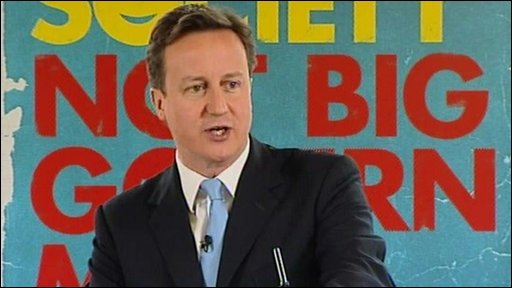
Cameron and his slogan: "Big Society, Not Big Government". Catchy, eh?

Despite this avowed self-denial, however, Cameron and his attack dog, Communities and Local Government Secretary Eric Pickles, are quick to decry any cuts to front-line services that councils feel they have to impose. They call instead for what they term “back-office savings”. This, the latest in a long line of political weasel phrases, is meant to convey a cut that is only painful for local authorities themselves and that somehow mysteriously does not affect the public (that is to say the voter). What this phrase means in practice, of course, is redundancies and pay cuts. These measures, devastating for individuals, are less visible and less likely to bring onto the streets members of the public (as opposed to organised demonstrators like students and union members). They are being demanded of the police, the NHS and the BBC as well as of local councils.

Of course, as I pointed out in a letter published in The Guardian last week, the government has yet to demand “back-office savings” of those banks that are now partly in public ownership or indeed of any other institutions staffed by what used to be called “the Tories’ friends in the City”. Even in middle England, resentment of the kid-gloves treatment of the banks and their greedy employees is detectable. People have wearied of the government being sucker-punched by the banks with their "warnings" that "the best people" will go abroad or that whole businesses will relocate if the managers don't receive shedloads of money. Call their bluff, tell them to fuck off if they'd prefer to live in any other country that will have them (if indeed any other will). Redraw the tax laws so that earnings made in Britain cannot be sheltered in tax havens. Let those who live and work elsewhere but keep a home here and send their kids to schools in Britain pay a big levy for the privilege.

In any case, what about all those scientists whose resarch funding is being cut? Doesn't the government fret about them moving abroad in a new brain drain? What about other important talents and skills: academics, teachers, doctors, nurses, surgeons, law enforcement officers, writers, directors, actors, technicians of all kinds? Why should greedy bankers be the only people Britain wants to keep?

As for local authorities, I advocate that councils play on this restiveness in the Tory heartlands. The government is taking an avowedly partisan line in palming the choice of cuts onto councils while distancing itself from the choices that those councils make. Is there any reason why the councils should not respond in kind – for instance, by withdrawing services (refuse collection, road repairs) specifically from those wards that returned Conservative and Liberal Democrat councillors, on the argument that those residents will be looked after by the Big Society?

Cameron continues to believe that he can distract the electorate from their increasing pain by his talk of creating a Big Society (or his BS as it is widely called in Westminster and Whitehall). Defending the concept in The Observer, Cameron tried to pre-empt his critics: “the first objection [to the Big Society] is that it is too vague” but the rest of his article was unspecified, unargued waffle. For instance, he reckons that “if neighbours want to take over the running of a post office, park or playground, we will help them” but he ignores the obvious objection that there are well-established regulations, drawn up to protect both people and institutions, which cannot simply be “taken over”. Cameron airily says that he’s going to sweep away all those checks and balances that prevent untested people from working with children, a curious stance in the light of his subsequent rant against the Supreme Court.

Stay out of my garden, Maude

Francis Maude, the Minister for the Cabinet Office and another bĆŖte noire of the Tory right, has been obliged by Cameron to speak for the BS concept – it is noticeable that no other cabinet member ever mentions it – and he has been complaining that Labour have been spreading the myth that the BS is just a cover for the cuts. This is pretty rich when you consider how repeatedly (and evidently successfully) the government has put onto the last Labour government the whole blame for what, at the time, we all understood to be a global recession. Now that inflation is the latest statistic to be soaring on his watch, the Chancellor George Osborne announces that it is an “international problem”. How does that work, then?

Ministers need a diversionary tactic because they have begun to comprehend that the cuts will grow steadily more unpopular and that the government that the voters will seek to punish is their own. Blaming Labour will pay diminishing returns. Ministers are now talking in terms of "unpopular but necessary measures" rather than simply "necessary measures". Forecasts of "choppy water" and "difficult months" pop up almost routinely, as if to soften the blows that the government knows it will receive in by- and local elections this year. "We're in for a long haul to get back to normality" Clarke told The Telegraph.

What is so distasteful about this kind of talk is that it is all about the government's own fortunes and nothing about the people's deprivations. "When we get through this." the assumption is, "the nation will thank us". But for people who lose their jobs, their homes, their services, their support, their businesses, maybe their health and in some cases even their lives, there will be no recovery. The damage that the government is doing now will, for many people, be irrevocable.

Wednesday, July 07, 2010

GETTING THE MESSAGE ACROSS

On June 9th, I sent a bunch of policy proposals to the five candidates for leadership of the Labour Party. I declared in my covering letter that "I represent no lobby, faction or interest but myself. I am not even a member of the Party but I have long supported it at the ballot box and I always wish it well". I made brief quotes from each of the candidates' statements reproduced in The Guardian eight days earlier, describing them as "what I call 'Mom-and-apple-pie' politics, full of warm generalities against which no one even mildly small-l liberal could argue" and I asked "are you all interchangeable or just too timid to make concrete, radical proposals that the others might shy from?" I concluded: "The coalition has proposed that we must think the unthinkable. For Labour to be outflanked in imagination and boldness would be nothing short of a tragedy. I hope my contribution is useful and will be taken in the spirit in which it is offered".

Only the office of David Miliband has so far responded to the document, in warm generalised terms. Not a peep from any of the others but we live in an age when the elementary courtesy of an acknowledgment of receipt is no longer thought necessary, even though email avoids the trouble of signing, putting into an envelope and posting such an acknowledgment. Following an excellent article by the former Labour MP Tony Wright in The Guardian last Wednesday, I have also sent him a copy. Dr Wright is now based at the Institute of Public Policy Research, the function of which is to do left-of-centre thinking.

For the record, I post my proposals below. Some of these notions will be familiar to the more devoted of my readers and of them I beg their indulgence.

POLICY PROPOSALS for LABOUR

I am 63. In only the first four years of my life has there been a Labour government that made a fundamental and lasting difference to the life of the nation. Subsequent Labour governments have certainly made contributions to the lives of various groupings, but almost entirely in the realm of social policy. And none of these achievements – the Open University, say, or civil partnerships – is unthinkable under a relatively enlightened Tory government. What is more, many of the most far-reaching measures – reform of the divorce and abortion laws and abolition of the death penalty, for instance – have only succeeded by the stamina and determination of backbenchers introducing Private Members’ Bills.

Both Clement Attlee and Harold Wilson invoked Lenin’s phrase about the need to take over “the commanding heights of the economy”. Attlee achieved more by that measure than did Wilson. Some 18 months ago, when the Brown government began to take significant stakes in high street banks, I dared to think that this dream might come to pass after all. But the imperturbable city easily frightens ministers with its patently empty but apparently convincing talk of the need to remain independent, just as with its sophistry about attracting “the best”. Someone who will only work for a salary to which is attached a seven-figure bonus is not interested in service, only in self-service. Personal greed is not some kind of measure of financial acumen. In any case, under a global financial crisis, how can any self-important trader be sure that there are jobs elsewhere ripe for the picking? The city plays many bluffs that need to be given short shrift.

When it is being “pragmatic” – a favourite term of Wilson’s that has been taken up by Cameron (and John McDonnell and Andy Burnham) – Labour risks offering merely a less economically competent alternative, to which voters turn when the Tories are exhausted and corrupt (1964, 1997). But Labour must present itself as creative, energetic and fearless. Just before the last televised debate, I wrote to Gordon Brown, recalling the catalogue of Labour’s achievements that he presented to conference a year or two ago; it brought the hall to its feet. I urged him to rerun the list in his television peroration. I still argue that Labour needs to think positively about what it has done; but even more so about what more it must do.

The following proposals are radical. Many of them will of course have been discussed at policy meetings but few if any of them have, I think, been advocated publicly by frontbenchers. But all the leadership candidates have spoken of the need for the party to listen so I hope some practical, imaginative suggestions will not come amiss.

Bring public transport back into public ownership and make it free

Transport accounts for a greater proportion of expenditure for the poorest in society than for the richest: since 1997, bus and coach fares have risen 24 percent above inflation, whereas overall motoring costs have fallen 14 percent in real terms. Public transport accounts for far less pollution than does private. Road building destroys more valuable land than does rail extension. For all these reasons, a properly integrated transport policy requires that the bus, coach and tram network, the underground system and the railways be brought back together under public ownership and run for service rather than for profit. Then all public road, underground and rail travel should be free to all at the point of delivery, not merely for over-60s. There would be a major saving in infrastructure and staffing in the removal of the ticketing operation. Redundancies may be offset by the expansion of services (including through the night) and the commensurate recruitment of more drivers. More security and information staff would be appropriate too. On the railways, the ending of first class tickets could be cushioned by the provision of more “quiet carriages”, from which under-18s, mobile phones, personal sound systems and alcohol would be banned. More staff would be necessary to enforce such regulations.

Once there is a free public transport system, measures can be put in place to encourage the public to use it rather than to rely on their own cars, on taxis and, within the UK, on air travel. Road tolls must be introduced, graded according to the number of occupants of each car, so that car-pooling is strongly encouraged. Many more routes through unsuitable areas should be denied to all but public transport and essential business. Surcharges on vehicular fuels could favour commercial vehicles over private and much more strongly advantage unleaded petrol. A judicious combination of tax advantages and cost grading could offer incentives to companies to favour rail freight over road haulage; perhaps in time freight too could travel gratis on the railways, thereby encouraging firms to relocate close to the rail network and disused lines, stations and depots to be reactivated. Naturally, specific tasks and needs delivered by road vehicles would be exempted (GPs, emergency services).

There would be long-term savings in the reduction of, inter alia, wasteful traffic jams, the dominance of carbon-emitting vehicles, the undermining of buildings and the continuing need for roadworks and expansion. Fewer people would be killed or maimed in road accidents too. The public may well rebel at the notion of “the driver being penalised again” but government needs to be strong enough to lead a change in the culture.

Bring the utilities back into public ownership

I am far from being alone in decrying the conduct of the enterprises that have taken over the utilities, the ownership of many of which is now in the hands of foreign companies and shareholders who have no concern for British consumers. It is a nonsense that, for instance, the “big six” power companies can act as a cartel; that water in Scotland is administered by Thames Water; that British Gas perpetually harass us to accept them as our electricity supplier when so many improvements could be made in their service of gas; that BT cannot attend to network faults for its own customers until the time has elapsed (by Ofcom fiat) that it notionally takes to see to such a repair for the customer of a rival company.

In practice, many utility companies enjoy a practical monopoly in the areas where they operate and their charges relate not so much to market forces as to the often fanciful claims that they make for their commitment to modernisation and the safeguarding of resources. But what consumers most fervently deplore is the colossal greed that these companies betray in their scales of charges. The most recent quarterly gas bill for our four-bedroom house is above £825. All the utilities are gratuitously overpriced and these prices of course hit the poorest disproportionately.

The last Labour government wanted to propel the Royal Mail into the same culture of profit-before-service, and very unpopular the proposal was too, particularly because the efforts to stem the service’s losses have already greatly reduced the quality of its performance. Moreover, the departing CEO, head-hunted for an even more lucrative post at ITV, has been allowed to plunder Royal Mail to the tune of £3.5million as his “golden handshake”. Now the coalition government plans to execute the part-privatisation policy. When the Tories first split off the telephone system from the Post Office, they neglected the fact – or most likely didn’t even know – that the only reliable, unvandalised public phone boxes (this was long before the spread of mobiles) were those to be found in post offices. And these boxes were all promptly ripped out. The great practical virtue of public ownership is that it permits of integrated systems.

Government need not be fearful of the resistance that companies would offer to take over. Labour has long experience of nationalising private industry. Shareholders are routinely advised that the value of their investments may go down as well as up and the losses that stakeholders in utilities will claim to have sustained by what they denounce as a “state grab” will be as nothing compared to the value wiped off shares during the downturn over recent months. The public can only gain by the public ownership of the public utilities.

Overhaul the criminal justice system

If the courts stopped committing those convicted of non-violent crime to prison, there would be no need for capital expenditure on new gaols. Financial crimes could be countered by punitive financial penalties over a commensurate number of years (those convicted would have their finances regularly audited by court-appointed accountants and would be obliged to lead a palpably circumscribed life). Other white-collar crime, burglary and petty offences could be penalised by rigorous regimes of community service. It serves no purpose to incarcerate the likes of Jonathan Aitken, Jeffrey Archer, the royal correspondent of the News of the World or people who have failed to pay their television licences. Prisons too often act as universities of crime, dispatching their “graduates” better able to break the law than when they arrived. A programme of emptying gaols of prisoners who constitute no danger to the public ought to be drawn up within days of coming to power.

There should be a new test imposed by the courts on all those found guilty of violent or coercive crime: is this convicted individual objectively a danger to the public? If the court finds this to be the case, the presumption should be that the offender, whatever his or her age at the time of conviction, will be detained at Her Majesty’s pleasure until past the age of 60. The concept of parole would be abolished. Incarceration should be reserved for those so convicted by the court. This way society benefits from – rather than paying the keep of – supervised restitution from all but its most recalcitrant and antisocial transgressors.

At the introduction of this new test, it could be made clear that the carrying of an offensive weapon would be a strong factor in determining whether an individual were deemed a danger to the public. A couple of exemplary convictions of 17 year-olds for a minimum of 43 years, allied to a wide and sensitively handled weapons amnesty, ought to have a profound effect on the safety of the streets and the gang culture in British cities. It follows that some crimes, even though clearly serious, would not necessarily carry the additional judgment of the perpetrator being a danger to the public – a crime passionnel, for instance – but rapists, child molesters, muggers who use violent assault, armed robbers, large-scale drug dealers and indeed dangerous and drunken drivers would be subject to this test. There ought also to be a presumption that any driver found guilty of killing or maiming or even endangering members of the public while in charge of a vehicle would at least be banned from driving for the rest of his or her life, whatever the impact on that person’s means of earning an income. This is another cultural change that a government ought to be strong enough to lead.

There are many different kinds of pollution that require to be tackled through government regulation

There will always be vested interests and cranks who refute climate change – the Holocaust-deniers of a “final solution” that threatens the planet’s very survival – but most political leaders across the world do recognise the peril in which we have placed ourselves. Whether there is the political will sufficiently to address the challenge is another matter. International capital is notoriously protective of its own short-term interests and will fight viciously to eschew what it deems burdens and restraints imposed on behalf of prospects and populations that do not register on its balance sheets. The efforts to turn the tide of global destruction depend largely on the governments of China, Russia, India, the United States and Latin America but European nations can certainly lead by example.

Environmental damage is too readily committed and too lightly dismissed. The law in Britain should be changed so that where, for instance, waterways are impaired or cancer clusters are found in the population, the onus will fall on the enterprises accused of responsibility to prove that their own systems and tests are such that they can only be blameless. The possibility of being found guilty by default will oblige all organisations whose activities might conceivably leach toxins into the environment critically to review their preventative measures.

There are other sorts of pollution that require imaginative government intervention and regulation. The intrusion of noise and light, not only in built-up areas, is growing unchecked. The physical and mental health of countless individuals is undermined in subtle and profound ways by the increasing inability to enjoy darkness and quiet. Two false gods are given precedence here: the god of personal freedom, who demands that we must be allowed to impose our noise on others; and the god of security who must be appeased by the driving out of dark places. In each case, personal freedom and security is paradoxically reduced because the health (and therefore the freedom and security) of the victim is undermined.

Another pollutant is advertising (including the disguised promotion that is excessive packaging). The intrusion of marketing onto every possible platform has a long-term impact on the population, especially the young who are taught to believe that telling the world how flawlessly fabulous you are is the route to success and that only by conducting yourself as the modern equivalent of a sandwich-board man can you achieve anything. By its nature, advertising promotes both excess and blind acceptance, two psychologies of dangerous exploitability. Government should intervene.

Significantly increase duty on items that damage public health and ring-fence the income for the NHS

Whenever governments attempt to intervene in private activities that have a deleterious effect on those who pursue them (and, though this is routinely ignored in the argument, on others too), people complain about “the nanny state”. Oddly enough, the same people scamper to nanny NHS when they begin to suffer the diseases caused by smoking, drinking, obesity and so on. This point might usefully be made more often.

Recurrent proposals for price controls and consumption restrictions, advertising and sponsorship bans and other such measures (ones that also punish responsible consumption and adversely affect enterprises that are innocent third parties) are always fiercely fended off by vested interests. Rather than fixing a minimum price for alcohol, a simpler measure would be to revoke the licences of all supermarkets and non-specialist chains to sell alcohol and indeed smoking materials. This would also be a useful counter-balance to the over-mighty supermarkets that have driven so many off-licences, pubs and newsagent/tobacconists out of business. Many young people find an off-licence a rather more daunting outlet than a corner Costcutter with its discounted plonk and strong beers.

Then a Labour Chancellor might impose new, swingeing duties on smoking materials and alcohol that are strictly and accountably ring-fenced for payment direct to the NHS, so that smokers and drinkers may know that they are contributing towards the treatment that they will themselves require. A similar imposition might be made on processed foods, using a sliding scale dictated by objective nutritional assessments, with more stringent tests and surcharges imposed on catering supplies, the contents of which are not (but could be and should be) vouchsafed to consumers. If that works well, all foodstuffs that cannot demonstrate that they are organic might subsequently be surcharged in the same way. Food producers will have an incentive to put themselves in a position where they can demonstrate the healthy nature of their ingredients and processes. This is taxation as organic carrot rather than as resented stick.

Then government should introduce punitive surcharges on those whose drunken behaviour necessitates the calling out of emergency services. Specific spot charges for the handling of incidents need not be the thin end of a wedge of general charging for police and/or paramedic services; rather, voters generally would welcome knowing that they are not having to pay for the clearing up after anti-social indulgence in town centres. This would be a targeted surcharge that would also win a lot of votes.

Ensure an equitable system of income tax

It is a puzzlement that, over the last thirteen years in power, Labour never managed to close the many loopholes in the taxation system that allow those who can afford smart accountants to avoid paying their dues. Tax avoidance is a major industry in Britain but it should not be beyond the wit of either Treasury or HMRC number-crunchers to scale it down significantly, if not eradicate it altogether.

Meanwhile, the issue of “nom doms” has greatly exercised politicians and commentators on all sides. The question of whether someone who lives abroad for tax purposes should enjoy status privileges in Britain is, to my mind, an irrelevant and misleading question. Where someone designates her or his principal residence is far too manipulable a matter. After all, the proprietor of The Daily Mail lives to all intents and purposes in Wiltshire but, by some sleight of hand, pays tax as a resident of Paris at a much more favourable rate than do run-of-the-mill Wiltshire multi-millionaires. Those who bear the onerous task of owning The Daily Telegraph from their tax exile in Monaco must laugh to scorn the fainthearted level of graft in the Westminster village, that has been so comprehensively uncovered by their organ. Moat-cleaning indeed! Why not acquire a Channel Island? That’s a vastly more cost-effective scam.

The problem of nom doms is readily solved. Income should be taxed not on the basis of where the earner lives but where the income is earned. Better yet, follow the practice of the IRS in the United States: tax without reference to either the location of the earner’s domicile or the country of the income’s origin. To avoid taxation, Americans have to renounce their US citizenship and even after that their US income is taxed on the same basis as that of a guest worker. If Americans can live with such a system, Brits sure as hell can too.

No doubt there would be a degree of departure from these shores among those unwilling to submit to contributing an appropriate proportion of their wealth to public provision. Such people merit a one-word response: “Goodbye”. If, to continue owning several mansions and a private jet, they are obliged to be based in a country where, beyond their gated communities, they are surrounded by abject poverty, that is for their consciences to reconcile. But it is a self-serving myth that our industries cannot survive without greedy, grasping individuals. They can and will survive (the BBC will go on after Jonathan Ross, for instance) because there are always people who are thoughtful as well as talented, who want work that is stimulating first and lucrative only as may be, and who will choose to stay in a decent society that diligently cares for all its members.

Revivify manufacturing

Britain’s manufacturing base was destroyed by Margaret Thatcher: everybody knows that. But Jim Callaghan’s Selective Employment Tax, if not starting the rot, certainly helped it on its way. This was a piece of government intervention in business that calculatedly favoured service over smokestack industries. The result is that financial arrangements are sold, planners are advised and shelves are stacked in Britain, but things – machines, materials, objects – are made in eastern Europe and the Far East. People still think of factories, plants and workshops as providing “real” jobs, and offices, shops and call centres as nothing to inspire pride in work and job satisfaction. Tangible products bear powerful magic.

David Cameron talks airily about Britain being a “broken society” without looking hard for the origins of this breakdown. Job security – in service industries as well as in manufacturing – died under Thatcher. The taking-over, asset-stripping, franchising, Friedmannite free-for-all of those days ensured that no brand can be relied on any longer or can even be understood to mean what it seems to mean, even outside of manufacturing (for Coutts read RBS; for Selfridge’s read Weston; for Manchester United read Yankee fraudsters). Fifty-five years of covetousness-inspiring advertising (“it takes the waiting out of wanting”) pumped directly into people’s homes, as decreed by Churchill’s 1950s government, has had a profound effect on the public’s sense of entitlement. If you undermine people’s sense of who they are and then encourage them to think they’re somebody else, it’s little wonder that they start to get narky.

With a judicious combination of investment and incentive, government can begin a revival of manufacturing that would recreate a true sense of community wherever it is located. Tax breaks for firms that do not outsource to countries where labour is grossly underpaid would help to rekindle domestic output. Britain used to glory in a skilled workforce and could do so again. New demand for apprenticeships would keep young people out of the clutches of both the gang and the cheap booze cultures. Almost a million now registered as out of work are aged between 16 and 24; almost half of the black people in that demographic are unemployed. Nick Clegg was “lost for words” according to the Birmingham student who confronted him on youth unemployment during the election campaign.

Clearly Britain can never again be “the workshop of the world” but she has no need to be a parasite, the eternal middleman whose only contribution to trade is to add to its cost. As international capital shows so little interest in investing in British skills, government will have to take on the task. But we shall need to start by bringing on the skills in the first place.

The promise of “education, education, education” must be fulfilled

Jonathan Swift (wise in all things) originated the notion that “parents are last of all others to be trusted with the education of their own children” [Gulliver’s Travels chap VI]. It is a Tory mantra that parents alone ought to decide what education is available for their children; Labour should set its face against such a nostrum.

Education is not a branch of business and its nature must not be determined by the (imagined) demands of the market. Nor should private capital be allowed to penetrate any deeper into schools and universities than at present. But equally education needs to be freed of the growing infrastructure of quotas and league tables. These yardsticks are far too reductive. Teaching is an art, not a science, and does not lend itself to mechanistic measures. Politicians need to be willing to trust teachers and head teachers; they will certainly be rewarded by perceptible advances in the overall quality of the school system.

The thrust of education is to widen the horizons of pupils, to present them with the rich variety of society, culture, history and intellectual enquiry and to encourage them to ask questions. Supernatural superstition, by contrast, seeks to confine minds to narrow paths, to prescribe a fixed Weltanschauung and to proscribe alternative views, to require unquestioning fealty. Accordingly, the very notion of “faith schools” (a contradiction in terms) ought to be banished from the Labour lexicon. Any teaching that smacks of indoctrination should be disallowed in all publicly funded education establishments.

Centres of study outside the state system need to be closely monitored too. The unfolding revelations about child abuse in the Catholic church give government an opportunity to impose more rigorous vigilance on convent schools and seminaries, including a requirement that such institutions introduce their pupils to wider supernatural notions and, more important, to rational, science-based readings of history, nature and psychology. For the security of the indigenous population, Islam must not be permitted to build a network of madrasahs here (or indeed to shape a foothold for Sharia law). The presumption ought to be that the education system is wedded to the dissemination of factually-based knowledge and formally neutral on matters of interpretation. To those who claim angrily that “this is a Christian country”, the present Archbishop of Canterbury’s calm adumbration of a separation of church and state [New Statesman interview, December 22nd 2008] may be pointed out.

Create an environment in which people do not need to feel that incomers of any kind get preferential treatment

The general election of 2001 was the first in which I did not vote Labour (I only returned to the colours this year when it seemed really necessary). There were two reasons for this disaffection; I will come to the second in due course. The first concerned the immigration policies being pursued by the Blair government that, poorly represented as they clearly were by ministers, appeared to be imposing cruel restrictions on asylum seekers. As the sitting MP in the constituency where I then voted happened to be the immigration minister, it suited my purpose to register a protest. I am pleased to record that the swing from Labour to the Liberal Democrats in that seat in 2001 was exceeded only in the constituency of the then Lib Dem leader, Charles Kennedy, and proud that the reaction in the area was strongly to liberalism rather than to racism. After I had moved out of the constituency, the Lib Dems took the seat in 2005 and retained it this year. (Labour’s majority in 1997 had exceeded 20,000).

Seasoned politicians know that how things look is at least as important in politics as how they are (something apt to be forgotten when MPs try to fend off scandal: for instance, the long-running expenses saga and the Lord Levy/“cash for honours” debacle). While it is a relief that support for the BNP appears to be in retreat across the country, the widespread fear of immigration, however unjustified that fear may be, needs to be recognised and addressed. Politicians have a duty to pursue measures that may not be taken to legitimate xenophobia or racism. How policy in this area is presented – how it looks – is quite as critical as what it is.

It would be reasonable to impose upon local authorities the obligation to pursue policies concerning housing and other benefits that favour citizens who can demonstrate that they have local roots. Where people imagine that (im)migrant workers are permitted to “jump the queue”, there is resentment that can turn ugly. The criteria to be used would speak to history and longevity and their use would have the added effect of encouraging incomers to seek legitimacy.

Ed Balls is clearly right to seek a Europe-wide solution to these issues. Little in recent times has been more perplexing than the phenomenon of the refugee encampment at Sangatte, Pas-de-Calais. Why did so many asylum-seekers, having already reached the security and stable job-market of France, yet risk life, limb and arrest by attempting to cross to Britain? Why was European policy not sufficiently co-ordinated for this shaming spectacle to be unnecessary?

If British policy towards economic refugees and asylum seekers differs significantly from that of other EU member states, it is proper for Britain to take up the matter. The free movement of workers within the EU clearly needs to be revisited. In an era when, for instance, British university students have been and are being impoverished by the system of loans, it is cruel to deprive them of the traditional supplementary jobs in bars and restaurants by allowing those jobs to be taken by incomers from the new member states.

That Turkey is a Muslim country is not the only reason to oppose her membership of the European Union – although it is a sound one: Islam is highly inimical to many strands of tolerance that have been hard won across Europe since World War II. But Turkish membership will bring a whole new influx of migrant workers into western Europe with all the potential for localised racial tensions that such a change will surely bring.

Successive British governments’ attitude to Europe has been highly equivocal and has prompted the electoral scepticism that it deserved. Labour ministers contrived to fight the European parliamentary elections of 2009 almost entirely without mention of Europe or its parliament. Labour was rewarded with a third place behind UKIP, with strongly pro-EU Lib Dems fourth. The arguments made by interests that oppose European membership are patently meretricious and will bear no serious economic challenge. But these arguments are rarely engaged by EU apologists, who appear to take the view that they know best and hence that the electorate should not worry its pretty little head. From Edward Heath and Roy Jenkins on, advocates of the European Union have rarely deigned actually to make the case to the electorate. It is true that the British media carry minimal coverage of European affairs. That is not an excuse for European enthusiasts to allow scepticism to take root among the public by default.

Rather than as English, I see myself as a citizen of the world. Not many do so; certainly no politicians that I can name off-hand. (Michael Howard’s Tory Party fought a European election with the designation “The Conservative Party, putting Britain first” on the ballot paper. What does it mean?) The day will come, in this marketing age, when the declaration “I love this country” will be deemed a sufficient platform from which to seek office, as it certainly is in the US (viz John Edwards). After all, we live in a time when some British politicians imagine that an undertaking to “take” an issue “forward” amounts to a statement of policy. Of all politicians, Labour ones should be ready both to talk and to listen to the electorate as to adults, acknowledging the voters’ keen concerns but taking the time to try to ameliorate them and to put them into context. Pace Margaret Thatcher, we are not about to be swamped. We should say so.

We must significantly reduce our armaments and disengage from international military adventuring

The abiding reason why, for the first time, I did not vote Labour in 2001 was that Mr Blair had by that date already taken this nation to war on more occasions than any other leader in history, monarch or minister, and his incursion into Afghanistan and his second into Iraq were then still in the future. I had not enthusiastically voted Labour in 1997 in order to offer a blank cheque for death and destruction.

Whatever one’s moral stance, no activity is remotely as extravagant as waging war. The cost of materiel dwarfs the equipping of any other enterprise and we know well enough that the generals are never satisfied with what they are given. We need those resources to fund the other policies put forward in these pages. Moreover, no activity inflicts more damage, both immediate and lasting, on the planet. So indeed does the absurdly expensive training for war (as anyone knows who lives under RAF flight paths). And the numberless war casualties are largely innocent bystanders with no means to protect their homes or to find refuge.

Troops sent to the frontline, whom it is sacrilege ever to criticise, are routinely brutalised and commit atrocities they never imagined before joining up. We are righteous in condemning the cavalier behaviour of the troops of other nations – those of Israel most lately – but will concede no ground to critics of our own and permit the military (and the police) to continue to act as judge and jury on their own catastrophes (think of Deepcut Barracks). Yet, to our age-old shame, successive governments treat those who return maimed from action in a pitifully shabby fashion, and this has been a stain on our society for centuries, as Kipling testified.

What is the argument in support of our continuing to act as a moral police force, strutting around the globe and breaching the sovereignty of other nations with our interventions, invasions and attempts at “regime-change”? It is proposed that this somehow guarantees our own security. But it is no coincidence that Islamist terrorist attacks have occurred in New York and Washington, Madrid and London, rather than Bern, Oslo, Tokyo or Wellington. Aggression abroad and vulnerability at home are in a chicken-and-egg relationship. Who can seriously doubt that our continued presence in Afghanistan acts as recruiting sergeant for the Taliban? These guerrillas see themselves as freedom fighters, much as did the resistance to Hitler in Europe in World War Two, and in the same way they attack through the ambush, the crude bomb and the sniper. We condemn in our enemy what we applaud and memorialise in our ally.

Unable to learn from experience, we continue to plunge into unwinnable wars that armchair generals assure us will be over in a fortnight. We are soon mired in gore from which we can contrive no withdrawal acceptable to our own amour propre. The elegant and shrewd diplomat Prince El Hassan bin Talal of Jordan likes to quote this saying: “The gentle art of saving face/May yet destroy the human race”. So we are told the Gaza blockade must continue or Hamas will “claim victory”. So what if they do?

Why does Britain remain in the Nuclear Club? Like everyone else, we call our nuclear capacity “defence”. Realistically, Britain is so strategically situated that it is unthinkable for either Europe or the United States to allow us to be seriously threatened. In the European Union, only France also possesses nuclear capacity. Germany’s key role in international affairs does not appear to be diminished by her lack of a nuclear profile. Two independent nations physically straddled by the US – Canada with Alaska to her north, and Mexico with Hawaii to her west – co-exist without being required by Washington to go nuclear. Insofar as Britain might be a target for nations developing nuclear weapons, her own nuclear capacity may just as readily be ascribed as a pretext or as a deterrent. Our oldest and closest ally is, after all, the only nation ever to deploy nuclear weapons against another country. Possession does not preclude first use.

Britain could take herself out of the nuclear equation. Further, she could lead a decisive initiative for global peace. She could forego her UN veto and membership of the Security Council, at the same time urging the other members to follow suit. She could propose a major rewrite of the UN charter, which remains almost exactly as written in 1945. The only way to give the UN actual power would be to ensure that no nation has greater power than the UN itself. The UN should be enabled to order the immediate cessation of hostilities between member states and to suspend any member state that pursues hostilities. Other members, including those sympathetic to any rogue state’s cause, must be impelled by charter to suspend all trade dealings with the suspended member. The UN must have the resources to assume control of negotiations between parties. If both sides are taken out of benefit of membership, the issue of “blame” becomes futile and UN negotiators begin with a level playing field. But waging war must be against the UN’s bedrock principles and in practice a gambit that is made impracticable because each of the warring nations thereby becomes an international pariah and is accordingly hard pressed.

No one suggests that such a scheme would be an easy sell: to the Chinese, to the Americans, to the Russians or indeed to the British electorate. But what is the point of political power if not to aim for the impossible and to change the world?

[Since I wrote this section of the document, Simon Jenkins has argued that the entire defence budget is unjustifiable and that the armed services should be wholly and immediately wound up (The Guardian June 9th). Taken together, his argument and mine make a powerful case but, given the nature of its core vote, the Tory government is never going to carry out such a policy. Labour can and must].

Labour needs to rediscover its core values

The abandonment of Clause IV by Tony Blair in 1995 was the central plank of what was characterised as “New Labour” and, it was argued, would make Labour more acceptable to the electorate. What it really achieved, of course, was to make Labour more acceptable to international capital (personified in the man whom Mr Blair seemed to believe was the key to his success, Rupert Murdoch). International capital is itself less acceptable to the electorate than it was fifteen years ago. It is widely perceived to be responsible for the despoliation of the planet, the exploitation of wars and the impoverishment of many countries particularly on the African continent, along with the destruction of small businesses and the standardisation of shopping areas, the plundering of football clubs and the corruption of all professional sports, the quality reduction of broadcasting (especially in Britain) and the constant bombardment of advertising and promotion.

That successive Labour governments have made no discernible impact on the redistribution of wealth raises the embarrassing question of what the Labour Party is for. Not just to fend off the temporary effect of a recession, surely. Had I been a government minister, I would have tendered my resignation when Gordon Brown and Alistair Darling did not make agreed levels of pay restraint a basic condition of the bank bail-outs that they offered on the tax payers’ behalf.

Since Cameron became Tory leader, there have been many occasions when Labour dismayingly seemed the most right-wing grouping in parliament. Labour ought not to favour cutting into the culture of benefits. It always used to be that the left supported benefits even when some people received them who didn’t need them and the right supported cuts in benefits even for people who could not manage without them: it was a key test by which one told the left from the right. But that distinction has become blurred in both directions. New Labour has grown more prepared to let deprived people swing in the wind and the Tories have become more anxious at least to give lip service to the welfare state (this conversion will be sorely tested over the coming months). But in Labour philosophy, it ought to be better that we risk losing the supposed talent of asset strippers and financial speculators than that we starve a whole class of people that might generate all sorts of talent.

A sure test of a government’s instincts is the stance of the Home Secretary. How disturbing it is that so many of the most reactionary holders of this office have been Labour: Sir Frank Soskice, Merlyn Rees, David Blunkett, Charles Clarke, John Reid and, in most unexpected ways, Alan Johnson.

It is simplistic to argue that, insofar as we surrender our liberties, the enemies of the state have won. but there is more than a germ of truth there and it needs to inform all measures proposed and taken. The policy of introducing ID cards was one that greatly damaged Labour’s reputation. Apart from all the civil liberty objections, there was the obvious danger that some future government would see a source of revenue in offering for sale the information gleaned through these cards, not to mention the sorry record of government agencies in protecting confidential data.

Dismantling much of the surveillance state ought to be on Labour’s agenda too. Britain’s infrastructure of surveillance is, as so often noted, the most extensive in the world, yet so many recent cases have shown that the surveillance simply doesn’t work. Whether it is Britain’s tradition of a chronic lack of maintenance skills or the public’s slyness in avoiding being seen while at nefarious activities, the investment is clearly not worth it.

Labour will not quickly recover the trust of the electorate until it clarifies the distinctions between itself and the Tories. If it appears to cosy up to big business more readily than it requires big business to make sacrifices for the benefit of all, it will merely be fighting the Tories for rich donors and a small sector of the electorate. If it is not prepared to take bold steps in order to redistribute wealth and power, it will only be able to offer itself as a differently able version of the Con-Dem coalition. The voters will be more likely to settle for the cabinet of millionaires that they already have than a bunch of half-hearted free-marketeers.

Saturday, September 19, 2009

The ROAD to RECOVERY

The political parties are now competing to look for ways to render more palatable the raising of taxes and the lowering of public spending. Here are some suggestions.

1) Slap a considerable tax hike on alcohol and smoking materials but ring-fence it entirely for the NHS. The tax can be presented as a charge for the “nanny-state” treatment drinkers and smokers will need from the health service in the future. Such targeted taxation is both socially constructive and morally defensible – and rather more effective than the British Medical Association’s advocacy of a ban on advertising and sponsorship. It puts the onus back on the individual to take responsibility for his behaviour. A further range of surcharges might be imposed on fast foods, on food packaging and, eventually, on all processed and perhaps even non-organic foods. Food producers will have an incentive to put themselves in a position where they can demonstrate the healthy nature of their ingredients and processes. This is taxation as organic carrot rather than as resented stick.

2) The government should introduce punitive charges against those whose drunken behaviour necessitates the calling out of emergency services. Specific spot charges for the handling of incidents need not be the thin end of a wedge of general charging for police and/or paramedic services; indeed, voters generally would welcome knowing that they are not having to pay for the clearing up after anti-social indulgence in town centres. This would be a targeted surcharge that would also win a lot of votes.

3) If the courts stopped committing those convicted of non-violent crime to prison, there would be no need for capital expenditure on new gaols. Financial crimes could be countered with swingeing financial penalties over a commensurate number of years (those convicted would have their finances regularly audited by court-appointed accountants). Other white-collar crime, burglary and petty offences could be penalised by rigorous regimes of community service. Incarceration would be reserved for those who are found by the courts to constitute a danger to the public. This way society benefits from – rather than paying the keep of – the supervision of all but its most recalcitrant and antisocial transgressors.

4) Announce an imminent date for the withdrawal of troops from Afghanistan. This would be a popular change of policy. That our occupation of parts of another sovereign state keeps our streets safe from terrorists is a theory, not a fact. Many of us argue that our presence in Islamic countries rather recruits terrorists with a grudge against Britain: “don’t mess with the Moslems” as last week’s convicted would-be airline bomber declared on his suicide video. Nations that do not take it upon themselves to police the world do not, by and large, have a problem with terrorists. But here’s the clincher: we simply can’t afford this monstrous expense. Let the UN take on the task of making the world safe. That’s what it’s for.

5) Then begin scaling down our entire military capacity, starting with Trident. Britain’s present status in the world does not require us to remain armed to the teeth. Maintaining nuclear capacity and a military strength that invites our presence in every international conflict is colossally expensive. We have far greater need for renewed infrastructure, libraries, schools and university places that do not impoverish those that win them. That is what the electorate wants.

6) Bring in a new top tax level of 100 percent for all those remunerated (including supposed bonuses and share options) to the tune of £1million or more per year. In a recession or even not in a recession, nobody has need of more than £1million per year. “Oh,” the city will squeal, “but there will be a haemorrhage of talent to other countries”. To which I have a one-word reply: “Goodbye”. There might be some departures among those who are more interested in raking in the shekels than finding job satisfaction. But frankly the rest of the world is not so short of talent of its own that it would come recruiting here in significant numbers. In any case, few of the city fat cats have demonstrated much in the way of talent in recent years. What the public justly resents is that these titans of business get paid bonuses that make you clench your arse-cheeks even when their businesses are tumbling down the lavatory pan. Had I been a government minister, I would have tendered my resignation because Gordon Brown and Alistair Darling did not make agreed levels of pay restraint a condition of the bank bail-outs that they offered on the tax payers’ behalf.

7) Scrapping the ID cards is a no-brainer and it seems certain to happen whichever party forms the next government. Dismantling much of the surveillance state ought to be on the agenda too. Britain’s infrastructure of surveillance is, as so often noted, the most extensive in the world, yet so many recent cases have shown that the surveillance simply doesn’t work. Whether it is Britain’s tradition of a chronic lack of maintenance skills or the public’s slyness in avoiding being seen while at nefarious activities, the investment is clearly not worth it.

8) I do not favour cutting into the culture of benefits. It always used to be that the left supported benefits even when some people received them who didn’t need them and the right supported cuts in benefits even for people who could not manage without them. But that distinction has become blurred in both directions. New Labour is more ready to let deprived people swing in the wind and the Tories are more anxious at least to give lip service to the welfare state. Better that we risk losing the supposed talent of asset strippers and financial speculators than that we starve a whole class of people that might generate all sorts of talent.

The Chancellor warns of hard choices. These are easy ones.