The POLITICS of TRUTH
From the audience at BBC1’s Question Time the other week, a man in a Max Miller jacket delivered himself of the opinion that “I look at people talking sometimes and I know that they’re lying, right? You can see that they’re lying. And talk about pulling the wool over your eyes, they try to do it. I’m glad I came here today to say that, because when I watch it on telly it’s like a film, d’you know what I mean? It’s not real. But I’m just saying – people want to be more truthful. If not, bring out lie detectors, d’you know what I mean?”
This barely coherent sentiment elicited a low rumble of approval in the hall, but none of the parliamentarians on the panel – Sir Menzies Campbell, Iain Duncan Smith and Harriet Harman – rose to the challenge, though they must have assumed, as I did, that this was the self-consciously sober version of the pub sentiment: “these politicians, they’re all fackin’ liars, d’you know what I mean?”
No doubt in his own dealings, Max Miller Man is veracity personified. But his aperçu is one that many evidently recognise; or rather, one that many lazily embrace, because politicians are easy targets and scoring points off aunt sallies is a national sport. Ever since the 1950s, when television put public figures into our homes on a regular basis, the deference shown by previous generations to the elites – of class, power, wealth, achievement, fame, intellect – has melted away. Now, anyone who tiptoes into, strides into or is thrust into the limelight is riding for a fall from the off.
It’s flying in the face of fashion, conventional wisdom and even perhaps common sense, but I want to suggest that politicians as a class are poorly served by the commentariat and the court of public opinion. Of course I disagree politically with practically all of them, there being very few parliamentarians, now or in history, holding, voicing and maintaining genuinely radical and progressive views. If a chap sees the world in a way diametrically opposed to how I see it, then naturally it follows that he is a cad, a shyster or a fool. But MPs as a breed are not significantly less honourable, scrupulous or altruistic than, say, postal workers, composers, solicitors, cricketers, interior decorators, farmers, travel agents, firefighters or bookies; and rather more so, I venture, than journalists and press barons.
Inextricably mingled with that falling away of deference has been the ever-increasing scrutiny inflicted by the media on the minutiae of day-to-day – even minute-to-minute – politics. Tony Blair’s nose hair, Gordon Brown’s fingernails, David Cameron’s incipient bald patch, nothing is too insignificant or too personal to escape the discourtesy of commentators. There is an unarticulated consensus that every politician has the hide of a perissodactyl and hence cannot be embarrassed, crushed or wounded, however presumptuous or disobliging the assault.
Of course, compared with actually being a politician, the likes of Quentin Letts, Andrew Rawnsley, Richard Littlejohn, Will Self and Simon Hoggart have a laughably undemanding function, tossing off a few hundred words of scorn and prejudice every few days. Any jerk can stand on the sidelines and jeer, as we see every week on Have I Got News for You?. Stanley Baldwin’s famous rejoinder, supplied by his cousin Rudyard Kipling, ought to have killed off for ever the readiness of newspapers to carry political comment: “What the proprietorship of these papers is aiming at is power, and power without responsibility – the prerogative of the harlot through the ages”. Eighty-one years later, the paper tarts are still there.
Consider the chasm between the accountability of political diarists and columnists and that of MPs. If Melanie Phillips’ latest passionately held conviction is totally at odds with what she wrote ten years ago, who cares? But politicians are expected to square the circle about every issue every day and woe betide any minister rash enough to suggest that he might have modulated his thinking, or that differing contexts might require nuanced responses. The coalition is on a hiding to nothing just at present because there has been some tinkering with policy detail. Their party opponents, naturally enough, cry “U-turn” but so does everyone else. Yet if ministers didn’t trim out tax and other adjustments that look more hindrance than help, the chasing press pack would howl that they don’t listen. So they are damned if they do and damned if they don’t. Of course, the real answer is to get policies right in the first place. But there are no medals for being wise after the event.
Consider another impossibility we have been tutored to demand of our politicians. This is that each of them echo, word for word, everything that everybody else in their own party ever says about anything. As soon as any individual falls short of this ridiculous litmus test, the commentariat whoop and holler like children on a sugar rush.
Oddly enough, here in the real world, intelligent people find that they may make congenial alliances even with other intelligent people with whom they discover profound and wide differences. This is not permitted in British politics: every member of a political party is expected to parrot every party line. In a more sophisticated democracy – Greece, say, or Israel – it is a given that if there are twenty people in a room, even though they all be members of the same political alliance, there will be twenty separate views about pretty much everything more significant than the weather. We might learn something from that.
Because British politicians are under continuous pressure to subscribe to orthodoxy, the concept of “collective responsibility” is highly significant for cabinets and shadow cabinets alike. The effect of this constraint is that front-benchers – and, by association, loyal party supporters – are obliged to subscribe vociferously and regularly to policies and (more uncomfortably) statements to which they may be, at best, indifferent. This frequently requires the deployment of a talent that is rarely mastered, that of persuasive circumlocution. This talent is also called upon when some aggressive interviewer demands a yes/no answer to a question that lends itself to no such bald simple-mindedness. Politics, m’lud, is a subtle business, and monosyllabic, unstructured answers are usually no answer at all. Columnists and opinion-makers are never called upon to jump through this kind of hoop. It would be instructive to see them required to do so.
I suggest that we are setting the bar impossibly high for our politicians, individuals who, with few exceptions, have chosen to submit themselves to a role that offers relatively modest and certainly unpredictable personal rewards. It is always possible that day-to-day political manoeuvrings at Westminster are quite as corrupt as in Chicago or Kiev or Palermo, though I beg to doubt it.
It is in the nature of becoming a legislator that you are going to find yourself encountering, socially or in the way of business, billionaires and other highly powerful people. As an MP, even as a minister in a cabinet proverbially of millionaires like the present one, you may well find yourself at a reception where your personal wealth cannot hold a candle to that of fellow guests like Bob Diamond, JK Rowling, David Beckham, Damien Hurst and Richard Desmond. They know that quite as well as you do. Aware that they could buy you several times over, they may not be about to extend to you the condescension that your status as a legislator might be thought to merit. This is a pretty uncomfortable tightrope to walk.
It is hardly to be wondered at if, in the big-willie world of power and dealing and high finance, mere politicians feel in some degree inadequate. What is very surprising is that many more of them are not corrupted than the small number that gets found out. And what is so dismally revealing is the lack of ambition, the petty degree of corruption that does get uncovered. When The Daily Telegraph began its long and deeply relished dance-of-the-seventy-veils that was the great MPs’ expenses scandal, you could picture the Barclay twins, to whom falls the not terribly onerous task of owning The Telegraph, scoffing at the pathetic level of graft that their reporters uncovered – flat-screen tellies and duck houses indeed! – as they read the revelations on their island of Brecqhou where they enjoy their wealth untroubled by the tax man because they get away with being registered in Monaco.
Another proprietor whose organ routinely disdains politicians of all colours is Lord Rothermere, inheritor of the Daily Mail titles. Rothermere lives in practice on a fine estate in Wiltshire but, for tax evasion purposes, is a citizen of Paris. Thus do Baldwin’s harlots continue to wield power without responsibility while enjoying wealth without contributing to the public purse.
Something else about politicos that is routinely derided is their custom – a requirement of party managers – to shine a flattering light on every manifestation of their efforts. I have news for you: this instinct is not peculiar to MPs. Talking up is as old as language itself. But commentators would have you believe that this gambit was born in the Blair era, when it gained a powerfully evocative name: spin.
Well, you know, we all employ spin. The still-extant ancestor of the aforementioned Question Time is Radio 4’s Any Questions, chaired these many years by Jonathan, the younger brother of the television programme’s host David Dimbleby. In recent years, Dimbleby Minor has taken to referring to the lunchtime repeat of his vehicle as “the Saturday broadcast”, but for many seasons before that, he was content to account the repeat as “the Saturday edition” as if, in some mysterious manner, it differed from the original live transmission on a Friday evening. This, boys and girls, is pure spin. Indeed, “the Saturday broadcast” is not significantly less a piece of spin than “the Saturday edition”. We all, constantly and in our daily lives, attempt (often unconsciously) to put the best … er … spin on everything we say and do. And why not?
But be fair: spinning is not lying. And giving a comprehensive answer, even if it inclines to the tortuous, is not lying. And avoiding a candid declaration that you feel a lot more sanguine about some of your party’s policies than others is not lying. A politician may twist and turn and temporize, but if she tells a lie to parliament she will surely sacrifice her career. Max Miller Man would do well to remember that.
Showing posts with label The Daily Telegraph. Show all posts
Showing posts with label The Daily Telegraph. Show all posts
Thursday, May 31, 2012


Tuesday, July 05, 2011
DEFERENCE CUTS
Of course, it’s all the fault of the 1960s. For the century and a half before that revolutionary decade, the “great and the good” were treated with all the deference to which they considered themselves entitled. In the longer view, I suppose, the scornful, the satirical and the downright scabrous have been more often in the ascendancy: one thinks of Swift, Pope and Defoe in the first half of the 18th century, Gillray and Rowlandson in the second half. Apart from the freedom that they may make of unbridled linguistic usage, the humorists, impersonators and caricaturists of the present age draw no more blood than did their afore-named predecessors.
In between times, geese were generally not said boo to and certainly not offered any sauce to gander at. In 1951, as a general election got under way, the BBC politely asked the shadow Foreign Secretary, Anthony Eden, if he would care to submit himself to an interview before an outside broadcast camera. Eden gamely said that he would but made it clear that the only interrogator he would tolerate was Leslie Mitchell, the Corporation’s senior harmless lightweight.
 Leslie Mitchell, a safe pair of hands
Mitchell duly squared up to the soon-to-be Foreign Secretary (and, given Churchill’s relative frailty, effectively manager of the government) with this opening salvo: “Well now, Mr Eden, with your very considerable experience of foreign affairs, it's quite obvious that I should start by asking you something about the international situation today. Or perhaps you would prefer to talk about home? Which is it to be?” It seems a mighty chasm between that pat-ball and the take-no-prisoner cross-examinations of Sir Robin Day and Jeremy Paxman.
The Mitchell approach, with all its complaisant clubman undertones, was swept away by the swiftly accumulating developments of the 1960s, particularly those unleashed by Hugh Carleton Greene’s leadership of the BBC and crystalized in That Was the Week That Was on the box and Private Eye in print. The pendulum swung from one extreme to the other and remained fixed on “yah boo” from that day to this.
 Eden in interview with Mitchell: everything in the garden was lovely
Fast forward, then, and we find the hapless Ed Miliband unmercifully pilloried for giving the same answer to every question in a television interview, recorded by ITV but pooled for general use, that would appear in that night’s news on every outlet. You can watch the tape on this link:
http://bit.ly/lzqs4S
I should have thought it was perfectly obvious that Miliband’s performance had a clear purpose to it and not a purpose that he would feel the need to explain because he would have no reason to expect that this tape would be released in order to mock him. The mockery that has indeed been heaped upon him demonstrates some resonance about the state of the culture.
Here, for instance, is Damian Thompson in The Daily Telegraph: “Not since George Brown used to go on television smashed out of his wits has a Labour politician made such a hash of things … he gave the same answer six times, irrespective of the question. His voice was robotic, his eyes glazed … At any moment, you expected a hypnotist to step forward, snap his fingers, and say: ‘You’re back in the room now, Ed’. For the Tories, truly this is the gift that keeps on giving”.
Incidentally and as a matter of record, George Brown did not “used to go on television smashed out of his wits”. He went on television clearly (and in the circumstances forgivably) affected by drink just the once, on the night of Labour’s triumph at the 1964 general election. I watched his appearance at the time and can vouchsafe that he was very far from out of his wits. Damian Thompson – who, in case you were wondering, is a Tory (and one of William Hague’s gay protégées but that’s a story for another day) – was two at the time. He attended something called Presentation College in Reading so you might think he would know something about presentation. Let me take the trouble to explain to him – and to any of my readers puzzled by Miliband’s “interview” – what was going on here.
Anyone who ever looks up from their iPad or their burger and chips will have noticed that very little coverage of politics in the media in the last – oh – thirty years is concerned with what politicians actually say. Considerably more is devoted to what reporters and other commentators (some of those themselves politicians) say about them. The only times that politicians’ own words are given due space and time are when they have said something disobliging, revelatory, erroneous, apologetic or unguarded. Or – and this is germane to the case under review – when the rules oblige the bulletins to give equal space to opposition as well as to government and the opposition has made a clear statement of policy.
 Ed in interview: "I vill say this only once"
This swing away from what politicians wish to say (“perhaps you would prefer to talk about home”) to what reporters and commentators wish to say is a central part of the process of the media’s wholly successful attempt to arrogate to itself the setting of the political agenda, indeed of the whole agenda of public discourse.
Not surprisingly, politicians have sought means to combat this, not least in the employment of media advisors. These advisors came up with a nifty device, the sound-bite. This device – a succinct, free-standing summary of a position – was gratefully seized upon by the media, particularly the broadcast media, as a means of appearing to satisfy – or at least to include – actual politicians in their own disquisitions. For a long time, politicians felt that they could rely upon the media to spot and pick up on these sound-bites, as long as they were prominently voiced. Alas, that is no longer the case. The news media are so competitive with each other and so desperate to hold audiences against the ever-increasing distractions from new media that they try to insist upon exclusive tasters of what a politician has to say (you’ll have noticed how often you see someone giving a speech mutely while the reporter comments and then suddenly making whatever main point the speech had to deliver in a one-to-one interview).
Smart politicians, anxious (as the jargon has it) “to get their message across”, seek to control how they are heard with even more brutal techniques. One such was precisely what Miliband was up to. He agreed to a pooled interview and then declined to say anything except his prepared sound-bite, giving the broadcasters no option but to transmit what Miliband wanted rather than some (to his mind) secondary, irrelevant or perhaps less well expressed alternative. The device worked on the night. Miliband’s position, cogently stated, appeared on every news bulletin.
That should have been that. However, the interviewer was evidently a neophyte who had never encountered this phenomenon before, though several leading politicians have used it, including George Osborne and Alistair Darling. “His interviewer, Damon Green, was freaked out, as he later confessed” according to Damian Thompson. In an entirely underhand move, Green or some other ITV person released the complete tape to YouTube where, without context, Miliband’s performance was bound to seem curious.
 Damian – Omen II
Green may be a greenhorn but Thompson is not. There are only two possible readings of Thompson’s shock-horror account. Either he genuinely doesn’t know how broadcast news operates which, for a man who has been in the business nearly thirty years, is itself quite a scandal (what does he do all day?). Or he knows perfectly well but is trying to do the leader of the party he opposes a piece of no good in the eyes of readers who cannot be expected to divine why such an apparently odd interview should have taken place. I incline to the latter explanation, if only to spare Thompson’s blushes.
The Telegraph’s agenda is one thing. That professional broadcasters who consider themselves progressive (people like Chris Addison and Armando Iannucci) should join in a Twitter harangue that seeks to characterise Miliband as if he is in some degree autistic is perfectly horrible. I appreciate that I am in a category numbering fewer than double figures in believing that Ed Miliband is a good, thoughtful, shrewd and smart leader of the Labour Party and – here’s the clincher – that there is no one else remotely close to leading who could or would do better. I don’t agree with all his positions or policies. Far from it: I oppose him on public service worker strikes, on his failure to make regulation of the banks and radical tightening of the tax system a crusade, and on Libya. But nobody in the Labour ranks is voicing that sort of opposition so I don’t see the advantage of damaging Labour by damaging its leader.
What is so depressing about this ridiculous episode is that, as with Gordon Brown’s overheard remarks about Gillian Duffy, the morality of the media and its use of its privileged access is not questioned, even by experienced and progressive commentators. My regular readers may remember that I advised Brown to hit back at Sky News for breaching his confidentiality by subterfuge rather than to hold his head in his hands in a BBC studio as though he were at fault. I hope Miliband will wake up and take Damon Green to task for his ignorant and illicit release of the tape. But I fear that even politicians have been seduced into believing that the media is so powerful it can do whatever it wishes. After all, it has taken the revelations about hacking into the already dead Milly Dowler’s phone for the criminal behaviour of Murdoch’s underlings really to get people angry.
 Johann: there's a tirade in town
Another story about media morality gave the same Damian Thompson another stick with which to beat the left. Johann Hari, a columnist on The Independent, “confessed” to having imported extracts from their writings into interviews with various thinkers and, as it were, passing these quotes off as if given to him on the day. Hari justified this by arguing that the written thoughts were better expressed than the spoken ones and that several fellow journalists had told him that the practice was common.
Leave it to Damian Thompson to invent the world in which Hari operates: “Student radicals re-tweet his tirades against Tories, bankers, Catholics, Americans etc before rolling out of bed at noon”. This is so unworthy. A radical student re-tweeter of my acquaintance – how many of those does Thompson actually know? – regularly rolls out of bed at 11:45, sometimes even earlier.
As it happens, I follow Hari on Twitter, though not in The Independent, and I must have slept through all his tirades (can you do a tirade in 140 characters?). What I most recall of his tweets is his admiration for Grace Dent and Clive James, two writers who (as may be verified in earlier postings) I abominate. I submit that admiring Dent and James hardly constitutes a threat to the established order.
Thompson accuses Hari of being “happy to tell lies” and indeed the headline of his piece picks up that notion: “Writers who tell lies for a ‘greater truth’.” On Twitter, where the traffic is very far from universally supportive of Hari, I have seen him accused of “plagiarism” and “theft”. None of these accusations has any merit. Hari has certainly been naïve. He has probably been encouraged to work above his pay scale. But what he has been doing is merely to try to make his journalism as readable and authoritative as possible. Though I never went so far as to substitute written material for spoken in print interviews that I conducted, I certainly subbed and tidied up the spoken quotes that I included because verbatim transcript of speech usually read inelegantly at best, incoherently at worst.
In sum, I suggest that Hari could have conducted himself, both in the interviews that led to the outcry and in the outcry itself a touch more shrewdly. But to pillory him is absurd. Compared with the Neanderthals at News International and the crude propagandists at The Telegraph, Hari’s sins are pettifogging.
Of course, it’s all the fault of the 1960s. For the century and a half before that revolutionary decade, the “great and the good” were treated with all the deference to which they considered themselves entitled. In the longer view, I suppose, the scornful, the satirical and the downright scabrous have been more often in the ascendancy: one thinks of Swift, Pope and Defoe in the first half of the 18th century, Gillray and Rowlandson in the second half. Apart from the freedom that they may make of unbridled linguistic usage, the humorists, impersonators and caricaturists of the present age draw no more blood than did their afore-named predecessors.
In between times, geese were generally not said boo to and certainly not offered any sauce to gander at. In 1951, as a general election got under way, the BBC politely asked the shadow Foreign Secretary, Anthony Eden, if he would care to submit himself to an interview before an outside broadcast camera. Eden gamely said that he would but made it clear that the only interrogator he would tolerate was Leslie Mitchell, the Corporation’s senior harmless lightweight.

Mitchell duly squared up to the soon-to-be Foreign Secretary (and, given Churchill’s relative frailty, effectively manager of the government) with this opening salvo: “Well now, Mr Eden, with your very considerable experience of foreign affairs, it's quite obvious that I should start by asking you something about the international situation today. Or perhaps you would prefer to talk about home? Which is it to be?” It seems a mighty chasm between that pat-ball and the take-no-prisoner cross-examinations of Sir Robin Day and Jeremy Paxman.
The Mitchell approach, with all its complaisant clubman undertones, was swept away by the swiftly accumulating developments of the 1960s, particularly those unleashed by Hugh Carleton Greene’s leadership of the BBC and crystalized in That Was the Week That Was on the box and Private Eye in print. The pendulum swung from one extreme to the other and remained fixed on “yah boo” from that day to this.

Fast forward, then, and we find the hapless Ed Miliband unmercifully pilloried for giving the same answer to every question in a television interview, recorded by ITV but pooled for general use, that would appear in that night’s news on every outlet. You can watch the tape on this link:
http://bit.ly/lzqs4S
I should have thought it was perfectly obvious that Miliband’s performance had a clear purpose to it and not a purpose that he would feel the need to explain because he would have no reason to expect that this tape would be released in order to mock him. The mockery that has indeed been heaped upon him demonstrates some resonance about the state of the culture.
Here, for instance, is Damian Thompson in The Daily Telegraph: “Not since George Brown used to go on television smashed out of his wits has a Labour politician made such a hash of things … he gave the same answer six times, irrespective of the question. His voice was robotic, his eyes glazed … At any moment, you expected a hypnotist to step forward, snap his fingers, and say: ‘You’re back in the room now, Ed’. For the Tories, truly this is the gift that keeps on giving”.
Incidentally and as a matter of record, George Brown did not “used to go on television smashed out of his wits”. He went on television clearly (and in the circumstances forgivably) affected by drink just the once, on the night of Labour’s triumph at the 1964 general election. I watched his appearance at the time and can vouchsafe that he was very far from out of his wits. Damian Thompson – who, in case you were wondering, is a Tory (and one of William Hague’s gay protégées but that’s a story for another day) – was two at the time. He attended something called Presentation College in Reading so you might think he would know something about presentation. Let me take the trouble to explain to him – and to any of my readers puzzled by Miliband’s “interview” – what was going on here.
Anyone who ever looks up from their iPad or their burger and chips will have noticed that very little coverage of politics in the media in the last – oh – thirty years is concerned with what politicians actually say. Considerably more is devoted to what reporters and other commentators (some of those themselves politicians) say about them. The only times that politicians’ own words are given due space and time are when they have said something disobliging, revelatory, erroneous, apologetic or unguarded. Or – and this is germane to the case under review – when the rules oblige the bulletins to give equal space to opposition as well as to government and the opposition has made a clear statement of policy.

This swing away from what politicians wish to say (“perhaps you would prefer to talk about home”) to what reporters and commentators wish to say is a central part of the process of the media’s wholly successful attempt to arrogate to itself the setting of the political agenda, indeed of the whole agenda of public discourse.
Not surprisingly, politicians have sought means to combat this, not least in the employment of media advisors. These advisors came up with a nifty device, the sound-bite. This device – a succinct, free-standing summary of a position – was gratefully seized upon by the media, particularly the broadcast media, as a means of appearing to satisfy – or at least to include – actual politicians in their own disquisitions. For a long time, politicians felt that they could rely upon the media to spot and pick up on these sound-bites, as long as they were prominently voiced. Alas, that is no longer the case. The news media are so competitive with each other and so desperate to hold audiences against the ever-increasing distractions from new media that they try to insist upon exclusive tasters of what a politician has to say (you’ll have noticed how often you see someone giving a speech mutely while the reporter comments and then suddenly making whatever main point the speech had to deliver in a one-to-one interview).
Smart politicians, anxious (as the jargon has it) “to get their message across”, seek to control how they are heard with even more brutal techniques. One such was precisely what Miliband was up to. He agreed to a pooled interview and then declined to say anything except his prepared sound-bite, giving the broadcasters no option but to transmit what Miliband wanted rather than some (to his mind) secondary, irrelevant or perhaps less well expressed alternative. The device worked on the night. Miliband’s position, cogently stated, appeared on every news bulletin.
That should have been that. However, the interviewer was evidently a neophyte who had never encountered this phenomenon before, though several leading politicians have used it, including George Osborne and Alistair Darling. “His interviewer, Damon Green, was freaked out, as he later confessed” according to Damian Thompson. In an entirely underhand move, Green or some other ITV person released the complete tape to YouTube where, without context, Miliband’s performance was bound to seem curious.

Green may be a greenhorn but Thompson is not. There are only two possible readings of Thompson’s shock-horror account. Either he genuinely doesn’t know how broadcast news operates which, for a man who has been in the business nearly thirty years, is itself quite a scandal (what does he do all day?). Or he knows perfectly well but is trying to do the leader of the party he opposes a piece of no good in the eyes of readers who cannot be expected to divine why such an apparently odd interview should have taken place. I incline to the latter explanation, if only to spare Thompson’s blushes.
The Telegraph’s agenda is one thing. That professional broadcasters who consider themselves progressive (people like Chris Addison and Armando Iannucci) should join in a Twitter harangue that seeks to characterise Miliband as if he is in some degree autistic is perfectly horrible. I appreciate that I am in a category numbering fewer than double figures in believing that Ed Miliband is a good, thoughtful, shrewd and smart leader of the Labour Party and – here’s the clincher – that there is no one else remotely close to leading who could or would do better. I don’t agree with all his positions or policies. Far from it: I oppose him on public service worker strikes, on his failure to make regulation of the banks and radical tightening of the tax system a crusade, and on Libya. But nobody in the Labour ranks is voicing that sort of opposition so I don’t see the advantage of damaging Labour by damaging its leader.
What is so depressing about this ridiculous episode is that, as with Gordon Brown’s overheard remarks about Gillian Duffy, the morality of the media and its use of its privileged access is not questioned, even by experienced and progressive commentators. My regular readers may remember that I advised Brown to hit back at Sky News for breaching his confidentiality by subterfuge rather than to hold his head in his hands in a BBC studio as though he were at fault. I hope Miliband will wake up and take Damon Green to task for his ignorant and illicit release of the tape. But I fear that even politicians have been seduced into believing that the media is so powerful it can do whatever it wishes. After all, it has taken the revelations about hacking into the already dead Milly Dowler’s phone for the criminal behaviour of Murdoch’s underlings really to get people angry.

Another story about media morality gave the same Damian Thompson another stick with which to beat the left. Johann Hari, a columnist on The Independent, “confessed” to having imported extracts from their writings into interviews with various thinkers and, as it were, passing these quotes off as if given to him on the day. Hari justified this by arguing that the written thoughts were better expressed than the spoken ones and that several fellow journalists had told him that the practice was common.
Leave it to Damian Thompson to invent the world in which Hari operates: “Student radicals re-tweet his tirades against Tories, bankers, Catholics, Americans etc before rolling out of bed at noon”. This is so unworthy. A radical student re-tweeter of my acquaintance – how many of those does Thompson actually know? – regularly rolls out of bed at 11:45, sometimes even earlier.
As it happens, I follow Hari on Twitter, though not in The Independent, and I must have slept through all his tirades (can you do a tirade in 140 characters?). What I most recall of his tweets is his admiration for Grace Dent and Clive James, two writers who (as may be verified in earlier postings) I abominate. I submit that admiring Dent and James hardly constitutes a threat to the established order.
Thompson accuses Hari of being “happy to tell lies” and indeed the headline of his piece picks up that notion: “Writers who tell lies for a ‘greater truth’.” On Twitter, where the traffic is very far from universally supportive of Hari, I have seen him accused of “plagiarism” and “theft”. None of these accusations has any merit. Hari has certainly been naïve. He has probably been encouraged to work above his pay scale. But what he has been doing is merely to try to make his journalism as readable and authoritative as possible. Though I never went so far as to substitute written material for spoken in print interviews that I conducted, I certainly subbed and tidied up the spoken quotes that I included because verbatim transcript of speech usually read inelegantly at best, incoherently at worst.
In sum, I suggest that Hari could have conducted himself, both in the interviews that led to the outcry and in the outcry itself a touch more shrewdly. But to pillory him is absurd. Compared with the Neanderthals at News International and the crude propagandists at The Telegraph, Hari’s sins are pettifogging.
Sunday, June 12, 2011
PAINED LABOUR
The Labour Party is indulging its death wish again. You’d think its supporters in Westminster and Fleet Street would remember how damaging these bouts can be. But we know that journalists and columnists have the attention span of a mayfly and backbenchers would die of boredom if they didn’t have something vague but loomingly large to gossip and grumble about.
Ever since the Tory press started to worry last autumn that Ed Miliband might prove to be an effective and election-winning leader, it has systematically attacked him in its columns and editorials – and of course in its news-reporting which, in modern newspapers, is not distinct from expressions of opinion. If Miliband were not doing well, they wouldn’t need to bother. But the endlessly suggestible backbenchers and the commentators in the centrist and slightly left-ish papers have let themselves be influenced by these attacks and are parroting them. So now a consensus is building that Miliband is not doing well.
The front page of The Sunday Times today cites David Blunkett and John Prescott to justify its headline: “Labour big beasts maul Ed Miliband”. Here is the entirety of the “mauling” quoted from Blunkett: “We need to remember that Ed has only been opposition leader for eight months and it took David Cameron two years to establish himself in the public eye. However, the next year will prove vital in creating momentum and a sense of direction”. Stand well back while the blood flows past you.
 Ed Miliband has every reason to be fed up
There are also quotes from party donors (all of them usually figures of fun) and further unattributed quotes, none of them especially critical of Miliband. The most savage unnamed speaker has a go at Ed Balls. This kind of non-story suggests that the Murdoch press do not expect readers actually to read their journalism but merely to be swayed by headlines that bear little relation to the text. And insofar as people do skip over political news and glimpse front pages in shops or being read by others, such headlines probably do have the effect required by Murdoch’s own political agenda.
John Prescott is also quoted in the Sunday Times piece. Prescott spent the morning on Twitter angrily denying that he and the author of the piece, Isabel Oakeshott (whom Prescott rather niftily refers to as Bullshott), had discussed anything other than how she came by his ex-directory number. He says that the quote was pure invention and the paper eventually accepted that and posted an apology. But of course in the unlikely event that a retraction appears on page 94 of next Sunday’s edition, it won’t signify because the lie has been spread. Job done.
How galling this all must be for Miliband. He must ask himself, as I ask, what the hell these grumblers think they want. The 2015 manifesto to be published now? Another leadership contest? The leader to change his voice, as Margaret Thatcher did, or his choice of headgear, as William Hague did, or – worst of all – his instinct not to grin inanely, as Gordon Brown did? Once it becomes the conventional wisdom that Labour cannot win with this leader, nothing he does will satisfy the doubters. If he starts to trim to accommodate this insanity, he will begin to make gestures that are against his own instincts and then he really will be in trouble. As Michael White wrote in The Guardian a couple of weeks ago, “some Labour activists are gagging to be betrayed”.
 John Prescott contemplates The Sunday Times; or channels Les Dawson
Today’s Observer carries various soundbites of “advice” from presumed supporters of the party. Needless to say, they don’t stand up to much scrutiny. Sunder Katwala of the Fabian Society has the most supportive verdict on Miliband’s leadership thus far, but his advice on how to proceed is far from useful: “Articulate his strategy to get Labour into power … we need to hear where the leader defines where he wants the rethink to end up”. That sounds like fair advice for the party conference in, at the earliest, 2013.
Robert Philpot of Progress says that “Labour needs to reach out to those who have voted Tory in the past”. A lot of modern politicians talk about “reaching out” without suggesting what it means in practice. Philpot’s notion seems to involve co-opting right wing policies. If the opposite of reaching out is shoving away, then such a switch would certainly shove away many who have voted Labour in the past.
A lot of the others use the kind of warm waffle that all politicians of all persuasions use – about articulating people’s aspirations, reconnecting to the people, uniting interests under common themes. Ed Miliband already goes in for too much warm waffle. I hope he doesn’t take any of this vague and patronising advice to heart.
 Prescott in his 20s: rather a looker
Guardian columnists like Martin Kettle and John Harris, nominally Labour supporters, do Cameron’s work for him by wringing their hands over the future of Labour, just as they did while Gordon Brown was prime minister. You begin to wonder if they aren’t Tory fifth columnists. They and the Labour backbenchers briefing against Miliband need to ask themselves some serious and searching questions:
1) How much of your criticism of/misgivings about Miliband translates directly into a wish that somebody else was leading the party, rather than that he would change his personality (which he won’t and shouldn’t be expected to do)?
2) If someone else is to lead the party, who? Can you guarantee that similar criticism and misgivings will not arise twelve months into that leader’s reign, rendering the leadership change pointlessly damaging?
3) What policies is Miliband failing to advance that would carry any support in the party?
4) How does any leader of the opposition, of any party, connect with the public without gimmicks or stunts? Are you absolutely sure that you don’t secretly want some kind of celebrity as party leader? If so, there is one who would happily take the job and I’d like to hear why you would not support him. His name is Ken Livingstone.
Labour is running a consistent opinion poll lead of five or six percent over the Tories. Sceptics say that this is “soft” and that it should be higher. Sceptics, by their nature, are never satisfied with anything. It is often said that the ballot box is the only poll that counts, so let’s examine the by-elections in this parliament. Bear in mind that all three could be accounted “unnecessary”, that is to say, precipitated by a vacancy that ought to have been avoided. In the past, the vote has often reflected irritation with unwarranted electoral burdens of this kind. Not this year.
Labour held Oldham East & Saddleworth on January 13th with 42.1 percent of the vote, an increase of 10.2 percent on the general election. The Tories came third, shedding 13.6 percent of their vote. Labour held Barnsley Central on March 3rd with 60.8 percent of the vote, an increase of 13.5 percent on the general election. The Tories came third (after UKIP), dropping 9 percent of their vote. (The Lib Dems fell from second to sixth). Labour held Leicester South on May 5th with 57.8 percent of the vote, an increase of 12.2 percent on the general election. The Tories came third, shedding 6.3 percent of their vote. The next by-election will be at Inverclyde, this time an unavoidable one because the sitting member died. It will be held on June 30th. I am hopeful that the 14,500 Labour majority is safe, even from the SNP.
You can call Labour’s support as soft as you like, but these are real results in real elections. I can’t see anything in these results suggesting that Ed Miliband has anything to fear from the electorate just yet. An average increase in a party’s vote of 11.97 percent is pretty impressive by anyone’s standards, especially in relatively safe seats where the scope for advance is necessarily limited. I look forward to the first by-election in a Tory seat and, even more, in a Lib Dem seat.
 Oh Balls, here comes another revelation.
None of this is to say that I am complacent about Labour’s chances or uncritical of Miliband’s positions. I will advance some criticisms below, but they will be of policy not of personality, of substance not of style. The context of them is, however, that I know of no one in the parliamentary party who is advocating, privately or publicly, the policies that I advocate.
First, I think it a great pity that Labour supported the government’s policy on Libya. I have set out my own view on the matter in earlier postings and do not propose to rehearse it here. But, with his well-known opposition to the Iraq invasion, Miliband could credibly and consistently have voiced opposition to Britain joining the NATO attacks on Gaddafi’s regime. Such opposition would have anticipated the dwindling support for the action among the British public and given Labour a line to use about public finances, so that, when Cameron and Osborne claim “no alternative”, Miliband and Balls could say “don’t spend £3million per day on military hubris”.
Second, Labour ought to have immediately countered the coalition’s attacks on the welfare state and public expenditure by demanding a balancing attack on tax loopholes, bank profits and city bonuses. There is a deep well of untapped public resentment against tax avoiders, non doms, fat cats and those who are patently not “all in this together” with the rest of us. Miliband and Balls can openly accept that Gordon Brown and Alistair Darling got too close to the city and that city regulation was neglected by successive Labour governments. They need to counter Cameron’s playground taunts that “you didn’t do it when you could” with an undertaking to do it next time and a strong statement that Labour not having done it does not justify the coalition not doing it.
Third, Labour does need to get onto the front foot about the government’s record. Cameron easily turns arguments about his present policies into attacks on Labour’s past policies and/or lack of present policies. Miliband – indeed, the whole Labour frontbench – needs to grab this nettle and make it clear that the only policies of interest to anyone are those being presently pursued. Cameron’s stock answer – what would Labour do? – needs to be neutralised as irrelevant when there is no election in sight. It doesn’t matter what Labour would/might do and has/hasn’t done. The only thing that actually redounds on people’s lives right now is what the coalition is doing right now. Labour must keep the focus on that and that alone.
The current email revelations have not been fielded cleverly. Ed Balls shouldn’t leave himself looking slippery, defensive and rattled by trying to deny plotting or justify what may or may not have been said. Rather, he should take the line that The Daily Telegraph ought to be prosecuted for receiving stolen goods, that the paper – with its regular use of illicitly acquired material, whether by sending a fake constituent wired into Vince Cable’s surgery or publishing stolen records of MPs’ expenses – is no better than the News of the World hacking public figures’ mobile phones. And nor is The Guardian publishing the diplomatic traffic hacked by WikiLeaks. He should say that nobody outside the loop can know about party and government relations because the emails are only a part of the story seen out of context. And anyway it’s nobody else’s fucking business (he probably should leave out “fucking”).
Regular readers will know that I felt that Gordon Brown should have attacked SkyNews for broadcasting his private remarks about Gillian Duffy rather than humiliating himself for being overheard. It’s the same with the emails. Politicians need to tough out these attacks and to counter with the absolutely justified argument that the gutter methods of the media need to be brought under control by legislation. I don’t advocate more secrecy. I do advocate more confidentiality.
Labour has a big and juicy target to oppose as the coalition unravels and Cameron’s overweening self-confidence leads him into more and more miscalculation. Support for the coalition is on a downward path. In the end, elections are always lost by governments rather than won by oppositions. Ed Miliband has every reason to expect to be the next prime minister. But he needs not only to ride out the misgivings but to quell them.
I’d start by retiring at least two-thirds of his under-performing shadow cabinet and toughing out any outcry from the party about the supposed democracy of having a voted-in front bench. The party has made life difficult for itself by electing too much dead wood. Miliband could do much worse than bring some hungry and angry trouble-makers into the front line.
The Labour Party is indulging its death wish again. You’d think its supporters in Westminster and Fleet Street would remember how damaging these bouts can be. But we know that journalists and columnists have the attention span of a mayfly and backbenchers would die of boredom if they didn’t have something vague but loomingly large to gossip and grumble about.
Ever since the Tory press started to worry last autumn that Ed Miliband might prove to be an effective and election-winning leader, it has systematically attacked him in its columns and editorials – and of course in its news-reporting which, in modern newspapers, is not distinct from expressions of opinion. If Miliband were not doing well, they wouldn’t need to bother. But the endlessly suggestible backbenchers and the commentators in the centrist and slightly left-ish papers have let themselves be influenced by these attacks and are parroting them. So now a consensus is building that Miliband is not doing well.
The front page of The Sunday Times today cites David Blunkett and John Prescott to justify its headline: “Labour big beasts maul Ed Miliband”. Here is the entirety of the “mauling” quoted from Blunkett: “We need to remember that Ed has only been opposition leader for eight months and it took David Cameron two years to establish himself in the public eye. However, the next year will prove vital in creating momentum and a sense of direction”. Stand well back while the blood flows past you.

There are also quotes from party donors (all of them usually figures of fun) and further unattributed quotes, none of them especially critical of Miliband. The most savage unnamed speaker has a go at Ed Balls. This kind of non-story suggests that the Murdoch press do not expect readers actually to read their journalism but merely to be swayed by headlines that bear little relation to the text. And insofar as people do skip over political news and glimpse front pages in shops or being read by others, such headlines probably do have the effect required by Murdoch’s own political agenda.
John Prescott is also quoted in the Sunday Times piece. Prescott spent the morning on Twitter angrily denying that he and the author of the piece, Isabel Oakeshott (whom Prescott rather niftily refers to as Bullshott), had discussed anything other than how she came by his ex-directory number. He says that the quote was pure invention and the paper eventually accepted that and posted an apology. But of course in the unlikely event that a retraction appears on page 94 of next Sunday’s edition, it won’t signify because the lie has been spread. Job done.
How galling this all must be for Miliband. He must ask himself, as I ask, what the hell these grumblers think they want. The 2015 manifesto to be published now? Another leadership contest? The leader to change his voice, as Margaret Thatcher did, or his choice of headgear, as William Hague did, or – worst of all – his instinct not to grin inanely, as Gordon Brown did? Once it becomes the conventional wisdom that Labour cannot win with this leader, nothing he does will satisfy the doubters. If he starts to trim to accommodate this insanity, he will begin to make gestures that are against his own instincts and then he really will be in trouble. As Michael White wrote in The Guardian a couple of weeks ago, “some Labour activists are gagging to be betrayed”.

Today’s Observer carries various soundbites of “advice” from presumed supporters of the party. Needless to say, they don’t stand up to much scrutiny. Sunder Katwala of the Fabian Society has the most supportive verdict on Miliband’s leadership thus far, but his advice on how to proceed is far from useful: “Articulate his strategy to get Labour into power … we need to hear where the leader defines where he wants the rethink to end up”. That sounds like fair advice for the party conference in, at the earliest, 2013.
Robert Philpot of Progress says that “Labour needs to reach out to those who have voted Tory in the past”. A lot of modern politicians talk about “reaching out” without suggesting what it means in practice. Philpot’s notion seems to involve co-opting right wing policies. If the opposite of reaching out is shoving away, then such a switch would certainly shove away many who have voted Labour in the past.
A lot of the others use the kind of warm waffle that all politicians of all persuasions use – about articulating people’s aspirations, reconnecting to the people, uniting interests under common themes. Ed Miliband already goes in for too much warm waffle. I hope he doesn’t take any of this vague and patronising advice to heart.

Guardian columnists like Martin Kettle and John Harris, nominally Labour supporters, do Cameron’s work for him by wringing their hands over the future of Labour, just as they did while Gordon Brown was prime minister. You begin to wonder if they aren’t Tory fifth columnists. They and the Labour backbenchers briefing against Miliband need to ask themselves some serious and searching questions:
1) How much of your criticism of/misgivings about Miliband translates directly into a wish that somebody else was leading the party, rather than that he would change his personality (which he won’t and shouldn’t be expected to do)?
2) If someone else is to lead the party, who? Can you guarantee that similar criticism and misgivings will not arise twelve months into that leader’s reign, rendering the leadership change pointlessly damaging?
3) What policies is Miliband failing to advance that would carry any support in the party?
4) How does any leader of the opposition, of any party, connect with the public without gimmicks or stunts? Are you absolutely sure that you don’t secretly want some kind of celebrity as party leader? If so, there is one who would happily take the job and I’d like to hear why you would not support him. His name is Ken Livingstone.
Labour is running a consistent opinion poll lead of five or six percent over the Tories. Sceptics say that this is “soft” and that it should be higher. Sceptics, by their nature, are never satisfied with anything. It is often said that the ballot box is the only poll that counts, so let’s examine the by-elections in this parliament. Bear in mind that all three could be accounted “unnecessary”, that is to say, precipitated by a vacancy that ought to have been avoided. In the past, the vote has often reflected irritation with unwarranted electoral burdens of this kind. Not this year.
Labour held Oldham East & Saddleworth on January 13th with 42.1 percent of the vote, an increase of 10.2 percent on the general election. The Tories came third, shedding 13.6 percent of their vote. Labour held Barnsley Central on March 3rd with 60.8 percent of the vote, an increase of 13.5 percent on the general election. The Tories came third (after UKIP), dropping 9 percent of their vote. (The Lib Dems fell from second to sixth). Labour held Leicester South on May 5th with 57.8 percent of the vote, an increase of 12.2 percent on the general election. The Tories came third, shedding 6.3 percent of their vote. The next by-election will be at Inverclyde, this time an unavoidable one because the sitting member died. It will be held on June 30th. I am hopeful that the 14,500 Labour majority is safe, even from the SNP.
You can call Labour’s support as soft as you like, but these are real results in real elections. I can’t see anything in these results suggesting that Ed Miliband has anything to fear from the electorate just yet. An average increase in a party’s vote of 11.97 percent is pretty impressive by anyone’s standards, especially in relatively safe seats where the scope for advance is necessarily limited. I look forward to the first by-election in a Tory seat and, even more, in a Lib Dem seat.

None of this is to say that I am complacent about Labour’s chances or uncritical of Miliband’s positions. I will advance some criticisms below, but they will be of policy not of personality, of substance not of style. The context of them is, however, that I know of no one in the parliamentary party who is advocating, privately or publicly, the policies that I advocate.
First, I think it a great pity that Labour supported the government’s policy on Libya. I have set out my own view on the matter in earlier postings and do not propose to rehearse it here. But, with his well-known opposition to the Iraq invasion, Miliband could credibly and consistently have voiced opposition to Britain joining the NATO attacks on Gaddafi’s regime. Such opposition would have anticipated the dwindling support for the action among the British public and given Labour a line to use about public finances, so that, when Cameron and Osborne claim “no alternative”, Miliband and Balls could say “don’t spend £3million per day on military hubris”.
Second, Labour ought to have immediately countered the coalition’s attacks on the welfare state and public expenditure by demanding a balancing attack on tax loopholes, bank profits and city bonuses. There is a deep well of untapped public resentment against tax avoiders, non doms, fat cats and those who are patently not “all in this together” with the rest of us. Miliband and Balls can openly accept that Gordon Brown and Alistair Darling got too close to the city and that city regulation was neglected by successive Labour governments. They need to counter Cameron’s playground taunts that “you didn’t do it when you could” with an undertaking to do it next time and a strong statement that Labour not having done it does not justify the coalition not doing it.
Third, Labour does need to get onto the front foot about the government’s record. Cameron easily turns arguments about his present policies into attacks on Labour’s past policies and/or lack of present policies. Miliband – indeed, the whole Labour frontbench – needs to grab this nettle and make it clear that the only policies of interest to anyone are those being presently pursued. Cameron’s stock answer – what would Labour do? – needs to be neutralised as irrelevant when there is no election in sight. It doesn’t matter what Labour would/might do and has/hasn’t done. The only thing that actually redounds on people’s lives right now is what the coalition is doing right now. Labour must keep the focus on that and that alone.
The current email revelations have not been fielded cleverly. Ed Balls shouldn’t leave himself looking slippery, defensive and rattled by trying to deny plotting or justify what may or may not have been said. Rather, he should take the line that The Daily Telegraph ought to be prosecuted for receiving stolen goods, that the paper – with its regular use of illicitly acquired material, whether by sending a fake constituent wired into Vince Cable’s surgery or publishing stolen records of MPs’ expenses – is no better than the News of the World hacking public figures’ mobile phones. And nor is The Guardian publishing the diplomatic traffic hacked by WikiLeaks. He should say that nobody outside the loop can know about party and government relations because the emails are only a part of the story seen out of context. And anyway it’s nobody else’s fucking business (he probably should leave out “fucking”).
Regular readers will know that I felt that Gordon Brown should have attacked SkyNews for broadcasting his private remarks about Gillian Duffy rather than humiliating himself for being overheard. It’s the same with the emails. Politicians need to tough out these attacks and to counter with the absolutely justified argument that the gutter methods of the media need to be brought under control by legislation. I don’t advocate more secrecy. I do advocate more confidentiality.
Labour has a big and juicy target to oppose as the coalition unravels and Cameron’s overweening self-confidence leads him into more and more miscalculation. Support for the coalition is on a downward path. In the end, elections are always lost by governments rather than won by oppositions. Ed Miliband has every reason to expect to be the next prime minister. But he needs not only to ride out the misgivings but to quell them.
I’d start by retiring at least two-thirds of his under-performing shadow cabinet and toughing out any outcry from the party about the supposed democracy of having a voted-in front bench. The party has made life difficult for itself by electing too much dead wood. Miliband could do much worse than bring some hungry and angry trouble-makers into the front line.
Friday, June 10, 2011
ROLLING with the PUNCHES II
A large part of my journalism career was spent writing about television. As someone who grew up with the medium’s golden age, I eagerly cast myself in the 1970s as its print champion. It seemed to me that television was not yet written about well enough: where were the weighty books and where was the newspaper criticism that did it justice? In fact there was already a pretty strong tradition of thoughtful arts section writing about television, but I couldn’t know then that such thoughtfulness would die out rather than deepen.
Apart from a year on the trade magazine Broadcast, I never got to write regular reviews of television or any other art form. Reviewing jobs are very tricky to come by. Basically, you need to be standing by the arts editor’s desk beaming benignly when the baton is passed on. Such opportunities are almost always bestowed before anyone outside the paper knows there is one. Suddenly, a critic’s column ends with a sign-off and a commendation to follow the critic’s anointed successor. When an unplanned vacancy occurs, there is a mad scramble. The long-time theatre critic of The Daily Mail, Jack Tinker, died suddenly. I zipped down to Northcliffe House and delivered a letter to Paul Dacre, the veteran editor, applying for the job. He wrote me an unexpectedly charming, personal and modest reply, apologetic that he couldn’t give me an immediate answer. But I didn’t get the gig.
Most of my journalism about television was previewing and reporting. Previewing never had the status of reviewing, though Time Out magazine, whose third television editor I was, and Elkan Allan at The Sunday Times considerably raised the game for the penetration of previewing into programme-makers’ consciousnesses. And such was the pertinence of the news-gossip-and-preview format that Pattie Williams and I worked up in the Time Out television section that we became remarkably influential. One BBC producer told me that each week on publication day Television Centre fell silent while everyone absorbed our latest fusillades. When The Guardian ran a piece on Bruce Forsyth with the headline “The Most Important Man in British Television”, someone at Time Out cut the headline out and stuck it over my pigeonhole.
The point was that Pattie and I were serious about television. We thought that it should be covered with the same expertise, discrimination and passion as any other art form. We developed an auteur theory of programme-makers and we wrote about the mechanics of montage, camerawork, genre and transmission modes, in order to encourage our readers to understand better why some programmes worked more effectively than others and why programme-makers made the decisions that they did.
After less than eighteen months, I got headhunted by The Observer which was expanding its coverage of television. I wrote a more extensive selection of weekly previews than the paper had ever carried before, along with a comment column. Colour pieces were supplied on a fortnightly turnaround by Russell Harty and Melvyn Bragg, and there was also a review column. This was the only element that I had a problem with. The review was by Clive James. I considered James to be the destroyer of proper criticism of the medium; and James was – important distinction – a reviewer, not a critic.
 Clive James, a serious critic
The Observer had a fine tradition of television critics: TC Worsley, Maurice Richardson, George Melly. Each of these was serious about television. James wasn’t. He was serious about wanting to get onto television, which he duly did. But his writing about television was, in fact, a blog avant la lettre in which he mused about the world. Thus he merely used television as a sounding board against which to bounce his worldview. Tragically, many people were seduced by this, even otherwise sensible people who worked in television. It was claimed by some at the paper that James accounted for a quarter of the paper’s sales all by himself. I ground my teeth.
Inevitably, James’ notion of how to write about television became the template for others to follow: AA Gill, Stephen Pile, Charlie Brooker. The critics who, in my time, assessed the medium on its own terms rather than as a thing over there to be mocked – Peter Black, Peter Fiddick, Séan Day-Lewis, Jimmy Thomas, Shaun Usher, Dennis Potter, Jennifer Selway, Chris Dunkley, even (in her own sweet way) Nancy Banks-Smith – have no successors.
Grace Dent, with whom I had a Twitter spat described in the previous posting, writes about television in the Guide section of the Saturday edition of The Guardian. I read her for the first and last time last weekend. She wrote about a programme called Four Rooms, employing the kind of look-at-me-ma allusions and comparisons that were staple Clive James. The programme being about antiques, she began with a clod-hopping assault on Antiques Roadshow (so timely 32 years into its run), including an elaborate conceit about it being on at tea-time that was somewhat scuppered by the fact that transmission was moved out of the tea-time slot some three years ago.
She described one of Four Rooms presenters as “foisting dice in some hapless victim’s face”, clearly unaware of the meaning of “to foist” – maybe she was thinking of “hoist”. Her characteristic showy riffs are extended way past their effect and only scratch, never bite. In sum, she’s a lightweight. She has no seriousness of purpose. She cares diddly-squat about television for its own sake and is, like her predecessor in the slot Charlie Brooker, merely looking for an all-purpose on-screen career delivering banter. I expect she’ll get it too. If you want to read her column, it may be found at
http://bit.ly/lMBiTw
 Grace Dent: last appearance (I promise)
Cheap show-offs like Dent are terribly sensitive about any remarks made about them, however determinedly they maintain a scornful attitude to all of television’s output. Indeed, reviewers generally dish it out readily but take it badly. Dusty Hughes was theatre editor when I was on Time Out, went on to run the Bush Theatre and then became a playwright. I reviewed a play of his at the National Theatre. Its director, Richard Eyre, actually went to the trouble of dropping me a line to thank me for my remarks. Dusty, by contrast, rang my home and demanded of my partner to be allowed to speak to me (I was out) because he wanted to call me a cunt. Same review. But Richard Eyre hadn’t been a reviewer.
Whenever the “victim” of a bad review hits back, however briefly, the critic always wants the last word. The latest example is the theatre critic on The Daily Telegraph, Charles Spencer, another ineffable lightweight. Spencer’s only moment of limelight beyond the tiny proportion of Telegraph types who read about the arts came when he described Nicole Kidman’s brief nudity on the London stage as “pure theatrical Viagra”. Though the phrase was widely quoted – by far the most by Spencer himself who evidently felt he was Oscar Wilde reincarnated – it survives no examination as a meaningful metaphor, even if you wanted to go down that road.
In the present nonsense, Spencer had given his usual snotty review to the latest production of Deborah Warner, whose work he doesn’t have the capacity to understand. Warner, perhaps a touch ad hominem, accounted Spencer “a toad” (the resemblance is not wholly far-fetched). The amphibian, while declaring that “I’d hoped to take her anger on the chin like a man and keep quiet”, naturally could not forbear to write a whole column of reply, justifying it by essaying that “this spat does raise interesting questions”. Sadly he never wrote about any of those. I did laugh, though, when he described Warner’s work as “self-advertising”. Pure theatrical myopia, anyone?
 Charles Spencer, the theatre critic, not the former brother-in-law of the Prince of Wales
Read it if you must at http://tgr.ph/iuip5T
Also last Saturday, Clive James returned to reviewing television. He had been secured by The Daily Telegraph under the banner or “world’s greatest television critic”, though of course this was probably demanded as part of the deal by his agent. James has in all probability returned to reviewing because he is ill with leukaemia and it’s a job he can do as and when his health allows (unlike his television interviewing). James’ return has been hailed by his friends on Twitter. I can’t raise much anger about it now, partly because he’s dying, mostly because the battle to establish a useful body of television criticism is long lost.
James’ first column is here:
http://bit.ly/lKuIu1
It’s vintage in the sense that everything I hated about his stuff is intact. He always wrote like a man who could listen to the sound of his own voice all day and he still does. The chief topic of his column is the drama serial The Shadow Line about which he actually says almost nothing. There is an absurdly elaborated detour on the movie tropes of John Woo in order to make a tiny point about a directorial tic of the television serial’s writer-director Hugo Blick. And of course James comes back to a non-televisual experience of his own at the end. Yes, his metasubject is the same as ever: it’s Clive James.
A large part of my journalism career was spent writing about television. As someone who grew up with the medium’s golden age, I eagerly cast myself in the 1970s as its print champion. It seemed to me that television was not yet written about well enough: where were the weighty books and where was the newspaper criticism that did it justice? In fact there was already a pretty strong tradition of thoughtful arts section writing about television, but I couldn’t know then that such thoughtfulness would die out rather than deepen.
Apart from a year on the trade magazine Broadcast, I never got to write regular reviews of television or any other art form. Reviewing jobs are very tricky to come by. Basically, you need to be standing by the arts editor’s desk beaming benignly when the baton is passed on. Such opportunities are almost always bestowed before anyone outside the paper knows there is one. Suddenly, a critic’s column ends with a sign-off and a commendation to follow the critic’s anointed successor. When an unplanned vacancy occurs, there is a mad scramble. The long-time theatre critic of The Daily Mail, Jack Tinker, died suddenly. I zipped down to Northcliffe House and delivered a letter to Paul Dacre, the veteran editor, applying for the job. He wrote me an unexpectedly charming, personal and modest reply, apologetic that he couldn’t give me an immediate answer. But I didn’t get the gig.
Most of my journalism about television was previewing and reporting. Previewing never had the status of reviewing, though Time Out magazine, whose third television editor I was, and Elkan Allan at The Sunday Times considerably raised the game for the penetration of previewing into programme-makers’ consciousnesses. And such was the pertinence of the news-gossip-and-preview format that Pattie Williams and I worked up in the Time Out television section that we became remarkably influential. One BBC producer told me that each week on publication day Television Centre fell silent while everyone absorbed our latest fusillades. When The Guardian ran a piece on Bruce Forsyth with the headline “The Most Important Man in British Television”, someone at Time Out cut the headline out and stuck it over my pigeonhole.
The point was that Pattie and I were serious about television. We thought that it should be covered with the same expertise, discrimination and passion as any other art form. We developed an auteur theory of programme-makers and we wrote about the mechanics of montage, camerawork, genre and transmission modes, in order to encourage our readers to understand better why some programmes worked more effectively than others and why programme-makers made the decisions that they did.
After less than eighteen months, I got headhunted by The Observer which was expanding its coverage of television. I wrote a more extensive selection of weekly previews than the paper had ever carried before, along with a comment column. Colour pieces were supplied on a fortnightly turnaround by Russell Harty and Melvyn Bragg, and there was also a review column. This was the only element that I had a problem with. The review was by Clive James. I considered James to be the destroyer of proper criticism of the medium; and James was – important distinction – a reviewer, not a critic.

The Observer had a fine tradition of television critics: TC Worsley, Maurice Richardson, George Melly. Each of these was serious about television. James wasn’t. He was serious about wanting to get onto television, which he duly did. But his writing about television was, in fact, a blog avant la lettre in which he mused about the world. Thus he merely used television as a sounding board against which to bounce his worldview. Tragically, many people were seduced by this, even otherwise sensible people who worked in television. It was claimed by some at the paper that James accounted for a quarter of the paper’s sales all by himself. I ground my teeth.
Inevitably, James’ notion of how to write about television became the template for others to follow: AA Gill, Stephen Pile, Charlie Brooker. The critics who, in my time, assessed the medium on its own terms rather than as a thing over there to be mocked – Peter Black, Peter Fiddick, Séan Day-Lewis, Jimmy Thomas, Shaun Usher, Dennis Potter, Jennifer Selway, Chris Dunkley, even (in her own sweet way) Nancy Banks-Smith – have no successors.
Grace Dent, with whom I had a Twitter spat described in the previous posting, writes about television in the Guide section of the Saturday edition of The Guardian. I read her for the first and last time last weekend. She wrote about a programme called Four Rooms, employing the kind of look-at-me-ma allusions and comparisons that were staple Clive James. The programme being about antiques, she began with a clod-hopping assault on Antiques Roadshow (so timely 32 years into its run), including an elaborate conceit about it being on at tea-time that was somewhat scuppered by the fact that transmission was moved out of the tea-time slot some three years ago.
She described one of Four Rooms presenters as “foisting dice in some hapless victim’s face”, clearly unaware of the meaning of “to foist” – maybe she was thinking of “hoist”. Her characteristic showy riffs are extended way past their effect and only scratch, never bite. In sum, she’s a lightweight. She has no seriousness of purpose. She cares diddly-squat about television for its own sake and is, like her predecessor in the slot Charlie Brooker, merely looking for an all-purpose on-screen career delivering banter. I expect she’ll get it too. If you want to read her column, it may be found at
http://bit.ly/lMBiTw

Cheap show-offs like Dent are terribly sensitive about any remarks made about them, however determinedly they maintain a scornful attitude to all of television’s output. Indeed, reviewers generally dish it out readily but take it badly. Dusty Hughes was theatre editor when I was on Time Out, went on to run the Bush Theatre and then became a playwright. I reviewed a play of his at the National Theatre. Its director, Richard Eyre, actually went to the trouble of dropping me a line to thank me for my remarks. Dusty, by contrast, rang my home and demanded of my partner to be allowed to speak to me (I was out) because he wanted to call me a cunt. Same review. But Richard Eyre hadn’t been a reviewer.
Whenever the “victim” of a bad review hits back, however briefly, the critic always wants the last word. The latest example is the theatre critic on The Daily Telegraph, Charles Spencer, another ineffable lightweight. Spencer’s only moment of limelight beyond the tiny proportion of Telegraph types who read about the arts came when he described Nicole Kidman’s brief nudity on the London stage as “pure theatrical Viagra”. Though the phrase was widely quoted – by far the most by Spencer himself who evidently felt he was Oscar Wilde reincarnated – it survives no examination as a meaningful metaphor, even if you wanted to go down that road.
In the present nonsense, Spencer had given his usual snotty review to the latest production of Deborah Warner, whose work he doesn’t have the capacity to understand. Warner, perhaps a touch ad hominem, accounted Spencer “a toad” (the resemblance is not wholly far-fetched). The amphibian, while declaring that “I’d hoped to take her anger on the chin like a man and keep quiet”, naturally could not forbear to write a whole column of reply, justifying it by essaying that “this spat does raise interesting questions”. Sadly he never wrote about any of those. I did laugh, though, when he described Warner’s work as “self-advertising”. Pure theatrical myopia, anyone?

Read it if you must at http://tgr.ph/iuip5T
Also last Saturday, Clive James returned to reviewing television. He had been secured by The Daily Telegraph under the banner or “world’s greatest television critic”, though of course this was probably demanded as part of the deal by his agent. James has in all probability returned to reviewing because he is ill with leukaemia and it’s a job he can do as and when his health allows (unlike his television interviewing). James’ return has been hailed by his friends on Twitter. I can’t raise much anger about it now, partly because he’s dying, mostly because the battle to establish a useful body of television criticism is long lost.
James’ first column is here:
http://bit.ly/lKuIu1
It’s vintage in the sense that everything I hated about his stuff is intact. He always wrote like a man who could listen to the sound of his own voice all day and he still does. The chief topic of his column is the drama serial The Shadow Line about which he actually says almost nothing. There is an absurdly elaborated detour on the movie tropes of John Woo in order to make a tiny point about a directorial tic of the television serial’s writer-director Hugo Blick. And of course James comes back to a non-televisual experience of his own at the end. Yes, his metasubject is the same as ever: it’s Clive James.
Monday, May 30, 2011
JUST ANOTHER WORD for NOTHING LEFT to LOSE
Until about a decade ago, I was, for thirty years on and off, a working journalist and a fully paid-up member of the National Union of Journalists. I’d be a journalist again if anyone took my stuff, but I am too long out of the business; the people who decide things have never heard of me and don’t deign to respond to unsolicited pieces; and maybe what I think and/or how I write is no longer wanted (quiet at the back there).
I had a lot of regard for many of the people I met in my newspaper and magazine years – photographers, stringers, reporters, printers, sub-editors, reviewers, researchers, columnists, editors – but I learned to be very sceptical about the culture of the press. Almost everything that made me feel uncomfortable in those years has got more intense since.
Some scene setting before we get onto that. The press is in terminal decline – no one can doubt that. If there are any printed newspapers at all a decade hence, it will be astonishing. In Britain, many national and London newspapers have (come and) gone in my lifetime: Daily Sketch, News Chronicle, The Star, Daily Herald, The Graphic, Sunday Dispatch, The Evening News, Today, The European, The Post, The Illustrated London News, Sunday Correspondent, London Daily News, Sunday Sport. The Guardian came awfully close to closing its stable-mate, the oldest surviving British paper The Observer, last year and commentators ring the death-knell of The Independent and Independent on Sunday pretty much every month.
 The late News Chronicle
It’s the very necessity to publish and print that hands the newspapers their fatal disadvantage. Direct on-line printing is certainly quicker than the linotype, cold press, peeling-a-spread-off-the-stone world that still obtained when I joined The Observer in 1977. It’s the distribution that kills it. I don’t know if the same routines obtain now but, in my day, if you walked along Fleet Street around 4:00 am and peered down the side streets, you’d see the Bedford vans, bearing the liveries of the national organs and the news-agency chains, parked on the pavements, while bundles of early editions tumbled down chutes to men waiting on the tailboards below: the press’s nocturnal emissions.
First cinema newsreels, then the wireless, then much more decisively television, now conclusively the internet, the print’s successors have demonstrated the crucial ingredient that printed newspapers can never have: immediacy. As a consequence, those fast media have marauded into newspapers’ primary source of revenue, advertising. Compare any printed paper’s current edition with one from just two or three years back and the drop in advertising is stark, classified even more than display.
And compare the coverage. Most papers have trimmed the number of their supplements and rationalised their staff. There are notably fewer special offers and give-aways. And the newsprint on which The Guardian is printed is clearly flimsier than a year or two ago.
At the same time, the press has been markedly slow to respond to challenges from elsewhere. Only three years ago, The Daily Telegraph still carried a large proportion of pages printed in monochrome. This is no competition for television that has been in full colour for nearly half a century.
 The Times in the days when its front was given over to classifieds
The strategies that editors and proprietors have followed are rarely admirable and not always comprehensible. It’s not just the dreary, industry-wide reliance on pictures of “pretty girls”, notoriously naked ones in Rupert Murdoch’s The Sun, which has actually trademarked the phrase “Page Three”. It’s that Murdoch, more than any media proprietor, has sought to influence governments and in that quest he has been highly successful.
Of the British prime ministers over the last fifty years or so, those who assiduously courted Fleet Street in general and, more recently, Murdoch in particular, have benefited from a generally benign press – Harold Macmillan, Harold Wilson, Margaret Thatcher, Tony Blair – while those who scorned such low cunning have found themselves increasingly excoriated by columnists and editorial alike – Sir Alec Douglas Home, Edward Heath, Jim Callaghan, John Major, Gordon Brown. Thus far, David Cameron has diligently shown himself to belong to the former camp, with what result only the 2015 election will show; although note that Ed Miliband has not seemed to attend much to press relations.
In a wider sense, the wider media has invented and developed that horrendous phenomenon of contemporary society, celebrity culture. The famous were ever a staple for the popular press – hitherto known as “the tabloids” until middle market papers like The Express and Daily Mail adopted the format, followed by supposedly “quality” organs like The Times and The Independent which call their tabloid manifestations “compact”. Cinema, wireless and then television, in their form such threats to the very existence of newspapers, yet furnished a lifeline by vouchsafing sprinklings of stardust that reporters and photographers might gratefully snort up. And now, newspapers from all parts of the market are celebrity obsessed. One reason why no-name journalists like me ceased to find work is because so many columns and reviews are written by – or at least by-lined by – actors and comedians.
The relations between reporters and photographers and their prey soon grew complicated. With the growth of so-called “yellow” journalism and the arrival of the paparazzo photographer (named after the aggressive lensman in Fellini’s La Dolce Vita), the famous found themselves more the victims than the beneficiaries of press interest.
 Ryan & Stacey Giggs, tweeted into the limelight
So we come to the present sorry and entangled juncture, at which people in the public eye attempt to cover their personal affairs (in every sense) by securing so-called super-injunctions that can be ignored by thousands of civilians gossiping on social internet platforms like Twitter. The latter breach of law – if that is what it is – is clearly far too easy to commit. I did it myself, mentioning the footballer Ryan Giggs en passant as “a super-injunctor” because by the time I did so he had already been fingered numberless times.
The reality is that Twitter hands its users a power that they do not have the inclination to ponder. Those few of us who bother to read the drearily endless legalese of the terms and conditions, that every commercial site posts somewhere and diligently prompts joiners to read and agree to, can hardly be expected to carry in our memories the responsibilities to which we have signed up, even if we had ever thought about them. No doubt there will sooner or later be a test case – perhaps the action taken by South Tyneside Council to secure from Twitter the identity of a tweeter whom it wants to sue for libel – that will bring home starkly to the Twitterati the enormity of the responsibility they undertake in setting out to gossip to the world.
But there is an ocean of muddy water here and the press is itself as responsible as anyone for making it so muddy. Consider the related but conflicted notions that are in play in this whole area: discretion, confidentiality, privacy, security, secrecy, evasion, dissimulation, subterfuge, suppression, conspiracy, treason. And in confronting all of these related but importantly separate notions, the press invokes the holiest of modern holy cows: the freedom of the press.
Not in the most perfervid of imaginations can the press truly be said to be free in any meaningful sense. First of all, the newspapers are owned. Their owners are much like those billionaires who buy football clubs. They tend to be foreigners or at any rate domiciled abroad, technically if not actually. They have bottomless pockets and they need to have such because newspapers, like football clubs, swim in seas of debt. And of course those owners have views and they are inclined to want to see their mouthpieces reflecting those views in a general and sometimes in a particular sense.
Proprietorial requirements dictate a great deal of the stances taken by the press. For instance, Rupert Murdoch’s complex interests in broadcasting are reflected in the consistently hostile posture struck by his organs towards the BBC and, to a lesser extent, ITV. This is less true of coverage of individual programmes or stars, because the editors gain little from being out of step on what the public adores. The constant carping is upon corporate policy. The editors imagine that this undermines the public’s affection for the BBC so that readers may be drawn to BSkyB instead.
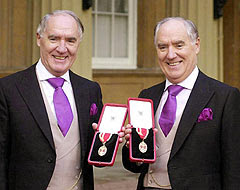 The Barclays, honoured by the Queen for services to tax avoidance
What brings viewers to Sky is its greedy accumulation of rights to sports and ever newer movies. Viewers grumble that they can no longer see major sporting events and films “free” on the traditional channels but then vote with their credit cards and sign up for Sky packages. The Murdoch papers play a significant cheerleading role in this process, just as Richard Desmond’s papers are obliged to enter into mutual promotion with Channel Five since the media empire builder added that faltering enterprise to his portfolio.
It can’t be news to many that the press is full of special pleading, self-interest and hypocrisy. The long and far-reaching campaign conducted by The Daily Telegraph concerning parliamentary expenses made my blood boil. The seemingly not very onerous task of owning The Telegraph (along with The Spectator) is conducted by the identical Barclay twins, Sir David and Sir Frederick, from their home on Monaco where they protect their billions from taxation. They must have enjoyed enormously their reporters’ stories of the trivial swindles of the pathetic politicos while they themselves wallow in untouched dosh. But none of their paper’s rivals pointed out this contrast: The Guardian declined to publish a letter I wrote, couched in diligently diplomatic terms, on the matter.
Not so far from us in Wiltshire lies the grand estate of Lord Rothermere, owner of the Daily Mail. I have no intelligence as to how much of each week, month or year his lordship resides there but, for the purposes of taxation, he “lives in France”. I’d be interested to hear his explanation as to how that arrangement differs from those of the so-called “benefits cheats” against whom his columnists rail. As long as the coalition government shows no sign of attending to the legal loopholes that allow the mega-rich to avoid paying taxation on a massive scale, you can be sure that the Tory press will not be switching its allegiance to Labour. Little wonder that Cameron smarms up to the news proprietors.
 Lord Rothermere plus disinterested friend
And what do the editors and reporters do with their endlessly trumpeted freedom? Well, they invoke it most often in conjunction with another illusory shibboleth: “the public’s right to know”. These two great causes may be thought well served when the press works long and hard, carefully and restrainedly, to uncover real wrongdoing. The exemplary research and diligence that powered the campaign in the 1960s by The Sunday Times to have victims of the drug thalidomide recompensed remains a template for investigative journalism.
Pursuing salacious stories about people who’ve been on the telly is not of the same order. To combat this blood sport, it is hardly surprising that the hunted have sought legal protection and so we have the super-injunctions that have attracted such scorn and been preposterously dismissed as an attack on “the freedom of the press”.
What should we make of the Ryan Giggs debacle? So many views are canvassed: that it serves him right, that it overshadows his career as a footballer, that he’s in an impossible position, that he’s perfectly entitled to cover his tracks. The Lib Dem backbencher John Hemming named Giggs in the House, using parliamentary privilege for a purpose that many MPs felt was illegitimate. Under such privilege, an MP may not be brought before the law by anyone for what he says, however libellous it might be, although he may certainly be disciplined by the Speaker for breaching parliamentary regulation and custom.
It’s fair to ask whether, if MPs are to use their privilege in this way, the protection it offers ought to be withdrawn. I have long believed it utterly iniquitous that, if the employee of a foreign embassy kills your child through dangerous or drunken driving, he is not liable and you may have no redress because he enjoys diplomatic immunity. And it hardly distinguishes Hemming’s stance that he himself is a ludicrous figure with a personal life as messy and amoral as any soap opera character, lived with careless unconcern.
 John Hemming MP, not especially choosy about his causes
The notion that Giggs “deserves everything he gets for cheating on his wife” errs on the side of puritan severity and determinism. Giggs is one of the oldest professional footballers still active at the highest level of the game and the corollary of that is that the world has changed profoundly since he entered the game. It’s easy to be morally superior about relatively uneducated working class boys who become very rich and famous without much psychological tuition in how to handle it. Henry Kissinger, a very clever and well educated man, once observed with delighted surprise that “power is a great aphrodisiac”. Giggs and Wayne Rooney and John Terry may not know what that means but they experience its operation. So did I in a small way. In the years that I was a television producer, I was offered sexual favours on a far more regular – even routine – basis than I ever was at any other period of my life. It’s an extremely disciplined individual who remembers always to just say no.
On the other hand, Giggs is a grown-up and he must know that involving himself in an adulterous relationship is a risky business, especially with a woman whose own “fame” derives from a so-called reality show and who could very readily be mistaken for a gold-digger. It’s in the nature of “cheating” in any way – adultery, drug-enhancement, expenses-fiddling, plotting terrorism – that a degree of furtive behaviour is required in its execution. Behaving furtively in itself implies a danger of being found out. Everybody being furtive must understand that the behaviour is AYOR.
But of course it’s nobody’s business what Giggs gets up to in his sexual life and nobody has any basis on which to pontificate, for instance, that his behaviour has “destroyed his family”. It might be that the public fuss has done far more damage to his domestic situation than would have been caused had he informed his wife of the adultery in his own time and without the hovering media. None of us can know what the ramifications might be but Mrs Stacey Giggs may well reflect that there have been four people in her marriage: her and her husband, his mistress and the watching world.
Into the middle of this melange has erupted another matter on which the press has not distinguished itself. I am not of the view that the highest achievement of press freedom is its willingness to pour abuse upon a public servant. The press, loudly led by the tabloids, decided very quickly after the so-called “Baby P” case broke that the witch to be hunted should be Head of Haringey Social Services, Sharon Shoesmith.
 Sharon Shoesmith, a rare image not chosen to suggest that she is smug
Now that she has appealed her dismissal and won her case, the knives have been unsheathed again. I accept that Shoesmith has not helped her own image with some of the comments she made to the media. Many a tweeter thrust into the spotlight might make comments that were not thought-through too. The Twitter bandwagon blackguarding Shoesmith is gleefully leapt on by thousands of know-nothings who wouldn’t themselves dream of taking a social worker job for ten times the miserable salary and wouldn’t begin to have the sense or sensibility to consider the conundrums daily presented by social work.
In a posting when the story first broke, before Shoesmith’s unfair dismissal, I wrote the following and I stand by it:
“Armchair pundits, among whom I readily number myself, have turned their special venom on the hapless social workers of Haringey. Because Baby P died on their watch, they have, in an inimitable headline from The Sun, ‘BLOOD ON THEIR HANDS’. Being wise after an event that they didn’t even know had happened until they read about it in the news columns is the special talent of armchair pundits. Columnists who couldn’t find Haringey in the London A-Z (let alone their arses with both hands) profess to know better than seasoned social workers what constitutes a palpable risk. Columnists whose entertainment expense accounts are higher in a week than a social worker earns in a month demand that heads roll.
“Social work is a vocational career. You need infinite patience and human sympathy. You have to be ready to work anti-social hours and be poorly paid. And you are immediately made aware that it is an art rather than a science. The decisions you make are based wholly on impressions and assessments that are subjective. There will be people whose casework you take on who will tell you what they think you’ll want to hear; others who will have few means of articulating what their situation is; and most of them will be in some degree desperate and not all of them can be saved from self-harm or harming others. Nobody pays you any heed until something “goes wrong” and then a bunch of scandalised know-alls in London, whose knowledge of social deprivation derives almost entirely from an occasional look at EastEnders, start writing about you as if you yourself are a serial killer.
“I honestly don’t understand why cases like this are taken up by the media at all. They have no news value. Editors prate about ‘human interest’ but if viewers, listeners and readers are ‘interested’ it is because the media does its best to make them so. It’s mere prurience. The day after the Baby P case went large, there was a brief story, played almost as big for a day or two, of a mother who had been sectioned after killing her two small children. Tragically for the pundits, there was no evidence of social workers stoking the fire of this particular case so it fell off the news agenda. That didn’t prevent the BBC Television News bulletins from carrying a vox pop with a neighbour who was too emotional to be able to contribute anything useful. What is the value of this kind of coverage? Do the editors believe that we need to be shown someone upset before we can understand that the case is upsetting? And what are we supposed to do with this knowledge? Wring our hands? Take to the streets? Perhaps write to our MPs – not least the prime minister and the leader of the opposition – and ask them to stop uttering the word “families” as though it has a religious connotation when all the media evidence suggests that families can actually be fatal for children?” [P BABY: NO MORE DRAMAS November 19th 2008]
Traditionally, the point at which one fully realises how grossly inaccurate is the daily reporting carried by the papers is the occasion when one is unfortunate enough to become the object of press interest. Again in a modest way, I have had my own small experience of this. The arrogant assumption, empty speculation and reckless kite-flying that routinely informs press coverage has been further overlaid of late by the greatly increased encouragement of rebarbative levels of abuse from readers. On-line comment threads attached to the threadbare and frequently synthetic sneerings of columnists and the gathering momentum of sanctimonious abuse on Twitter have demonstrated just how widespread among the public is the taste for impotent rage. The press gleefully throws petrol on these wildfires in the form of hapless individuals: Ken Clarke one week, Ryan Giggs the next, Sharon Shoesmith the next.
The media wields enormous power and prompts millions to assume they have knowledge that in fact they do not have. I would have a great deal more faith and confidence in the press if it considered and discussed its own responsibilities half as readily as it shouts its claims to rights to which it is not entitled.
Until about a decade ago, I was, for thirty years on and off, a working journalist and a fully paid-up member of the National Union of Journalists. I’d be a journalist again if anyone took my stuff, but I am too long out of the business; the people who decide things have never heard of me and don’t deign to respond to unsolicited pieces; and maybe what I think and/or how I write is no longer wanted (quiet at the back there).
I had a lot of regard for many of the people I met in my newspaper and magazine years – photographers, stringers, reporters, printers, sub-editors, reviewers, researchers, columnists, editors – but I learned to be very sceptical about the culture of the press. Almost everything that made me feel uncomfortable in those years has got more intense since.
Some scene setting before we get onto that. The press is in terminal decline – no one can doubt that. If there are any printed newspapers at all a decade hence, it will be astonishing. In Britain, many national and London newspapers have (come and) gone in my lifetime: Daily Sketch, News Chronicle, The Star, Daily Herald, The Graphic, Sunday Dispatch, The Evening News, Today, The European, The Post, The Illustrated London News, Sunday Correspondent, London Daily News, Sunday Sport. The Guardian came awfully close to closing its stable-mate, the oldest surviving British paper The Observer, last year and commentators ring the death-knell of The Independent and Independent on Sunday pretty much every month.

It’s the very necessity to publish and print that hands the newspapers their fatal disadvantage. Direct on-line printing is certainly quicker than the linotype, cold press, peeling-a-spread-off-the-stone world that still obtained when I joined The Observer in 1977. It’s the distribution that kills it. I don’t know if the same routines obtain now but, in my day, if you walked along Fleet Street around 4:00 am and peered down the side streets, you’d see the Bedford vans, bearing the liveries of the national organs and the news-agency chains, parked on the pavements, while bundles of early editions tumbled down chutes to men waiting on the tailboards below: the press’s nocturnal emissions.
First cinema newsreels, then the wireless, then much more decisively television, now conclusively the internet, the print’s successors have demonstrated the crucial ingredient that printed newspapers can never have: immediacy. As a consequence, those fast media have marauded into newspapers’ primary source of revenue, advertising. Compare any printed paper’s current edition with one from just two or three years back and the drop in advertising is stark, classified even more than display.
And compare the coverage. Most papers have trimmed the number of their supplements and rationalised their staff. There are notably fewer special offers and give-aways. And the newsprint on which The Guardian is printed is clearly flimsier than a year or two ago.
At the same time, the press has been markedly slow to respond to challenges from elsewhere. Only three years ago, The Daily Telegraph still carried a large proportion of pages printed in monochrome. This is no competition for television that has been in full colour for nearly half a century.

The strategies that editors and proprietors have followed are rarely admirable and not always comprehensible. It’s not just the dreary, industry-wide reliance on pictures of “pretty girls”, notoriously naked ones in Rupert Murdoch’s The Sun, which has actually trademarked the phrase “Page Three”. It’s that Murdoch, more than any media proprietor, has sought to influence governments and in that quest he has been highly successful.
Of the British prime ministers over the last fifty years or so, those who assiduously courted Fleet Street in general and, more recently, Murdoch in particular, have benefited from a generally benign press – Harold Macmillan, Harold Wilson, Margaret Thatcher, Tony Blair – while those who scorned such low cunning have found themselves increasingly excoriated by columnists and editorial alike – Sir Alec Douglas Home, Edward Heath, Jim Callaghan, John Major, Gordon Brown. Thus far, David Cameron has diligently shown himself to belong to the former camp, with what result only the 2015 election will show; although note that Ed Miliband has not seemed to attend much to press relations.
In a wider sense, the wider media has invented and developed that horrendous phenomenon of contemporary society, celebrity culture. The famous were ever a staple for the popular press – hitherto known as “the tabloids” until middle market papers like The Express and Daily Mail adopted the format, followed by supposedly “quality” organs like The Times and The Independent which call their tabloid manifestations “compact”. Cinema, wireless and then television, in their form such threats to the very existence of newspapers, yet furnished a lifeline by vouchsafing sprinklings of stardust that reporters and photographers might gratefully snort up. And now, newspapers from all parts of the market are celebrity obsessed. One reason why no-name journalists like me ceased to find work is because so many columns and reviews are written by – or at least by-lined by – actors and comedians.
The relations between reporters and photographers and their prey soon grew complicated. With the growth of so-called “yellow” journalism and the arrival of the paparazzo photographer (named after the aggressive lensman in Fellini’s La Dolce Vita), the famous found themselves more the victims than the beneficiaries of press interest.

So we come to the present sorry and entangled juncture, at which people in the public eye attempt to cover their personal affairs (in every sense) by securing so-called super-injunctions that can be ignored by thousands of civilians gossiping on social internet platforms like Twitter. The latter breach of law – if that is what it is – is clearly far too easy to commit. I did it myself, mentioning the footballer Ryan Giggs en passant as “a super-injunctor” because by the time I did so he had already been fingered numberless times.
The reality is that Twitter hands its users a power that they do not have the inclination to ponder. Those few of us who bother to read the drearily endless legalese of the terms and conditions, that every commercial site posts somewhere and diligently prompts joiners to read and agree to, can hardly be expected to carry in our memories the responsibilities to which we have signed up, even if we had ever thought about them. No doubt there will sooner or later be a test case – perhaps the action taken by South Tyneside Council to secure from Twitter the identity of a tweeter whom it wants to sue for libel – that will bring home starkly to the Twitterati the enormity of the responsibility they undertake in setting out to gossip to the world.
But there is an ocean of muddy water here and the press is itself as responsible as anyone for making it so muddy. Consider the related but conflicted notions that are in play in this whole area: discretion, confidentiality, privacy, security, secrecy, evasion, dissimulation, subterfuge, suppression, conspiracy, treason. And in confronting all of these related but importantly separate notions, the press invokes the holiest of modern holy cows: the freedom of the press.
Not in the most perfervid of imaginations can the press truly be said to be free in any meaningful sense. First of all, the newspapers are owned. Their owners are much like those billionaires who buy football clubs. They tend to be foreigners or at any rate domiciled abroad, technically if not actually. They have bottomless pockets and they need to have such because newspapers, like football clubs, swim in seas of debt. And of course those owners have views and they are inclined to want to see their mouthpieces reflecting those views in a general and sometimes in a particular sense.
Proprietorial requirements dictate a great deal of the stances taken by the press. For instance, Rupert Murdoch’s complex interests in broadcasting are reflected in the consistently hostile posture struck by his organs towards the BBC and, to a lesser extent, ITV. This is less true of coverage of individual programmes or stars, because the editors gain little from being out of step on what the public adores. The constant carping is upon corporate policy. The editors imagine that this undermines the public’s affection for the BBC so that readers may be drawn to BSkyB instead.

What brings viewers to Sky is its greedy accumulation of rights to sports and ever newer movies. Viewers grumble that they can no longer see major sporting events and films “free” on the traditional channels but then vote with their credit cards and sign up for Sky packages. The Murdoch papers play a significant cheerleading role in this process, just as Richard Desmond’s papers are obliged to enter into mutual promotion with Channel Five since the media empire builder added that faltering enterprise to his portfolio.
It can’t be news to many that the press is full of special pleading, self-interest and hypocrisy. The long and far-reaching campaign conducted by The Daily Telegraph concerning parliamentary expenses made my blood boil. The seemingly not very onerous task of owning The Telegraph (along with The Spectator) is conducted by the identical Barclay twins, Sir David and Sir Frederick, from their home on Monaco where they protect their billions from taxation. They must have enjoyed enormously their reporters’ stories of the trivial swindles of the pathetic politicos while they themselves wallow in untouched dosh. But none of their paper’s rivals pointed out this contrast: The Guardian declined to publish a letter I wrote, couched in diligently diplomatic terms, on the matter.
Not so far from us in Wiltshire lies the grand estate of Lord Rothermere, owner of the Daily Mail. I have no intelligence as to how much of each week, month or year his lordship resides there but, for the purposes of taxation, he “lives in France”. I’d be interested to hear his explanation as to how that arrangement differs from those of the so-called “benefits cheats” against whom his columnists rail. As long as the coalition government shows no sign of attending to the legal loopholes that allow the mega-rich to avoid paying taxation on a massive scale, you can be sure that the Tory press will not be switching its allegiance to Labour. Little wonder that Cameron smarms up to the news proprietors.

And what do the editors and reporters do with their endlessly trumpeted freedom? Well, they invoke it most often in conjunction with another illusory shibboleth: “the public’s right to know”. These two great causes may be thought well served when the press works long and hard, carefully and restrainedly, to uncover real wrongdoing. The exemplary research and diligence that powered the campaign in the 1960s by The Sunday Times to have victims of the drug thalidomide recompensed remains a template for investigative journalism.
Pursuing salacious stories about people who’ve been on the telly is not of the same order. To combat this blood sport, it is hardly surprising that the hunted have sought legal protection and so we have the super-injunctions that have attracted such scorn and been preposterously dismissed as an attack on “the freedom of the press”.
What should we make of the Ryan Giggs debacle? So many views are canvassed: that it serves him right, that it overshadows his career as a footballer, that he’s in an impossible position, that he’s perfectly entitled to cover his tracks. The Lib Dem backbencher John Hemming named Giggs in the House, using parliamentary privilege for a purpose that many MPs felt was illegitimate. Under such privilege, an MP may not be brought before the law by anyone for what he says, however libellous it might be, although he may certainly be disciplined by the Speaker for breaching parliamentary regulation and custom.
It’s fair to ask whether, if MPs are to use their privilege in this way, the protection it offers ought to be withdrawn. I have long believed it utterly iniquitous that, if the employee of a foreign embassy kills your child through dangerous or drunken driving, he is not liable and you may have no redress because he enjoys diplomatic immunity. And it hardly distinguishes Hemming’s stance that he himself is a ludicrous figure with a personal life as messy and amoral as any soap opera character, lived with careless unconcern.

The notion that Giggs “deserves everything he gets for cheating on his wife” errs on the side of puritan severity and determinism. Giggs is one of the oldest professional footballers still active at the highest level of the game and the corollary of that is that the world has changed profoundly since he entered the game. It’s easy to be morally superior about relatively uneducated working class boys who become very rich and famous without much psychological tuition in how to handle it. Henry Kissinger, a very clever and well educated man, once observed with delighted surprise that “power is a great aphrodisiac”. Giggs and Wayne Rooney and John Terry may not know what that means but they experience its operation. So did I in a small way. In the years that I was a television producer, I was offered sexual favours on a far more regular – even routine – basis than I ever was at any other period of my life. It’s an extremely disciplined individual who remembers always to just say no.
On the other hand, Giggs is a grown-up and he must know that involving himself in an adulterous relationship is a risky business, especially with a woman whose own “fame” derives from a so-called reality show and who could very readily be mistaken for a gold-digger. It’s in the nature of “cheating” in any way – adultery, drug-enhancement, expenses-fiddling, plotting terrorism – that a degree of furtive behaviour is required in its execution. Behaving furtively in itself implies a danger of being found out. Everybody being furtive must understand that the behaviour is AYOR.
But of course it’s nobody’s business what Giggs gets up to in his sexual life and nobody has any basis on which to pontificate, for instance, that his behaviour has “destroyed his family”. It might be that the public fuss has done far more damage to his domestic situation than would have been caused had he informed his wife of the adultery in his own time and without the hovering media. None of us can know what the ramifications might be but Mrs Stacey Giggs may well reflect that there have been four people in her marriage: her and her husband, his mistress and the watching world.
Into the middle of this melange has erupted another matter on which the press has not distinguished itself. I am not of the view that the highest achievement of press freedom is its willingness to pour abuse upon a public servant. The press, loudly led by the tabloids, decided very quickly after the so-called “Baby P” case broke that the witch to be hunted should be Head of Haringey Social Services, Sharon Shoesmith.

Now that she has appealed her dismissal and won her case, the knives have been unsheathed again. I accept that Shoesmith has not helped her own image with some of the comments she made to the media. Many a tweeter thrust into the spotlight might make comments that were not thought-through too. The Twitter bandwagon blackguarding Shoesmith is gleefully leapt on by thousands of know-nothings who wouldn’t themselves dream of taking a social worker job for ten times the miserable salary and wouldn’t begin to have the sense or sensibility to consider the conundrums daily presented by social work.
In a posting when the story first broke, before Shoesmith’s unfair dismissal, I wrote the following and I stand by it:
“Armchair pundits, among whom I readily number myself, have turned their special venom on the hapless social workers of Haringey. Because Baby P died on their watch, they have, in an inimitable headline from The Sun, ‘BLOOD ON THEIR HANDS’. Being wise after an event that they didn’t even know had happened until they read about it in the news columns is the special talent of armchair pundits. Columnists who couldn’t find Haringey in the London A-Z (let alone their arses with both hands) profess to know better than seasoned social workers what constitutes a palpable risk. Columnists whose entertainment expense accounts are higher in a week than a social worker earns in a month demand that heads roll.
“Social work is a vocational career. You need infinite patience and human sympathy. You have to be ready to work anti-social hours and be poorly paid. And you are immediately made aware that it is an art rather than a science. The decisions you make are based wholly on impressions and assessments that are subjective. There will be people whose casework you take on who will tell you what they think you’ll want to hear; others who will have few means of articulating what their situation is; and most of them will be in some degree desperate and not all of them can be saved from self-harm or harming others. Nobody pays you any heed until something “goes wrong” and then a bunch of scandalised know-alls in London, whose knowledge of social deprivation derives almost entirely from an occasional look at EastEnders, start writing about you as if you yourself are a serial killer.
“I honestly don’t understand why cases like this are taken up by the media at all. They have no news value. Editors prate about ‘human interest’ but if viewers, listeners and readers are ‘interested’ it is because the media does its best to make them so. It’s mere prurience. The day after the Baby P case went large, there was a brief story, played almost as big for a day or two, of a mother who had been sectioned after killing her two small children. Tragically for the pundits, there was no evidence of social workers stoking the fire of this particular case so it fell off the news agenda. That didn’t prevent the BBC Television News bulletins from carrying a vox pop with a neighbour who was too emotional to be able to contribute anything useful. What is the value of this kind of coverage? Do the editors believe that we need to be shown someone upset before we can understand that the case is upsetting? And what are we supposed to do with this knowledge? Wring our hands? Take to the streets? Perhaps write to our MPs – not least the prime minister and the leader of the opposition – and ask them to stop uttering the word “families” as though it has a religious connotation when all the media evidence suggests that families can actually be fatal for children?” [P BABY: NO MORE DRAMAS November 19th 2008]
Traditionally, the point at which one fully realises how grossly inaccurate is the daily reporting carried by the papers is the occasion when one is unfortunate enough to become the object of press interest. Again in a modest way, I have had my own small experience of this. The arrogant assumption, empty speculation and reckless kite-flying that routinely informs press coverage has been further overlaid of late by the greatly increased encouragement of rebarbative levels of abuse from readers. On-line comment threads attached to the threadbare and frequently synthetic sneerings of columnists and the gathering momentum of sanctimonious abuse on Twitter have demonstrated just how widespread among the public is the taste for impotent rage. The press gleefully throws petrol on these wildfires in the form of hapless individuals: Ken Clarke one week, Ryan Giggs the next, Sharon Shoesmith the next.
The media wields enormous power and prompts millions to assume they have knowledge that in fact they do not have. I would have a great deal more faith and confidence in the press if it considered and discussed its own responsibilities half as readily as it shouts its claims to rights to which it is not entitled.
Sunday, May 01, 2011
The LOUD LAUGH that SPOKE the VACANT MIND
In today’s Daily Telegraph, the columnist I love to hate, Simon Heffer, has once again voyaged into a subject of which he knows nothing: humour. Here is the link:
http://bit.ly/k4klbX
I shall now make Mr Heffer chuckle uncontrollably (given his susceptible funny bone) by revealing that my own name for him is Siphon Effluent. Did you see what I did there, Simon? Good, isn’t it.
The occasion of Mr Effluent’s latest outpouring was the wonderfully witty and hilarious wisecrack delivered in the house at Prime Minister’s Questions when the PM advised shadow minister Angela Eagle to “calm down, dear”. He and his backbenchers thought this so much funnier than the complete works of Oscar Wilde, SJ Perelman, PG Wodehouse and Stephen Fry rolled into one that Mr Cameron felt called upon to repeat the joke a further six times. Laugh? I thought I’d have to bite the television remote.
 Siphon Effluent with his beloved Thatch
Laughter in the house is not like laughter anywhere else (except probably the Bullingdon Club and the Oxford Union). It is a mirthless howl, the kind of har-har-har braying, accompanied by forced slapping of fat hams, that speaks not at all of appreciative and judicious admiration for a finely-turned phrase but entirely of bullies putting in the boot after their loudest mouth (whom they fear, or at least require to impress with “loyalty”) has played to the lowest common denominator by landing on an opponent a blow to the solar plexus. This kind of knee-jerk oinking is certainly not the prerogative of Flashmanesque Tories. All the other party cannon-fodder do it too, even (I shouldn’t wonder) the Greens. It was noticeable though that, while George Osborne hooted like a hairdresser at a Cher concert, Nick Clegg sat stony-faced throughout the entire episode.
Politicians as a breed are not all that amusing. Even some quite smooth orators, while skilled at rousing an audience, cannot deliver a funny line. Those politicos who are able to reveal a responsive sense of humour in a general way can indeed be funny themselves, regardless of political inclination: Heseltine, Kinnock, Kennedy, Hattersley, Portillo, Skinner, Widdecombe (the latter, perhaps, unintentionally). Ed Miliband shows encouraging signs of being able to mock thoughtfully, helped by some evidence that he doesn’t take himself too seriously all of the time. John Smith had a charmingly deprecating sense of humour.
 Angela Eagle: shot down by Cameron's deadly wit
In earlier generations, Harold Macmillan had a dry clubman’s wit, often quite lethal. Harold Wilson could be witheringly funny. Jo Grimond and Jeremy Thorpe were both quick-witted and smart Liberal Party leaders. I remember an edition of Any Questions? celebrating some early anniversary, during which Thorpe astonished all by his pitch-perfect and brilliantly “scripted” impersonations of some of the programme’s stalwarts not present in that edition: Ralph Whiteman, Ted Leather, Gerald Nabarro.
Winston Churchill’s many witticisms have gone down in legend, though some of them would fail modern tests of acceptability. No PM since has matched Churchill’s style, timing and sheer sense of mischief – “Bossom?” he sniffed at the surname of a new member. “Neither one thing nor the other”. But at least one contemporary statesman can deliver a witty speech with perfect timing and aplomb. Go to
http://bit.ly/jDop1g
to laugh out loud at Barack Obama's speech to yesterday's White House correspondents' dinner.
Typically, politicians have ‘jokes’ written for them, which they proceed to mangle in delivery, yet the faithful roar with simulated delight anyway. Tony Blair thought himself jolly good-humoured but the kind of thing that made him weep with laughter was that singing fish novelty that was all the rage among people with no taste for a day and half some time in the late ‘90s. Gordon Brown’s delivery of a joke was as leaden as John Major’s or Edward Heath’s. And Siphon Effluent’s great heroine, Margaret Thatcher, had no sense of humour whatsoever. The antediluvian playwright Sir Ronald Millar – don’t hold your breath for a revival of his plays – wrote the “you turn if you want to – the lady’s not for turning” shtik, a desperately laborious conceit even in skilled hands, but it brought a Tory conference to its knees weeping with uncontrollable mirth, despite that the dear leader had performed it with considerably less panache than Neville Chamberlain announcing “consequently this country is at war with Germany”.
 Siphon Effluent: the HL Mencken de nos jours
Siphon Effluent himself does make me laugh, mostly because he contrives to present the appearance of a sugar pig with marmalade smeared on his head. But his writing is dominated by his desire to be disobliging and, if he ever threatens to try for humour, it never ventures further than peevish scorn. He always refers to Mr Cameron as “Dave” – this is known in the trade as a “running gag” – presumably because he disdains a Tory leader who is not Thatcher and because some of the PM’s intimates appear to refer to him by this builder’s-mate moniker. (Not least of these intimates is the first lady, Samantha Cameron. There again, her sense of humour was revealed yesterday when she appeared to think it a jolly jape to roll up at a formal state occasion dressed for a constituency coffee morning; gratifyingly, she was comprehensively outshone by the effortlessly chic Miriam Clegg).
 Bernard Manning: evidently he and Effluent were separated at birth
In his piece on humour, Effluent makes a strenuous joke in calling Angela Eagle “a harridan”. He was so pleased with this that he repeated it. Now, Effluent is very keen on the correct use of English. Indeed, he is the in-house English monitor at The Telegraph, apt to send stinging emails to hapless journalists who have offended his sensibilities. So I find myself surprised that he should use the term “harridan”, which is defined by the OED as “a haggard old woman”, of a personable female of just 50.
Effluent writes further: “I suspect even Dave has the manners not to address a woman with whom he is not well acquainted as ‘dear’ except in jest” and later, on a different matter, “This column prides itself on its gallantry towards the ladies”. Yet he himself has the ungallant lack of breeding to write of a woman with whom he is not well acquainted in such an insulting manner. I think he should stand in the corner.
With brilliant skill and dazzling wit, Effluent turns what his admirers might have feared was a mortal thrust at “Dave” into an all-guns-blazing assault on Labour and “lefties” in general: “His [Cameron’s] mistake, however, was to think that these people are easy-going types who like a laugh. He has, at least, now admitted he realises that the Left doesn't have a sense of humour”.
 Jim Davidson: also seems to come in a similar shade to Effluent
Ah yes, the age-old canard that “lefties” have “no sense of humour”. It is of course fair and just to observe that there are individuals who are earnest and single-minded about their politics, but I never found that this degree of dedication was confined to the left. Had it been, we might now live in a more enlightened world. But the myth persists: on Any Questions? this weekend, UKIP leader Nigel Farage spoke of “po-faced Republicans”.
It can be argued – I have argued it myself – that comedy is fundamentally reactionary because it requires a reliable and enduring establishment, status quo, conventional wisdom against which to bounce. So, while pretending to subvert and mock, comedy really reinforces and humanises. It’s Lear’s Fool syndrome – the absolute monarch permits an all-licensed jester precisely because he is absolute and therefore the jester cannot draw blood, only wry smiles.
But there are many conventional wisdoms. Changes of government do not signal the end of satire. Effluent seems to imagine that only reactionary people are capable of being funny. “Comedians who are not Leftists” essays Effluent “have more or less been driven out of business. Bernard Manning was martyred in this cause. Jim Davidson is in the process of following him, not because he isn't funny, but because he was a strong supporter of Mrs Thatcher. Long after she left office, the spiteful little creeps who form the ‘comedy’ establishment of this country would get laughs from their bovine audiences simply by mentioning her name”.
 Tom Lehrer: 'We Will All Go Together When We Go'
If Effluent sees himself as a comedian, this is certainly his most laughable passage. The idea that Manning was “martyred” is preposterous. He may have fallen out of television fashion – many entertainers do and politics has nothing to do with it – but his club work (including at his own club) continued to bring him a handsome income. And I can’t help wondering how often Effluent was to be seen knocking back pints with hoi polloi at Manning’s place, roaring with delight and slapping his hams at “fookin’ Paki” so-called “gags”. If nothing else, the vulgarity of it all seems extremely unlikely to have appealed to Mr & Mrs Effluent as an alternative to their beloved Wagner, any more than one can picture them tripping to the end of a pier to rock with joy at Jim Davidson’s version of fun.
Perhaps Effluent is thinking of Ben Elton when he writes of “the spiteful little creeps” mentioning Thatcher’s name for a laugh. Elton certainly used to do stuff about the woman he called Thatch but that was back in the ‘80s in his spangly-suited phase. I would gently suggest that if Effluent were to take tea with Elton at the Ritz and probe him for his present political views, he might find that they have more in common than he imagines.
 Roy Battersby: as you see, an archetypal po-faced leftie
There have been plenty of intelligent, thoughtful and far from spiteful comics who are not reactionaries. In Effluent’s youth, he might have been aware of the American Tom Lehrer, a finely witty, talented and scrupulous social satirist who announced his retirement when Henry Kissinger was awarded the Nobel Peace Prize, on the grounds that the award rendered satire obsolete.
But even staunchly committed left-wingers have sprightly senses of humour. Tariq Ali, whom I knew a bit at one time, is a warmly funny and witty man. My old chum Roy Battersby would certainly fill the bill for Effluent when looking for a fully paid-up leftie. Roy was a key member of the Workers’ Revolutionary Party in the 1970s and ‘80s, took five years out of his directing career to work full-time for the party as its chief representative on the Palestinian question (he made a moving documentary called The Palestinian, fronted by Vanessa Redgrave), stood for parliament and was involved in the supposedly notorious Red House centre which was a constant target for MI6. Yet my abiding image of him is of a man wreathed in a beatific smile, relishing the pleasures of life and laughing uproariously at its manifold absurdities.
There is an unbridgeable gulf between, on the one hand, Roy, Tariq and Tom Lehrer and, on the other, a Simon Heffer whose idea of a comedian is Manning or Davidson and a David Cameron who thinks he’s being witty by quoting someone as repellent as Michael Winner in something as low class as a television advertisement and claims that anyone who cannot see such rubbish as meritorious lacks a sense of humour. I can’t imagine finding anything in common (humorous or otherwise) with anyone who would rather reside on the Heffer/Cameron/Manning side.
In today’s Daily Telegraph, the columnist I love to hate, Simon Heffer, has once again voyaged into a subject of which he knows nothing: humour. Here is the link:
http://bit.ly/k4klbX
I shall now make Mr Heffer chuckle uncontrollably (given his susceptible funny bone) by revealing that my own name for him is Siphon Effluent. Did you see what I did there, Simon? Good, isn’t it.
The occasion of Mr Effluent’s latest outpouring was the wonderfully witty and hilarious wisecrack delivered in the house at Prime Minister’s Questions when the PM advised shadow minister Angela Eagle to “calm down, dear”. He and his backbenchers thought this so much funnier than the complete works of Oscar Wilde, SJ Perelman, PG Wodehouse and Stephen Fry rolled into one that Mr Cameron felt called upon to repeat the joke a further six times. Laugh? I thought I’d have to bite the television remote.

Laughter in the house is not like laughter anywhere else (except probably the Bullingdon Club and the Oxford Union). It is a mirthless howl, the kind of har-har-har braying, accompanied by forced slapping of fat hams, that speaks not at all of appreciative and judicious admiration for a finely-turned phrase but entirely of bullies putting in the boot after their loudest mouth (whom they fear, or at least require to impress with “loyalty”) has played to the lowest common denominator by landing on an opponent a blow to the solar plexus. This kind of knee-jerk oinking is certainly not the prerogative of Flashmanesque Tories. All the other party cannon-fodder do it too, even (I shouldn’t wonder) the Greens. It was noticeable though that, while George Osborne hooted like a hairdresser at a Cher concert, Nick Clegg sat stony-faced throughout the entire episode.
Politicians as a breed are not all that amusing. Even some quite smooth orators, while skilled at rousing an audience, cannot deliver a funny line. Those politicos who are able to reveal a responsive sense of humour in a general way can indeed be funny themselves, regardless of political inclination: Heseltine, Kinnock, Kennedy, Hattersley, Portillo, Skinner, Widdecombe (the latter, perhaps, unintentionally). Ed Miliband shows encouraging signs of being able to mock thoughtfully, helped by some evidence that he doesn’t take himself too seriously all of the time. John Smith had a charmingly deprecating sense of humour.

In earlier generations, Harold Macmillan had a dry clubman’s wit, often quite lethal. Harold Wilson could be witheringly funny. Jo Grimond and Jeremy Thorpe were both quick-witted and smart Liberal Party leaders. I remember an edition of Any Questions? celebrating some early anniversary, during which Thorpe astonished all by his pitch-perfect and brilliantly “scripted” impersonations of some of the programme’s stalwarts not present in that edition: Ralph Whiteman, Ted Leather, Gerald Nabarro.
Winston Churchill’s many witticisms have gone down in legend, though some of them would fail modern tests of acceptability. No PM since has matched Churchill’s style, timing and sheer sense of mischief – “Bossom?” he sniffed at the surname of a new member. “Neither one thing nor the other”. But at least one contemporary statesman can deliver a witty speech with perfect timing and aplomb. Go to
http://bit.ly/jDop1g
to laugh out loud at Barack Obama's speech to yesterday's White House correspondents' dinner.
Typically, politicians have ‘jokes’ written for them, which they proceed to mangle in delivery, yet the faithful roar with simulated delight anyway. Tony Blair thought himself jolly good-humoured but the kind of thing that made him weep with laughter was that singing fish novelty that was all the rage among people with no taste for a day and half some time in the late ‘90s. Gordon Brown’s delivery of a joke was as leaden as John Major’s or Edward Heath’s. And Siphon Effluent’s great heroine, Margaret Thatcher, had no sense of humour whatsoever. The antediluvian playwright Sir Ronald Millar – don’t hold your breath for a revival of his plays – wrote the “you turn if you want to – the lady’s not for turning” shtik, a desperately laborious conceit even in skilled hands, but it brought a Tory conference to its knees weeping with uncontrollable mirth, despite that the dear leader had performed it with considerably less panache than Neville Chamberlain announcing “consequently this country is at war with Germany”.
Siphon Effluent himself does make me laugh, mostly because he contrives to present the appearance of a sugar pig with marmalade smeared on his head. But his writing is dominated by his desire to be disobliging and, if he ever threatens to try for humour, it never ventures further than peevish scorn. He always refers to Mr Cameron as “Dave” – this is known in the trade as a “running gag” – presumably because he disdains a Tory leader who is not Thatcher and because some of the PM’s intimates appear to refer to him by this builder’s-mate moniker. (Not least of these intimates is the first lady, Samantha Cameron. There again, her sense of humour was revealed yesterday when she appeared to think it a jolly jape to roll up at a formal state occasion dressed for a constituency coffee morning; gratifyingly, she was comprehensively outshone by the effortlessly chic Miriam Clegg).

In his piece on humour, Effluent makes a strenuous joke in calling Angela Eagle “a harridan”. He was so pleased with this that he repeated it. Now, Effluent is very keen on the correct use of English. Indeed, he is the in-house English monitor at The Telegraph, apt to send stinging emails to hapless journalists who have offended his sensibilities. So I find myself surprised that he should use the term “harridan”, which is defined by the OED as “a haggard old woman”, of a personable female of just 50.
Effluent writes further: “I suspect even Dave has the manners not to address a woman with whom he is not well acquainted as ‘dear’ except in jest” and later, on a different matter, “This column prides itself on its gallantry towards the ladies”. Yet he himself has the ungallant lack of breeding to write of a woman with whom he is not well acquainted in such an insulting manner. I think he should stand in the corner.
With brilliant skill and dazzling wit, Effluent turns what his admirers might have feared was a mortal thrust at “Dave” into an all-guns-blazing assault on Labour and “lefties” in general: “His [Cameron’s] mistake, however, was to think that these people are easy-going types who like a laugh. He has, at least, now admitted he realises that the Left doesn't have a sense of humour”.

Ah yes, the age-old canard that “lefties” have “no sense of humour”. It is of course fair and just to observe that there are individuals who are earnest and single-minded about their politics, but I never found that this degree of dedication was confined to the left. Had it been, we might now live in a more enlightened world. But the myth persists: on Any Questions? this weekend, UKIP leader Nigel Farage spoke of “po-faced Republicans”.
It can be argued – I have argued it myself – that comedy is fundamentally reactionary because it requires a reliable and enduring establishment, status quo, conventional wisdom against which to bounce. So, while pretending to subvert and mock, comedy really reinforces and humanises. It’s Lear’s Fool syndrome – the absolute monarch permits an all-licensed jester precisely because he is absolute and therefore the jester cannot draw blood, only wry smiles.
But there are many conventional wisdoms. Changes of government do not signal the end of satire. Effluent seems to imagine that only reactionary people are capable of being funny. “Comedians who are not Leftists” essays Effluent “have more or less been driven out of business. Bernard Manning was martyred in this cause. Jim Davidson is in the process of following him, not because he isn't funny, but because he was a strong supporter of Mrs Thatcher. Long after she left office, the spiteful little creeps who form the ‘comedy’ establishment of this country would get laughs from their bovine audiences simply by mentioning her name”.

If Effluent sees himself as a comedian, this is certainly his most laughable passage. The idea that Manning was “martyred” is preposterous. He may have fallen out of television fashion – many entertainers do and politics has nothing to do with it – but his club work (including at his own club) continued to bring him a handsome income. And I can’t help wondering how often Effluent was to be seen knocking back pints with hoi polloi at Manning’s place, roaring with delight and slapping his hams at “fookin’ Paki” so-called “gags”. If nothing else, the vulgarity of it all seems extremely unlikely to have appealed to Mr & Mrs Effluent as an alternative to their beloved Wagner, any more than one can picture them tripping to the end of a pier to rock with joy at Jim Davidson’s version of fun.
Perhaps Effluent is thinking of Ben Elton when he writes of “the spiteful little creeps” mentioning Thatcher’s name for a laugh. Elton certainly used to do stuff about the woman he called Thatch but that was back in the ‘80s in his spangly-suited phase. I would gently suggest that if Effluent were to take tea with Elton at the Ritz and probe him for his present political views, he might find that they have more in common than he imagines.

There have been plenty of intelligent, thoughtful and far from spiteful comics who are not reactionaries. In Effluent’s youth, he might have been aware of the American Tom Lehrer, a finely witty, talented and scrupulous social satirist who announced his retirement when Henry Kissinger was awarded the Nobel Peace Prize, on the grounds that the award rendered satire obsolete.
But even staunchly committed left-wingers have sprightly senses of humour. Tariq Ali, whom I knew a bit at one time, is a warmly funny and witty man. My old chum Roy Battersby would certainly fill the bill for Effluent when looking for a fully paid-up leftie. Roy was a key member of the Workers’ Revolutionary Party in the 1970s and ‘80s, took five years out of his directing career to work full-time for the party as its chief representative on the Palestinian question (he made a moving documentary called The Palestinian, fronted by Vanessa Redgrave), stood for parliament and was involved in the supposedly notorious Red House centre which was a constant target for MI6. Yet my abiding image of him is of a man wreathed in a beatific smile, relishing the pleasures of life and laughing uproariously at its manifold absurdities.
There is an unbridgeable gulf between, on the one hand, Roy, Tariq and Tom Lehrer and, on the other, a Simon Heffer whose idea of a comedian is Manning or Davidson and a David Cameron who thinks he’s being witty by quoting someone as repellent as Michael Winner in something as low class as a television advertisement and claims that anyone who cannot see such rubbish as meritorious lacks a sense of humour. I can’t imagine finding anything in common (humorous or otherwise) with anyone who would rather reside on the Heffer/Cameron/Manning side.
Wednesday, February 16, 2011
COAGULATION GOVERNMENT
The contradictions grow more evident with every passing day. The three most damaging charges successfully levelled by oppositions against British governments over the last half-century have concerned “u-turns”, “dither” and “sleaze”. David Cameron’s government has yet to be overwhelmed by sleaze and perhaps has been sufficiently energetic to avoid attracting many accusations of dithering, but the u-turns come thick and fast.
Ken Clarke, the Lord Chancellor (aka Justice Secretary), hinted at this failure of the coalition in his interview in The Daily Telegraph at the weekend. Clarke ruminated that “I don’t think middle England has quite taken on board the scale of the problem”. He was talking about the economy, which is not of course his fiefdom since the restoration of Tory rule. Some sixteen months before the election, Cameron brought him back into front-line politics as shadow Business Secretary. Until then he had spent the better part of a decade on the backbenches, from soon after the Tories lost the 1997 election – he had served as Chancellor for the last four years of John Major’s government.
 Kenneth Clarke: a personal view of civilisation not shared by all Tories
It is middle England that has been kicking up roughest just lately about government policy, especially the proposed sale of forests, the widespread closure of libraries and the evidence of a watering down, by complicated but suspicion-rousing means, of Cameron’s much-trumpeted commitment to the National Health Service. My reading is that Clarke’s remark is his way of indicating that he thinks the government is wrong on these issues because they will alienate core Tory votes. And indeed, it is in these areas, beginning with the fate of the greenwoods, that the u-turns have begun to look most likely,
Many on the Tory right (and not only on the right) loathe Ken Clarke for what they see as his unsound views – socially liberal, staunchly pro-European – and his faintly plebeian, even faintly bohemian style. He attended a direct grant rather than a public school, favours jazz, real ale and hush puppies and looks uncomfortable in evening dress. But he is a very old hand, only one MP short of being Father of the House (that is, the longest serving MP), and he has an undoubted populist touch, cutting a jovial, almost Falstaffian figure: the cover of the new issue of Private Eye makes splendid use of a funny picture of him.
 Cameron: leading a government of clots
His interview with The Telegraph preceded the vote in the Commons on the ruling of the European Court of Human Rights in Strasbourg. The court decided that the disallowing of all those in gaol from voting in parliamentary elections – as Britain has done for centuries – is unlawful. Clarke took the view that “I do not contemplate either government or parliament suddenly deciding it’s not bound by the rule of law”. He must have known by that stage that his leader fiercely, even emotionally deprecated the Strasbourg line. In part influenced by the PM, the House, in one of its bursts of almost universal outrage and self-righteousness, voted to defy the ruling by 234 votes to 22. Two former Home Secretaries, Jack Straw and David Davis, led the assault.
I found this vote incomprehensible. Parliament is a legislative body. The rule of law is its sovereign duty. How then can it in all conscience vote to defy the ruling of a court of law? In his speech, Davis said: “If you break the law, you cannot make the law”. He was talking about those in prison. But surely the complementary observation is true of parliamentarians: if you make the law, you cannot defy the law. So I find myself with the Justice Secretary on this – a matter of principle and protocol – while Cameron and most of the rest of the Commons are playing to an imagined gallery.
 Pickles: give 'er the money, Mabel
Within 48 hours, Cameron was again questioning a court ruling when Britain’s Supreme Court found that those listed on the sex offenders’ register ought to have the right to have their names expunged from it if they prove themselves to be reformed. The Prime Minister may imagine that he is shoring up his middle and not-so-middle England support in striking back at the courts, but the courts will not be on the government’s side if it leads the Commons into a situation where individuals who reckon that their rights are being denied start taking the government to law. The potential for the government having to pay out millions is high.
More errors have been committed concerning the armed forces, usually an area where Tory governments take it for granted that they are more trusted than Labour governments. The decommissioning and subsequent breaking-up of Nimrod spy planes has left many aghast, both within the military establishment and in the lay community. I cannot understand why the government did not seek to sell these extremely expensive planes to some other government. Now, pilots who have almost completed hundreds of hours of training, along with various other types of service personnel, are being informed that they are surplus to requirements and, to the fury of such military wallahs as Tory backbencher Patrick Mercer, they are being (in his words) “dumped by email” which he describes as a tactic “more appropriate to the ending of a playground romance”. More Tory support is endangered by these developments.
Meanwhile, the cuts juggernaut rolls on, some of its work adumbrated in last year’s spending review, some emerging from the backs of Treasury envelopes and then hurriedly withdrawn again. We are lately learning the extent of slashing and burning that local authorities are obliged to indulge by government fiat. Cameron is taking the line that, Pontius Pilate-like, the government is washing its hands of the specific cuts that councils make, in the hope that the opprobrium for cuts of whatever nature will attach to the hapless councils rather than to the coalition that imposed them.
 Cameron and his slogan: "Big Society, Not Big Government". Catchy, eh?
Despite this avowed self-denial, however, Cameron and his attack dog, Communities and Local Government Secretary Eric Pickles, are quick to decry any cuts to front-line services that councils feel they have to impose. They call instead for what they term “back-office savings”. This, the latest in a long line of political weasel phrases, is meant to convey a cut that is only painful for local authorities themselves and that somehow mysteriously does not affect the public (that is to say the voter). What this phrase means in practice, of course, is redundancies and pay cuts. These measures, devastating for individuals, are less visible and less likely to bring onto the streets members of the public (as opposed to organised demonstrators like students and union members). They are being demanded of the police, the NHS and the BBC as well as of local councils.
Of course, as I pointed out in a letter published in The Guardian last week, the government has yet to demand “back-office savings” of those banks that are now partly in public ownership or indeed of any other institutions staffed by what used to be called “the Tories’ friends in the City”. Even in middle England, resentment of the kid-gloves treatment of the banks and their greedy employees is detectable. People have wearied of the government being sucker-punched by the banks with their "warnings" that "the best people" will go abroad or that whole businesses will relocate if the managers don't receive shedloads of money. Call their bluff, tell them to fuck off if they'd prefer to live in any other country that will have them (if indeed any other will). Redraw the tax laws so that earnings made in Britain cannot be sheltered in tax havens. Let those who live and work elsewhere but keep a home here and send their kids to schools in Britain pay a big levy for the privilege.
In any case, what about all those scientists whose resarch funding is being cut? Doesn't the government fret about them moving abroad in a new brain drain? What about other important talents and skills: academics, teachers, doctors, nurses, surgeons, law enforcement officers, writers, directors, actors, technicians of all kinds? Why should greedy bankers be the only people Britain wants to keep?
As for local authorities, I advocate that councils play on this restiveness in the Tory heartlands. The government is taking an avowedly partisan line in palming the choice of cuts onto councils while distancing itself from the choices that those councils make. Is there any reason why the councils should not respond in kind – for instance, by withdrawing services (refuse collection, road repairs) specifically from those wards that returned Conservative and Liberal Democrat councillors, on the argument that those residents will be looked after by the Big Society?
Cameron continues to believe that he can distract the electorate from their increasing pain by his talk of creating a Big Society (or his BS as it is widely called in Westminster and Whitehall). Defending the concept in The Observer, Cameron tried to pre-empt his critics: “the first objection [to the Big Society] is that it is too vague” but the rest of his article was unspecified, unargued waffle. For instance, he reckons that “if neighbours want to take over the running of a post office, park or playground, we will help them” but he ignores the obvious objection that there are well-established regulations, drawn up to protect both people and institutions, which cannot simply be “taken over”. Cameron airily says that he’s going to sweep away all those checks and balances that prevent untested people from working with children, a curious stance in the light of his subsequent rant against the Supreme Court.
 Stay out of my garden, Maude
Francis Maude, the Minister for the Cabinet Office and another bête noire of the Tory right, has been obliged by Cameron to speak for the BS concept – it is noticeable that no other cabinet member ever mentions it – and he has been complaining that Labour have been spreading the myth that the BS is just a cover for the cuts. This is pretty rich when you consider how repeatedly (and evidently successfully) the government has put onto the last Labour government the whole blame for what, at the time, we all understood to be a global recession. Now that inflation is the latest statistic to be soaring on his watch, the Chancellor George Osborne announces that it is an “international problem”. How does that work, then?
Ministers need a diversionary tactic because they have begun to comprehend that the cuts will grow steadily more unpopular and that the government that the voters will seek to punish is their own. Blaming Labour will pay diminishing returns. Ministers are now talking in terms of "unpopular but necessary measures" rather than simply "necessary measures". Forecasts of "choppy water" and "difficult months" pop up almost routinely, as if to soften the blows that the government knows it will receive in by- and local elections this year. "We're in for a long haul to get back to normality" Clarke told The Telegraph.
What is so distasteful about this kind of talk is that it is all about the government's own fortunes and nothing about the people's deprivations. "When we get through this." the assumption is, "the nation will thank us". But for people who lose their jobs, their homes, their services, their support, their businesses, maybe their health and in some cases even their lives, there will be no recovery. The damage that the government is doing now will, for many people, be irrevocable.
The contradictions grow more evident with every passing day. The three most damaging charges successfully levelled by oppositions against British governments over the last half-century have concerned “u-turns”, “dither” and “sleaze”. David Cameron’s government has yet to be overwhelmed by sleaze and perhaps has been sufficiently energetic to avoid attracting many accusations of dithering, but the u-turns come thick and fast.
Ken Clarke, the Lord Chancellor (aka Justice Secretary), hinted at this failure of the coalition in his interview in The Daily Telegraph at the weekend. Clarke ruminated that “I don’t think middle England has quite taken on board the scale of the problem”. He was talking about the economy, which is not of course his fiefdom since the restoration of Tory rule. Some sixteen months before the election, Cameron brought him back into front-line politics as shadow Business Secretary. Until then he had spent the better part of a decade on the backbenches, from soon after the Tories lost the 1997 election – he had served as Chancellor for the last four years of John Major’s government.
 Kenneth Clarke: a personal view of civilisation not shared by all Tories
It is middle England that has been kicking up roughest just lately about government policy, especially the proposed sale of forests, the widespread closure of libraries and the evidence of a watering down, by complicated but suspicion-rousing means, of Cameron’s much-trumpeted commitment to the National Health Service. My reading is that Clarke’s remark is his way of indicating that he thinks the government is wrong on these issues because they will alienate core Tory votes. And indeed, it is in these areas, beginning with the fate of the greenwoods, that the u-turns have begun to look most likely,
Many on the Tory right (and not only on the right) loathe Ken Clarke for what they see as his unsound views – socially liberal, staunchly pro-European – and his faintly plebeian, even faintly bohemian style. He attended a direct grant rather than a public school, favours jazz, real ale and hush puppies and looks uncomfortable in evening dress. But he is a very old hand, only one MP short of being Father of the House (that is, the longest serving MP), and he has an undoubted populist touch, cutting a jovial, almost Falstaffian figure: the cover of the new issue of Private Eye makes splendid use of a funny picture of him.
 Cameron: leading a government of clots
His interview with The Telegraph preceded the vote in the Commons on the ruling of the European Court of Human Rights in Strasbourg. The court decided that the disallowing of all those in gaol from voting in parliamentary elections – as Britain has done for centuries – is unlawful. Clarke took the view that “I do not contemplate either government or parliament suddenly deciding it’s not bound by the rule of law”. He must have known by that stage that his leader fiercely, even emotionally deprecated the Strasbourg line. In part influenced by the PM, the House, in one of its bursts of almost universal outrage and self-righteousness, voted to defy the ruling by 234 votes to 22. Two former Home Secretaries, Jack Straw and David Davis, led the assault.
I found this vote incomprehensible. Parliament is a legislative body. The rule of law is its sovereign duty. How then can it in all conscience vote to defy the ruling of a court of law? In his speech, Davis said: “If you break the law, you cannot make the law”. He was talking about those in prison. But surely the complementary observation is true of parliamentarians: if you make the law, you cannot defy the law. So I find myself with the Justice Secretary on this – a matter of principle and protocol – while Cameron and most of the rest of the Commons are playing to an imagined gallery.
 Pickles: give 'er the money, Mabel
Within 48 hours, Cameron was again questioning a court ruling when Britain’s Supreme Court found that those listed on the sex offenders’ register ought to have the right to have their names expunged from it if they prove themselves to be reformed. The Prime Minister may imagine that he is shoring up his middle and not-so-middle England support in striking back at the courts, but the courts will not be on the government’s side if it leads the Commons into a situation where individuals who reckon that their rights are being denied start taking the government to law. The potential for the government having to pay out millions is high.
More errors have been committed concerning the armed forces, usually an area where Tory governments take it for granted that they are more trusted than Labour governments. The decommissioning and subsequent breaking-up of Nimrod spy planes has left many aghast, both within the military establishment and in the lay community. I cannot understand why the government did not seek to sell these extremely expensive planes to some other government. Now, pilots who have almost completed hundreds of hours of training, along with various other types of service personnel, are being informed that they are surplus to requirements and, to the fury of such military wallahs as Tory backbencher Patrick Mercer, they are being (in his words) “dumped by email” which he describes as a tactic “more appropriate to the ending of a playground romance”. More Tory support is endangered by these developments.
Meanwhile, the cuts juggernaut rolls on, some of its work adumbrated in last year’s spending review, some emerging from the backs of Treasury envelopes and then hurriedly withdrawn again. We are lately learning the extent of slashing and burning that local authorities are obliged to indulge by government fiat. Cameron is taking the line that, Pontius Pilate-like, the government is washing its hands of the specific cuts that councils make, in the hope that the opprobrium for cuts of whatever nature will attach to the hapless councils rather than to the coalition that imposed them.
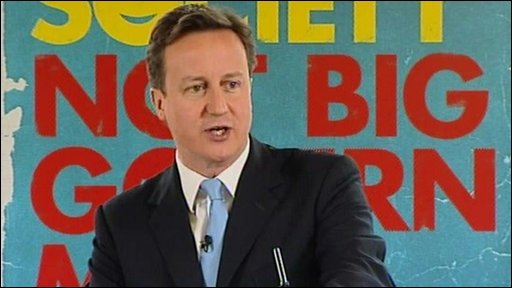 Cameron and his slogan: "Big Society, Not Big Government". Catchy, eh?
Despite this avowed self-denial, however, Cameron and his attack dog, Communities and Local Government Secretary Eric Pickles, are quick to decry any cuts to front-line services that councils feel they have to impose. They call instead for what they term “back-office savings”. This, the latest in a long line of political weasel phrases, is meant to convey a cut that is only painful for local authorities themselves and that somehow mysteriously does not affect the public (that is to say the voter). What this phrase means in practice, of course, is redundancies and pay cuts. These measures, devastating for individuals, are less visible and less likely to bring onto the streets members of the public (as opposed to organised demonstrators like students and union members). They are being demanded of the police, the NHS and the BBC as well as of local councils.
Of course, as I pointed out in a letter published in The Guardian last week, the government has yet to demand “back-office savings” of those banks that are now partly in public ownership or indeed of any other institutions staffed by what used to be called “the Tories’ friends in the City”. Even in middle England, resentment of the kid-gloves treatment of the banks and their greedy employees is detectable. People have wearied of the government being sucker-punched by the banks with their "warnings" that "the best people" will go abroad or that whole businesses will relocate if the managers don't receive shedloads of money. Call their bluff, tell them to fuck off if they'd prefer to live in any other country that will have them (if indeed any other will). Redraw the tax laws so that earnings made in Britain cannot be sheltered in tax havens. Let those who live and work elsewhere but keep a home here and send their kids to schools in Britain pay a big levy for the privilege.
In any case, what about all those scientists whose resarch funding is being cut? Doesn't the government fret about them moving abroad in a new brain drain? What about other important talents and skills: academics, teachers, doctors, nurses, surgeons, law enforcement officers, writers, directors, actors, technicians of all kinds? Why should greedy bankers be the only people Britain wants to keep?
As for local authorities, I advocate that councils play on this restiveness in the Tory heartlands. The government is taking an avowedly partisan line in palming the choice of cuts onto councils while distancing itself from the choices that those councils make. Is there any reason why the councils should not respond in kind – for instance, by withdrawing services (refuse collection, road repairs) specifically from those wards that returned Conservative and Liberal Democrat councillors, on the argument that those residents will be looked after by the Big Society?
Cameron continues to believe that he can distract the electorate from their increasing pain by his talk of creating a Big Society (or his BS as it is widely called in Westminster and Whitehall). Defending the concept in The Observer, Cameron tried to pre-empt his critics: “the first objection [to the Big Society] is that it is too vague” but the rest of his article was unspecified, unargued waffle. For instance, he reckons that “if neighbours want to take over the running of a post office, park or playground, we will help them” but he ignores the obvious objection that there are well-established regulations, drawn up to protect both people and institutions, which cannot simply be “taken over”. Cameron airily says that he’s going to sweep away all those checks and balances that prevent untested people from working with children, a curious stance in the light of his subsequent rant against the Supreme Court.
 Stay out of my garden, Maude
Francis Maude, the Minister for the Cabinet Office and another bête noire of the Tory right, has been obliged by Cameron to speak for the BS concept – it is noticeable that no other cabinet member ever mentions it – and he has been complaining that Labour have been spreading the myth that the BS is just a cover for the cuts. This is pretty rich when you consider how repeatedly (and evidently successfully) the government has put onto the last Labour government the whole blame for what, at the time, we all understood to be a global recession. Now that inflation is the latest statistic to be soaring on his watch, the Chancellor George Osborne announces that it is an “international problem”. How does that work, then?
Ministers need a diversionary tactic because they have begun to comprehend that the cuts will grow steadily more unpopular and that the government that the voters will seek to punish is their own. Blaming Labour will pay diminishing returns. Ministers are now talking in terms of "unpopular but necessary measures" rather than simply "necessary measures". Forecasts of "choppy water" and "difficult months" pop up almost routinely, as if to soften the blows that the government knows it will receive in by- and local elections this year. "We're in for a long haul to get back to normality" Clarke told The Telegraph.
What is so distasteful about this kind of talk is that it is all about the government's own fortunes and nothing about the people's deprivations. "When we get through this." the assumption is, "the nation will thank us". But for people who lose their jobs, their homes, their services, their support, their businesses, maybe their health and in some cases even their lives, there will be no recovery. The damage that the government is doing now will, for many people, be irrevocable.
Subscribe to:
Posts (Atom)

