The LOUD LAUGH that SPOKE the VACANT MIND
In today’s Daily Telegraph, the columnist I love to hate, Simon Heffer, has once again voyaged into a subject of which he knows nothing: humour. Here is the link:
http://bit.ly/k4klbX
I shall now make Mr Heffer chuckle uncontrollably (given his susceptible funny bone) by revealing that my own name for him is Siphon Effluent. Did you see what I did there, Simon? Good, isn’t it.
The occasion of Mr Effluent’s latest outpouring was the wonderfully witty and hilarious wisecrack delivered in the house at Prime Minister’s Questions when the PM advised shadow minister Angela Eagle to “calm down, dear”. He and his backbenchers thought this so much funnier than the complete works of Oscar Wilde, SJ Perelman, PG Wodehouse and Stephen Fry rolled into one that Mr Cameron felt called upon to repeat the joke a further six times. Laugh? I thought I’d have to bite the television remote.
Siphon Effluent with his beloved Thatch
Laughter in the house is not like laughter anywhere else (except probably the Bullingdon Club and the Oxford Union). It is a mirthless howl, the kind of har-har-har braying, accompanied by forced slapping of fat hams, that speaks not at all of appreciative and judicious admiration for a finely-turned phrase but entirely of bullies putting in the boot after their loudest mouth (whom they fear, or at least require to impress with “loyalty”) has played to the lowest common denominator by landing on an opponent a blow to the solar plexus. This kind of knee-jerk oinking is certainly not the prerogative of Flashmanesque Tories. All the other party cannon-fodder do it too, even (I shouldn’t wonder) the Greens. It was noticeable though that, while George Osborne hooted like a hairdresser at a Cher concert, Nick Clegg sat stony-faced throughout the entire episode.
Politicians as a breed are not all that amusing. Even some quite smooth orators, while skilled at rousing an audience, cannot deliver a funny line. Those politicos who are able to reveal a responsive sense of humour in a general way can indeed be funny themselves, regardless of political inclination: Heseltine, Kinnock, Kennedy, Hattersley, Portillo, Skinner, Widdecombe (the latter, perhaps, unintentionally). Ed Miliband shows encouraging signs of being able to mock thoughtfully, helped by some evidence that he doesn’t take himself too seriously all of the time. John Smith had a charmingly deprecating sense of humour.
Angela Eagle: shot down by Cameron's deadly wit
In earlier generations, Harold Macmillan had a dry clubman’s wit, often quite lethal. Harold Wilson could be witheringly funny. Jo Grimond and Jeremy Thorpe were both quick-witted and smart Liberal Party leaders. I remember an edition of Any Questions? celebrating some early anniversary, during which Thorpe astonished all by his pitch-perfect and brilliantly “scripted” impersonations of some of the programme’s stalwarts not present in that edition: Ralph Whiteman, Ted Leather, Gerald Nabarro.
Winston Churchill’s many witticisms have gone down in legend, though some of them would fail modern tests of acceptability. No PM since has matched Churchill’s style, timing and sheer sense of mischief – “Bossom?” he sniffed at the surname of a new member. “Neither one thing nor the other”. But at least one contemporary statesman can deliver a witty speech with perfect timing and aplomb. Go to
http://bit.ly/jDop1g
to laugh out loud at Barack Obama's speech to yesterday's White House correspondents' dinner.
Typically, politicians have ‘jokes’ written for them, which they proceed to mangle in delivery, yet the faithful roar with simulated delight anyway. Tony Blair thought himself jolly good-humoured but the kind of thing that made him weep with laughter was that singing fish novelty that was all the rage among people with no taste for a day and half some time in the late ‘90s. Gordon Brown’s delivery of a joke was as leaden as John Major’s or Edward Heath’s. And Siphon Effluent’s great heroine, Margaret Thatcher, had no sense of humour whatsoever. The antediluvian playwright Sir Ronald Millar – don’t hold your breath for a revival of his plays – wrote the “you turn if you want to – the lady’s not for turning” shtik, a desperately laborious conceit even in skilled hands, but it brought a Tory conference to its knees weeping with uncontrollable mirth, despite that the dear leader had performed it with considerably less panache than Neville Chamberlain announcing “consequently this country is at war with Germany”.
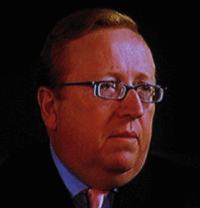
Siphon Effluent: the HL Mencken de nos jours
Siphon Effluent himself does make me laugh, mostly because he contrives to present the appearance of a sugar pig with marmalade smeared on his head. But his writing is dominated by his desire to be disobliging and, if he ever threatens to try for humour, it never ventures further than peevish scorn. He always refers to Mr Cameron as “Dave” – this is known in the trade as a “running gag” – presumably because he disdains a Tory leader who is not Thatcher and because some of the PM’s intimates appear to refer to him by this builder’s-mate moniker. (Not least of these intimates is the first lady, Samantha Cameron. There again, her sense of humour was revealed yesterday when she appeared to think it a jolly jape to roll up at a formal state occasion dressed for a constituency coffee morning; gratifyingly, she was comprehensively outshone by the effortlessly chic Miriam Clegg).
Bernard Manning: evidently he and Effluent were separated at birth
In his piece on humour, Effluent makes a strenuous joke in calling Angela Eagle “a harridan”. He was so pleased with this that he repeated it. Now, Effluent is very keen on the correct use of English. Indeed, he is the in-house English monitor at The Telegraph, apt to send stinging emails to hapless journalists who have offended his sensibilities. So I find myself surprised that he should use the term “harridan”, which is defined by the OED as “a haggard old woman”, of a personable female of just 50.
Effluent writes further: “I suspect even Dave has the manners not to address a woman with whom he is not well acquainted as ‘dear’ except in jest” and later, on a different matter, “This column prides itself on its gallantry towards the ladies”. Yet he himself has the ungallant lack of breeding to write of a woman with whom he is not well acquainted in such an insulting manner. I think he should stand in the corner.
With brilliant skill and dazzling wit, Effluent turns what his admirers might have feared was a mortal thrust at “Dave” into an all-guns-blazing assault on Labour and “lefties” in general: “His [Cameron’s] mistake, however, was to think that these people are easy-going types who like a laugh. He has, at least, now admitted he realises that the Left doesn't have a sense of humour”.
Jim Davidson: also seems to come in a similar shade to Effluent
Ah yes, the age-old canard that “lefties” have “no sense of humour”. It is of course fair and just to observe that there are individuals who are earnest and single-minded about their politics, but I never found that this degree of dedication was confined to the left. Had it been, we might now live in a more enlightened world. But the myth persists: on Any Questions? this weekend, UKIP leader Nigel Farage spoke of “po-faced Republicans”.
It can be argued – I have argued it myself – that comedy is fundamentally reactionary because it requires a reliable and enduring establishment, status quo, conventional wisdom against which to bounce. So, while pretending to subvert and mock, comedy really reinforces and humanises. It’s Lear’s Fool syndrome – the absolute monarch permits an all-licensed jester precisely because he is absolute and therefore the jester cannot draw blood, only wry smiles.
But there are many conventional wisdoms. Changes of government do not signal the end of satire. Effluent seems to imagine that only reactionary people are capable of being funny. “Comedians who are not Leftists” essays Effluent “have more or less been driven out of business. Bernard Manning was martyred in this cause. Jim Davidson is in the process of following him, not because he isn't funny, but because he was a strong supporter of Mrs Thatcher. Long after she left office, the spiteful little creeps who form the ‘comedy’ establishment of this country would get laughs from their bovine audiences simply by mentioning her name”.
Tom Lehrer: 'We Will All Go Together When We Go'
If Effluent sees himself as a comedian, this is certainly his most laughable passage. The idea that Manning was “martyred” is preposterous. He may have fallen out of television fashion – many entertainers do and politics has nothing to do with it – but his club work (including at his own club) continued to bring him a handsome income. And I can’t help wondering how often Effluent was to be seen knocking back pints with hoi polloi at Manning’s place, roaring with delight and slapping his hams at “fookin’ Paki” so-called “gags”. If nothing else, the vulgarity of it all seems extremely unlikely to have appealed to Mr & Mrs Effluent as an alternative to their beloved Wagner, any more than one can picture them tripping to the end of a pier to rock with joy at Jim Davidson’s version of fun.
Perhaps Effluent is thinking of Ben Elton when he writes of “the spiteful little creeps” mentioning Thatcher’s name for a laugh. Elton certainly used to do stuff about the woman he called Thatch but that was back in the ‘80s in his spangly-suited phase. I would gently suggest that if Effluent were to take tea with Elton at the Ritz and probe him for his present political views, he might find that they have more in common than he imagines.
Roy Battersby: as you see, an archetypal po-faced leftie
There have been plenty of intelligent, thoughtful and far from spiteful comics who are not reactionaries. In Effluent’s youth, he might have been aware of the American Tom Lehrer, a finely witty, talented and scrupulous social satirist who announced his retirement when Henry Kissinger was awarded the Nobel Peace Prize, on the grounds that the award rendered satire obsolete.
But even staunchly committed left-wingers have sprightly senses of humour. Tariq Ali, whom I knew a bit at one time, is a warmly funny and witty man. My old chum Roy Battersby would certainly fill the bill for Effluent when looking for a fully paid-up leftie. Roy was a key member of the Workers’ Revolutionary Party in the 1970s and ‘80s, took five years out of his directing career to work full-time for the party as its chief representative on the Palestinian question (he made a moving documentary called The Palestinian, fronted by Vanessa Redgrave), stood for parliament and was involved in the supposedly notorious Red House centre which was a constant target for MI6. Yet my abiding image of him is of a man wreathed in a beatific smile, relishing the pleasures of life and laughing uproariously at its manifold absurdities.
There is an unbridgeable gulf between, on the one hand, Roy, Tariq and Tom Lehrer and, on the other, a Simon Heffer whose idea of a comedian is Manning or Davidson and a David Cameron who thinks he’s being witty by quoting someone as repellent as Michael Winner in something as low class as a television advertisement and claims that anyone who cannot see such rubbish as meritorious lacks a sense of humour. I can’t imagine finding anything in common (humorous or otherwise) with anyone who would rather reside on the Heffer/Cameron/Manning side.
Showing posts with label Winston Churchill. Show all posts
Sunday, May 01, 2011
Sunday, October 05, 2008
WHITE FLAGS of ALL NOTIONS
While not accounted by any disinterested party ‘the winner’ of the Vice Presidential debate, Governor Palin was widely held to have drawn a little blood from Senator Biden with her disdainful dismissal of Senator Obama’s proposal to bring home the troops from Iraq in sixteen months: “Your plan is a white flag of surrender in Iraq and that is not what our troops need to hear today, that’s for sure”. It’s the kind of jut-jawed fundamentalism that gets plain folks whoopin’ and hollerin’ in the small towns where many of the votes are still up for grabs. Joe Biden didn’t squash it flat; Barack Obama needs to do so before the polls open. Because it’s rubbish.
“We’ll know we’re finished in Iraq”, Mrs Palin went on, “when the Iraqi government can govern its people and when the Iraqi security forces can secure its people”. This was less incendiary. Indeed, it was a tacit admission that Senator McCain’s commitment to the famous “surge” and its continued implementation is open-ended. Under successive Presidents McCain and Palin, American troops could still be in Iraq in 2024 at a cost at today’s prices (let alone tomorrow’s) of $10 billion per month. The home economy will be in more tatters than it is now.
The Obama team needs to nail the McCain camp on what they mean when they proclaim that the surge is working and that the troops are winning and that they won’t withdraw until they secure victory. What do they mean by victory? Is Sarah Palin’s answer the official one and how widely will such a resolution be recognized? To Joe Six-Pack and his Hockey-Mom wife sitting at home, it looks easy: American tanks rolling through a town cheered by civilians. That’s what Bush’s proclaimed victory looked like in 2003 in Baghdad. Joe and Honey now know that it wasn’t a victory, that it was just, in Churchill’s phrase, “the end of the beginning”.
What would constitute a situation that John McCain could genuinely call a victory? Any spin-doctor can dress up a picture and make it look better than it is but, in these days of embedded reporters and troops who are used to talking to the media, it’s harder to bamboozle the public than, for example, our leaders found at the time of World War I. What’s more, the media’s interests are global, like everyone else’s, and knee-jerk patriotism is no longer on offer as coverage.
A supporter of the surge, like McCain, is bound to stick with it because he cannot admit that he might be wrong. Unfortunately, most politicians have the same problem. Prince El Hassan bin Talal of Jordan, an elegant diplomat and a wily observer of the international scene, is fond of the saying: “The gentle art of saving face may yet destroy the human race”. If we get a President McCain, I hope the Prince emails it to him on his first morning.
Over the weekend, the Commander of the British Air Assault Brigade in Afghanistan, Brigadier Mark Carleton-Smith, told The Sunday Times: “We’re not going to win this war. It’s about reducing it to a manageable level of insurgency that’s not a strategic threat and can be managed by the Afghan army.
“We may well leave with there still being a low but steady level of insurgency … If the Taliban were prepared to sit on the other side of the table and talk about a political settlement, then that’s precisely the sort of progress that concludes insurgencies like this. That shouldn’t make people uncomfortable”.
The Brigadier’s observations would not be welcomed by McCain who said in his debate with Obama – and Palin repeated the jibe – that to sit down with the enemy “without preconditions” is naïve and self-defeating. But to be unconcerned with saving face is not the same as being irresolute and, quoting Churchill again, “to jaw-jaw is always better than to war-war”. Preconditions are too easily an excuse for refusing to talk at all. A truly strong and perceptive and fearless leader is prepared to go anywhere to talk to anyone about anything if it might preserve or hasten peace.
The US is not going to have a victory in Iraq in any form that its homeland will understand. Modern war is not like Wellington winning Waterloo. And you have to wonder whether a remotely recognizable victory is actually worth the cost, in lives and damaged minds and the destruction of communities as well in material ways. When the last American troops do finally leave Iraq, whether in the first term of a President Obama or at the behest of some as yet unknown future incumbent, what will we be able to point to and say “that has been achieved”? The danger for the US is that, by the time its troops leave, the reign of Saddam Hussein will be so far in the past that it will no longer seem to have been any part of the exercise.
And the conundrum that a President McCain or a President Palin would have to face is that as long as there are US troops in Iraq, they will be acting as a spur to insurgency. Whether an American politician thinks it justified or not, the fact is that many if not most Iraqis view the Americans as an invading army and will not rest until they are gone. It is the presence of foreign troops that keeps insurgency alive. just as it would do in any self-respecting country. Was it not the Americans who threw out the British more than 230 years ago? Had the British decided that they would stay until they had ‘victory’, they might still be there.
There is something a new president can do. Reject the Bush administration’s disdain for the rest of the world, go to the UN and ask the security council to agree to replace all national troops in both Iraq and Afghanistan with a non-partisan UN force of peace-keepers. That way, the western allies do not leave the respective regimes in those countries at the mercy of revolutionaries, fundamentalists and terrorists but they do pass the absurd costs of playing global policemen to the organisation whose function is to do just that. I don’t know why Bush and Blair didn’t think of this in the first place. (Well, I do know why but it does neither of them any credit).
While not accounted by any disinterested party ‘the winner’ of the Vice Presidential debate, Governor Palin was widely held to have drawn a little blood from Senator Biden with her disdainful dismissal of Senator Obama’s proposal to bring home the troops from Iraq in sixteen months: “Your plan is a white flag of surrender in Iraq and that is not what our troops need to hear today, that’s for sure”. It’s the kind of jut-jawed fundamentalism that gets plain folks whoopin’ and hollerin’ in the small towns where many of the votes are still up for grabs. Joe Biden didn’t squash it flat; Barack Obama needs to do so before the polls open. Because it’s rubbish.
“We’ll know we’re finished in Iraq”, Mrs Palin went on, “when the Iraqi government can govern its people and when the Iraqi security forces can secure its people”. This was less incendiary. Indeed, it was a tacit admission that Senator McCain’s commitment to the famous “surge” and its continued implementation is open-ended. Under successive Presidents McCain and Palin, American troops could still be in Iraq in 2024 at a cost at today’s prices (let alone tomorrow’s) of $10 billion per month. The home economy will be in more tatters than it is now.
The Obama team needs to nail the McCain camp on what they mean when they proclaim that the surge is working and that the troops are winning and that they won’t withdraw until they secure victory. What do they mean by victory? Is Sarah Palin’s answer the official one and how widely will such a resolution be recognized? To Joe Six-Pack and his Hockey-Mom wife sitting at home, it looks easy: American tanks rolling through a town cheered by civilians. That’s what Bush’s proclaimed victory looked like in 2003 in Baghdad. Joe and Honey now know that it wasn’t a victory, that it was just, in Churchill’s phrase, “the end of the beginning”.
What would constitute a situation that John McCain could genuinely call a victory? Any spin-doctor can dress up a picture and make it look better than it is but, in these days of embedded reporters and troops who are used to talking to the media, it’s harder to bamboozle the public than, for example, our leaders found at the time of World War I. What’s more, the media’s interests are global, like everyone else’s, and knee-jerk patriotism is no longer on offer as coverage.
A supporter of the surge, like McCain, is bound to stick with it because he cannot admit that he might be wrong. Unfortunately, most politicians have the same problem. Prince El Hassan bin Talal of Jordan, an elegant diplomat and a wily observer of the international scene, is fond of the saying: “The gentle art of saving face may yet destroy the human race”. If we get a President McCain, I hope the Prince emails it to him on his first morning.
Over the weekend, the Commander of the British Air Assault Brigade in Afghanistan, Brigadier Mark Carleton-Smith, told The Sunday Times: “We’re not going to win this war. It’s about reducing it to a manageable level of insurgency that’s not a strategic threat and can be managed by the Afghan army.
“We may well leave with there still being a low but steady level of insurgency … If the Taliban were prepared to sit on the other side of the table and talk about a political settlement, then that’s precisely the sort of progress that concludes insurgencies like this. That shouldn’t make people uncomfortable”.
The Brigadier’s observations would not be welcomed by McCain who said in his debate with Obama – and Palin repeated the jibe – that to sit down with the enemy “without preconditions” is naïve and self-defeating. But to be unconcerned with saving face is not the same as being irresolute and, quoting Churchill again, “to jaw-jaw is always better than to war-war”. Preconditions are too easily an excuse for refusing to talk at all. A truly strong and perceptive and fearless leader is prepared to go anywhere to talk to anyone about anything if it might preserve or hasten peace.
The US is not going to have a victory in Iraq in any form that its homeland will understand. Modern war is not like Wellington winning Waterloo. And you have to wonder whether a remotely recognizable victory is actually worth the cost, in lives and damaged minds and the destruction of communities as well in material ways. When the last American troops do finally leave Iraq, whether in the first term of a President Obama or at the behest of some as yet unknown future incumbent, what will we be able to point to and say “that has been achieved”? The danger for the US is that, by the time its troops leave, the reign of Saddam Hussein will be so far in the past that it will no longer seem to have been any part of the exercise.
And the conundrum that a President McCain or a President Palin would have to face is that as long as there are US troops in Iraq, they will be acting as a spur to insurgency. Whether an American politician thinks it justified or not, the fact is that many if not most Iraqis view the Americans as an invading army and will not rest until they are gone. It is the presence of foreign troops that keeps insurgency alive. just as it would do in any self-respecting country. Was it not the Americans who threw out the British more than 230 years ago? Had the British decided that they would stay until they had ‘victory’, they might still be there.
There is something a new president can do. Reject the Bush administration’s disdain for the rest of the world, go to the UN and ask the security council to agree to replace all national troops in both Iraq and Afghanistan with a non-partisan UN force of peace-keepers. That way, the western allies do not leave the respective regimes in those countries at the mercy of revolutionaries, fundamentalists and terrorists but they do pass the absurd costs of playing global policemen to the organisation whose function is to do just that. I don’t know why Bush and Blair didn’t think of this in the first place. (Well, I do know why but it does neither of them any credit).
Friday, February 09, 2007
POSTING the LIVING
When I began to collect postage stamps in the 1950s, there were rigorous rules about the kind of people who appeared on the nation’s envelopes. Since the Penny Black was first issued in 1840, only the reigning monarch was depicted on the stamps, the head and neck of Queen Victoria and Kings Edward VII, George V, Edward VIII and George VI, the head and shoulders of the present Queen, first in three-quarter face (all her predecessors had appeared as profiles, save for the younger George V), then from 1968 in profiled silhouette.
The first person seen on a stamp who was not head of state was George VI’s consort. The opening issue of his reign was a single brown stamp to mark the coronation; his wife unexpectedly took an equal share of the stamp. A couple of significant developments in stamp design had occurred in his father’s reign. In 1924 and 1925, successive pairs of issues marked the British Empire Exhibition of those years. These were the first of what came to be known as “commemoratives”, issued for a limited period and tied to a particular event, as opposed to the smaller stamps – always available and bearing only the monarch’s head with more or less decoration around it – that are known as “definitives”.
More commemoratives appeared in George VI’s time, including a set for the London Olympics of 1948 that, for the first time, included a non-royal figure. It was, however, a safely mythic one: “winged victory”. With Elizabeth II’s reign came more change. Figures began to be depicted that were not even mythic, though they were certainly emblematic: a postboy of 1660, stylized children representing Freedom from Hunger and generalized lifeboatmen.
Under the Postmaster-Generalship of the government minister then known as Anthony Wedgwood Benn, a major change took place. Apart from a great proliferation of commemoratives and the aforementioned redesign of the Queen’s head, Benn permitted the first identifiable commoner to be depicted on stamps when the quatercentenary of Shakespeare’s birth was marked by five issues, the largest set to date. The following year, the death of Churchill was even more controversially made subject of a two-stamp issue.
Thereafter, the convention has been that commoners may be depicted on the postage stamps, provided that they are no longer alive. In fact, several living members of the public have appeared, through the increasing use of photography as well as graphic design, but those depictions have been anonymous and as emblematic as the stylized postboy and lifeboatmen of the ‘60s.
Then, rather by accident, a living commoner did creep onto a stamp. In June 1999, the Post Office was partway into a project to mark the millennium with a succession of monthly sets on general themes. That month featured entertainers and the 19p issue showed Freddie Mercury on stage. Mercury was dead by this time but the other members of Queen were and are alive and, in the photograph that provided the basis for the design, the group’s drummer is visible. Thus does Roger Taylor merit a footnote in philatelic history.
Four years later, the England rugby team won the World Cup in Australia and, in the December, the Post Office issued a miniature sheet of four stamps to honour this victory. Each of the four designs carefully avoided showing the face of any player, though I dare say aficionados of the sport knew from the back views and shirt numbers which players were in the photographs and which were not.
By October 2005, the rules had been relaxed. A similar miniature sheet was issued to hail the England cricket team winning the Ashes. This time, players were seen full on and perfectly recognizable on the stamps. In that case, I couldn’t see why there shouldn’t be a stamp to mark Harold Pinter winning the Nobel Prize for Literature. But no such issue materialized.
The recent issue of stamps, which apparently “commemorates the first meeting of the young Paul McCartney and John Lennon fifty years ago”, takes the breakdown of the rules considerably further. Apart from a miniature sheet featuring Beatles collectables, the individual stamps each feature a Beatles album cover and hence the surviving members of the group, Sir Paul and Ringo Starr, are immortalized in the post. It says something about the philistine nature of the age that the first extant people in the public eye to be honoured on stamps are all sportsmen and pop stars.
Existing old masters, photographs and other images have been so miniaturized before but this issue is also a first in another way: the first time marketing images have been depicted on stamps. The reason for it quickly became clear to me. When I went to buy my own copies, the main post office in Bath had sold out of the stamps. A diligent counter staffer managed to rustle up a couple of strays but otherwise, she reported, their whole quota had gone in the first two days. Of course, collectors of Beatles memorabilia – a huge and ravening horde – fell upon this issue. It’s inevitable that the Post Office will note this and look at other subjects that have a commercial potential outside the usual run of stamp issues.
On Tuesday, a new set will be issued to celebrate half a century of the television programme The Sky at Night. Sir Patrick Moore is conspicuous by his absence. Not even a monocle indicates any connection of the issue to earth or its doings. Though BBC and ITV anniversaries have – legitimately, I feel – been marked by stamp issues, it seems nakedly populist for the Post Office to make a single television programme the subject of a set. Whatever next? A set based on I’m a Celebrity – Get Me Out of Here? A miniature sheet commemorating the Beckhams’ move to Los Angeles?
By the by, I eventually did find the remaining Beatles stamps, so please do not send me any, however poignant my plight might seem.
When I began to collect postage stamps in the 1950s, there were rigorous rules about the kind of people who appeared on the nation’s envelopes. Since the Penny Black was first issued in 1840, only the reigning monarch was depicted on the stamps, the head and neck of Queen Victoria and Kings Edward VII, George V, Edward VIII and George VI, the head and shoulders of the present Queen, first in three-quarter face (all her predecessors had appeared as profiles, save for the younger George V), then from 1968 in profiled silhouette.
The first person seen on a stamp who was not head of state was George VI’s consort. The opening issue of his reign was a single brown stamp to mark the coronation; his wife unexpectedly took an equal share of the stamp. A couple of significant developments in stamp design had occurred in his father’s reign. In 1924 and 1925, successive pairs of issues marked the British Empire Exhibition of those years. These were the first of what came to be known as “commemoratives”, issued for a limited period and tied to a particular event, as opposed to the smaller stamps – always available and bearing only the monarch’s head with more or less decoration around it – that are known as “definitives”.
More commemoratives appeared in George VI’s time, including a set for the London Olympics of 1948 that, for the first time, included a non-royal figure. It was, however, a safely mythic one: “winged victory”. With Elizabeth II’s reign came more change. Figures began to be depicted that were not even mythic, though they were certainly emblematic: a postboy of 1660, stylized children representing Freedom from Hunger and generalized lifeboatmen.
Under the Postmaster-Generalship of the government minister then known as Anthony Wedgwood Benn, a major change took place. Apart from a great proliferation of commemoratives and the aforementioned redesign of the Queen’s head, Benn permitted the first identifiable commoner to be depicted on stamps when the quatercentenary of Shakespeare’s birth was marked by five issues, the largest set to date. The following year, the death of Churchill was even more controversially made subject of a two-stamp issue.
Thereafter, the convention has been that commoners may be depicted on the postage stamps, provided that they are no longer alive. In fact, several living members of the public have appeared, through the increasing use of photography as well as graphic design, but those depictions have been anonymous and as emblematic as the stylized postboy and lifeboatmen of the ‘60s.
Then, rather by accident, a living commoner did creep onto a stamp. In June 1999, the Post Office was partway into a project to mark the millennium with a succession of monthly sets on general themes. That month featured entertainers and the 19p issue showed Freddie Mercury on stage. Mercury was dead by this time but the other members of Queen were and are alive and, in the photograph that provided the basis for the design, the group’s drummer is visible. Thus does Roger Taylor merit a footnote in philatelic history.
Four years later, the England rugby team won the World Cup in Australia and, in the December, the Post Office issued a miniature sheet of four stamps to honour this victory. Each of the four designs carefully avoided showing the face of any player, though I dare say aficionados of the sport knew from the back views and shirt numbers which players were in the photographs and which were not.
By October 2005, the rules had been relaxed. A similar miniature sheet was issued to hail the England cricket team winning the Ashes. This time, players were seen full on and perfectly recognizable on the stamps. In that case, I couldn’t see why there shouldn’t be a stamp to mark Harold Pinter winning the Nobel Prize for Literature. But no such issue materialized.
The recent issue of stamps, which apparently “commemorates the first meeting of the young Paul McCartney and John Lennon fifty years ago”, takes the breakdown of the rules considerably further. Apart from a miniature sheet featuring Beatles collectables, the individual stamps each feature a Beatles album cover and hence the surviving members of the group, Sir Paul and Ringo Starr, are immortalized in the post. It says something about the philistine nature of the age that the first extant people in the public eye to be honoured on stamps are all sportsmen and pop stars.
Existing old masters, photographs and other images have been so miniaturized before but this issue is also a first in another way: the first time marketing images have been depicted on stamps. The reason for it quickly became clear to me. When I went to buy my own copies, the main post office in Bath had sold out of the stamps. A diligent counter staffer managed to rustle up a couple of strays but otherwise, she reported, their whole quota had gone in the first two days. Of course, collectors of Beatles memorabilia – a huge and ravening horde – fell upon this issue. It’s inevitable that the Post Office will note this and look at other subjects that have a commercial potential outside the usual run of stamp issues.
On Tuesday, a new set will be issued to celebrate half a century of the television programme The Sky at Night. Sir Patrick Moore is conspicuous by his absence. Not even a monocle indicates any connection of the issue to earth or its doings. Though BBC and ITV anniversaries have – legitimately, I feel – been marked by stamp issues, it seems nakedly populist for the Post Office to make a single television programme the subject of a set. Whatever next? A set based on I’m a Celebrity – Get Me Out of Here? A miniature sheet commemorating the Beckhams’ move to Los Angeles?
By the by, I eventually did find the remaining Beatles stamps, so please do not send me any, however poignant my plight might seem.
Subscribe to:
Posts (Atom)


