Showing posts with label Barack Obama. Show all posts

Saturday, August 24, 2013

The FIRST CASUALTY of WAR

The Syrian government has declared variously that the missile attack on the Ghouta suburbs of Damascus early on Wednesday did not take place at all, that it took place but that no chemical weapons were involved, and that chemical weapons were indeed involved but that they were inflicted by rebel forces. These statements cannot all be correct. Is any of them true?

There can be no doubt that an attack did take place. Many civilians died; the opposition claims more than a thousand. That people did die is beyond argument. Also not disputed is that the area where they died is characterised by resistance to the government’s attempts to quell the civil unrest – let us not prejudge anything by calling it a civil war – for the last two years.

Dead Syrian children

Moreover, all the recorded evidence so far offered to the world shows people suffering in a way that is not commensurate with an attack by conventional weapons. The victims are not showing blast injuries. Their motor functions are affected, particularly the breathing instinct. The spread of this effect on humans is evidently much wider than any structural damage in the area. There can be no doubt that, whatever killed these people, it was not explosives.

Was it a chemical agent? Only an impartial examination at the site can determine this to general satisfaction. Whether such an examination is possible depends wholly on the Syrian government itself. If Assad denies the inspectors, we shall be entitled to draw a conclusion, as I will consider in a moment.

Meanwhile, I want to try to examine the government’s notion that the footage widely circulated across the world is, in some sense, a “fabrication”. Presumably that would mean that the convulsing children that we have seen are actors, that people are playing at being dead. Is this at all credible? I submit that it is not. Given the chaotic nature of what we see, it would require remarkable creativity to “stage” such chaos without any glitch that revealed deception. Is any of the material released at all questionable? If it were, wouldn’t someone have noticed by now?

Dead Syrian adults

So it seems pretty conclusive that these things are established: i) that there was an attack; ii) that many civilians died; iii) that some kind of non-blast weapon was responsible for the casualties.

Now we come to the bottom line for the Assad government: the attack was inflicted by the rebels themselves. Does this argument have any merit? Well, it is certainly possible to suggest a motive for the rebels: that they wish to blackguard the Assad regime and “shame” foreign governments into intervening on behalf of the insurrection. William Hague’s increasingly bullish statements since Wednesday morning suggest that, if that was the aim, it is having some traction, at least with the British government. Obama remains carefully non-committal.

But is it possible to stand up the argument that the rebels would inflict such a grotesque death on the families of its own people, even if the exercise could be held to have a chance of tipping the argument about intervention?

Hague: bullish

I am reminded of a Jewish friend with family in Israel who told me in all seriousness that, when Israeli planes attack the Gaza strip, Palestinians lay their small children on the roofs of their homes so that they are more likely to be killed and hence the Israelis can be accused of war crimes. Although she has a Cambridge degree and has worked in current affairs broadcasting all her adult life, she could not recognise black propaganda when it was offered. I gently pointed out the notorious precedent that the Nazis spread lies about the morality of the Jews in order to make them appear less than human and so more dispensable, but she wouldn’t make the connection. People are willing to believe anything, however far-fetched, if it reflects badly on their enemy.

If the Syrian rebels did this themselves, a lot of people would necessarily be in on the exercise. How could the rebels be sure that no one would expose the deception? Yet we still await the first report of any defector from the opposition’s cause, decrying the tactics of the rebels, whereas several highly-placed officials in the Assad regime have left the country in disgust. Moreover, it is known that the Syrian government has developed chemical weapons: that is not at issue. When would they deploy such weapons, then, if not in a situation that they themselves account a profound threat to the state? It is always possible that Syrian rebels have gained access to chemical weapons, but there is as yet no independent evidence of it.

The UN inspectors ought to have the expertise to determine whether chemical weapons are in opposition hands. They are presently in Syria but the government will not permit them to visit Ghouta. Why so? That there are inspectors in the country at all is only as a result of protracted negotiations. The government says it cannot guarantee the inspectors’ safety. The rebels have said they will ensure that the inspectors are safe in Ghouta. If the inspectors are prepared to go, what argument remains to Assad? We must conclude that he fears what they will discover. If he wants to stay credible, he needs to pre-empt that conclusion.

Obama: non-committal

If there were an international consensus that the Assad government used chemical weapons against its own people, that would change the game, if only in that (once hostilities cease, if they ever do) Assad could be brought before the international court to face charges of war crimes. But there is no such consensus. Alexander Lukashevich, the Russian foreign office spokesman, declared that a homemade rocket carrying unidentified chemical substances had been launched from an area controlled by the opposition.

“All this cannot but suggest that once again we are dealing with a pre-planned provocation,” his statement continued. “This is supported by the fact that the criminal act was committed near Damascus at the very moment when a mission of UN experts had successfully started their work of investigating allegations of the possible use of chemical weapons there ... Moscow considers important an objective and professional investigation into what happened. And we call on all those who have the possibility to influence armed extremists to make every effort to end provocations with chemical agents”.

Moscow mouthpiece Lukashevich

Of course, if the Russians want to argue that the occurrence of this “criminal act” at the time of the US inspectors’ visit argues for it being an attack by rebels, one might counter that it could just as well be a double bluff, that the Assad regime launched the attack fully intending to tell the inspectors that it must be the rebels’ action. If the rebels are capable of staging an atrocity to look like the work of the government, the reverse is just as feasible and even more likely to be doable.

Russia’s alliance with Syria ensures that the UN’s hands are tied in any attempt to approve some anti-Assad action through the security council. As with so many other international crises, the fact that certain powerful nations may wield a veto leaves the UN powerless and raises the stakes for those nations that would be prepared to make some intervention. I have argued before that the UN’s charter needs to be rewritten and, at the risk of exasperating my regular readers, I am now going to argue it again.

No substantial rewrite of the charter has occurred since it was first drawn up in 1945. The time has long past when the UN needs to be given power independent of individual member states, power greater than any individual member, indeed greater than the sum of individual members.

The veto has to be scrapped. No nation, neither China nor Russia nor the US, can be permitted to continue to block the business of the UN and to override the will of a majority of members. All nations should have the same stake in the global community.

Support for Assad

The UN needs to have the power – by which I mean the military power – to intervene in any breakdown of peaceful coexistence and to impose a cessation of hostilities. This might be between any two or more nations squaring up to each other – say, Israel and Lebanon or Azerbaijan and Armenia – or within a sovereign nation where the ruling party is fighting any kind of insurrection – Somalia or Colombia or Libya or Egypt. Where the UN deems it necessary, its troops would depose the government and take over the day-to-day management of the nation’s affairs. After all, whatever else you may believe about Assad, he has patently lost control of his nation. He is, to borrow Norman Lamont’s resonant words, “in office but not in power”.

How could the UN muster such power? I propose that each member nation be obliged to contribute to the UN’s peace-keeping forces the same level of funding, personnel and matériel that it commits to its own national defence. So if, for the sake of argument, the US’s total military budget were $800bn, it would be required to commit the same amount to the UN force. The Swiss government’s share of the UN force bill might be $4bn. In this way, the UN would be furnished with military might sufficient to overwhelm any conceivable national militia and its troops would be as international as possible. With a scheme like this in place, most nations would see both the necessity and the opportunity to scale down their domestic expenditure on what they term defence. That in itself would render the world a more stable place.

Such an imposition on all member states would profoundly alter the psychology of defence. The UN needs to establish as a baseline that any engagement in military combat is intolerable to the community of nations. As it is, the “just wars” are always those fought by a nation’s own troops. From the outside looking in, other nation’s wars are, at the very least, regrettable. More often they are indefensible. And, however righteous the combatants, all wars occasion atrocities on all sides. It is idle to pretend that other people’s wars are crueller and bloodier than those in which we take part.

But, I hear you object, you cannot ride roughshod over the sovereignty of individual nations. To that I say: the game has changed. Nations are no longer discrete entities whose disputes remain within their borders. Look at the flood of refugees from Syria into neighbouring countries. How can those countries, none of them wealthy, cope with the demands that Syria’s folly makes upon them? And why should they be required to do so? Furthermore, what is the cost to the planet of all this destruction visited upon it? Why should other nations be expected to clean up the mess of this – it needs to be stated – indulgence by the government and the citizenry of Syria?

The UN needs to be an organisation that holds as its core belief not only that waging war is destructive and regrettable but that waging war will not be tolerated by the community of nations, however wealthy and righteous and self-important the combatants might be. So my revamped UN would have the power – both judicially, by statute, and literally, by force of arms – to police the planet and snuff out any outbreak of hostilities within hours. All the members of the UN would have to agree to accept this awesome global authority and to isolate any nation in every practical manner until the UN deemed that its full membership of the community of nations had been earned again.

UN inspectors arrive in Damascus

If this dispensation had been in place, the hostilities in Syria would have been halted in the first week. Assad would have been obliged to resolve the contradictions in his nation or step down in favour of a temporary administration controlled by the UN that would have addressed the differences among the populace and set up fair and free elections. By the way, under my new model UN, every nation would be obliged to allow a comprehensive delegation from the UN to oversee and examine national elections and to declare whether they have been acceptable, the UN’s final judgment being paramount and not subject to appeal. Any head of state or indeed any individual candidate found to have transgressed would be barred from future office.

Imagine the different course of events in Egypt over the last two and a half years. Mubarak would have lost control of the country to a UN peace-keeping force. He might still have been tried and imprisoned by the courts. Free elections might still have brought the Muslim Brotherhood to power. Had there been demonstrations against Morsi, they would have been permitted. But what was, by any objective measure, a military coup this summer would not have been allowed to take place. And so there would have been no massacre of protesters.

Well, you will say, none of the security council nations is going to surrender its veto, so this is a pipe-dream. I could simply snap back: ok, so what’s your solution that won’t simply make matters worse? At least I am making a concrete, constructive proposal that has yet to be tried and found wanting.

I am realistic, though. There is only one means by which what I propose could be achieved. Someone would have to run for the US presidency on a programme that included this proposal for the revamping of the UN. The chorus of abuse that would argue that this would be an abject surrender of American power and self-importance would need to be argued down. The candidate would have to win the argument and win the election and then embark on a long and hugely testing round of diplomacy to persuade sufficient of the other security council nations to agree. Yes, it’s a big ask. But what is the point of going into politics if it is not with the intention of changing the world?

Monday, December 17, 2012

BULLETS and BALLOTS

What is to be done about gun control in the United States? Given that he will never again put himself up for office, Barack Obama cannot argue that the electorate prevents him from enacting new legislation – not this far from the mid-term elections at any rate. It is suggested that the “fiscal cliff” stand-off with the Republican-controlled Congress will absorb all his negotiating room, but gun control ought not to be a party issue, not if presented smartly.

Nobody suggests that it will be easy. The Second Amendment to the US Constitution declares that “the right of the people to keep and bear arms shall not be infringed”. This clause was inserted 121 years ago last Saturday. The US was a very different place at the beginning of the 1790s when the drive west was getting under way. Over the following thirty years, the population of the country nearly tripled and the proportion living to the west of the Appalachians grew from five percent to twenty-five percent. This was the period when the native American was being systematically driven from his ancestral lands. So the right to bear arms was an unsurprising product of the wild frontier.

An emotional Obama speaks about the massacre

Is such a right necessary now? American lawlessness is often proclaimed as one of the nation’s greatest problems. Of course, the unfettered proliferation of deadly weapons itself promotes that lawlessness. For us in Britain, where firearms are much more often seen on the telly than (as it were) in the flesh, travelling in many parts of the world comes as a culture shock, especially in the matter of packing heat. Whether it is police being armed at so many European borders or teenaged soldiers walking the streets and riding the buses toting their TAR-21s in middle-eastern countries or those dinky little signs in suburban American front gardens that warn “armed response”, the mild-mannered Brits might be forgiven for feeling a touch of paranoia when far from home.

In the last five years, two judgments by the US Supreme Court have ratified the Second Amendment, underlining the individual’s right to possess a firearm for the purpose of protecting his property. Some restrictions have lapsed in recent years and polling suggests that support for gun control has waned at the same time, perhaps related to the perceived threat of terrorism.

But is there really anything remotely sensible to be said against rescinding the Second Amendment? I found a site (also styling itself Common Sense) that offers four arguments against gun control, largely attempting to defeat statistical points. Well, I too would rather eschew statistics and instead deploy reason. This site’s arguments are:

1: Thugs ignore gun laws.
2: Thugs prefer unarmed victims and avoid potentially armed citizens.
3: Crime is deviant behaviour.
4: Quotes the Second Amendment as “the Trump Card”.

This last is not an argument at all and cannot be engaged. The so-called “Colonel” who writes the blog (in actuality a children’s illustrator named Mary Dall) calls the Amendment “absolute, unambiguous and supersedes all arguments”. Well, it isn’t and it doesn’t. As for the first three arguments, the real debate is only marginally about crime. Rather, the discussion is about access. Most Americans seem quite convinced by the proposal that Iran having nuclear capacity is not a good idea. But it is no more of a good idea for American individuals even less stable than Mahmoud Ahmadinejad to have access to deadly weapons.

Lanza: a chilling augury

The pro-gun lobby always puts forward the old saw that “it isn’t guns that kill people, it’s people that kill people”. I guess it’s not food that feeds people, it’s people that feed people. But you can bet that people with food are more adept at feeding people than people without food. Now make the analogy with guns. Adam Lanza, the Newtown, Connecticut killer, would have achieved many fewer casualties if he had only been able to throttle his victims. Even with a kitchen knife, he couldn’t have killed fleeing children, at least not without risking the loss of his weapon. The guns gave him the capacity to slay twenty-seven. Perhaps if he had had a missile, he could have taken out the whole school from his bedroom window.

Of course criminals will still get their hands on guns. That happens in Britain too. The difference is that practically all of the 0.1-per-1,000 of the UK population who are killed by guns are killed by criminals, whereas a substantial majority of the 3-per-1,000 Americans who die by guns do so in accidental shootings, domestic disputes or rampages by the unhinged. That is the critical difference that derives from easy access to guns.

Lanza's weapon of choice: the Bushmaster AR-15 assault rifle

Moreover, tightening the regulations that govern the licensing of weapons will not make sufficient difference. As we saw in the harrowing incident at Newtown, the mass murderer helped himself to the weapons registered to his mother, who then became his first victim. Indeed, she had taught him to shoot. It might be instructive to learn what proportion of Americans is slain by their own guns.

A lot of Americans – some women as well as men – like to indulge the fantasy of being some dauntless combination of Wyatt Earp and Buffalo Bill. This fantasy is clung to as an inalienable right and, in consequence, the cold dead hand of Charlton Heston still grips the American legislature. Well, neighbourhood law-enforcement is a profession and a sophisticated one with a good many controls and regulations. It is not the business of amateurs. And hunting ought to be restricted too, both for the sake of the survival of America’s dwindling wildlife and to prevent the kind of accident that so besmirched the otherwise blemishless reputation of former Vice-President Dick Cheney.

The Connecticut mansion where Lanza killed his mother

It is blindingly obvious – to rational people if not to the National Rifle Association – that fewer guns in private hands will result in fewer deaths by gunshot. Some now argue that the Newtown children might have survived if their teachers had gone to school armed. That presupposes such a lot of elements cohering – that the teachers happened to have their weapons at the ready when Lanza shot his way into the school, that at least one of them would have had no compunction about shooting him in cold blood, that no child or teacher would have been hurt in crossfire, that no kind of a gun battle would have developed, that no curious child was ever able to get their hands on a weapon, that no accident would ever occur in the storing or maintaining of the school’s arsenal, that the school’s security was always so good that it would be impossible that someone wanting to grab a cache of guns could break in.

The answer is not to arm the school but to disarm the Lanza household. Why is this so difficult to grasp? Why are men with small penises allowed to hold sway over rational thought because of their desire to look big with a deadly weapon to hand? People have to be prepared to surrender their pleasures (killing defenceless birds and animals) and their comforts (armed response) for the greater good. And to those who still argue for unfettered gun possession, the best response is simply to begin the litany of names of the children who died at Lanza’s hands. And then those of the teachers. And then those who died at Northern Illinois University, at Virginia Tech, at Nickel Mines Amish School, at Red Lake Senior High, at Columbine …

Monday, November 26, 2012

MY PLAN for PEACE

In the October presidential debates, very little was said by either the thoughtful, progressive candidate or the opportunist, reactionary candidate about the world. The great majority of the arguments they framed referred wholly to the internal politics of the United States. For sure, there were passing references to foreign affairs and to the various kinds of tumult and change in Libya, Syria and other lands; to demonstrate the width if not the depth of his homework, Mitt Romney even name-checked Mali. But these references were not in any important way statesmanlike. What they foregrounded was what is considered the ne plus ultra of political dialogue in the US: the American interest.

Since the break-up of the Soviet Union, America has proudly proclaimed itself the world’s only ‘superpower’. If this is a matter of pride in power, why are successive US administrations so insecure in their super status? Why do they behave as the schoolyard bully, cuffing the uppity kids, taking the collectables off the milquetoasts and insisting on going straight to the head of the line when the tuck shop opens? In a manner no different from that of the despised George W Bush, Barack Obama tells his ‘fellow Americans’ and indeed the rest of the world that he puts American interests above everything else.

Obama – street-fighting man?

Wouldn’t it be more useful, more democratic, more libertarian, more confident, more Christian to be the gentle giant, putting the interests of the whole planet above everything else? Isn’t it actually in the American interest for the whole planet to be peaceful and prosperous? Obama began his first term by sounding a relatively conciliatory note towards Iran, whose regime he and most other western leaders believe is bent on developing nuclear weapons. But Obama never followed up on this tone. Economic sanctions have caused and continue to cause great hardship among the populace of Iran. But if American diplomats have ever sat down with their Iranian equivalents to talk out some settlement of this mutual suspicion and hostility, no such talks have been made public.

Now the US grows daily more suspicious of China. Romney and the Republicans – and not only people on the right – urge Obama to “stand up to” the Chinese. What does it mean? It suits everyone not to spell it out. And it means they don’t have to invest long hours in subtle, intricate diplomacy. But I expect the Chinese would like to live in peace and prosperity just as much as the Americans would. What seems to me to be obvious (though it is never said by politicians) is that the advantage of one nation does not automatically exclude some advantage for another. There are alternatives to ruthless competition just as there are alternatives to mutually assured destruction.

Cameron – pugilist?

Not that every other nation is any different. In his fractious dealings with both his own MPs and his opposite numbers in the European governments, David Cameron speaks of very little other than “the British interest”. Across the EU, the Germans, Greeks, French, Italians and Spanish are locked in mutual distrust that one or all of the others will seek to smuggle past them a deal that is not in their own interest. In the early days of the Common Market, there was a notion that all nations would work together and for their mutual benefit, summed up in the term communautaire. It’s not a word many use now.

And if the leaders cannot confidently and openly talk to each other and to their electorates about economics, they certainly can’t communicate any better about warfare. In an age of instant communication of non-negotiable positions, diplomacy starts on the back foot and on no foot at all if any parties are saying that they “will not talk to” any other parties. Politicians fear that they will seem weak unless they express certainty about the results of their actions and intransigent resolution towards the ‘aggressor’ or the ‘terrorist’. So the ‘defeat’ of your enemy becomes a yardstick by which your actions are to be judged, as if the sentiments that nurtured your enemy will mysteriously melt away when a few hot-headed guerrillas have been pushed back on the ground.

A shrewd judge of affairs in the Middle East, Prince El Hassan bin Talal of Jordan, likes to quote this saying: “the gentle art of saving face may yet destroy the human race”. Indeed, because politicians fear that subtlety and light and shade will read as weakness, hostages to fortune are offered in their declarations of intent. Which outbreak of hostilities over the last 50 years, one wonders, has concluded with a clear-cut situation, to which the self-styled good guys can point and say “look, everyone: the loss of life, the destruction of communities and the alienation of hitherto apolitical people was well worth it, completely justified by our handsome victory”?

Crown Prince Hassan of Jordan – elegant

Perhaps the least comprehensible aspect of the response that the world’s flashpoints produces from the secure, wealthy regimes of the north and west is the utter lack of imagination those regimes display towards relatively poor and deprived communities.

I have a modest proposal. We must give the United Nations actual power and that of course means power greater than that of any one member. The UN charter, still almost exactly as written in 1945, needs substantial revision. The permanent members of the Security Council must agree to surrender their veto, the prerogative of the bully over the powerless. No member can be allowed exemption.

The veto means that the UN has no muscle to flex against the US or China or the other elite nations. Which of them will volunteer to forego a veto? It would need a visionary party leader or presidential candidate to carry the case with his own electorate, so as to take a mandate to the other Security Council members; a diplomat of rare persuasive power, who implicitly understands the global gain of a truly powerful UN, to convert even one of the holders of the veto. But someone needs to attempt it. What is political power for if not to change the world? Meanwhile, the remit of the UN’s International Court of Justice needs to be widened so as not to depend on the consent of those states that are party to a dispute, another tough sell.

The UN should assume the power to order the immediate cessation of hostilities between member states. Waging war must be against the UN’s bedrock principles. Any member visiting warfare on another should be suspended forthwith from UN membership. In practice this must mean that all other member states, including those sympathetic to the miscreant’s cause, suspend all trade and other dealings with the suspended member. A blanket economic freeze would soon encourage a government to halt hostilities.

The UN must then have sufficient manpower and materiel to put immediate boots on the ground in overwhelming numbers in any and every land where hostilities break out, in order to impose and hold the peace. How can this be achieved? Simply by requiring every member nation to supply troops, weapons and supplies of an equal value to that which it spends on what it is pleased to call defence. Thus the US defence budget – $711bn in 2011 – would have to be precisely matched by its contribution to the UN’s peace-keeping budget. I suggest that it would not be long before nations saw that they got what we might call satisfyingly less bang for their buck if they cut their own defence budgets.

Netanyahu – gesture of good will

The UN must then have the resources to assume control of negotiation of a settlement between the disputatious nations. Warfare must be a gambit that is made impracticable because it makes each of the warring nations an international pariah. If both sides are taken out of benefit of UN membership, the issue of ‘blame’ is largely futile. The UN negotiators can then begin with a level playing field.

The UN should also have the power to intervene in a sovereign nation’s internal affairs or where there is civil strife (as currently in Syria) between a government and the population that is attempting to dislodge it. The UN’s remit should be truly global and part of that global interest would be the philosophy that instability in any nation is the concern of all nations. At present, for example, Syria’s neighbours are being obliged to cope with a vast influx of refugees. Matters such as the suppression of a particular tribal or religious grouping within a nation state might be confronted on a case-by-case basis. But the UN could hold sway over issues other than warfare. It could wield its power, no longer fettered by national vetoes, to impose restrictions on the activities that contribute so catastrophically to the destruction of the environment.

The recent hostilities between Israel and the Palestinians could have been brought to a quicker end or indeed pre-empted altogether if Ban Ki-moon had had the authority to land UN troops along the Israel-Gaza border. Instead, Ban toured the region’s seats of government pleading for restraint. Binyamin Netanyahu, to whom restraint is a foreign country, is widely accused of bombing Gaza not to stop Palestinian rockets falling (largely harmlessly) on Israel but to ensure his own re-election next year. Such calculations are only possible because Israel believes it needs to please none but its own people. A truly powerful UN would utterly transform the Middle East.

Ban – you, yes you do the dirty work

Barack Obama has indulged Israel with far less enthusiasm than any of his recent predecessors as president, but even he buys into the old saw that everything Israeli governments do is for the security of their own people. Nor does Obama recognise the State of Palestine as many nations now do. Obama would exercise the US veto if recognition of Palestine came before the Security Council. Of the other permanent Security Council members, China and Russia have recognised Palestine, France has not and the UK has offered conditional recognition.

American presidents traditionally declare their “love of freedom” and their desire to spread democracy throughout the world, but they are frequently less enthusiastic about nations being free to make their own choices, especially through the ballot box. The electorate of Palestine may exercise its democratic right to elect Hamas but democratic regimes do not love democracy and freedom so keenly that they recognize the democratically elected regime. “Don’t do what I do, do what I say” is the prerogative of the bully.

And it is this reinforcement of the planet’s power structure by the way that the UN is constituted that needs most urgently to be addressed. The UN could be a true force for good, the most powerful and constructive enterprise that man has ever devised. To bring that about needs leaders of rare courage and stamina. Where are they?

Wednesday, October 31, 2012

RACE to the FINISH

This time next week, give or take a hanging chad or a tropical storm, we should know whether Barack Obama is to be a two-term or a one-term president. That the electoral outcome could be in doubt has only really been a matter of moment since the first television debate between the two major candidates (I think we can safely discount the possibility that Roseanne Barr, the Peace and Freedom Party candidate, will be the 45th occupant of the Oval Office).

It says a lot about the tenor of American politics and its relationship with television that Mitt Romney’s campaign, hitherto universally scorned as the most inept in the modern era, could be turned around simply because he was able to trot through three debates without perpetrating a major gaffe and because the incumbent was perceived to be relatively subdued in the first of the encounters. Such a low threshold of credibility hardly suggests that the American electorate is either very thoughtful or very far-sighted.

Moreover, one might imagine that sufficient numbers of snake-oil salesmen have run for public office in the US for the voters to be leary of broad and uncosted promises. Yet no presidential candidate since Richard Nixon has been more ready to say anything to get elected than Mitt Romney. Can any member of the Republican team say, hand on heart, that they know for a certainty what is Romney’s definitive position on any issue of the day?

Mitt's tax affairs remain a mystery

This readiness to embrace an implausible candidate who reckons to carry the right-wing banner is a peculiarly American trait. Just as the twice-elected George W Bush was at best a joke and in general an inadequate to the rest of the world, so Obama remains held in high esteem everywhere except in the States. Under a Republican chief executive, disobliging remarks about his character and record are held to be un-American. Yet the most vituperative abuse is poured onto Obama’s head by Tea Party adherents and others. This says a lot about innate attitudes in America. Indeed, it is absurdly difficult to overestimate the unblushing conservatism of a huge proportion of the American populace.

In a posting earlier this year – The Elephant is Still in the Room (March 12th) – I explained why I feared that Obama’s declaration that he would ask the rich to contribute “just a little bit more” to the economy was something that might deny him re-election. I still don’t discount that but I detect a more potent swell against the incumbent. And I am sorry to say that I believe it is the race issue.

Those attacks on Obama that are meant to be abusive and damaging are really addressed to the notion of his legitimacy as an American. And even after four years of him leading and representing the American people on the world stage – certainly with no less dignity or distinction than any of his predecessors – these nay-sayers have revived the attacks with even greater venom. There are three prongs to these absurd claims: that he is “secretly” a Muslim, that he is nakedly a Socialist and that he was not born in Hawaii as his birth certificate clearly states.

Dog-lovers have never forgiven Mitt for driving hundreds of miles with the family dog in a cage lashed to the car roof

From Donald Trump upwards, people of malicious intent and clinical stubbornness insist that, despite a total lack of any corroborating evidence, all these assertions are true. Outside the States, there are millions who – unlike the Americans – have actually lived under Muslim or Socialist governments and who therefore can recognise the genuine article. Show me anyone in the world outside the Republican-Tea Party nexus in the States who sincerely reckons that Obama is either a Muslim or a Socialist.

But of course Obama is an “outsider”, not a “proper” American so it stands to reason that he would be trying to impose “foreign” notions on the upstanding Americans: QED. The whole cockamamie stance speaks to the real objection to Obama, the racial objection. A few weeks ago, a Florida woman gave her vox pop view to a BBC reporter. Mitt Romney she declared “has more experience. And more class”. You can hear precisely what she means underneath those words: “why, Mr Romney is white”.

A placard sometimes seen at Romney rallies yells: “Put the white back in the White House”. It would be encouraging if the Republican stewards told the bearers to take these down but they don’t. As with every other issue, Mitt Romney has played fast and loose with the race card. Would he support the implementation of the Development, Relief and Education for Alien Minors Act (the DREAM Act), a federal measure designed to admit to citizenship those integrated children whose parents brought them to the US without proper documentation? Romney has said yes, no and partly. Then Romney has floated the elusive notion of “self-deportation”, a technique that is theoretically voluntary, yet you just know that its implementation would be accompanied by techniques designed to impel the inadequately documented to leave.

Having no foreign policies of his own, Mitt is apt to echo Barack's

Voting in Arizona will be watched with particular interest in connection with this matter. The state’s immigration law is bitterly resented by the Hispanic community and its chief architect was recruited to be a Romney advisor. Arizona has been safely in the Republican camp since favourite-son Barry Goldwater’s run for president in 1964. But lately, against the trend, Obama has been eating into Romney’s lead there. Instead of being marked as “Republican” in the forecasting graphics, Arizona is now counted, in the jargon, “leaning Republican”. That may have great significance, not just for this election but for future political developments.

As it happens, Romney has immigration issues in his own family. Though his myriad sons have all-American names like Biff, Jerk and Schlong rather than Dai, Rhys and Gwrddywal, Romney is married to a woman whose parents came from Wales. What’s more, Ann Romney’s father was fiercely opposed all his life to supernatural superstition and was shamefully baptised into the Mormon church by his children within days of his death in 1992. He’d have been incandescent with rage to be dragooned into what he termed “hogwash”. For his children, this must have looked like the DREAM solution.

One of the most heartening aspects of the 2008 election was the way Obama’s candidature galvanised non-whites. Hundreds of thousands – maybe millions – of citizens who had never voted before, because they felt disenfranchised by a WASP establishment, found themselves queuing round the block to vote for a black presidential candidate. Well, you might say, those people will vote again and so he’ll be safely returned. But will they vote?

A big issue for Obama's second term will be the USA's response to the economic power of China

For many, I surmise, nothing much has been changed by four years of Obama. The president has very properly governed on behalf of all the citizenry and so, in the longest recession in living memory, few of those who already didn’t have much have added to their store. Many of them will not be motivated to vote as they were four years ago and many of them will reason that they made their great gesture then and they don’t need to repeat it. The glass ceiling has been broken and, had he not ruled himself out by self-inflicted damage, Herman Cain might have been the Republican candidate.

The Democrats have several causes for hope, however. One is the streamlined organisation on the ground that got the vote out so overwhelmingly last time. Re-election as an operation has been planned and fine-tuned ceaselessly for at least two years, a time during which the Republicans have frequently been all over the place. Another is that incumbency is certainly an advantage. Those presidents who failed to be re-elected – Ford, Carter, Bush Sr – were held in low esteem by their own parties, let alone their opponents, and the rival candidates in each case offered a credible new start. And Hurricane Sandy has been as good an “October surprise” as any incumbent could wish, allowing him to be and to appear responsive and decisive: at any rate, the storm is certainly not about to cost Obama any votes, unless he fumbles something in this last week of campaigning.

Opinion poll trackers like The New York Times and The Huffington Post have never shown any serious doubt that Obama would prevail. But opinion pollsters can be very wrong: as I frequently remind my readers, I was unable to stay up for the 2004 elections and retired to bed with Bob Worcester’s confident “calling it” for John Kerry ringing in my ears. So I do genuinely fear that the unprincipled puppet may yet make it to the White House, buoyed by the unspoken racism of vast tracts of the supposedly god-fearing electorate. But I cling to the audacity of hope.

Monday, March 12, 2012

The ELEPHANT is STILL in the ROOM

Yes, of course the best political entertainment this year has been the tussle for the nomination to represent the Republican Party in November’s US presidential election. Democrat Party supporters, the chattering classes and enlightened, informed people everywhere have pointed and laughed to scorn, while Barack Obama – no slouch he – has quietly got on with amassing the most gigantic electoral war-chest in global history and turning every public appearance into a stump speech.

The Republicans have no one to blame but themselves if they appear to be careering to defeat. Since the 2008 election, they have allowed the Tea Party and its bankrollers to annexe the GOP agenda and to muscle in on its choice of candidates. Both in their general demeanour and in the kind of candidate behind whom they have lined up, Tea Partiers have been blithely unafraid of looking like the lunatic fringe. Unhappily for them, this has paid diminishing returns as the months roll inexorably towards judgment day.

The Republican elephant – or possibly a mammoth

Candidates with uncompromising, irrational views tend to look wilder and flakier the more they are exposed to public scrutiny. And the unblinking attention of the media, even when it is that of Fox News, is merciless in cutting these numbskulls down to size. The Sarah Palin phenomenon seems to have burned out at last. Her successors as the darlings of the right – Michele Bachmann, Rick Perry, Herman Cain – quickly proved utterly inadequate to the task. Those still standing – Mitt Romney, Rick Santorum, Newt Gingrich and Ron Paul – have failed to gather irresistible momentum beyond their respective (and very distinct) core support.

Romney is the establishment choice, precisely because he isn’t a product of the Tea Party bubble. Like his father, George W Romney, he was a liberal Republican governor of a northern state (though Mitt stood down after one term) and, eerily repeating history, the son is also the front-runner in a race for the candidature but prone to hobbling his own case, just like the father. In 1968, George W allowed himself to be decisively overtaken by Richard Nixon. Unlike his father, Mitt has built ruthlessly on inherited wealth – George W was a self-made man -– and his financial ethics have been talked up as a potent liability by his Republican rivals, most usefully for the Democrats’ electoral machine. Mitt’s own uncanny knack for sounding the wrong kind of sang froid about his wealth and thus making his business success seem even more of a millstone may yet deny him the party nomination in August. A lot can happen in five months.

The Democrats' donkey (now retired)

It’s a curiosity of American iconography that the major political parties’ emblems are arse about face. The Grand Old Party presents itself as an elephant but its ability to forget – to rewrite history and move rapidly on – is unrivalled. The Democratic Party has dropped the donkey as its emblem, perhaps finally aware that it was ever incapable of delivering the donkey’s proverbial backwards kick. Since World War II, both parties have run with candidates who stood no chance – George McGovern (still around, rising 90) and Fritz Mondale for the Democrats, Barry Goldwater and Bob Dole for the Republicans – but the ferocity with which the doomed candidate’s party rivals slug it out cannot be compared. For instance, the story of George W Romney’s opposition to the candidacy of the right-wing fundamentalist Goldwater in 1964 is worth seeking out. Mitt lacks Dad’s killer instinct.

Not so great after all: the other George W

When it comes to the crunch, the Republican Party – like Britain’s Tories – is most always mindful of its own best interests and ruthless in the despatch with which it divests itself of a candidate it knows cannot win. Don’t discount the possibility of someone not now running being drafted to rescue the cause. In this campaign, the GOP has faced an unprecedented dilemma because the immeasurable power of the Tea Party makes everything so uncertain. The invisible Koch Brothers, without whose billions the Tea Party would be nothing, exert huge power but lack the practical political skills to see what both the immediate and the long-term effects of that power might be. And the Washington elite has not had to deal with such incoming power before. There is no roadmap for what is going down.

In a provocative assessment, widely circulated, George Monbiot credits the eccentric Russian émigrée writer Ayn Rand (who died thirty years ago this month) as the source of much current right-wing philosophy in the US. I do not doubt for a moment that Rand has had her adherents – many of them, intriguingly, in Silicon Valley – but Monbiot quotes a Zogby survey (which I cannot locate on the internet) to the effect that one American in three has read Rand’s notorious philosophical treatise, Atlas Shrugged. I apologise – disputing with George Monbiot is not to be undertaken lightly – but one-third of the US has certainly not heard of Rand, let alone read her. I should be more persuaded by a finding that one in three Americans has not read a book of any kind since leaving high school.

Atlas Puffed: Ayn Rand

Rand was undeniably influential – let’s not forget that Alan Greenspan, who ran the Federal Reserve for twenty years, was a close protégé – but in terms of public recognition she was no Oprah Winfrey. She constructed her own slant on the American dream but she did not originate or even embody the articulation of that dream. James Truslow Adams’ 1931 treatise Epic of America attempts a summary that still serves: “that dream of a land in which life should be better and richer and fuller for everyone, with opportunity for each according to ability or achievement … It is not a dream of motor cars and high wages merely, but a dream of social order in which each man and each woman shall be able to attain to the fullest stature of which they are innately capable and be recognised by others for what they are, regardless of the fortuitous circumstances of birth or position”.

The peculiar contribution Rand made to the dream was to argue that opportunity and attainment are constrained by regulation and concern for others, that the American dreamer should shrug off the pettifogging attentions of authority and government and the finer feelings of his neighbours and ruthlessly pursue the dream. It was a more incisive spin on a staple, age-old figure from American myth and literature, offered again and again to the public especially through the medium of cinema: the romantic individualist, the maverick, the heroic outlaw, the lawman who breaks all the rules, the righteous man of action.

Mitt marries his Ann, 1969

Truslow Adams perceived that the American dream was inherently a repudiation of European class and caste, hierarchy and inheritance. In the American dream, all might rise – in the pre-feminist legend, any boy could grow up to be President – and birth, school, club and all such masonic connections would count for nothing. Rand took this further, preaching that community and social interdependence also counted for nothing. There is a clear echo in Margaret Thatcher’s famous retort during a 1987 interview for Woman’s Own: “[people] are casting their problems on society and who is society? There is no such thing! There are individual men and women and there are families. And no government can do anything except through people and people look to themselves first. It is our duty to look after ourselves and then also to help look after our neighbour”.

Santorum: "Some gay men are this big"

Barack Obama has been widely “accused” of being a Socialist – not, of course, by Europeans who know what a Socialist is, but by Americans. That is because Obama has made a few small gestures towards trying to relieve the plight of the poor and the unemployed and those who cannot afford health cover. Even with the prevailing philosophy of the post-Blairite governing class in Britain, wherein more and more social provision is either outsourced to racketeers or withdrawn altogether, Obama’s achievements look small beer. By a rich piece of irony, Mitt Romney introduced health care measures in Massachusetts during his governorship that in many ways provided the model for Obama’s federal health care reform of 2010. Romney is no more a Randian by nature than is Obama.

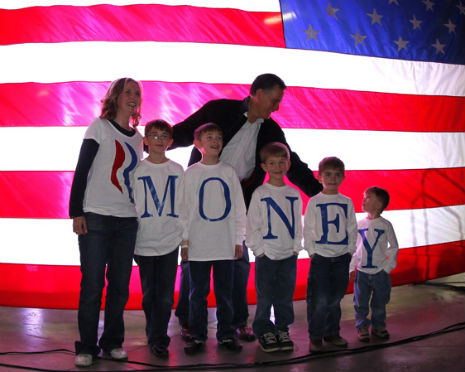
The letters of 'Mint' Romney's name come sadly adrift: even if, as some claim, it's photoshopped, it's still right on the money

Now Obama is indicating that those with enormous wealth might reasonably be called upon to contribute a larger proportion of the tax that they might expect to pay if they didn’t have accountants. In this, he is in step with European politicians, even Conservative ones. In the light of the economic conditions under which most of us struggle, it seems a mild enough line to take. Obama clearly hopes to outflank right-wingers like Santorum and Gingrich who think economic salvation derives from private enterprise having the freedom to exploit and to reward itself disproportionately. Handily, it also undercuts Romney because Romney is so very, very rich – were he to become President, he would be the second richest man ever to enter the Oval Office (the richest was John F Kennedy).

And here I enter a note of caution. That American dream is still very potent. Millions of Americans – and not just right-wing fundamentalists in the south and mid-west – take the view that untold wealth might be just around their own corner, and if they could just get a break they would soon feature in the Forbes list. They know rationally that this is very unlikely to happen, that for every lucky son-of-a-gun who strikes gold there are thousands upon thousands who only sift soil and stones, including themselves. But they still dream and – in a notion that Obama will remember – they hope. It’s quite a universal impulse really. Europeans also subscribe to it when they play the lottery.

Gingrich sought to bring down Bill Clinton for sexual peccadilloes but is a notorious hound himself

It’s my contention that many Americans – the ones who, while they may not read or follow Ayn Rand, still revere the all-American maverick – are actually repelled by any idea that the wealthy should be, as the rich will claim, “soaked” or “punished” in being more heavily taxed. If you cling to a dream of untold wealth, your dream is tarnished by any suggestion that the IRS might then take it away again. So you don’t resent the other guy’s riches – good luck to him. Let him screw the government for all he can get.

Santorum wants less regulation, except in the bedroom

Barack Obama had better beware that he doesn’t characterise the wealthy paying a greater share in such a way that the Koch brothers are able to galvanise a wave of militant sympathy for the poor bloody rich to sweep through the Tea Party and wash a man whom that movement cordially loathes into the White House. It would be a poor Obaman legacy to find that his second term is supplanted by a chief who would be ripe for Dick Cheney-like manipulation on a grand scale, a hapless President Romney.

Monday, June 06, 2011

ROLLING with the PUNCHES

In my third month as a Twitter user, I find that I am still feeling my way. It is in many aspects a curious phenomenon, most particularly because one is working in a public forum of unknowable nature and range. Anyone who has ever performed any kind of display in public or service to the public knows of that mysterious hinterland wherein one semi-exists, not discerned by most, but at the same time discerned both by some of the passing traffic and by those arrested by one’s performance or even witnessing it out of a planned intent. On Twitter, one sends remarks – it’s hard to know what else to call public statements of 140 characters or fewer – into a void that may indeed be empty or may be a vast echo chamber.

If echoes bounce back from public display, they may create a heady sense of being – I don’t know – validated, perhaps, or even (hah) important. Many years ago, I was sitting in a tube train in London when I noticed that the man sitting next to me was reading a theatre review that I had written for the monthly magazine Plays & Players. A moment later – and here it leaps into the surreal – I realised that the man sitting opposite me was reading the television section of Time Out, of which section I was at the time editor and hence author of much of it. In my corner seat, I was literally hemmed in by my public. You will be relieved to be assured that I kept my trap shut at this curious coincidence.

On Twitter, your “timeline” – the accumulating thread that logs your own tweets – also shows tweets by those you follow. All of us choose tweeters to follow – “following” – for a variety of reasons. Those who follow us – “followers” – are apt to seem and indeed be random (brought to you by some linking internet device) as well as be on your list because they think you might prove interesting.

Young Master Rooney, before needing the hair transplant he revealed in a tweet

You can tell from the number of tweets overtly or covertly on the subject that something exercising more tweeters than any other matter is the size of their own following. Naturally, public figures attract massive numbers of followers. Footballer Wayne Rooney joined Twitter a couple of weeks after I did and already he has 10,000 followers for every one that I have. That, I’m inclined think, is down to fame rather than literary merit.

Barack Obama is followed by nearly 8.5million, impressively but not too surprisingly. He follows almost 700,000 and you know at once that he can’t personally be looking at his timeline. Even if everyone he follows only tweeted once a week, he could still never read them all. Kevin Spacey is an example of someone who has it right. He has almost 2million followers and he follows just eleven tweeters. That keeps things within bounds. The more people you follow, the more work you give yourself.

And the work varies a lot from tweeter to tweeter. Some joined two or three years ago, posted half a dozen tweets, and then stopped. If they are famous, they may already have wracked up hundreds of followers and those followers have kept following. But of course if the tweeter has nothing to say for two years, the average follower has doubtless forgotten that this star was ever on their following list (you have to call up the list to see who indeed you are following – or who is following you – beyond the most recent handful).

Inevitably, there are some you would gladly follow if only they joined Twitter – in my own case, Alan Bennett, John Berger, Mary Robinson (her Foundation tweets on her behalf), Victoria Wood, John Pilger, Jonathan Miller, Marina Hyde – but you can see only too well why they don’t.

Mutual followers can and do swap remarks, even have extended conversations rather as they do on Google Chat. When you click on the ‘reply’ link on someone’s tweet, the box for your reply has their twitter identity along with an @ symbol. The back-and-forth appears on your respective timelines but not on those of your other followers. You can reply to – that is to say, address a tweet to – someone you follow but who does not reciprocate. However, your tweet will not appear on their timeline. Your tweet may still be seen by them, though, if they click on their own link called ‘@Mentions’: that brings up a list of all tweets containing their ID plus the @ symbol.

Some post their remarks abstemiously. Some – especially journalists, politicians and comedians, in my limited experience – appear to have their tweeting line open all their waking hours. Many of those compulsive tweeters pass on everything that catches their eye, so their tweets are full of links and retweets (repeating the tweets of others) that contain links. This is all very well if you have the time to follow up on all these impulsive heads-ups.

To keep the thing within bounds, I have tried not to be promiscuous in my following. Experience has shown what appeals to me most in using Twitter and it’s predictable enough. It is the reading of – and, whenever possible, the perpetrating of – pithy one-liners, original aperçus and interesting findings. This yields some unpredictable results. For instance, several humorists whose long-form work and appearances in other mediums have never attracted me prove very palatable at 140 characters a time: Steve Martin, Armando Iannucci, Arthur Smith, David Schneider, Albert Brooks, Danny Baker.

Oliver Burkeman, unquiet tweeter

I’ve picked up – and in several cases put down again (“unfollowed” in the jargon) – various contributors to the paper I read most regularly, The Guardian. Of these, Stephen Moss (who tweets as “benonix”) is the one I’m most likely to stick with. He doesn’t overtweet and he doesn’t give me too much extra homework. But he follows six times as many others as I do and I wonder how he finds the time.

One of the wrinkles on Twitter is something called Follow Friday. No doubt simply for the alliteration, this is designated the day for recommending tweeters you follow to people who follow you. The phrase Follow Friday, like any other phrase that recurs in tweets, soon produces a separate thread which one can access by putting Follow Friday in the search box (the place you also go looking for unaccessed tweeters). If a recurring phrase really takes off for a while, it is said to be “trending” and gets added to a trending list.

The hash tag – # – also creates a separate thread so by adding #ff to one’s tweet one immediately throws one’s recommendations into a vast list available to all. Ever out of step, I decided to institute a contrary movement and introduced Forsake Friday, listing those tweeters I propose to unfollow. Last Friday, this got me some trouble.

I had followed for a while one of The Guardian’s correspondents based in the States, Oliver Burkeman. He was often interesting and entertaining but he did seem to pass on to his followers every blessed thing that caught his eye and, when accessing those things means calling up various websites and looking at pictures or reading articles, you do start to flag. I tweeted:

#ForsakeFriday: giving up @oliverburkeman – so many refs and links and conversations equals too much homework; sorry …#ff

To my astonishment, he replied within a couple of minutes:

@WSteG I’m sorry! You must follow some very quiet tweeters if I am among your most prolific!

An indenture to part with Grace

Now, I had once tweeted Mr Burkeman to suggest that he might like to follow me (a bit of a cheek, perhaps, and not one I’ve tried with anyone else) because I thought we had some interests in common. He didn’t rise to that and he never signed up to follow me, so he must have had his mentions thread open when my tweet dropped into it. I wrote back:

@oliverburkeman Well … there are only so many hours in the day.

And that was that. Between these tweets, I posted another tweet:

#ForsakeFriday – also shedding @gracedent – I don’t know what #bgt is, but, from her many, many tweets on it, I sure don’t want to know #ff

Grace Dent also writes in The Guardian. She took over the television column in the paper’s pocket-sized Saturday Guide when Charlie Brooker graduated to fame on the box. What I wrote there wasn’t strictly accurate. I did know that #bgt meant Britain’s Got Talent, a programme that I have never seen (indeed, I watch ITV so rarely that I doubt I have ever even caught a trail for it). As a cultural entity, it is impossible to avoid entirely because newspapers, including The Guardian, run so much stuff about it, stuff that I don’t read but do notice. As for feigning ignorance, playing the faux naïf card is something I have done since childhood and I am aware that it can be (doubtless, usually is) hugely irritating.

It irritated me that Ms Dent tweeted throughout each “bgt” broadcast – evidently nightly – and in a manner that suggested that anyone reading her must be doing the same. I had elected to follow her, rather on a whim, because I fancied that she might be entertaining. But even if she was being entertaining about “bgt”, I didn’t care to know.

Well, she too shot back, just as promptly as Burkeman, “via Osfoora for iPhone” which suggested to me that she tweets on the move:

@WSteG Oh please don’t go. I thought we really had something.

This made me laugh but astonished me. Like Burkeman, she doesn’t follow me. And she has nearly 64,000 followers. Why the hell should she be bothered to reply? I couldn’t resist. Back I shot:

@gracedent Oh, hey, if only you were THAT funny about stuff I understand …

Seconds later came the iPhone reply:

@WSteG are you ok? You seem to be sending shitty messages to a woman you don’t know on the Internet using your real name. Do you mean to?

Being more than 140 characters, this had to extend onto a website for elongated tweets. I was gob-smacked. She seemed to be suggesting that I was the kind of person who writes anonymous hate mail in green ink. Somewhat hysterical, no? I replied:

@gracedent Um … “shitty”? I didn’t know The Guardian was such a protective bubble. Is anonymity required of those who don’t follow bgt?

On reflection, I think I was trying to pack too much meaning into that tweet. She came back, via the web rather than the phone:

@WSteG Stephen. Leave me alone. Polite request.

Evidently this is a novel by Grace Dent, not one I am likely to read

Now, I feel sure that I made some bad misjudgments here. Perhaps unconsciously influenced by the name Twitter, I have been a little inclined to twit people when tweeting them and, especially if they don’t know me, this can come out wrong. No doubt as a result, I felt that this exchange had escalated horribly. Moreover, it seemed gruesomely ironic that an intention to stop following someone ended in them telling you to leave them alone. Well, I passed the rest of the afternoon feeling rather upset and rattled and, after a decent interval, I sent this:

@gracedent Really, really sorry to have given offence. Your column makes me laugh. Best wishes, Steve G

I heard no more. But I was still brooding about it next day. I had put Ms Dent’s name in search and quickly found a tweet that read, in its entirety, “I’d love to punch grace dent in the face”. This was by a woman who used “her real name”. Perhaps Dent had read that before I appeared on her radar and was feeling vulnerable. I looked at her own timeline and found that she had been chirruping away ever since her exchange with me. The only relic of that was her last tweet to me, the “leave me alone” one. I sent her a last message:

@gracedent Of our exchanges yesterday, the only one on your timeline makes me sound like a stalker. Please be kind enough to delete it.

She didn’t, of course. But her timeline lengthens so fast that the tweet she wouldn’t delete is too far down for access now.

Grace Dent, as I say, writes about television. I wasn’t being truthful when I said – trying to be kind – that her column makes me laugh. I’d never read it. So I did read it on Saturday. And that will be my starting point for my next posting …

Sunday, May 01, 2011

The LOUD LAUGH that SPOKE the VACANT MIND

In today’s Daily Telegraph, the columnist I love to hate, Simon Heffer, has once again voyaged into a subject of which he knows nothing: humour. Here is the link:

http://bit.ly/k4klbX

I shall now make Mr Heffer chuckle uncontrollably (given his susceptible funny bone) by revealing that my own name for him is Siphon Effluent. Did you see what I did there, Simon? Good, isn’t it.

The occasion of Mr Effluent’s latest outpouring was the wonderfully witty and hilarious wisecrack delivered in the house at Prime Minister’s Questions when the PM advised shadow minister Angela Eagle to “calm down, dear”. He and his backbenchers thought this so much funnier than the complete works of Oscar Wilde, SJ Perelman, PG Wodehouse and Stephen Fry rolled into one that Mr Cameron felt called upon to repeat the joke a further six times. Laugh? I thought I’d have to bite the television remote.

Siphon Effluent with his beloved Thatch

Laughter in the house is not like laughter anywhere else (except probably the Bullingdon Club and the Oxford Union). It is a mirthless howl, the kind of har-har-har braying, accompanied by forced slapping of fat hams, that speaks not at all of appreciative and judicious admiration for a finely-turned phrase but entirely of bullies putting in the boot after their loudest mouth (whom they fear, or at least require to impress with “loyalty”) has played to the lowest common denominator by landing on an opponent a blow to the solar plexus. This kind of knee-jerk oinking is certainly not the prerogative of Flashmanesque Tories. All the other party cannon-fodder do it too, even (I shouldn’t wonder) the Greens. It was noticeable though that, while George Osborne hooted like a hairdresser at a Cher concert, Nick Clegg sat stony-faced throughout the entire episode.

Politicians as a breed are not all that amusing. Even some quite smooth orators, while skilled at rousing an audience, cannot deliver a funny line. Those politicos who are able to reveal a responsive sense of humour in a general way can indeed be funny themselves, regardless of political inclination: Heseltine, Kinnock, Kennedy, Hattersley, Portillo, Skinner, Widdecombe (the latter, perhaps, unintentionally). Ed Miliband shows encouraging signs of being able to mock thoughtfully, helped by some evidence that he doesn’t take himself too seriously all of the time. John Smith had a charmingly deprecating sense of humour.

Angela Eagle: shot down by Cameron's deadly wit

In earlier generations, Harold Macmillan had a dry clubman’s wit, often quite lethal. Harold Wilson could be witheringly funny. Jo Grimond and Jeremy Thorpe were both quick-witted and smart Liberal Party leaders. I remember an edition of Any Questions? celebrating some early anniversary, during which Thorpe astonished all by his pitch-perfect and brilliantly “scripted” impersonations of some of the programme’s stalwarts not present in that edition: Ralph Whiteman, Ted Leather, Gerald Nabarro.

Winston Churchill’s many witticisms have gone down in legend, though some of them would fail modern tests of acceptability. No PM since has matched Churchill’s style, timing and sheer sense of mischief – “Bossom?” he sniffed at the surname of a new member. “Neither one thing nor the other”. But at least one contemporary statesman can deliver a witty speech with perfect timing and aplomb. Go to
http://bit.ly/jDop1g
to laugh out loud at Barack Obama's speech to yesterday's White House correspondents' dinner.

Typically, politicians have ‘jokes’ written for them, which they proceed to mangle in delivery, yet the faithful roar with simulated delight anyway. Tony Blair thought himself jolly good-humoured but the kind of thing that made him weep with laughter was that singing fish novelty that was all the rage among people with no taste for a day and half some time in the late ‘90s. Gordon Brown’s delivery of a joke was as leaden as John Major’s or Edward Heath’s. And Siphon Effluent’s great heroine, Margaret Thatcher, had no sense of humour whatsoever. The antediluvian playwright Sir Ronald Millar – don’t hold your breath for a revival of his plays – wrote the “you turn if you want to – the lady’s not for turning” shtik, a desperately laborious conceit even in skilled hands, but it brought a Tory conference to its knees weeping with uncontrollable mirth, despite that the dear leader had performed it with considerably less panache than Neville Chamberlain announcing “consequently this country is at war with Germany”.

Siphon Effluent: the HL Mencken de nos jours

Siphon Effluent himself does make me laugh, mostly because he contrives to present the appearance of a sugar pig with marmalade smeared on his head. But his writing is dominated by his desire to be disobliging and, if he ever threatens to try for humour, it never ventures further than peevish scorn. He always refers to Mr Cameron as “Dave” – this is known in the trade as a “running gag” – presumably because he disdains a Tory leader who is not Thatcher and because some of the PM’s intimates appear to refer to him by this builder’s-mate moniker. (Not least of these intimates is the first lady, Samantha Cameron. There again, her sense of humour was revealed yesterday when she appeared to think it a jolly jape to roll up at a formal state occasion dressed for a constituency coffee morning; gratifyingly, she was comprehensively outshone by the effortlessly chic Miriam Clegg).

Bernard Manning: evidently he and Effluent were separated at birth

In his piece on humour, Effluent makes a strenuous joke in calling Angela Eagle “a harridan”. He was so pleased with this that he repeated it. Now, Effluent is very keen on the correct use of English. Indeed, he is the in-house English monitor at The Telegraph, apt to send stinging emails to hapless journalists who have offended his sensibilities. So I find myself surprised that he should use the term “harridan”, which is defined by the OED as “a haggard old woman”, of a personable female of just 50.

Effluent writes further: “I suspect even Dave has the manners not to address a woman with whom he is not well acquainted as ‘dear’ except in jest” and later, on a different matter, “This column prides itself on its gallantry towards the ladies”. Yet he himself has the ungallant lack of breeding to write of a woman with whom he is not well acquainted in such an insulting manner. I think he should stand in the corner.

With brilliant skill and dazzling wit, Effluent turns what his admirers might have feared was a mortal thrust at “Dave” into an all-guns-blazing assault on Labour and “lefties” in general: “His [Cameron’s] mistake, however, was to think that these people are easy-going types who like a laugh. He has, at least, now admitted he realises that the Left doesn't have a sense of humour”.

Jim Davidson: also seems to come in a similar shade to Effluent

Ah yes, the age-old canard that “lefties” have “no sense of humour”. It is of course fair and just to observe that there are individuals who are earnest and single-minded about their politics, but I never found that this degree of dedication was confined to the left. Had it been, we might now live in a more enlightened world. But the myth persists: on Any Questions? this weekend, UKIP leader Nigel Farage spoke of “po-faced Republicans”.

It can be argued – I have argued it myself – that comedy is fundamentally reactionary because it requires a reliable and enduring establishment, status quo, conventional wisdom against which to bounce. So, while pretending to subvert and mock, comedy really reinforces and humanises. It’s Lear’s Fool syndrome – the absolute monarch permits an all-licensed jester precisely because he is absolute and therefore the jester cannot draw blood, only wry smiles.

But there are many conventional wisdoms. Changes of government do not signal the end of satire. Effluent seems to imagine that only reactionary people are capable of being funny. “Comedians who are not Leftists” essays Effluent “have more or less been driven out of business. Bernard Manning was martyred in this cause. Jim Davidson is in the process of following him, not because he isn't funny, but because he was a strong supporter of Mrs Thatcher. Long after she left office, the spiteful little creeps who form the ‘comedy’ establishment of this country would get laughs from their bovine audiences simply by mentioning her name”.

Tom Lehrer: 'We Will All Go Together When We Go'

If Effluent sees himself as a comedian, this is certainly his most laughable passage. The idea that Manning was “martyred” is preposterous. He may have fallen out of television fashion – many entertainers do and politics has nothing to do with it – but his club work (including at his own club) continued to bring him a handsome income. And I can’t help wondering how often Effluent was to be seen knocking back pints with hoi polloi at Manning’s place, roaring with delight and slapping his hams at “fookin’ Paki” so-called “gags”. If nothing else, the vulgarity of it all seems extremely unlikely to have appealed to Mr & Mrs Effluent as an alternative to their beloved Wagner, any more than one can picture them tripping to the end of a pier to rock with joy at Jim Davidson’s version of fun.

Perhaps Effluent is thinking of Ben Elton when he writes of “the spiteful little creeps” mentioning Thatcher’s name for a laugh. Elton certainly used to do stuff about the woman he called Thatch but that was back in the ‘80s in his spangly-suited phase. I would gently suggest that if Effluent were to take tea with Elton at the Ritz and probe him for his present political views, he might find that they have more in common than he imagines.

Roy Battersby: as you see, an archetypal po-faced leftie

There have been plenty of intelligent, thoughtful and far from spiteful comics who are not reactionaries. In Effluent’s youth, he might have been aware of the American Tom Lehrer, a finely witty, talented and scrupulous social satirist who announced his retirement when Henry Kissinger was awarded the Nobel Peace Prize, on the grounds that the award rendered satire obsolete.

But even staunchly committed left-wingers have sprightly senses of humour. Tariq Ali, whom I knew a bit at one time, is a warmly funny and witty man. My old chum Roy Battersby would certainly fill the bill for Effluent when looking for a fully paid-up leftie. Roy was a key member of the Workers’ Revolutionary Party in the 1970s and ‘80s, took five years out of his directing career to work full-time for the party as its chief representative on the Palestinian question (he made a moving documentary called The Palestinian, fronted by Vanessa Redgrave), stood for parliament and was involved in the supposedly notorious Red House centre which was a constant target for MI6. Yet my abiding image of him is of a man wreathed in a beatific smile, relishing the pleasures of life and laughing uproariously at its manifold absurdities.

There is an unbridgeable gulf between, on the one hand, Roy, Tariq and Tom Lehrer and, on the other, a Simon Heffer whose idea of a comedian is Manning or Davidson and a David Cameron who thinks he’s being witty by quoting someone as repellent as Michael Winner in something as low class as a television advertisement and claims that anyone who cannot see such rubbish as meritorious lacks a sense of humour. I can’t imagine finding anything in common (humorous or otherwise) with anyone who would rather reside on the Heffer/Cameron/Manning side.