LIES, DAMNED LIES and OPINION POLLS
I was born in May 1947. In only the first four years of my life has there been a Labour government that made a fundamental and lasting difference to the life of the nation. Subsequent administrations have certainly contributed to the lives of various groupings, but almost entirely in the realm of social policy. And none of these achievements – the Open University, say, or civil partnerships – is unimaginable under a relatively enlightened Tory government. What is more, many of the most far-reaching measures – reform of the divorce and abortion laws and abolition of the death penalty, for instance – have only prevailed through the stamina and determination of backbenchers introducing Private Members’ Bills.
Both Clement Attlee and Harold Wilson invoked Lenin’s phrase about the need to take over “the commanding heights of the economy”. Attlee achieved more by that measure than did Wilson. In 2008, when the Brown government began to take significant stakes in high street banks, I dared to think that this dream might come to pass after all. But the imperturbable city easily frightens ministers with patently empty but apparently convincing talk of the need to remain independent, as with sophistry about attracting “the best”. Someone who will only work for a salary to which is attached a seven-figure bonus is not interested in service, only in self-service. Personal greed is not some kind of measure of financial acumen. In any case, under a global financial crisis, how can any self-important trader be sure that there are jobs elsewhere ripe for the picking? The city plays many bluffs that need to be given short shrift.
When it is being “pragmatic” – a favourite term of Wilson’s that was taken up by Cameron – Labour offers merely a less economically competent alternative, to which voters turn only when the Tories are exhausted and corrupt (1964, 1997). But Labour must present itself as creative, energetic and fearless. Ahead of the last televised debate of the general election, I wrote to Gordon Brown, recalling the catalogue of Labour’s achievements that he had presented to conference some eighteen months earlier; it brought the hall to its feet. I vainly urged him to rerun the list in his television peroration. I still argue that Labour needs to think positively about what it has done; but even more so about what more it must do.
Governments of both left and right tend to move towards a consensual centre, thereby alienating their grassroots. Labour leaders shrug off the cries of betrayal. Wilson argued that Labour was always “broad church”. Jim Callaghan remarked that “you can never reach the promised land. You can march towards it”.
Such positions rationalise those governmental experiences that Rab Butler dubbed “the art of the possible”. Only in the unusually non-conformist climate of the immediate post-war years did a Labour cabinet feel sufficiently confident to implement a truly radical and reformist programme. That Attlee’s majority fell from 146 seats to a mere five at the subsequent general election suggests that these measure were unpopular. In fact, the 1950 election produced a bizarre distribution of spoils, for Labour actually increased its vote share on 1945. At a further election eighteen months later, Churchill was returned to power despite that Labour won a greater share of the vote than the Tories, its highest ever indeed. (This anomaly is explained by the Liberals recording their lowest ever share of the vote). Labour was then out of office for thirteen years.
The most cogent criticism of the Labour opposition under Ed Miliband is that it is being too timid. Nobody makes cracks about “Red Ed” these days. I have plenty of proposals for radical policies that would get Labour elected with a comfortable majority. But a programme for government may wait until nearer the end of this parliament. We are not yet two years in to government by coalition and an opposition’s job at this juncture is roundly to oppose. This is a role that Miliband and his team have played with no more than fitful effect. A major part of the failure concerns the Labour front bench’s willingness to let Cameron make the running, score points at will (I know little of sport so I may be mixing some metaphors here) and persuade large swathes of the electorate to believe that all the pain being applied with such relish by the Tories (and such discomfort by the Liberal Democrats) is really the fault of Labour.
Cameron may be intending to fight the next general election on the record of the Brown rather than of his own administration. This would be a curious and probably unprecedented circumstance but shadow ministers have done all they may to encourage him in any belief that such a strategy might pay dividends. During the financial crisis of 2008-09, of which Gordon Brown’s handling won great credit from leading economists around the world, the Tory opposition scorned Labour’s wholly justified position that the crisis was global in nature. Needless to say, the present government blames world conditions – in particular those within the Eurozone – for the current slide into recession, along with “the mess” that Labour bequeathed. It refuses to accept any responsibility for its own actions, which, thus far, have only achieved an increase rather than a cut in the deficit but deep cuts in the welfare state, along with a systematic preparation of both the NHS and the primary, secondary and higher education networks for wholesale privatisation. These things, we are regularly told, are “necessary”.
Labour seems to have decided to roll over and submit to this lamentable catalogue of abnegation of public responsibility. All it appears prepared to argue is for a temporary cut in VAT, the reduction of some bankers’ bonuses and some kind of unspecified revenge for the incidence of phone-hacking by journalists. The rest of Labour’s stance may be entirely embraced as temporising. There is undeniably a logic to this attitude, given that Miliband and Balls have effectively conceded that the last government “got it wrong” in almost every particular, which must infuriate Brown, Alistair Darling and indeed David Miliband.
Labour even seems incapable of negating the childish thrust, regularly rehearsed by coalition members and journalists alike, that Ed Miliband “knifed his brother in the back”. At the time of the autumn party conferences, Andrew Neil jovially suggested to Harriet Harman that Ed would never live this down. She ought to have had the wit to ask whether he would be putting to a leading Tory that Cameron back-stabbed David Davis. Because Labour is incapable of rebutting this canard, Cameron can rouse his backbenchers and the commentariat to orgasms of joy and admiration merely by rebuffing Miliband’s attempt to prise Cameron and Clegg apart with the line “it’s not like we’re brothers”. Is it beyond the wit of Labour’s scriptwriters to work up a new riff on the “two Davids” legend, this time with one strutting on the world stage and the other glowering among the also-rans? At least Ed invited his brother to serve. Cameron has put Davis out to grass.
I see that among “Executive Director” posts recently advertised by the Labour Party were those for Communications and for Rebuttal and Policy. We must hope that energetic and imaginative people were appointed. If nothing else, the job of rebuttal needs boldly ratchetting up with immediate effect.
Some significant opportunities have already been missed and will not come again. One was Libya. I doubt that there was deep public support for the government’s involvement in the Libyan civil war. Miliband had been opposed to the invasion of Iraq. He could have convincingly and consistently forged and led a parliamentary opposition to this enterprise, woundingly characterising it as Cameron’s amour propre and putting daily and unyielding pressure on the government to come clean about the true financial cost of the operation. Of course Cameron would have crowed about the fall of Gaddafi and made out that this “proved” that Labour was “wrong on this as on every other issue”, but such triumphalism is only ever temporary (as George W Bush foolishly claimed one month into the Iraq debacle: “job done”) and we now see the regime in Libya both threatened by a newly resurgent rump and accused of being as brutal as its hated predecessor. Such sagas are never “over”. There may yet be more costs to the Treasury.
Labour says that it will accept the government’s cuts, even those that hit Labour’s heartlands hardest. “Being responsible” they call it. This kind of stance has become the norm for Labour ever since Harold Wilson’s day. In ancient times, one of the methods whereby you could confidently arbitrate between Labour and Tory was how the two parties approached issues such as state aid, tax rates, NHS availability, immigration and so on. There was a handy rule of thumb: Labour took the view that if a few people got relief who had no need of it, that was a price worth paying for ensuring that those who were in need were helped; the Conservatives took the view that if a few people who needed relief failed to receive it, that was a price worth paying for ensuring that public funds did not go to waste. It is no longer possible to chart this philosophical difference between the two parties. Labour and the Tories only diverge on the level of aid to be denied. Otherwise, modern Labour subscribes to the tabloid scapegoating of “benefit cheats” just as much as Tories do.
What governments can afford is always more about politics than about economics. Instead of joining in the psychology and language of “cuts”, Labour should come at it from the vantage point of imagining a clean sheet and then start to pencil in what it would spend. Looked at from that perspective, it is much easier to espouse, for instance, a policy that does not allow for tax avoidance, instead of the much more fraught exercise of trying to erode a status quo of sharp practice and finagling.
It is a puzzlement that, over its last thirteen years in power, Labour never managed to close the many loopholes in the taxation system that allow those who can afford smart accountants to avoid paying their dues. Cameron takes the line that he needn’t make any reforms that Labour failed to make because Miliband has no grounds for complaint. Miliband can scotch that at once; two wrongs don’t make a right; even though it wasn’t done then, it must be done now. Tax avoidance is a major industry in Britain, but even without starting again with tax law it should not be beyond the wit of either Treasury or HMRC number-crunchers to scale it down significantly, if not eradicate it altogether. But Labour could begin by determining that the very profession of accountancy, the raison d’être of which is the avoidance of tax, be itself taxed as the luxury of the rich. Then we might be getting some place.
A method of avoiding tax much favoured by the mega-rich is the practise of dissembling in the matter of where one lives. The issue of “non doms”, that greatly exercised politicians and commentators on all sides a year or two ago, has dropped off the agenda in favour of high earnings. But moving one’s tax base – or the threat of doing so – remains a ploy for the powerful. The question of whether someone who lives abroad for tax purposes should enjoy status privileges in Britain is, to my mind, an irrelevant and misleading question. Where someone designates her or his principal residence is far too manipulable a matter. After all, the proprietor of The Daily Mail lives to all intents and purposes in Wiltshire but, by some sleight of hand, pays tax as a resident of Paris at a much more favourable rate than do run-of-the-mill Wiltshire multi-millionaires. Those who bear the onerous task of owning The Daily Telegraph from their tax exile in Monaco must laugh to scorn the fainthearted level of graft in the Westminster village, as so comprehensively uncovered by their organ. Moat-cleaning indeed! Why not acquire a Channel Island? That’s a vastly more cost-effective scam.
The problem of non doms is readily solved. Income should be taxed not on the basis of where the earner lives but where the income is earned. Better yet, follow the practice of the IRS in the United States: tax without reference to either the location of the earner’s domicile or the country of the income’s origin. To avoid taxation, Americans have to renounce their US citizenship and even after that their US income is taxed on the same basis as that of a guest worker. If Americans can live with such a system, Brits sure as hell can too.
Perhaps there would be a degree of permanent departure from these shores among those unwilling to submit to contributing an appropriate proportion of their wealth to public provision. Such people merit a one-word response: “Goodbye”. If, to continue owning several mansions and a private jet, they are obliged to be based in a country where, beyond their gated communities, they are surrounded by abject poverty, that is for their consciences to reconcile. But it is a self-serving myth that our industries cannot survive without greedy, grasping individuals. They can and will survive (the BBC has survived the departure of Jonathan Ross, for instance) because there are always people who are thoughtful as well as talented, who want work that is stimulating first and lucrative only as may be, and who will choose to stay in a decent society that diligently cares for all its members. Let those perpared to live abroad for tax purposes lose their right to British citizenship altogether. That would sort the merely greedy from the downright criminal.
Starting again from scratch on public spending, Labour would soon find many causes that do not merit support from the public purse. Such an exercise would readily release the funds that would be required for an equable welfare state and a properly financed state system for health, education, policing and local services.
Of course there are risks in pursuing such policies. The press barons (non doms all) will hit back through their newspapers. But that is a bridge that Miliband has already burned. Right back to the last war, party leaders who made themselves amenable to Fleet Street, even if only by bestowing knighthoods, received a largely favourable press: Wilson, Thatcher, Blair, Cameron. Those who paid less attention to the press – Douglas Home, Heath, Callaghan, Foot, Kinnock, Major, Hague, Duncan Smith, Brown – were increasingly pilloried. In this dynamic, Rupert Murdoch was the chief instigator and the others dutifully followed. In declaring war on News International, Miliband has ensured that the press generally will be hostile. There is much for the Executive Director for Rebuttal to do.
On one matter, the press is primed to make life difficult for leaders who suffer a particular sort of misfortune – and Miliband presently suffers it. It is a negative finding by opinion polls. I have long argued that polling organisations offer an utterly misleading pseudo-science that suits – and may very well be tailored to suit – the newspapers that carry their “findings”. On one of the slowest of news days, Boxing Day last year, The Guardian gleefully trumpeted an ICM poll that allowed it to headline its first leader, with almost indecent relish: “Cameron in command”. The paper was rewarded with days and days of name-checks across the media. A month later, ICM furnished it with figures that gave the Tories a clear lead. That day’s leader was stern: “Rogue polls are very rare. Most polls currently put the Tories ahead … the polls are broadly right. And today’s poll is right. Better get used to it”.
Well, let’s just see. How many thousands of people were interviewed by ICM’s cold-callers? Oh right: 1,003. That is around 0.002 percent of the UK electorate. How much certainty would you be prepared to erect on such minuscule foundations? Ah, but ICM (as do all polling organisations) has anticipated that. “Data were weighted to the profile of all adults aged 18+ (including non telephone owning households). Data were weighted by sex, age, social class, household tenure, work status and region. Targets for the weighted data were derived from the National Readership survey, a random probability survey comprising 36,000 [that’s 0.08 percent of the UK electorate] random face-to-face interviews conducted annually. The data were further weighted by declared votes in the 2010 general election”.
In other words, the data that ICM gathers from this tiny sample of people who happened to answer the phone is not presented as is but is massaged by a process that is not disclosed. In a dictatorship, one imagines, the figures would be massaged by a combination of bribery and threat from the regime. Obviously that doesn’t happen in Britain but we are entitled to be sceptical of any undisclosed system of presenting data that is used for propaganda purposes. And then there is a factor that cannot be weighted, even by experienced masseurs: what percentage of respondents may be trusted to tell the truth?
“Rogue polls are very rare”. Oh yeah? Notoriously, the polls misforecast the outcome of the 1992 general election, even up to the BBC exit poll conducted on the day as voters were leaving the booths. Lots of rogues there. And I recall the 2004 US elections. I was staying with a friend and unable to sit up all night with the results as is my wont. Eccentrically, my friend (a BBC woman) had switched to ITV’s coverage and we heard the famous MORI pollster Robert Worcester tell Alastair Stewart that he was “calling” the election for John Kerry. We went to bed elated and rose to deflation. Worcester was subsequently knighted for services to misinformation.
There is a more reliable guide to political sympathy than opinion polls. It is actual votes in ballot boxes. Five mainland by-elections were held last year, the last just a week before ICM completed its fieldwork for the findings published on December 26th. Even taking into account the distortion caused by the vote at Inverclyde in June (where the SNP advanced against all other parties but Labour held on), the average increase in Labour’s vote in the five polls was 8.9 percent. In the first three of these by-elections, each called in circumstances that normally would lead to a certain resentment of the defending party, Labour increased its vote by an average of 11.9 percent. At Feltham and Heston on December 15th, it was 8.6 percent and here, for the first time in any of these ballots, the Tories came as high as second. Difficult to found an image of “Cameron in command” on these results.
But the Tory press – and, under its influence, the supposedly disinterested broadcast news – prefers the reading of the polling organisations because it suits their agenda. The Guardian too is happier with the ICM data than with real votes: after all, it still has to justify its journalism that relentlessly undermined Gordon Brown and its editorial support of the Liberal Democrats at the general election that helped to bring about the coalition with the Tories.
Labour’s new Executive Director of Rebuttal should quickly establish the convention that Labour discounts opinion polls and only recognises voting results. Every time Martha Kearney or Jeremy Paxman tells a Labour representative that the party is doing badly in the polls, the response should be to quote the by-elections. And when and if a by-election proves bad for Labour, it can be addressed as a real rather than a fantasy problem. There is much rebuilding to be done.
Showing posts with label David Davis. Show all posts
Showing posts with label David Davis. Show all posts
Sunday, January 29, 2012


Wednesday, September 28, 2011
BEING LACKED and LOST/WHY THEN WE RACK the VALUE
Ed Miliband made a good speech to the party conference. The word he hit time and again was “values”. It’s a usefully resonant term, speaking of morality as well as of economy, trailing association with family and tradition and honesty. And he encapsulated it in a neatly turned soundbite: “the wrong values for our country and the wrong values for our time: that’s David Cameron”.
I also thought he dealt subtly with the first subject that the commentators always bring up, this notion that his poll ratings are relatively poor. Those of opposition leaders always are low through their early months because opportunities to embed their strengths in the public consciousness are few. Miliband’s first few pages harked back to JK Galbraith’s coining of the “conventional wisdom” as something to be shunned, and he gamely bracketed it with consensus. He gave Ed Balls generous credit for opposing the conventional wisdom on the economy twelve months ago at a time – though he didn’t spell this out (but he didn’t need to) – when he, Miliband, was passing over Balls as the natural shadow Chancellor in favour of Alan Johnson.
 Miliband on the podium today
He took some pleasure in reminding us of the credit he won on all sides for his stance on the hacking scandal: “I knew I was breaking rule one of British politics: don’t mess with Rupert Murdoch”. And he cited his own immigrant background to ally himself with those who feel excluded from David Cameron’s phantom Big Society: “21st century Britain – still a country for the insiders”. He ambitiously described himself as “the guy who’s determined to break the closed circles of Britain … we must take on the vested interests wherever they are because that is how we defend the public interest”.
The NHS is always fuel for a Labour leader’s speech and he duly got plenty of traction from a dazzling riff that ended with “the oldest truth in British politics: you can’t trust the Tories on the National Health Service”. I thought the applause would never end.
He also got off some sharply wounding points against perceived enemies of the people: Sir Fred Goodwin, energy companies (“let’s call a rigged market what it is”), Southern Cross, “runaway rewards at the top”, Nick Clegg (knockabout stuff) and the PM: “only David Cameron could believe that you make ordinary families work harder by making them poorer and the rich work harder by making them richer”.
In committing the party to be “pro-business” and for “co-operation, not conflict”, he was making an impeccably Social Democrat pitch. However, this didn’t stop the BBC’s Nick Robinson anticipating “We Told You So: Red Ed” headlines in the papers tomorrow – the Tory press, presumably. But it should be good for all shades of opinion that he wants to make Britain primarily a manufacturing nation again: “not financial engineering but real engineering”. We can all support his campaign for apprenticeships and his determination to favour productive business over asset-stripping: “growth is built on sand if it comes from our predators and not our producers”.
But I feared that there was too much revisionism and that much of it is wrapped up with a need the Labour leadership feels to apologize for losing public support. It surely isn’t necessary specifically to repudiate past policy positions, especially ones that are three decades old. The coalition government daily justifies its mistakes and its dire policies by blaming Labour for the “mess” it left. The Labour leadership has already left it too long to nail this lie credibly. Now is not the time to start handing the Tories abject quotes to be further exploited against the last government’s record.
 A so-called Wordle of Miliband's speech; obviously they didn't load "values" onto the program
I don’t care for gesture politics. David Cameron evidently won a lot of credit for making a public statement of regret over Bloody Sunday. While I concede that he executed it graciously, I dispute that it cost him anything to do. He was five in 1972. Nobody blames him. The Heath government of the time was a very different beast from Cameron’s government and only four members of its cabinet are alive: Robert Carr (94), Peter Carrington (92), Margaret Thatcher (85 in a fortnight) and Jim Prior (84 in a fortnight). I don’t imagine that Cameron cleared his apology with any of them.
The “conventional wisdom” that Labour has much to apologize for is due for putting out to grass. It’s not the only old news. Jockeying the BBC’s live coverage of Miliband’s speech – disrupted, as was every other broadcaster’s, by a brief power failure at the Liverpool conference hall – Andrew Neil presumed to know what “people” think, as commentators are apt to do, for instance that they perceive Miliband as someone who “stabbed his brother in the back”. As a summary of the Labour leadership contest, it doesn’t survive five seconds of mature consideration. Anyway, why does no one suggest that Cameron stabbed David Davis in the back in order to win the Tory leadership?
Neil also banged on about the opinion poll ratings. As I tire of pointing out, opinion polls are a bankrupt pseudo-science, exemplified by Bob Worcester “calling” the 2004 US election for John Kerry quite late in the process on ITV. Look at the by-election results since the general election. Go on, look at them.
That Labour has missed some tricks under Miliband must be acknowledged. There are many ways of releasing public expenditure and easing the burden on the public, and most of them are rather more effective than a temporary lowering of VAT, the benefit of which is highly questionable. I fervently wish that Miliband and Labour had had the courage to oppose Cameron’s intervention in Libya. With his often quoted opposition to the Iraq invasion – at the time, not in retrospect – Miliband could have credibly articulated the case against the UK’s involvement.
Instead he declared that we could not “stand by” and watch Gaddafi killing his own citizens. Well, we stand by through many another repressive regime: Syria, Bahrain, Yemen, Myanmar, Iran, North Korea, Zimbabwe, Russia, China. We do precious little to assist in those events that we call “natural disasters” but that we know are, at least in part, the result of man-made climate change: floods last year and this in Pakistan; floods and earthquakes in Australasia; earthquake, tsunami and nuclear disaster in Japan; tornados across the Caribbean and the southern States; famine in east Africa.
Yesterday, The Guardian scared up a defence analyst who reckoned that the cost to the British economy of Cameron’s self-serving strut upon the world stage, climaxed by his complaisant speech to the UN last week, will be in the order of £1.75bn. And don’t imagine that the British will not go on paying for months to come yet. At the London Conference on Libya in March, Cameron declared: “We must ensure the delivery of humanitarian aid where it is needed … when the fighting is over, we will need to put right the damage that Gaddafi has inflicted”.
My feeling is that there is little deep-seated support for this war among the electorate. Had Miliband stepped away from the consensus, the conventional wisdom, he could have given voice and point to this indifference and turned it into respect for his integrity. Now he and Balls could show persuasively that, under their policies, the government would have had at least £1.75bn to spend on stimulating growth, bolstering the NHS, reducing tuition fees or whatever domestic policy seemed most welcome to the electorate at the time. Cameron would have crowed for a few days when it seemed that his Libya policy had been “a success” but, besides pointing out that the Libya adventure, like that in Iraq and Afghanistan, is not over till it’s over and even then not without consequence, Miliband could have asked on a regular basis “at what cost”?
Labour should by now have worked up a programme of sources of revenue for encouraging the economy and never mind behaving as if they have accepted the Tories’ obsession with hauling down the deficit. Shadow ministers also might spend a bit more time pointing out that government expenditure is actually going up rather than coming down, instead of fatalistically accepting that it was Labour who went on a colossal spending spree.
So, although I like and admire Miliband, am glad he is the Labour leader and believe he can and will win the next election, I think he and his under-powered team should have inflicted rather more damage on the coalition. It’s certainly not too late to make up the lack.
Ed Miliband made a good speech to the party conference. The word he hit time and again was “values”. It’s a usefully resonant term, speaking of morality as well as of economy, trailing association with family and tradition and honesty. And he encapsulated it in a neatly turned soundbite: “the wrong values for our country and the wrong values for our time: that’s David Cameron”.
I also thought he dealt subtly with the first subject that the commentators always bring up, this notion that his poll ratings are relatively poor. Those of opposition leaders always are low through their early months because opportunities to embed their strengths in the public consciousness are few. Miliband’s first few pages harked back to JK Galbraith’s coining of the “conventional wisdom” as something to be shunned, and he gamely bracketed it with consensus. He gave Ed Balls generous credit for opposing the conventional wisdom on the economy twelve months ago at a time – though he didn’t spell this out (but he didn’t need to) – when he, Miliband, was passing over Balls as the natural shadow Chancellor in favour of Alan Johnson.

He took some pleasure in reminding us of the credit he won on all sides for his stance on the hacking scandal: “I knew I was breaking rule one of British politics: don’t mess with Rupert Murdoch”. And he cited his own immigrant background to ally himself with those who feel excluded from David Cameron’s phantom Big Society: “21st century Britain – still a country for the insiders”. He ambitiously described himself as “the guy who’s determined to break the closed circles of Britain … we must take on the vested interests wherever they are because that is how we defend the public interest”.
The NHS is always fuel for a Labour leader’s speech and he duly got plenty of traction from a dazzling riff that ended with “the oldest truth in British politics: you can’t trust the Tories on the National Health Service”. I thought the applause would never end.
He also got off some sharply wounding points against perceived enemies of the people: Sir Fred Goodwin, energy companies (“let’s call a rigged market what it is”), Southern Cross, “runaway rewards at the top”, Nick Clegg (knockabout stuff) and the PM: “only David Cameron could believe that you make ordinary families work harder by making them poorer and the rich work harder by making them richer”.
In committing the party to be “pro-business” and for “co-operation, not conflict”, he was making an impeccably Social Democrat pitch. However, this didn’t stop the BBC’s Nick Robinson anticipating “We Told You So: Red Ed” headlines in the papers tomorrow – the Tory press, presumably. But it should be good for all shades of opinion that he wants to make Britain primarily a manufacturing nation again: “not financial engineering but real engineering”. We can all support his campaign for apprenticeships and his determination to favour productive business over asset-stripping: “growth is built on sand if it comes from our predators and not our producers”.
But I feared that there was too much revisionism and that much of it is wrapped up with a need the Labour leadership feels to apologize for losing public support. It surely isn’t necessary specifically to repudiate past policy positions, especially ones that are three decades old. The coalition government daily justifies its mistakes and its dire policies by blaming Labour for the “mess” it left. The Labour leadership has already left it too long to nail this lie credibly. Now is not the time to start handing the Tories abject quotes to be further exploited against the last government’s record.

I don’t care for gesture politics. David Cameron evidently won a lot of credit for making a public statement of regret over Bloody Sunday. While I concede that he executed it graciously, I dispute that it cost him anything to do. He was five in 1972. Nobody blames him. The Heath government of the time was a very different beast from Cameron’s government and only four members of its cabinet are alive: Robert Carr (94), Peter Carrington (92), Margaret Thatcher (85 in a fortnight) and Jim Prior (84 in a fortnight). I don’t imagine that Cameron cleared his apology with any of them.
The “conventional wisdom” that Labour has much to apologize for is due for putting out to grass. It’s not the only old news. Jockeying the BBC’s live coverage of Miliband’s speech – disrupted, as was every other broadcaster’s, by a brief power failure at the Liverpool conference hall – Andrew Neil presumed to know what “people” think, as commentators are apt to do, for instance that they perceive Miliband as someone who “stabbed his brother in the back”. As a summary of the Labour leadership contest, it doesn’t survive five seconds of mature consideration. Anyway, why does no one suggest that Cameron stabbed David Davis in the back in order to win the Tory leadership?
Neil also banged on about the opinion poll ratings. As I tire of pointing out, opinion polls are a bankrupt pseudo-science, exemplified by Bob Worcester “calling” the 2004 US election for John Kerry quite late in the process on ITV. Look at the by-election results since the general election. Go on, look at them.
That Labour has missed some tricks under Miliband must be acknowledged. There are many ways of releasing public expenditure and easing the burden on the public, and most of them are rather more effective than a temporary lowering of VAT, the benefit of which is highly questionable. I fervently wish that Miliband and Labour had had the courage to oppose Cameron’s intervention in Libya. With his often quoted opposition to the Iraq invasion – at the time, not in retrospect – Miliband could have credibly articulated the case against the UK’s involvement.
Instead he declared that we could not “stand by” and watch Gaddafi killing his own citizens. Well, we stand by through many another repressive regime: Syria, Bahrain, Yemen, Myanmar, Iran, North Korea, Zimbabwe, Russia, China. We do precious little to assist in those events that we call “natural disasters” but that we know are, at least in part, the result of man-made climate change: floods last year and this in Pakistan; floods and earthquakes in Australasia; earthquake, tsunami and nuclear disaster in Japan; tornados across the Caribbean and the southern States; famine in east Africa.
Yesterday, The Guardian scared up a defence analyst who reckoned that the cost to the British economy of Cameron’s self-serving strut upon the world stage, climaxed by his complaisant speech to the UN last week, will be in the order of £1.75bn. And don’t imagine that the British will not go on paying for months to come yet. At the London Conference on Libya in March, Cameron declared: “We must ensure the delivery of humanitarian aid where it is needed … when the fighting is over, we will need to put right the damage that Gaddafi has inflicted”.
My feeling is that there is little deep-seated support for this war among the electorate. Had Miliband stepped away from the consensus, the conventional wisdom, he could have given voice and point to this indifference and turned it into respect for his integrity. Now he and Balls could show persuasively that, under their policies, the government would have had at least £1.75bn to spend on stimulating growth, bolstering the NHS, reducing tuition fees or whatever domestic policy seemed most welcome to the electorate at the time. Cameron would have crowed for a few days when it seemed that his Libya policy had been “a success” but, besides pointing out that the Libya adventure, like that in Iraq and Afghanistan, is not over till it’s over and even then not without consequence, Miliband could have asked on a regular basis “at what cost”?
Labour should by now have worked up a programme of sources of revenue for encouraging the economy and never mind behaving as if they have accepted the Tories’ obsession with hauling down the deficit. Shadow ministers also might spend a bit more time pointing out that government expenditure is actually going up rather than coming down, instead of fatalistically accepting that it was Labour who went on a colossal spending spree.
So, although I like and admire Miliband, am glad he is the Labour leader and believe he can and will win the next election, I think he and his under-powered team should have inflicted rather more damage on the coalition. It’s certainly not too late to make up the lack.
Wednesday, February 16, 2011
COAGULATION GOVERNMENT
The contradictions grow more evident with every passing day. The three most damaging charges successfully levelled by oppositions against British governments over the last half-century have concerned “u-turns”, “dither” and “sleaze”. David Cameron’s government has yet to be overwhelmed by sleaze and perhaps has been sufficiently energetic to avoid attracting many accusations of dithering, but the u-turns come thick and fast.
Ken Clarke, the Lord Chancellor (aka Justice Secretary), hinted at this failure of the coalition in his interview in The Daily Telegraph at the weekend. Clarke ruminated that “I don’t think middle England has quite taken on board the scale of the problem”. He was talking about the economy, which is not of course his fiefdom since the restoration of Tory rule. Some sixteen months before the election, Cameron brought him back into front-line politics as shadow Business Secretary. Until then he had spent the better part of a decade on the backbenches, from soon after the Tories lost the 1997 election – he had served as Chancellor for the last four years of John Major’s government.
 Kenneth Clarke: a personal view of civilisation not shared by all Tories
It is middle England that has been kicking up roughest just lately about government policy, especially the proposed sale of forests, the widespread closure of libraries and the evidence of a watering down, by complicated but suspicion-rousing means, of Cameron’s much-trumpeted commitment to the National Health Service. My reading is that Clarke’s remark is his way of indicating that he thinks the government is wrong on these issues because they will alienate core Tory votes. And indeed, it is in these areas, beginning with the fate of the greenwoods, that the u-turns have begun to look most likely,
Many on the Tory right (and not only on the right) loathe Ken Clarke for what they see as his unsound views – socially liberal, staunchly pro-European – and his faintly plebeian, even faintly bohemian style. He attended a direct grant rather than a public school, favours jazz, real ale and hush puppies and looks uncomfortable in evening dress. But he is a very old hand, only one MP short of being Father of the House (that is, the longest serving MP), and he has an undoubted populist touch, cutting a jovial, almost Falstaffian figure: the cover of the new issue of Private Eye makes splendid use of a funny picture of him.
 Cameron: leading a government of clots
His interview with The Telegraph preceded the vote in the Commons on the ruling of the European Court of Human Rights in Strasbourg. The court decided that the disallowing of all those in gaol from voting in parliamentary elections – as Britain has done for centuries – is unlawful. Clarke took the view that “I do not contemplate either government or parliament suddenly deciding it’s not bound by the rule of law”. He must have known by that stage that his leader fiercely, even emotionally deprecated the Strasbourg line. In part influenced by the PM, the House, in one of its bursts of almost universal outrage and self-righteousness, voted to defy the ruling by 234 votes to 22. Two former Home Secretaries, Jack Straw and David Davis, led the assault.
I found this vote incomprehensible. Parliament is a legislative body. The rule of law is its sovereign duty. How then can it in all conscience vote to defy the ruling of a court of law? In his speech, Davis said: “If you break the law, you cannot make the law”. He was talking about those in prison. But surely the complementary observation is true of parliamentarians: if you make the law, you cannot defy the law. So I find myself with the Justice Secretary on this – a matter of principle and protocol – while Cameron and most of the rest of the Commons are playing to an imagined gallery.
 Pickles: give 'er the money, Mabel
Within 48 hours, Cameron was again questioning a court ruling when Britain’s Supreme Court found that those listed on the sex offenders’ register ought to have the right to have their names expunged from it if they prove themselves to be reformed. The Prime Minister may imagine that he is shoring up his middle and not-so-middle England support in striking back at the courts, but the courts will not be on the government’s side if it leads the Commons into a situation where individuals who reckon that their rights are being denied start taking the government to law. The potential for the government having to pay out millions is high.
More errors have been committed concerning the armed forces, usually an area where Tory governments take it for granted that they are more trusted than Labour governments. The decommissioning and subsequent breaking-up of Nimrod spy planes has left many aghast, both within the military establishment and in the lay community. I cannot understand why the government did not seek to sell these extremely expensive planes to some other government. Now, pilots who have almost completed hundreds of hours of training, along with various other types of service personnel, are being informed that they are surplus to requirements and, to the fury of such military wallahs as Tory backbencher Patrick Mercer, they are being (in his words) “dumped by email” which he describes as a tactic “more appropriate to the ending of a playground romance”. More Tory support is endangered by these developments.
Meanwhile, the cuts juggernaut rolls on, some of its work adumbrated in last year’s spending review, some emerging from the backs of Treasury envelopes and then hurriedly withdrawn again. We are lately learning the extent of slashing and burning that local authorities are obliged to indulge by government fiat. Cameron is taking the line that, Pontius Pilate-like, the government is washing its hands of the specific cuts that councils make, in the hope that the opprobrium for cuts of whatever nature will attach to the hapless councils rather than to the coalition that imposed them.
 Cameron and his slogan: "Big Society, Not Big Government". Catchy, eh?
Despite this avowed self-denial, however, Cameron and his attack dog, Communities and Local Government Secretary Eric Pickles, are quick to decry any cuts to front-line services that councils feel they have to impose. They call instead for what they term “back-office savings”. This, the latest in a long line of political weasel phrases, is meant to convey a cut that is only painful for local authorities themselves and that somehow mysteriously does not affect the public (that is to say the voter). What this phrase means in practice, of course, is redundancies and pay cuts. These measures, devastating for individuals, are less visible and less likely to bring onto the streets members of the public (as opposed to organised demonstrators like students and union members). They are being demanded of the police, the NHS and the BBC as well as of local councils.
Of course, as I pointed out in a letter published in The Guardian last week, the government has yet to demand “back-office savings” of those banks that are now partly in public ownership or indeed of any other institutions staffed by what used to be called “the Tories’ friends in the City”. Even in middle England, resentment of the kid-gloves treatment of the banks and their greedy employees is detectable. People have wearied of the government being sucker-punched by the banks with their "warnings" that "the best people" will go abroad or that whole businesses will relocate if the managers don't receive shedloads of money. Call their bluff, tell them to fuck off if they'd prefer to live in any other country that will have them (if indeed any other will). Redraw the tax laws so that earnings made in Britain cannot be sheltered in tax havens. Let those who live and work elsewhere but keep a home here and send their kids to schools in Britain pay a big levy for the privilege.
In any case, what about all those scientists whose resarch funding is being cut? Doesn't the government fret about them moving abroad in a new brain drain? What about other important talents and skills: academics, teachers, doctors, nurses, surgeons, law enforcement officers, writers, directors, actors, technicians of all kinds? Why should greedy bankers be the only people Britain wants to keep?
As for local authorities, I advocate that councils play on this restiveness in the Tory heartlands. The government is taking an avowedly partisan line in palming the choice of cuts onto councils while distancing itself from the choices that those councils make. Is there any reason why the councils should not respond in kind – for instance, by withdrawing services (refuse collection, road repairs) specifically from those wards that returned Conservative and Liberal Democrat councillors, on the argument that those residents will be looked after by the Big Society?
Cameron continues to believe that he can distract the electorate from their increasing pain by his talk of creating a Big Society (or his BS as it is widely called in Westminster and Whitehall). Defending the concept in The Observer, Cameron tried to pre-empt his critics: “the first objection [to the Big Society] is that it is too vague” but the rest of his article was unspecified, unargued waffle. For instance, he reckons that “if neighbours want to take over the running of a post office, park or playground, we will help them” but he ignores the obvious objection that there are well-established regulations, drawn up to protect both people and institutions, which cannot simply be “taken over”. Cameron airily says that he’s going to sweep away all those checks and balances that prevent untested people from working with children, a curious stance in the light of his subsequent rant against the Supreme Court.
 Stay out of my garden, Maude
Francis Maude, the Minister for the Cabinet Office and another bête noire of the Tory right, has been obliged by Cameron to speak for the BS concept – it is noticeable that no other cabinet member ever mentions it – and he has been complaining that Labour have been spreading the myth that the BS is just a cover for the cuts. This is pretty rich when you consider how repeatedly (and evidently successfully) the government has put onto the last Labour government the whole blame for what, at the time, we all understood to be a global recession. Now that inflation is the latest statistic to be soaring on his watch, the Chancellor George Osborne announces that it is an “international problem”. How does that work, then?
Ministers need a diversionary tactic because they have begun to comprehend that the cuts will grow steadily more unpopular and that the government that the voters will seek to punish is their own. Blaming Labour will pay diminishing returns. Ministers are now talking in terms of "unpopular but necessary measures" rather than simply "necessary measures". Forecasts of "choppy water" and "difficult months" pop up almost routinely, as if to soften the blows that the government knows it will receive in by- and local elections this year. "We're in for a long haul to get back to normality" Clarke told The Telegraph.
What is so distasteful about this kind of talk is that it is all about the government's own fortunes and nothing about the people's deprivations. "When we get through this." the assumption is, "the nation will thank us". But for people who lose their jobs, their homes, their services, their support, their businesses, maybe their health and in some cases even their lives, there will be no recovery. The damage that the government is doing now will, for many people, be irrevocable.
The contradictions grow more evident with every passing day. The three most damaging charges successfully levelled by oppositions against British governments over the last half-century have concerned “u-turns”, “dither” and “sleaze”. David Cameron’s government has yet to be overwhelmed by sleaze and perhaps has been sufficiently energetic to avoid attracting many accusations of dithering, but the u-turns come thick and fast.
Ken Clarke, the Lord Chancellor (aka Justice Secretary), hinted at this failure of the coalition in his interview in The Daily Telegraph at the weekend. Clarke ruminated that “I don’t think middle England has quite taken on board the scale of the problem”. He was talking about the economy, which is not of course his fiefdom since the restoration of Tory rule. Some sixteen months before the election, Cameron brought him back into front-line politics as shadow Business Secretary. Until then he had spent the better part of a decade on the backbenches, from soon after the Tories lost the 1997 election – he had served as Chancellor for the last four years of John Major’s government.
 Kenneth Clarke: a personal view of civilisation not shared by all Tories
It is middle England that has been kicking up roughest just lately about government policy, especially the proposed sale of forests, the widespread closure of libraries and the evidence of a watering down, by complicated but suspicion-rousing means, of Cameron’s much-trumpeted commitment to the National Health Service. My reading is that Clarke’s remark is his way of indicating that he thinks the government is wrong on these issues because they will alienate core Tory votes. And indeed, it is in these areas, beginning with the fate of the greenwoods, that the u-turns have begun to look most likely,
Many on the Tory right (and not only on the right) loathe Ken Clarke for what they see as his unsound views – socially liberal, staunchly pro-European – and his faintly plebeian, even faintly bohemian style. He attended a direct grant rather than a public school, favours jazz, real ale and hush puppies and looks uncomfortable in evening dress. But he is a very old hand, only one MP short of being Father of the House (that is, the longest serving MP), and he has an undoubted populist touch, cutting a jovial, almost Falstaffian figure: the cover of the new issue of Private Eye makes splendid use of a funny picture of him.
 Cameron: leading a government of clots
His interview with The Telegraph preceded the vote in the Commons on the ruling of the European Court of Human Rights in Strasbourg. The court decided that the disallowing of all those in gaol from voting in parliamentary elections – as Britain has done for centuries – is unlawful. Clarke took the view that “I do not contemplate either government or parliament suddenly deciding it’s not bound by the rule of law”. He must have known by that stage that his leader fiercely, even emotionally deprecated the Strasbourg line. In part influenced by the PM, the House, in one of its bursts of almost universal outrage and self-righteousness, voted to defy the ruling by 234 votes to 22. Two former Home Secretaries, Jack Straw and David Davis, led the assault.
I found this vote incomprehensible. Parliament is a legislative body. The rule of law is its sovereign duty. How then can it in all conscience vote to defy the ruling of a court of law? In his speech, Davis said: “If you break the law, you cannot make the law”. He was talking about those in prison. But surely the complementary observation is true of parliamentarians: if you make the law, you cannot defy the law. So I find myself with the Justice Secretary on this – a matter of principle and protocol – while Cameron and most of the rest of the Commons are playing to an imagined gallery.
 Pickles: give 'er the money, Mabel
Within 48 hours, Cameron was again questioning a court ruling when Britain’s Supreme Court found that those listed on the sex offenders’ register ought to have the right to have their names expunged from it if they prove themselves to be reformed. The Prime Minister may imagine that he is shoring up his middle and not-so-middle England support in striking back at the courts, but the courts will not be on the government’s side if it leads the Commons into a situation where individuals who reckon that their rights are being denied start taking the government to law. The potential for the government having to pay out millions is high.
More errors have been committed concerning the armed forces, usually an area where Tory governments take it for granted that they are more trusted than Labour governments. The decommissioning and subsequent breaking-up of Nimrod spy planes has left many aghast, both within the military establishment and in the lay community. I cannot understand why the government did not seek to sell these extremely expensive planes to some other government. Now, pilots who have almost completed hundreds of hours of training, along with various other types of service personnel, are being informed that they are surplus to requirements and, to the fury of such military wallahs as Tory backbencher Patrick Mercer, they are being (in his words) “dumped by email” which he describes as a tactic “more appropriate to the ending of a playground romance”. More Tory support is endangered by these developments.
Meanwhile, the cuts juggernaut rolls on, some of its work adumbrated in last year’s spending review, some emerging from the backs of Treasury envelopes and then hurriedly withdrawn again. We are lately learning the extent of slashing and burning that local authorities are obliged to indulge by government fiat. Cameron is taking the line that, Pontius Pilate-like, the government is washing its hands of the specific cuts that councils make, in the hope that the opprobrium for cuts of whatever nature will attach to the hapless councils rather than to the coalition that imposed them.
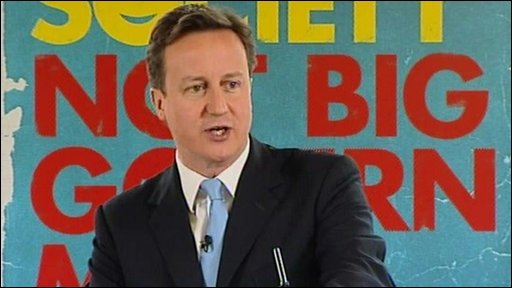 Cameron and his slogan: "Big Society, Not Big Government". Catchy, eh?
Despite this avowed self-denial, however, Cameron and his attack dog, Communities and Local Government Secretary Eric Pickles, are quick to decry any cuts to front-line services that councils feel they have to impose. They call instead for what they term “back-office savings”. This, the latest in a long line of political weasel phrases, is meant to convey a cut that is only painful for local authorities themselves and that somehow mysteriously does not affect the public (that is to say the voter). What this phrase means in practice, of course, is redundancies and pay cuts. These measures, devastating for individuals, are less visible and less likely to bring onto the streets members of the public (as opposed to organised demonstrators like students and union members). They are being demanded of the police, the NHS and the BBC as well as of local councils.
Of course, as I pointed out in a letter published in The Guardian last week, the government has yet to demand “back-office savings” of those banks that are now partly in public ownership or indeed of any other institutions staffed by what used to be called “the Tories’ friends in the City”. Even in middle England, resentment of the kid-gloves treatment of the banks and their greedy employees is detectable. People have wearied of the government being sucker-punched by the banks with their "warnings" that "the best people" will go abroad or that whole businesses will relocate if the managers don't receive shedloads of money. Call their bluff, tell them to fuck off if they'd prefer to live in any other country that will have them (if indeed any other will). Redraw the tax laws so that earnings made in Britain cannot be sheltered in tax havens. Let those who live and work elsewhere but keep a home here and send their kids to schools in Britain pay a big levy for the privilege.
In any case, what about all those scientists whose resarch funding is being cut? Doesn't the government fret about them moving abroad in a new brain drain? What about other important talents and skills: academics, teachers, doctors, nurses, surgeons, law enforcement officers, writers, directors, actors, technicians of all kinds? Why should greedy bankers be the only people Britain wants to keep?
As for local authorities, I advocate that councils play on this restiveness in the Tory heartlands. The government is taking an avowedly partisan line in palming the choice of cuts onto councils while distancing itself from the choices that those councils make. Is there any reason why the councils should not respond in kind – for instance, by withdrawing services (refuse collection, road repairs) specifically from those wards that returned Conservative and Liberal Democrat councillors, on the argument that those residents will be looked after by the Big Society?
Cameron continues to believe that he can distract the electorate from their increasing pain by his talk of creating a Big Society (or his BS as it is widely called in Westminster and Whitehall). Defending the concept in The Observer, Cameron tried to pre-empt his critics: “the first objection [to the Big Society] is that it is too vague” but the rest of his article was unspecified, unargued waffle. For instance, he reckons that “if neighbours want to take over the running of a post office, park or playground, we will help them” but he ignores the obvious objection that there are well-established regulations, drawn up to protect both people and institutions, which cannot simply be “taken over”. Cameron airily says that he’s going to sweep away all those checks and balances that prevent untested people from working with children, a curious stance in the light of his subsequent rant against the Supreme Court.
 Stay out of my garden, Maude
Francis Maude, the Minister for the Cabinet Office and another bête noire of the Tory right, has been obliged by Cameron to speak for the BS concept – it is noticeable that no other cabinet member ever mentions it – and he has been complaining that Labour have been spreading the myth that the BS is just a cover for the cuts. This is pretty rich when you consider how repeatedly (and evidently successfully) the government has put onto the last Labour government the whole blame for what, at the time, we all understood to be a global recession. Now that inflation is the latest statistic to be soaring on his watch, the Chancellor George Osborne announces that it is an “international problem”. How does that work, then?
Ministers need a diversionary tactic because they have begun to comprehend that the cuts will grow steadily more unpopular and that the government that the voters will seek to punish is their own. Blaming Labour will pay diminishing returns. Ministers are now talking in terms of "unpopular but necessary measures" rather than simply "necessary measures". Forecasts of "choppy water" and "difficult months" pop up almost routinely, as if to soften the blows that the government knows it will receive in by- and local elections this year. "We're in for a long haul to get back to normality" Clarke told The Telegraph.
What is so distasteful about this kind of talk is that it is all about the government's own fortunes and nothing about the people's deprivations. "When we get through this." the assumption is, "the nation will thank us". But for people who lose their jobs, their homes, their services, their support, their businesses, maybe their health and in some cases even their lives, there will be no recovery. The damage that the government is doing now will, for many people, be irrevocable.
Wednesday, May 12, 2010
CABINET in the SKY
A few quick musings on the new cabinet. After having a really atrocious election, fluffing and blustering through interviews on subjects she did not grasp, Theresa May is the new Home Secretary, far higher up the ranks than she ever was in opposition. There’s only one explanation and that is Cameron’s dire shortage of women in his new team, even fewer than Gordon Brown had. Indeed, she, Caroline Spelman at Environment and Cheryl Gillan in the Welsh Office are the only women announced and May has to double up on policy for women and equality. Although Sayeeda Warsi will attend cabinet too, you can’t call hers a government post because she is there as party co-chairman under the age-old non-job title of Minister Without Portfolio. Her fellow co-chairman, Andrew Feldman, will not attend cabinet. The Lib Dems, even more poorly supplied with leading women, bring none to the cabinet, though Sarah Teather has often been touted as of ministerial potential.
Though he has found a position for Iain Duncan Smith to go with fellow ex-party leader William Hague, Cameron has given nothing to his erstwhile leadership rival David Davis. I wonder whether he offered and was refused or whether he has written Davis out of the history of his rise.
Meanwhile, the only gay member of Cameron’s shadow cabinet, Nick Herbert, is one of the casualties of coalition. No one outside his circle evidently knows whether the apparently monastic Lib Dem David Laws would be qualified to fill this breach. Talking of sexual chemistry (which I wasn’t), I learn that the new Foreign Secretary is flying to Washington as early as this Friday. You can bet your life, however, that Hillary Clinton will not go all giggly and moist over William Hague to quite the degree that she very publicly did over David Miliband. She will be fervently hoping that Miliband is indeed the shoo-in to be Labour leader that he clearly looks. It seems weird that, were the boyish Miliband to succeed, he would be the oldest leader among those of the three main parties, if only by fifteen months.
A few quick musings on the new cabinet. After having a really atrocious election, fluffing and blustering through interviews on subjects she did not grasp, Theresa May is the new Home Secretary, far higher up the ranks than she ever was in opposition. There’s only one explanation and that is Cameron’s dire shortage of women in his new team, even fewer than Gordon Brown had. Indeed, she, Caroline Spelman at Environment and Cheryl Gillan in the Welsh Office are the only women announced and May has to double up on policy for women and equality. Although Sayeeda Warsi will attend cabinet too, you can’t call hers a government post because she is there as party co-chairman under the age-old non-job title of Minister Without Portfolio. Her fellow co-chairman, Andrew Feldman, will not attend cabinet. The Lib Dems, even more poorly supplied with leading women, bring none to the cabinet, though Sarah Teather has often been touted as of ministerial potential.
Though he has found a position for Iain Duncan Smith to go with fellow ex-party leader William Hague, Cameron has given nothing to his erstwhile leadership rival David Davis. I wonder whether he offered and was refused or whether he has written Davis out of the history of his rise.
Meanwhile, the only gay member of Cameron’s shadow cabinet, Nick Herbert, is one of the casualties of coalition. No one outside his circle evidently knows whether the apparently monastic Lib Dem David Laws would be qualified to fill this breach. Talking of sexual chemistry (which I wasn’t), I learn that the new Foreign Secretary is flying to Washington as early as this Friday. You can bet your life, however, that Hillary Clinton will not go all giggly and moist over William Hague to quite the degree that she very publicly did over David Miliband. She will be fervently hoping that Miliband is indeed the shoo-in to be Labour leader that he clearly looks. It seems weird that, were the boyish Miliband to succeed, he would be the oldest leader among those of the three main parties, if only by fifteen months.
Sunday, September 14, 2008
SIT DOWN, YOU’RE ROCKING the BOAT
It’s a pity that so few in the Westminster village evidently have much historical perspective. Almost every government of my lifetime has suffered, to some degree or other, the mid-term blues. Despite the catastrophe for Eden of the Suez Crisis in 1956, it took Labour another eight years to win a general election. Before the Falklands War, you would have got long odds on Thatcher gaining a second term. Labour was supposed to win the 1992 election right up to the count – indeed the BBC proclaimed Neil Kinnock prime minister on the basis of exit polls – but the Major government came back from the dead. In 2000, William Hague was thought for a time to be well placed to capitalise on Blair’s then unpopularity. As it turned out Hague was the first Tory leader since Austen Chamberlain not to become prime minister, his successor Iain Duncan Smith was the second and his successor Michael Howard the third. Conversely, I still can picture the double page spread in The Observer the Sunday before the Tories won in 1970: “The agony of Edward Heath” was its headline. Save in Zimbabwe, no election result is a foregone conclusion; no poll counts except the actual vote.
My point is that This Too Will Pass. For Labour backbenchers – both perpetual ones and those newly relegated from the front bench – to run around like recently beheaded chickens is the merest folly. How the government’s foes, from Cameron to Salmond, must rub their hands with glee. All the Tories need do is watch. Opposition could not be easier.
The media has decided that Labour cannot possibly win the next election, whether it comes in 2009 or 2010. Nobody notes that just a year ago, the picture was very different. In an ICM poll, the results of which were published on September 19th 2007, Labour was supported by 40% against the Conservatives’ 32% and 20% for the Liberal Democrats. Gordon Brown’s approval ratings among voters of all party allegiances was +32, David Cameron’s was +25 and Sir Menzies Campbell’s was –5; their respective ratings among their own party followers were +73, +25 and +48. Only a fool would propose to anticipate where such ratings will be in mid-September 2009.
Yet Labour MPs – not excluding, if so-called ‘private briefings’ given to journalists have any merit and I always doubt that they do, actual ministers – are queuing up to hurl their own careers and the prospects for their party onto the pyre by telling anyone who will listen that Gordon Brown has to go. And what, in god’s name, do they imagine will be gained by that? Who presently in the house, let alone the cabinet, has the charisma or the credibility to transform the government’s fortunes?
The sad fact that these hysterics cannot grasp is that the government’s present unpopularity rests largely on the economy’s downturn. If David Cameron or Tony Blair or Ming Campbell or Nick Clegg or Ann Widdecombe or Jade Goody or David Beckham were presently prime minister, the polls would still not favour the government. All the ministers who might remotely be likely to stand if there were a leadership contest know this. In the present circumstances, being in government is a bed of nails. Only a masochist would gladly take over at number 10.
Joan Ryan, who resigned as vice-chairman of the party at the end of last week, told a BBC reporter: “lots of people are saying, you know, we need now to have this debate”. What debate? David Davis resigned and prompted a by-election because he wanted a national debate on the eroding of civil freedoms. Did you miss that debate? So did I. There are certain individual policies – ID cards, detention of terror suspects – that do not command the full support of the Labour party and when they come before the house they are hotly and exhaustively debated. Otherwise, the cabinet is as united on policy as any since World War II.
So what is the debate about? Well of course it’s about personalities. On Any Questions this weekend, Tony Benn was gallantly arguing yet again that the debate ought to be about issues, not personalities. But the fact is that Benn’s argument was lost years ago. The media is not interested in issues or policy but ‘stars’ and, because the media is powerful, even professionals pay it heed and begin to believe what it says. The media has decided that Brown’s fall from grace is a good story. Consequently, Brown almost never gets any coverage, either broadcast or print, that does not begin from the premise that there is “more trouble” for the prime minister. If Brown slashed everyone’s taxes, took Britain out of the European Union and gave the electorate a referendum on, inter alia, capital punishment, ID cards, smoking in public places, immigration, troops out of Iraq and Afghanistan and the weather in summer, the media would still find a way to present it as “trouble” for Brown.
His worst trouble is the inward-looking, easily swayed nature of politicians today. In his big speech at the party conference, the PM will need to make it clear that he isn’t stepping down this side of an election in any circumstances save unforeseen illness; that if backbenchers care to run their version of Sir Anthony Meyer against him (the so-articulate Joan Ryan perhaps) they are welcome to try but that she and they should expect to lose the whip; that nobody this side of the horizon has any better ideas about getting through the downturn and changing the leader will not change the ideas; that all this hysteria only makes the party look like an amateur rabble instead of a mature political movement; that the media is not the government’s friend and those feeding it tittle-tattle off the record do very much more harm than good and indeed give the media cover under which to make up stories and claim they reflect reality; that he has earned backbench loyalty by being the most successful Chancellor in a century and that he expects to be able to draw on that credit now that the going is tough.
Pace Mr Benn, let’s talk personalities for a moment. I agree with Tam Dalyell, father of the last house, that Tony Blair was the worst prime minister of our lifetime. I rejoiced that the Tories chose a Blair Mark II to lead them, believing that the electorate would have had enough of “pretty straight sort of guy” spin. I omitted to note that the electorate never went off Blair sufficiently to vote him out of office, though, had they been given a chance to do so in 2010, who knows what the result would have been? Cameron has played his first years in opposition exactly as Blair played his, even repeatedly accusing the prime minister of “dithering”, a charge that fitted John Major far better than it does Gordon Brown.
It was Blair’s plausibility as much as any other quality that stuck in my craw and Cameron strikes me the same. These guys are snake-oil salesmen: Blair was a lawyer, Cameron a career politico. Brown is, I believe, much more grounded in reality. His forte is not being ingratiating. But that’s a harder sell in a sound-bite culture. America will elect McCain (I now feel sure) because the American electorate always prefers the genial guy over the earnest guy: Reagan over Carter and Mondale, Clinton over Bush Sr and Dole, Bush Jr over Gore and Kerry. It doesn't matter much if the laid-back guy is obviously a duffer. Sufficient numbers like to imagine having a beer with their president that they overwhelm those who contemplate with equanimity being nagged by their president. No need to make it more complicated, pundits.
Labour is a bit short of geniality. Maybe Brown is indeed doomed against Cameron but which of its top brass wouldn’t be? Ed Balls is probably as chirpy as any member of the government but the press hate him and he suffers from having spent so long as a super-loyal Brownite. Alan Johnson might be their best bet: bluff, twinkly enough and certainly a contrast to Cameron. But has he got a thick enough skin? Brown has this much going for him: he exhibits no iota of discomfort or pain or bewilderment at the daily onslaught he has to undergo, not in public anyway.
It may be that there is no way out for Labour, that the downturn will be politically fatal as it would be fatal for any party that had to deal with it. But these strident absolutes are folly: that Labour cannot win, that Brown must go. Anything can happen in politics and the party needs to keep its nerve and present a united front so that the government can have the best shot at coming through the crisis unscathed.
It’s a pity that so few in the Westminster village evidently have much historical perspective. Almost every government of my lifetime has suffered, to some degree or other, the mid-term blues. Despite the catastrophe for Eden of the Suez Crisis in 1956, it took Labour another eight years to win a general election. Before the Falklands War, you would have got long odds on Thatcher gaining a second term. Labour was supposed to win the 1992 election right up to the count – indeed the BBC proclaimed Neil Kinnock prime minister on the basis of exit polls – but the Major government came back from the dead. In 2000, William Hague was thought for a time to be well placed to capitalise on Blair’s then unpopularity. As it turned out Hague was the first Tory leader since Austen Chamberlain not to become prime minister, his successor Iain Duncan Smith was the second and his successor Michael Howard the third. Conversely, I still can picture the double page spread in The Observer the Sunday before the Tories won in 1970: “The agony of Edward Heath” was its headline. Save in Zimbabwe, no election result is a foregone conclusion; no poll counts except the actual vote.
My point is that This Too Will Pass. For Labour backbenchers – both perpetual ones and those newly relegated from the front bench – to run around like recently beheaded chickens is the merest folly. How the government’s foes, from Cameron to Salmond, must rub their hands with glee. All the Tories need do is watch. Opposition could not be easier.
The media has decided that Labour cannot possibly win the next election, whether it comes in 2009 or 2010. Nobody notes that just a year ago, the picture was very different. In an ICM poll, the results of which were published on September 19th 2007, Labour was supported by 40% against the Conservatives’ 32% and 20% for the Liberal Democrats. Gordon Brown’s approval ratings among voters of all party allegiances was +32, David Cameron’s was +25 and Sir Menzies Campbell’s was –5; their respective ratings among their own party followers were +73, +25 and +48. Only a fool would propose to anticipate where such ratings will be in mid-September 2009.
Yet Labour MPs – not excluding, if so-called ‘private briefings’ given to journalists have any merit and I always doubt that they do, actual ministers – are queuing up to hurl their own careers and the prospects for their party onto the pyre by telling anyone who will listen that Gordon Brown has to go. And what, in god’s name, do they imagine will be gained by that? Who presently in the house, let alone the cabinet, has the charisma or the credibility to transform the government’s fortunes?
The sad fact that these hysterics cannot grasp is that the government’s present unpopularity rests largely on the economy’s downturn. If David Cameron or Tony Blair or Ming Campbell or Nick Clegg or Ann Widdecombe or Jade Goody or David Beckham were presently prime minister, the polls would still not favour the government. All the ministers who might remotely be likely to stand if there were a leadership contest know this. In the present circumstances, being in government is a bed of nails. Only a masochist would gladly take over at number 10.
Joan Ryan, who resigned as vice-chairman of the party at the end of last week, told a BBC reporter: “lots of people are saying, you know, we need now to have this debate”. What debate? David Davis resigned and prompted a by-election because he wanted a national debate on the eroding of civil freedoms. Did you miss that debate? So did I. There are certain individual policies – ID cards, detention of terror suspects – that do not command the full support of the Labour party and when they come before the house they are hotly and exhaustively debated. Otherwise, the cabinet is as united on policy as any since World War II.
So what is the debate about? Well of course it’s about personalities. On Any Questions this weekend, Tony Benn was gallantly arguing yet again that the debate ought to be about issues, not personalities. But the fact is that Benn’s argument was lost years ago. The media is not interested in issues or policy but ‘stars’ and, because the media is powerful, even professionals pay it heed and begin to believe what it says. The media has decided that Brown’s fall from grace is a good story. Consequently, Brown almost never gets any coverage, either broadcast or print, that does not begin from the premise that there is “more trouble” for the prime minister. If Brown slashed everyone’s taxes, took Britain out of the European Union and gave the electorate a referendum on, inter alia, capital punishment, ID cards, smoking in public places, immigration, troops out of Iraq and Afghanistan and the weather in summer, the media would still find a way to present it as “trouble” for Brown.
His worst trouble is the inward-looking, easily swayed nature of politicians today. In his big speech at the party conference, the PM will need to make it clear that he isn’t stepping down this side of an election in any circumstances save unforeseen illness; that if backbenchers care to run their version of Sir Anthony Meyer against him (the so-articulate Joan Ryan perhaps) they are welcome to try but that she and they should expect to lose the whip; that nobody this side of the horizon has any better ideas about getting through the downturn and changing the leader will not change the ideas; that all this hysteria only makes the party look like an amateur rabble instead of a mature political movement; that the media is not the government’s friend and those feeding it tittle-tattle off the record do very much more harm than good and indeed give the media cover under which to make up stories and claim they reflect reality; that he has earned backbench loyalty by being the most successful Chancellor in a century and that he expects to be able to draw on that credit now that the going is tough.
Pace Mr Benn, let’s talk personalities for a moment. I agree with Tam Dalyell, father of the last house, that Tony Blair was the worst prime minister of our lifetime. I rejoiced that the Tories chose a Blair Mark II to lead them, believing that the electorate would have had enough of “pretty straight sort of guy” spin. I omitted to note that the electorate never went off Blair sufficiently to vote him out of office, though, had they been given a chance to do so in 2010, who knows what the result would have been? Cameron has played his first years in opposition exactly as Blair played his, even repeatedly accusing the prime minister of “dithering”, a charge that fitted John Major far better than it does Gordon Brown.
It was Blair’s plausibility as much as any other quality that stuck in my craw and Cameron strikes me the same. These guys are snake-oil salesmen: Blair was a lawyer, Cameron a career politico. Brown is, I believe, much more grounded in reality. His forte is not being ingratiating. But that’s a harder sell in a sound-bite culture. America will elect McCain (I now feel sure) because the American electorate always prefers the genial guy over the earnest guy: Reagan over Carter and Mondale, Clinton over Bush Sr and Dole, Bush Jr over Gore and Kerry. It doesn't matter much if the laid-back guy is obviously a duffer. Sufficient numbers like to imagine having a beer with their president that they overwhelm those who contemplate with equanimity being nagged by their president. No need to make it more complicated, pundits.
Labour is a bit short of geniality. Maybe Brown is indeed doomed against Cameron but which of its top brass wouldn’t be? Ed Balls is probably as chirpy as any member of the government but the press hate him and he suffers from having spent so long as a super-loyal Brownite. Alan Johnson might be their best bet: bluff, twinkly enough and certainly a contrast to Cameron. But has he got a thick enough skin? Brown has this much going for him: he exhibits no iota of discomfort or pain or bewilderment at the daily onslaught he has to undergo, not in public anyway.
It may be that there is no way out for Labour, that the downturn will be politically fatal as it would be fatal for any party that had to deal with it. But these strident absolutes are folly: that Labour cannot win, that Brown must go. Anything can happen in politics and the party needs to keep its nerve and present a united front so that the government can have the best shot at coming through the crisis unscathed.
Thursday, June 12, 2008
An UNEXPECTED HERO
The Conservative Party has always had a penchant for political theatre. From Quentin Hailsham’s futile offer at the party conference to renounce his peerage so that he would be available to lead the party, to Enoch Powell’s “Tiber foaming with blood” speech that so angered Edward Heath, to Michael Heseltine’s petulant walk-out from the Thatcher cabinet over Westland, to John Redwood’s quixotic tilt at John Mayor’s leadership (eliciting one of the most damaging of all brutal headlines in The Sun: “Redwood versus Deadwood”) and now to David Davis’ gallant resignation to precipitate a by-election, Tories certainly know how to get the Westminster pulses racing.
Mr Davis has earned my astonished admiration. That he took everyone, not least David Cameron, by surprise was evident as the news broke during The World at One. What surprises me even more is how courageous and principled his decision seems, at least on the face of it. I had thought – admit it, so had you – that this was one of the most devious, calculating politicians of the present generation. Yet no one, including him, can begin to guess what will be the result of Mr Davis’ gamble. He may lose his 5,000 majority at Haltemprice and Howden, especially if, as conventional wisdom has it, voters resent what they see as unnecessary by-elections and if, as some claim, Gordon Brown has widespread support for his desire to put on the statute book a provision for terrorism suspects – or indeed anyone else of whom a police officer happens not to like the look – to be held for up to 42 days.
The MP will surely not lose the seat, however, because the party leader of his chief challenger, the Liberal Democrats, moved very quickly to announce that there would be no candidate under his colours at the by-election. Nick Clegg moved so quickly, indeed, that one wonders whether he consulted the local party or whether this was a fait accompli handed down from central office. If the latter, he may come to regret it. As I write, there is strong speculation that Labour will not field a candidate either. That would leave Mr Davis’ gesture looking rather empty. Indeed, there might be a danger of the turnout being so low for an election that has become a foregone conclusion that Mr Davis loses credibility; or even gets beaten by a minor party candidate. What a disaster it would be if the British National Party were to capture the seat by default.
We may discover in the fullness of time that Mr Davis has badly miscalculated. For this is the kind of unforeseen event that can change the political weather. We may find ourselves looking back and feeling that we can date the moment when Labour turned the corner and won the 2010 general election to this one.
But whatever the outcome, I take my hat off to David Davis. He has put himself in great jeopardy – in particular, perhaps, within his own party where there was always a residue of suspicion that he has a maverick temperament – in order to take a matter of great national importance to the electorate. The contrast to the government’s squalid scramble to save itself from a humiliating defeat in the vote is there for all to see. While Davis raises his standard and dares democracy to deny him, the prime minister tells a press conference with a straight face that no deal was done for the nine votes of the Democratic Unionist Party that secured his victory in the house by nine votes. As an SDLP member said unarguably after the vote, instead of a humiliating defeat, the government got a humiliating victory. The fact that nobody believes Brown when he denies any deal renders it immaterial whether there was a deal or not. As I’ve written before on this blog – and as Brown is smart enough to know – how it looks in politics is very much more important than how it is. And Brown emerges looking like a liar.
Meanwhile, David Davis is absolutely right to make libertarianism a cause worth politically dying for. As a libertarian socialist, I watch in horror as a Labour government dismantles the freedoms that we have taken for granted for centuries. If Brown does survive to 2010, we may yet see a British equivalent of Guantánamo Bay. And where will that be sited? I humbly suggest the Falkland Islands.
The Conservative Party has always had a penchant for political theatre. From Quentin Hailsham’s futile offer at the party conference to renounce his peerage so that he would be available to lead the party, to Enoch Powell’s “Tiber foaming with blood” speech that so angered Edward Heath, to Michael Heseltine’s petulant walk-out from the Thatcher cabinet over Westland, to John Redwood’s quixotic tilt at John Mayor’s leadership (eliciting one of the most damaging of all brutal headlines in The Sun: “Redwood versus Deadwood”) and now to David Davis’ gallant resignation to precipitate a by-election, Tories certainly know how to get the Westminster pulses racing.
Mr Davis has earned my astonished admiration. That he took everyone, not least David Cameron, by surprise was evident as the news broke during The World at One. What surprises me even more is how courageous and principled his decision seems, at least on the face of it. I had thought – admit it, so had you – that this was one of the most devious, calculating politicians of the present generation. Yet no one, including him, can begin to guess what will be the result of Mr Davis’ gamble. He may lose his 5,000 majority at Haltemprice and Howden, especially if, as conventional wisdom has it, voters resent what they see as unnecessary by-elections and if, as some claim, Gordon Brown has widespread support for his desire to put on the statute book a provision for terrorism suspects – or indeed anyone else of whom a police officer happens not to like the look – to be held for up to 42 days.
The MP will surely not lose the seat, however, because the party leader of his chief challenger, the Liberal Democrats, moved very quickly to announce that there would be no candidate under his colours at the by-election. Nick Clegg moved so quickly, indeed, that one wonders whether he consulted the local party or whether this was a fait accompli handed down from central office. If the latter, he may come to regret it. As I write, there is strong speculation that Labour will not field a candidate either. That would leave Mr Davis’ gesture looking rather empty. Indeed, there might be a danger of the turnout being so low for an election that has become a foregone conclusion that Mr Davis loses credibility; or even gets beaten by a minor party candidate. What a disaster it would be if the British National Party were to capture the seat by default.
We may discover in the fullness of time that Mr Davis has badly miscalculated. For this is the kind of unforeseen event that can change the political weather. We may find ourselves looking back and feeling that we can date the moment when Labour turned the corner and won the 2010 general election to this one.
But whatever the outcome, I take my hat off to David Davis. He has put himself in great jeopardy – in particular, perhaps, within his own party where there was always a residue of suspicion that he has a maverick temperament – in order to take a matter of great national importance to the electorate. The contrast to the government’s squalid scramble to save itself from a humiliating defeat in the vote is there for all to see. While Davis raises his standard and dares democracy to deny him, the prime minister tells a press conference with a straight face that no deal was done for the nine votes of the Democratic Unionist Party that secured his victory in the house by nine votes. As an SDLP member said unarguably after the vote, instead of a humiliating defeat, the government got a humiliating victory. The fact that nobody believes Brown when he denies any deal renders it immaterial whether there was a deal or not. As I’ve written before on this blog – and as Brown is smart enough to know – how it looks in politics is very much more important than how it is. And Brown emerges looking like a liar.
Meanwhile, David Davis is absolutely right to make libertarianism a cause worth politically dying for. As a libertarian socialist, I watch in horror as a Labour government dismantles the freedoms that we have taken for granted for centuries. If Brown does survive to 2010, we may yet see a British equivalent of Guantánamo Bay. And where will that be sited? I humbly suggest the Falkland Islands.
Subscribe to:
Posts (Atom)

