A RAVISHING ROW
At my school in the 1960s, there were termly outings to the theatre. I expect there still are. Nothing unusual about that, you will say. Theatre-goers have long known that a Stratford matinee is only to be undertaken if one can tolerate an auditorium full of adolescents whispering, giggling, rustling sweet papers and, nowadays doubtless, texting each other when bored.
Our English master had a pretty adventurous eye for what to take us to. On one occasion, we even came down to London by coach to see a musical. The one in question had a proper literary pedigree, being based on a comedy of 1730 by Henry Fielding. It had been adapted by Bernard Miles for the opening production at the splendid little theatre that Miles founded at Blackfriars, the much missed Mermaid. The lyrics were by Lionel Bart and the music by Laurie Johnson. The show was a huge hit, the biggest the Mermaid ever had, running on and off for five years including a West End transfer.
Now, if you are surprised at our being taken to a musical, prepare to be astounded at the nature of that musical. It was called Lock Up Your Daughters and its main subject is made explicit in the title of the original Fielding: Rape Upon Rape. Can you imagine a group of teenaged boys today being taken by their school to a raucous celebration of rape?
The original vinyl album of a tuneful show
The show was tremendously lascivious in a very good-natured way – and remember that censorship was still ruthlessly imposed on theatres in those days. Nonetheless, the sight of the splendiferous Hy Hazell, legs as long as the Eiffel Tower, huskily lip-smacking her way through a naughty little number called ‘When Does the Ravishing Begin?’ was a formative experience for most of the boys on the outing.
The verb “to ravish” is not much used now. Its fifth definition in the OED, the one that concerns us here, is “to drag off or carry away (a woman) by force or with violence (occas. also implying subsequent rape”. Yet until pretty recently, this was considered to be a lark, even by women. Certainly, in my youth, rape was a good joke or, perhaps I should say, an occasion for bad jokes: “Grape! Grape!” “Don’t you mean ‘Rape! Rape!’” “No, there was a bunch of them”.
The original programme
Times have changed. In the 1990s, Chichester Festival Theatre boldly mounted a revival of Lock Up Your Daughters. The cast was led by George Cole, with whom I had worked, and Sheila Hancock, whom I had admired for more than thirty years. I persuaded The Guardian to let me interview them. No piece I contributed to the paper was ever more altered in the subbing. A persistent subtext of disdain and disapproval was injected into the published version of what I had written. I bitterly resented it but of course it was too late to disavow. One casualty was that I decided not to try to pursue a plan I had been nursing to attempt a biography of Cole.
But I went to the press night of the revival and was struck by how cruelly time had treated it. It did now seem, at best, in dubious taste. The reviews were universally damning, no one making any reference to the huge hit the show had been a generation earlier.
Ken puts his hush-puppies in it again
Since this morning, there has been a tremendous hoo-ha about an appearance by the Justice Secretary, Ken Clarke, on Radio 5 Live. I listened carefully to the programme and, for a limited period, you can too at:
http://bbc.in/8ZHTEH
If you do, you may deplore, as I do, the contumely being poured on Clarke’s head. The central problem with the programme, or so it seems to me, is that the interviewer, Victoria Derbyshire, never pays Clarke the elementary compliment of listening to what he is saying. This is a grave professional lapse and if anyone deserves to be pilloried for their performance on the programme it is her.
What Derbyshire does repeatedly is to assume that Clarke is trying to excuse or disregard certain categories of rape. In his report on the BBC’s television news at 6:00, Nick Robinson suggested that Clarke’s error was to refer to “serious rape”, with the implication that not all rape is serious. What Clarke is actually trying to do is to explain that the law as it stands discriminates between different sexual encounters. But Derbyshire cannot hear this; she is too busy being offended by the notion of a man suggesting that some rapes are more serious than others.
Victoria Derbyshire – and you are not to take the piss by gazing at her bosom
It would be interesting to hear Derbyshire’s response to Germaine Greer on rape, written five years ago. I don’t think I need to state Dr Greer’s credentials as a feminist or as a serious thinker on all aspects of sexual politics. Her view can be read here:
http://ind.pn/18LZlg
and I particularly draw the attention of readers (and of Derbyshire) to Dr Greer’s use of the term “petty rape”.
So, can there be a distinction between one rape and another? Take the case of a girl of 15 who looks and dresses like a 20 year-old and who is enthusiastically sleeping around. In law, any male above the age of 15 who sleeps with her is committing rape. That is how the courts characterise sex with a girl (or indeed a boy) who is not classed as a child but is still below the age of consent which, in Britain, is 16. This kind of rape is known to lawyers – though the phrase is not in fact enshrined in statute – as statutory rape.
Dr Greer in the days of her pomp
Now consider the phenomenon of “date-rape”. This is a fraught area because it swings so much on one person’s word against that of another and on what one person understood at the time the act took place, given that the circumstances of the act might be overlaid with the consumption of intoxicants of various kinds. This is not to say that it is a less-than-serious crime. But it often enough takes place in a situation confused by many other factors.
I don’t know what proportion of my readers would suggest that either of these examples of rape equates with the gang-rape of a pensioner or the systematic sexual assault on civilians by military personnel in a war situation. Ken Clarke, it seems to me, was trying to suggest that there are degrees of seriousness in rape cases. Who would dispute that? Would you?
For any woman who has suffered rape, such debate must be irrelevant and insensitive. The water of the 5 Live interview was much muddied by a caller being injected into the proceedings. She had been through the extended trauma of being raped by a man – I think I understand her account correctly – who was out on parole after previous convictions and who was then given a reduced sentence. She became understandably emotional in the telling.
Clarke snoozing through this spring's budget
It was unfair and exploitative of the producer to ambush Clarke with this. Very properly, he didn’t attempt to engage with the woman’s case – how could he? – but he wasn’t able to shake off the disadvantage that personal emotion of this kind lays on rational debate. Derbyshire, on the other hand, seemed to believe that the woman’s experience “proved” that Clarke was wrong.
The internet has been aflame ever since. Twitter’s 140-character limit on individual comment is apt to encourage the disobliging and the ad hominem. I have no doubt that the great majority of tweets and thread comments on the matter were not informed by actually listening to the programme, if indeed, the tweeters were any more capable of listening to Clarke than was Derbyshire.
Opportunistically, Ed Miliband called for Clarke to go at Prime Minister’s Questions. David Cameron, who evidently hadn’t heard the programme nor been briefed on it, remained studiously non-committal on his Justice Secretary’s fate and attempted, none too successfully, to steer the subject back to government policy on sentencing which, of course, is just what the discussion ought to be about. However, Cameron has quite a bit of form now in letting his ministers swing in the breeze. And subsequently all remarks released from Downing Street have been lukewarm at best. So Clarke may still perish and that would be a loss. Despite the instant judgments of internet traffic, he is one of the more enlightened of this government’s representatives.
Showing posts with label Ken Clarke. Show all posts
Wednesday, May 18, 2011
Wednesday, February 16, 2011
COAGULATION GOVERNMENT
The contradictions grow more evident with every passing day. The three most damaging charges successfully levelled by oppositions against British governments over the last half-century have concerned “u-turns”, “dither” and “sleaze”. David Cameron’s government has yet to be overwhelmed by sleaze and perhaps has been sufficiently energetic to avoid attracting many accusations of dithering, but the u-turns come thick and fast.
Ken Clarke, the Lord Chancellor (aka Justice Secretary), hinted at this failure of the coalition in his interview in The Daily Telegraph at the weekend. Clarke ruminated that “I don’t think middle England has quite taken on board the scale of the problem”. He was talking about the economy, which is not of course his fiefdom since the restoration of Tory rule. Some sixteen months before the election, Cameron brought him back into front-line politics as shadow Business Secretary. Until then he had spent the better part of a decade on the backbenches, from soon after the Tories lost the 1997 election – he had served as Chancellor for the last four years of John Major’s government.
Kenneth Clarke: a personal view of civilisation not shared by all Tories
It is middle England that has been kicking up roughest just lately about government policy, especially the proposed sale of forests, the widespread closure of libraries and the evidence of a watering down, by complicated but suspicion-rousing means, of Cameron’s much-trumpeted commitment to the National Health Service. My reading is that Clarke’s remark is his way of indicating that he thinks the government is wrong on these issues because they will alienate core Tory votes. And indeed, it is in these areas, beginning with the fate of the greenwoods, that the u-turns have begun to look most likely,
Many on the Tory right (and not only on the right) loathe Ken Clarke for what they see as his unsound views – socially liberal, staunchly pro-European – and his faintly plebeian, even faintly bohemian style. He attended a direct grant rather than a public school, favours jazz, real ale and hush puppies and looks uncomfortable in evening dress. But he is a very old hand, only one MP short of being Father of the House (that is, the longest serving MP), and he has an undoubted populist touch, cutting a jovial, almost Falstaffian figure: the cover of the new issue of Private Eye makes splendid use of a funny picture of him.
Cameron: leading a government of clots
His interview with The Telegraph preceded the vote in the Commons on the ruling of the European Court of Human Rights in Strasbourg. The court decided that the disallowing of all those in gaol from voting in parliamentary elections – as Britain has done for centuries – is unlawful. Clarke took the view that “I do not contemplate either government or parliament suddenly deciding it’s not bound by the rule of law”. He must have known by that stage that his leader fiercely, even emotionally deprecated the Strasbourg line. In part influenced by the PM, the House, in one of its bursts of almost universal outrage and self-righteousness, voted to defy the ruling by 234 votes to 22. Two former Home Secretaries, Jack Straw and David Davis, led the assault.
I found this vote incomprehensible. Parliament is a legislative body. The rule of law is its sovereign duty. How then can it in all conscience vote to defy the ruling of a court of law? In his speech, Davis said: “If you break the law, you cannot make the law”. He was talking about those in prison. But surely the complementary observation is true of parliamentarians: if you make the law, you cannot defy the law. So I find myself with the Justice Secretary on this – a matter of principle and protocol – while Cameron and most of the rest of the Commons are playing to an imagined gallery.
Pickles: give 'er the money, Mabel
Within 48 hours, Cameron was again questioning a court ruling when Britain’s Supreme Court found that those listed on the sex offenders’ register ought to have the right to have their names expunged from it if they prove themselves to be reformed. The Prime Minister may imagine that he is shoring up his middle and not-so-middle England support in striking back at the courts, but the courts will not be on the government’s side if it leads the Commons into a situation where individuals who reckon that their rights are being denied start taking the government to law. The potential for the government having to pay out millions is high.
More errors have been committed concerning the armed forces, usually an area where Tory governments take it for granted that they are more trusted than Labour governments. The decommissioning and subsequent breaking-up of Nimrod spy planes has left many aghast, both within the military establishment and in the lay community. I cannot understand why the government did not seek to sell these extremely expensive planes to some other government. Now, pilots who have almost completed hundreds of hours of training, along with various other types of service personnel, are being informed that they are surplus to requirements and, to the fury of such military wallahs as Tory backbencher Patrick Mercer, they are being (in his words) “dumped by email” which he describes as a tactic “more appropriate to the ending of a playground romance”. More Tory support is endangered by these developments.
Meanwhile, the cuts juggernaut rolls on, some of its work adumbrated in last year’s spending review, some emerging from the backs of Treasury envelopes and then hurriedly withdrawn again. We are lately learning the extent of slashing and burning that local authorities are obliged to indulge by government fiat. Cameron is taking the line that, Pontius Pilate-like, the government is washing its hands of the specific cuts that councils make, in the hope that the opprobrium for cuts of whatever nature will attach to the hapless councils rather than to the coalition that imposed them.
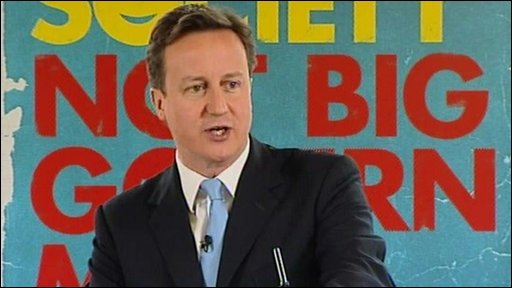
Cameron and his slogan: "Big Society, Not Big Government". Catchy, eh?
Despite this avowed self-denial, however, Cameron and his attack dog, Communities and Local Government Secretary Eric Pickles, are quick to decry any cuts to front-line services that councils feel they have to impose. They call instead for what they term “back-office savings”. This, the latest in a long line of political weasel phrases, is meant to convey a cut that is only painful for local authorities themselves and that somehow mysteriously does not affect the public (that is to say the voter). What this phrase means in practice, of course, is redundancies and pay cuts. These measures, devastating for individuals, are less visible and less likely to bring onto the streets members of the public (as opposed to organised demonstrators like students and union members). They are being demanded of the police, the NHS and the BBC as well as of local councils.
Of course, as I pointed out in a letter published in The Guardian last week, the government has yet to demand “back-office savings” of those banks that are now partly in public ownership or indeed of any other institutions staffed by what used to be called “the Tories’ friends in the City”. Even in middle England, resentment of the kid-gloves treatment of the banks and their greedy employees is detectable. People have wearied of the government being sucker-punched by the banks with their "warnings" that "the best people" will go abroad or that whole businesses will relocate if the managers don't receive shedloads of money. Call their bluff, tell them to fuck off if they'd prefer to live in any other country that will have them (if indeed any other will). Redraw the tax laws so that earnings made in Britain cannot be sheltered in tax havens. Let those who live and work elsewhere but keep a home here and send their kids to schools in Britain pay a big levy for the privilege.
In any case, what about all those scientists whose resarch funding is being cut? Doesn't the government fret about them moving abroad in a new brain drain? What about other important talents and skills: academics, teachers, doctors, nurses, surgeons, law enforcement officers, writers, directors, actors, technicians of all kinds? Why should greedy bankers be the only people Britain wants to keep?
As for local authorities, I advocate that councils play on this restiveness in the Tory heartlands. The government is taking an avowedly partisan line in palming the choice of cuts onto councils while distancing itself from the choices that those councils make. Is there any reason why the councils should not respond in kind – for instance, by withdrawing services (refuse collection, road repairs) specifically from those wards that returned Conservative and Liberal Democrat councillors, on the argument that those residents will be looked after by the Big Society?
Cameron continues to believe that he can distract the electorate from their increasing pain by his talk of creating a Big Society (or his BS as it is widely called in Westminster and Whitehall). Defending the concept in The Observer, Cameron tried to pre-empt his critics: “the first objection [to the Big Society] is that it is too vague” but the rest of his article was unspecified, unargued waffle. For instance, he reckons that “if neighbours want to take over the running of a post office, park or playground, we will help them” but he ignores the obvious objection that there are well-established regulations, drawn up to protect both people and institutions, which cannot simply be “taken over”. Cameron airily says that he’s going to sweep away all those checks and balances that prevent untested people from working with children, a curious stance in the light of his subsequent rant against the Supreme Court.
Stay out of my garden, Maude
Francis Maude, the Minister for the Cabinet Office and another bête noire of the Tory right, has been obliged by Cameron to speak for the BS concept – it is noticeable that no other cabinet member ever mentions it – and he has been complaining that Labour have been spreading the myth that the BS is just a cover for the cuts. This is pretty rich when you consider how repeatedly (and evidently successfully) the government has put onto the last Labour government the whole blame for what, at the time, we all understood to be a global recession. Now that inflation is the latest statistic to be soaring on his watch, the Chancellor George Osborne announces that it is an “international problem”. How does that work, then?
Ministers need a diversionary tactic because they have begun to comprehend that the cuts will grow steadily more unpopular and that the government that the voters will seek to punish is their own. Blaming Labour will pay diminishing returns. Ministers are now talking in terms of "unpopular but necessary measures" rather than simply "necessary measures". Forecasts of "choppy water" and "difficult months" pop up almost routinely, as if to soften the blows that the government knows it will receive in by- and local elections this year. "We're in for a long haul to get back to normality" Clarke told The Telegraph.
What is so distasteful about this kind of talk is that it is all about the government's own fortunes and nothing about the people's deprivations. "When we get through this." the assumption is, "the nation will thank us". But for people who lose their jobs, their homes, their services, their support, their businesses, maybe their health and in some cases even their lives, there will be no recovery. The damage that the government is doing now will, for many people, be irrevocable.
The contradictions grow more evident with every passing day. The three most damaging charges successfully levelled by oppositions against British governments over the last half-century have concerned “u-turns”, “dither” and “sleaze”. David Cameron’s government has yet to be overwhelmed by sleaze and perhaps has been sufficiently energetic to avoid attracting many accusations of dithering, but the u-turns come thick and fast.
Ken Clarke, the Lord Chancellor (aka Justice Secretary), hinted at this failure of the coalition in his interview in The Daily Telegraph at the weekend. Clarke ruminated that “I don’t think middle England has quite taken on board the scale of the problem”. He was talking about the economy, which is not of course his fiefdom since the restoration of Tory rule. Some sixteen months before the election, Cameron brought him back into front-line politics as shadow Business Secretary. Until then he had spent the better part of a decade on the backbenches, from soon after the Tories lost the 1997 election – he had served as Chancellor for the last four years of John Major’s government.
Kenneth Clarke: a personal view of civilisation not shared by all ToriesIt is middle England that has been kicking up roughest just lately about government policy, especially the proposed sale of forests, the widespread closure of libraries and the evidence of a watering down, by complicated but suspicion-rousing means, of Cameron’s much-trumpeted commitment to the National Health Service. My reading is that Clarke’s remark is his way of indicating that he thinks the government is wrong on these issues because they will alienate core Tory votes. And indeed, it is in these areas, beginning with the fate of the greenwoods, that the u-turns have begun to look most likely,
Many on the Tory right (and not only on the right) loathe Ken Clarke for what they see as his unsound views – socially liberal, staunchly pro-European – and his faintly plebeian, even faintly bohemian style. He attended a direct grant rather than a public school, favours jazz, real ale and hush puppies and looks uncomfortable in evening dress. But he is a very old hand, only one MP short of being Father of the House (that is, the longest serving MP), and he has an undoubted populist touch, cutting a jovial, almost Falstaffian figure: the cover of the new issue of Private Eye makes splendid use of a funny picture of him.
Cameron: leading a government of clotsHis interview with The Telegraph preceded the vote in the Commons on the ruling of the European Court of Human Rights in Strasbourg. The court decided that the disallowing of all those in gaol from voting in parliamentary elections – as Britain has done for centuries – is unlawful. Clarke took the view that “I do not contemplate either government or parliament suddenly deciding it’s not bound by the rule of law”. He must have known by that stage that his leader fiercely, even emotionally deprecated the Strasbourg line. In part influenced by the PM, the House, in one of its bursts of almost universal outrage and self-righteousness, voted to defy the ruling by 234 votes to 22. Two former Home Secretaries, Jack Straw and David Davis, led the assault.
I found this vote incomprehensible. Parliament is a legislative body. The rule of law is its sovereign duty. How then can it in all conscience vote to defy the ruling of a court of law? In his speech, Davis said: “If you break the law, you cannot make the law”. He was talking about those in prison. But surely the complementary observation is true of parliamentarians: if you make the law, you cannot defy the law. So I find myself with the Justice Secretary on this – a matter of principle and protocol – while Cameron and most of the rest of the Commons are playing to an imagined gallery.
Pickles: give 'er the money, MabelWithin 48 hours, Cameron was again questioning a court ruling when Britain’s Supreme Court found that those listed on the sex offenders’ register ought to have the right to have their names expunged from it if they prove themselves to be reformed. The Prime Minister may imagine that he is shoring up his middle and not-so-middle England support in striking back at the courts, but the courts will not be on the government’s side if it leads the Commons into a situation where individuals who reckon that their rights are being denied start taking the government to law. The potential for the government having to pay out millions is high.
More errors have been committed concerning the armed forces, usually an area where Tory governments take it for granted that they are more trusted than Labour governments. The decommissioning and subsequent breaking-up of Nimrod spy planes has left many aghast, both within the military establishment and in the lay community. I cannot understand why the government did not seek to sell these extremely expensive planes to some other government. Now, pilots who have almost completed hundreds of hours of training, along with various other types of service personnel, are being informed that they are surplus to requirements and, to the fury of such military wallahs as Tory backbencher Patrick Mercer, they are being (in his words) “dumped by email” which he describes as a tactic “more appropriate to the ending of a playground romance”. More Tory support is endangered by these developments.
Meanwhile, the cuts juggernaut rolls on, some of its work adumbrated in last year’s spending review, some emerging from the backs of Treasury envelopes and then hurriedly withdrawn again. We are lately learning the extent of slashing and burning that local authorities are obliged to indulge by government fiat. Cameron is taking the line that, Pontius Pilate-like, the government is washing its hands of the specific cuts that councils make, in the hope that the opprobrium for cuts of whatever nature will attach to the hapless councils rather than to the coalition that imposed them.
Cameron and his slogan: "Big Society, Not Big Government". Catchy, eh?Despite this avowed self-denial, however, Cameron and his attack dog, Communities and Local Government Secretary Eric Pickles, are quick to decry any cuts to front-line services that councils feel they have to impose. They call instead for what they term “back-office savings”. This, the latest in a long line of political weasel phrases, is meant to convey a cut that is only painful for local authorities themselves and that somehow mysteriously does not affect the public (that is to say the voter). What this phrase means in practice, of course, is redundancies and pay cuts. These measures, devastating for individuals, are less visible and less likely to bring onto the streets members of the public (as opposed to organised demonstrators like students and union members). They are being demanded of the police, the NHS and the BBC as well as of local councils.
Of course, as I pointed out in a letter published in The Guardian last week, the government has yet to demand “back-office savings” of those banks that are now partly in public ownership or indeed of any other institutions staffed by what used to be called “the Tories’ friends in the City”. Even in middle England, resentment of the kid-gloves treatment of the banks and their greedy employees is detectable. People have wearied of the government being sucker-punched by the banks with their "warnings" that "the best people" will go abroad or that whole businesses will relocate if the managers don't receive shedloads of money. Call their bluff, tell them to fuck off if they'd prefer to live in any other country that will have them (if indeed any other will). Redraw the tax laws so that earnings made in Britain cannot be sheltered in tax havens. Let those who live and work elsewhere but keep a home here and send their kids to schools in Britain pay a big levy for the privilege.
In any case, what about all those scientists whose resarch funding is being cut? Doesn't the government fret about them moving abroad in a new brain drain? What about other important talents and skills: academics, teachers, doctors, nurses, surgeons, law enforcement officers, writers, directors, actors, technicians of all kinds? Why should greedy bankers be the only people Britain wants to keep?
As for local authorities, I advocate that councils play on this restiveness in the Tory heartlands. The government is taking an avowedly partisan line in palming the choice of cuts onto councils while distancing itself from the choices that those councils make. Is there any reason why the councils should not respond in kind – for instance, by withdrawing services (refuse collection, road repairs) specifically from those wards that returned Conservative and Liberal Democrat councillors, on the argument that those residents will be looked after by the Big Society?
Cameron continues to believe that he can distract the electorate from their increasing pain by his talk of creating a Big Society (or his BS as it is widely called in Westminster and Whitehall). Defending the concept in The Observer, Cameron tried to pre-empt his critics: “the first objection [to the Big Society] is that it is too vague” but the rest of his article was unspecified, unargued waffle. For instance, he reckons that “if neighbours want to take over the running of a post office, park or playground, we will help them” but he ignores the obvious objection that there are well-established regulations, drawn up to protect both people and institutions, which cannot simply be “taken over”. Cameron airily says that he’s going to sweep away all those checks and balances that prevent untested people from working with children, a curious stance in the light of his subsequent rant against the Supreme Court.
Stay out of my garden, MaudeFrancis Maude, the Minister for the Cabinet Office and another bête noire of the Tory right, has been obliged by Cameron to speak for the BS concept – it is noticeable that no other cabinet member ever mentions it – and he has been complaining that Labour have been spreading the myth that the BS is just a cover for the cuts. This is pretty rich when you consider how repeatedly (and evidently successfully) the government has put onto the last Labour government the whole blame for what, at the time, we all understood to be a global recession. Now that inflation is the latest statistic to be soaring on his watch, the Chancellor George Osborne announces that it is an “international problem”. How does that work, then?
Ministers need a diversionary tactic because they have begun to comprehend that the cuts will grow steadily more unpopular and that the government that the voters will seek to punish is their own. Blaming Labour will pay diminishing returns. Ministers are now talking in terms of "unpopular but necessary measures" rather than simply "necessary measures". Forecasts of "choppy water" and "difficult months" pop up almost routinely, as if to soften the blows that the government knows it will receive in by- and local elections this year. "We're in for a long haul to get back to normality" Clarke told The Telegraph.
What is so distasteful about this kind of talk is that it is all about the government's own fortunes and nothing about the people's deprivations. "When we get through this." the assumption is, "the nation will thank us". But for people who lose their jobs, their homes, their services, their support, their businesses, maybe their health and in some cases even their lives, there will be no recovery. The damage that the government is doing now will, for many people, be irrevocable.
Sunday, April 25, 2010
SLEEPWALKING to DISASTER
I am far from sanguine about May 6th. I suspect the number who have made up their minds that they are definitely not going to vote Labour, even though they yet do not know what they will do, is going to prove decisive. It’s hard to believe that Gordon Brown will still be the prime minister come Ascension Day, which is a week after polling.
The pundits are now agreed that the days following the vote will be filled with horse-trading. I am not so sure. I would not be at all surprised if the Tory vote proved stronger than anticipated, strong enough to form an administration without having to go into a huddle with others. Or if there is a rough three-way split, I fear that Gordon Brown will figure he is justified in trying to cobble something together and will then spend several days in fraught mutual vituperation with other politicians (some of them surviving Labour ministers) before finding himself obliged to slink away abjectly and leave the mess for others to clear up, like Edward Heath did in the days after the first 1974 election.
Clegg as the Lib Dem emblem by Steve Bell 2008
The Tories are arguing hard against a three-way split, with Ken Clarke trying to frighten voters by talk of a hung parliament leading to economic meltdown. (We are at the stage, reached in most election campaigns, when parties try to stampede voters with dire warnings and, simultaneously, complain about smears). But of course “hung parliament” is not on the ballot paper and none of us will knowingly vote for stalemate. This is rather like appeals to the public to “stagger your journey” during transport disruption, as if one can stagger one’s journey all by oneself or, in rush hours on the underground, to “use all available doors”: how will I help to relieve the crush if I rush madly in and out of all the train’s doors one after the other?
Most of us will look at the ballot paper on election day and put our cross against either the representative of the party that we would most like to form the next government or against the representative of the party that we think will either benefit most from tactical voting or do the most damage to the party we hate. Some of us will do this knowing that our vote will be in vain, given that only the winner’s votes count in a first-past-the-post system. If the result is a hung parliament, it will not be by the will of the people so much as by the lack of a party and/or leader dominant in the public’s affections, coupled with the particular character of the way the votes are counted. If Ken Clarke and his mates would rather walk away than join with others to try to make one or more minority parties govern effectively, so be it. Cameron seems a little more circumspect on the matter than some of his lieutenants.
At several elections, the Liberal Democrats and their predecessors in the Liberal Party have dared to believe – and perhaps sometimes even had reason to believe – that they were on the verge of a significant electoral breakthrough. Notoriously, at his party conference in 1981, then leader of the Liberals David Steel, who had formed an alliance with the Social Democrats (a breakaway group from the Labour Party), called on his troops to “go back to your constituencies and prepare for government”. At the general election less than two years later, the Alliance won more than a quarter of the vote but less than one twenty-seventh of the seats, 23 in all.
The sudden rise in polling figures for the Lib Dems in the last ten days will not, I suspect, translate into many seats taken. The party has gained notional support at the expense of both the Tories and Labour, evidently more from the latter, though paradoxically this rise will probably hurt the Tories more.
Cameron the hoodie by David Parkins 2006
It is very hard to see why the rise should have come about. I know it’s because the Lib Dem leader, Nick Clegg, was widely said to have “won” the first of the televised debates; what I don’t understand is why he was so praised for his performance. Coming to it on-line a week late – I was away both on the night of the broadcast and subsequently – I watched in vain for this supposed star quality. I guess it was that most viewers had no sense of what Clegg was like before and were surprised that he was youngish, articulate and didn’t have two heads. As I had listened to him before, none of this knocked me sideways. All I can think is that it was, after all, just as well that the Lib Dems had unceremoniously dumped Ming Campbell because, sound and shrewd though he is, Sir Ming would have seemed even more antediluvian than Gordon Brown, and so David Cameron would have had the younger-than-59 vote all to himself.
In both televised debates so far, Cameron turned out to be unexpectedly ineffectual. In the first round, he barely laid a glove on Brown and left Clegg alone. In the second, he was a little more assertive, save that it came across a bit whiney. This is an objective assessment, not a party one. On a World at One phone-in the day after the second debate, I thought Cameron decisive, smart, nimble-footed, impeccably courteous and even quite sympathetic. If he’s going to make the last telly debate work for him, he’s going to have to up his game in that forum too.
Brown seemed largely in control in the second debate, even risking the odd joke (not always wisely) and riding roughshod over the debating points of the others. This seemed a good strategy but he still did least well in the instant polling so perhaps it is just that large numbers of people have already written him off. In the final debate, I wish he’d do two things. First, he should nail the issue of the increase in National Insurance rates, stop Cameron getting away with calling it “the jobs tax” and make the case for the rise that none of us knows (I certainly don’t), thereby refuting the Tory businessmen who wrote letters in Cameron’s support. As it stands, many viewers must be worrying about what this mysterious “jobs tax” is going to mean for them. The other need is for him to sound an upbeat note. At conference a year or two back, Brown gave a triumphant catalogue of Labour’s achievements in government that had the hall on its feet and gave the lie once and for all to “thirteen wasted years”. He should play that card again in his closing piece on Thursday. I wrote to him to pass on these two suggestions, but I doubt he will get them (in either sense of “get”).
Go Bro by Schrank 2009
Television news and the print media too have gone overboard for the television debates. They have also reinforced the sense that, the Chancellor and his shadows aside, the only politicians who really count are the three party leaders. Given the increasing likelihood that the next half-decade will be under a Conservative government, I think the electorate should have the chance to get a look what is certainly one of the lamest would-be government teams ever set before them. Even if Cameron and Clarke manage to make some sensible decisions between them, the rest will certainly make a hash of it. My prediction is that, by this time next year, the Cameron government will be one of the least popular this nation has ever had. That’ll be small comfort to Lord Brown of Kirkcaldy and Cowdenbeath or Lord Darling of Edinburgh South West.
The emphasis on the battle for 10 Downing Street has squeezed out other aspects of the democratic process as well as other mere ministers and their shadows. I wrote this letter to The Guardian a few days ago: “Dear Sir, I am surprised at your lack of coverage of the important exercise in democracy taking place on May 6th. I refer of course to the local elections in various district and unitary authorities and mayoralties across England and all the English metropolitan and London boroughs. Yours faithfully etc”. Needless to report, the paper has not been pleased to publish it. I begin to wonder if we shall even find out what the local results are this time around.
In the contemporary world, we are told often enough how grave and significant is our democratic right and duty to exercise our voting power. One way and another, however, it seems that the democratic quality of the exercise is being squeezed out of it. Gordon Brown remarked jovially at the start of the second debate that it had the feel of a TV popularity contest and indeed that is just what the whole coverage has. It is the qualities that play well on television – facility, fluency, geniality, bantering without rancour, unflappability -– that increasingly determine the fate of politicians rather than those that used to count – authority, articulacy, forthrightness, reassurance, intellect.
Politicians like Michael Foot, Roy Jenkins, Shirley Williams, Tony Benn, Tony Crosland, John Biffen, Ian Gilmore, Peter Carrington, Ian Mcleod, Jo Grimond, David Penhaligon, Menzies Campbell, John Mackintosh, Bryan Gould, John Smith and others would surely not have thrived in this chat-show culture. It is a culture that values George W Bush over Al Gore or John Kerry, largely because, to many unreflective folk, he seemed like the pleasanter guy to have a beer with. No wonder, then, that Cameron has seemed relatively plausible and that the new kid on the block, Clegg, seems acceptable to large numbers. What a way to run a democracy.
I am far from sanguine about May 6th. I suspect the number who have made up their minds that they are definitely not going to vote Labour, even though they yet do not know what they will do, is going to prove decisive. It’s hard to believe that Gordon Brown will still be the prime minister come Ascension Day, which is a week after polling.
The pundits are now agreed that the days following the vote will be filled with horse-trading. I am not so sure. I would not be at all surprised if the Tory vote proved stronger than anticipated, strong enough to form an administration without having to go into a huddle with others. Or if there is a rough three-way split, I fear that Gordon Brown will figure he is justified in trying to cobble something together and will then spend several days in fraught mutual vituperation with other politicians (some of them surviving Labour ministers) before finding himself obliged to slink away abjectly and leave the mess for others to clear up, like Edward Heath did in the days after the first 1974 election.
Clegg as the Lib Dem emblem by Steve Bell 2008The Tories are arguing hard against a three-way split, with Ken Clarke trying to frighten voters by talk of a hung parliament leading to economic meltdown. (We are at the stage, reached in most election campaigns, when parties try to stampede voters with dire warnings and, simultaneously, complain about smears). But of course “hung parliament” is not on the ballot paper and none of us will knowingly vote for stalemate. This is rather like appeals to the public to “stagger your journey” during transport disruption, as if one can stagger one’s journey all by oneself or, in rush hours on the underground, to “use all available doors”: how will I help to relieve the crush if I rush madly in and out of all the train’s doors one after the other?
Most of us will look at the ballot paper on election day and put our cross against either the representative of the party that we would most like to form the next government or against the representative of the party that we think will either benefit most from tactical voting or do the most damage to the party we hate. Some of us will do this knowing that our vote will be in vain, given that only the winner’s votes count in a first-past-the-post system. If the result is a hung parliament, it will not be by the will of the people so much as by the lack of a party and/or leader dominant in the public’s affections, coupled with the particular character of the way the votes are counted. If Ken Clarke and his mates would rather walk away than join with others to try to make one or more minority parties govern effectively, so be it. Cameron seems a little more circumspect on the matter than some of his lieutenants.
At several elections, the Liberal Democrats and their predecessors in the Liberal Party have dared to believe – and perhaps sometimes even had reason to believe – that they were on the verge of a significant electoral breakthrough. Notoriously, at his party conference in 1981, then leader of the Liberals David Steel, who had formed an alliance with the Social Democrats (a breakaway group from the Labour Party), called on his troops to “go back to your constituencies and prepare for government”. At the general election less than two years later, the Alliance won more than a quarter of the vote but less than one twenty-seventh of the seats, 23 in all.
The sudden rise in polling figures for the Lib Dems in the last ten days will not, I suspect, translate into many seats taken. The party has gained notional support at the expense of both the Tories and Labour, evidently more from the latter, though paradoxically this rise will probably hurt the Tories more.
Cameron the hoodie by David Parkins 2006It is very hard to see why the rise should have come about. I know it’s because the Lib Dem leader, Nick Clegg, was widely said to have “won” the first of the televised debates; what I don’t understand is why he was so praised for his performance. Coming to it on-line a week late – I was away both on the night of the broadcast and subsequently – I watched in vain for this supposed star quality. I guess it was that most viewers had no sense of what Clegg was like before and were surprised that he was youngish, articulate and didn’t have two heads. As I had listened to him before, none of this knocked me sideways. All I can think is that it was, after all, just as well that the Lib Dems had unceremoniously dumped Ming Campbell because, sound and shrewd though he is, Sir Ming would have seemed even more antediluvian than Gordon Brown, and so David Cameron would have had the younger-than-59 vote all to himself.
In both televised debates so far, Cameron turned out to be unexpectedly ineffectual. In the first round, he barely laid a glove on Brown and left Clegg alone. In the second, he was a little more assertive, save that it came across a bit whiney. This is an objective assessment, not a party one. On a World at One phone-in the day after the second debate, I thought Cameron decisive, smart, nimble-footed, impeccably courteous and even quite sympathetic. If he’s going to make the last telly debate work for him, he’s going to have to up his game in that forum too.
Brown seemed largely in control in the second debate, even risking the odd joke (not always wisely) and riding roughshod over the debating points of the others. This seemed a good strategy but he still did least well in the instant polling so perhaps it is just that large numbers of people have already written him off. In the final debate, I wish he’d do two things. First, he should nail the issue of the increase in National Insurance rates, stop Cameron getting away with calling it “the jobs tax” and make the case for the rise that none of us knows (I certainly don’t), thereby refuting the Tory businessmen who wrote letters in Cameron’s support. As it stands, many viewers must be worrying about what this mysterious “jobs tax” is going to mean for them. The other need is for him to sound an upbeat note. At conference a year or two back, Brown gave a triumphant catalogue of Labour’s achievements in government that had the hall on its feet and gave the lie once and for all to “thirteen wasted years”. He should play that card again in his closing piece on Thursday. I wrote to him to pass on these two suggestions, but I doubt he will get them (in either sense of “get”).
Go Bro by Schrank 2009Television news and the print media too have gone overboard for the television debates. They have also reinforced the sense that, the Chancellor and his shadows aside, the only politicians who really count are the three party leaders. Given the increasing likelihood that the next half-decade will be under a Conservative government, I think the electorate should have the chance to get a look what is certainly one of the lamest would-be government teams ever set before them. Even if Cameron and Clarke manage to make some sensible decisions between them, the rest will certainly make a hash of it. My prediction is that, by this time next year, the Cameron government will be one of the least popular this nation has ever had. That’ll be small comfort to Lord Brown of Kirkcaldy and Cowdenbeath or Lord Darling of Edinburgh South West.
The emphasis on the battle for 10 Downing Street has squeezed out other aspects of the democratic process as well as other mere ministers and their shadows. I wrote this letter to The Guardian a few days ago: “Dear Sir, I am surprised at your lack of coverage of the important exercise in democracy taking place on May 6th. I refer of course to the local elections in various district and unitary authorities and mayoralties across England and all the English metropolitan and London boroughs. Yours faithfully etc”. Needless to report, the paper has not been pleased to publish it. I begin to wonder if we shall even find out what the local results are this time around.
In the contemporary world, we are told often enough how grave and significant is our democratic right and duty to exercise our voting power. One way and another, however, it seems that the democratic quality of the exercise is being squeezed out of it. Gordon Brown remarked jovially at the start of the second debate that it had the feel of a TV popularity contest and indeed that is just what the whole coverage has. It is the qualities that play well on television – facility, fluency, geniality, bantering without rancour, unflappability -– that increasingly determine the fate of politicians rather than those that used to count – authority, articulacy, forthrightness, reassurance, intellect.
Politicians like Michael Foot, Roy Jenkins, Shirley Williams, Tony Benn, Tony Crosland, John Biffen, Ian Gilmore, Peter Carrington, Ian Mcleod, Jo Grimond, David Penhaligon, Menzies Campbell, John Mackintosh, Bryan Gould, John Smith and others would surely not have thrived in this chat-show culture. It is a culture that values George W Bush over Al Gore or John Kerry, largely because, to many unreflective folk, he seemed like the pleasanter guy to have a beer with. No wonder, then, that Cameron has seemed relatively plausible and that the new kid on the block, Clegg, seems acceptable to large numbers. What a way to run a democracy.
Thursday, July 02, 2009
LABOUR PAINS
The Right Hon the Baron Mandelson of Foy in the County of Herefordshire and of Hartlepool in the County of Durham, First Secretary of State, Secretary of State for Business, Innovation and Skills and Lord President of the Council, has got lost in the post. As my regular readers will know, I am no fan of the way Royal Mail is presently run – my dispute with its managers about “guaranteed delivery” continues – but I am even less a fan of privatisation, either in part or whole. Mandelson blamed “market conditions” for the government’s withdrawal of its attempt to sell off about a third of the national postal operation but that is clearly not the whole of the story.
The unpopularity of (part-)privatisation within the Labour Party clearly played its part. The government may well only have managed to get the legislation through the Commons with opposition support. Peter Mandelson knows how damaging that would have been. He may come off as a meritocrat and pragmatist, inured from the electoral battle by his unelected membership of the upper house, but his roots are firmly in the party. Herbert Morrison, a legendary figure to anyone over 60 with any feel for British politics, was Mandelson’s maternal grandfather. Young Peter left the party for a time over the Vietnam War and, more than thirty years ago, was part of a Labour movement delegation to Cuba along with Arthur Scargill. The Blairite fixer who played such a central role in making Labour look electable again is a man whose nose for both strategy and tactics is still sensitive.
But it’s a pity that the government isn’t better at pre-empting the charge, levelled by both opposition and media, of a climb-down. The new Home Secretary Alan Johnson, another minister with an astute sense of what the party will wear, has effectively killed off the long campaign for mandatory ID cards. But this too is widely seen as a defeat for Labour in general and Gordon Brown in particular. Why is it not within the wit of Downing Street spin doctors to present these adjustments as a response to a different charge routinely made against this government: that it doesn’t listen?
It is at such levels of impression made upon the voters that elections are won and lost. On both these matters, the government is made to look weak. Mandelson’s shadow in the Commons, Kenneth Clarke, will certainly not become First Secretary of State if David Cameron gives him a cabinet post in any Tory administration, but Clarke easily and confidently dismissed the whole government in his scorn for the bitter pill that Mandelson was swallowing. Clarke has a great facility for appearing on top of his brief and yet affable and clubbable at the same time. He scores his points in the same way that any chap would while standing in the bar at the local cricket match. Brown’s advisors ought to pay attention.
The frontman of choice for Brown since his reshuffle has been Liam Byrne, Chief Secretary to the Treasury. Byrne is the sort of man the cut of whose jib would, if you took a free newspaper from him, make you still check your change. Ken Clarke may very well lie as comprehensively as Byrne appears to do but it never occurs to me that Clarke is lying whereas I wouldn’t believe Byrne even if he told me that the economy was in a worse state than the government had anticipated. With spokesmen like this, Brown doesn’t need enemies.
I’m not entirely persuaded that the Lord Mandelson is much of a vote-winner either. I’m very willing to believe that he deserves his high reputation for competence in management, diplomacy, administration, foresight and the black arts. But that doesn’t translate into the common touch. I suspect he does have one skill that, in the cliché, characterises gay men: that he’s good with old ladies. I dare say Baroness Thatcher rather likes him, as she liked Norman St John Stevas, whom Mandelson somewhat resembles in manner. But I doubt it plays well on the council estates where everyone believes Neil Kinnock’s shameless joke that Mandelson, while in a Hartlepool chip shop, pointed to the mushy peas and said he’d have some of that guacamole. A story like that doesn’t have to be true; the truth lies in the fact that it is told at all.
Mandelson’s elevation to the position of First Secretary of State was widely derided and the title scorned as if it were some kind of nasty unconstitutional innovation. In fact the title has been bestowed on a number of senior cabinet ministers as far back as Rab Butler and as recently as John Prescott. Having been elected deputy leader of the party by the party, Harriet Harman might have reason to feel peeved that Mandelson has been elevated to the position prima facie of deputy prime minister. But as neither of them is likely ever to rise to the top job, it hardly signifies. What they should all be concentrating on is doing everything to ensure that Gordon Brown is still prime minister in twelve months’ time. Getting rid of unpopular policies is a start. Finding ways to make a virtue of a U-turn would be better. Not introducing hard-to-sell policies in the first place would be best of all.
The Right Hon the Baron Mandelson of Foy in the County of Herefordshire and of Hartlepool in the County of Durham, First Secretary of State, Secretary of State for Business, Innovation and Skills and Lord President of the Council, has got lost in the post. As my regular readers will know, I am no fan of the way Royal Mail is presently run – my dispute with its managers about “guaranteed delivery” continues – but I am even less a fan of privatisation, either in part or whole. Mandelson blamed “market conditions” for the government’s withdrawal of its attempt to sell off about a third of the national postal operation but that is clearly not the whole of the story.
The unpopularity of (part-)privatisation within the Labour Party clearly played its part. The government may well only have managed to get the legislation through the Commons with opposition support. Peter Mandelson knows how damaging that would have been. He may come off as a meritocrat and pragmatist, inured from the electoral battle by his unelected membership of the upper house, but his roots are firmly in the party. Herbert Morrison, a legendary figure to anyone over 60 with any feel for British politics, was Mandelson’s maternal grandfather. Young Peter left the party for a time over the Vietnam War and, more than thirty years ago, was part of a Labour movement delegation to Cuba along with Arthur Scargill. The Blairite fixer who played such a central role in making Labour look electable again is a man whose nose for both strategy and tactics is still sensitive.
But it’s a pity that the government isn’t better at pre-empting the charge, levelled by both opposition and media, of a climb-down. The new Home Secretary Alan Johnson, another minister with an astute sense of what the party will wear, has effectively killed off the long campaign for mandatory ID cards. But this too is widely seen as a defeat for Labour in general and Gordon Brown in particular. Why is it not within the wit of Downing Street spin doctors to present these adjustments as a response to a different charge routinely made against this government: that it doesn’t listen?
It is at such levels of impression made upon the voters that elections are won and lost. On both these matters, the government is made to look weak. Mandelson’s shadow in the Commons, Kenneth Clarke, will certainly not become First Secretary of State if David Cameron gives him a cabinet post in any Tory administration, but Clarke easily and confidently dismissed the whole government in his scorn for the bitter pill that Mandelson was swallowing. Clarke has a great facility for appearing on top of his brief and yet affable and clubbable at the same time. He scores his points in the same way that any chap would while standing in the bar at the local cricket match. Brown’s advisors ought to pay attention.
The frontman of choice for Brown since his reshuffle has been Liam Byrne, Chief Secretary to the Treasury. Byrne is the sort of man the cut of whose jib would, if you took a free newspaper from him, make you still check your change. Ken Clarke may very well lie as comprehensively as Byrne appears to do but it never occurs to me that Clarke is lying whereas I wouldn’t believe Byrne even if he told me that the economy was in a worse state than the government had anticipated. With spokesmen like this, Brown doesn’t need enemies.
I’m not entirely persuaded that the Lord Mandelson is much of a vote-winner either. I’m very willing to believe that he deserves his high reputation for competence in management, diplomacy, administration, foresight and the black arts. But that doesn’t translate into the common touch. I suspect he does have one skill that, in the cliché, characterises gay men: that he’s good with old ladies. I dare say Baroness Thatcher rather likes him, as she liked Norman St John Stevas, whom Mandelson somewhat resembles in manner. But I doubt it plays well on the council estates where everyone believes Neil Kinnock’s shameless joke that Mandelson, while in a Hartlepool chip shop, pointed to the mushy peas and said he’d have some of that guacamole. A story like that doesn’t have to be true; the truth lies in the fact that it is told at all.
Mandelson’s elevation to the position of First Secretary of State was widely derided and the title scorned as if it were some kind of nasty unconstitutional innovation. In fact the title has been bestowed on a number of senior cabinet ministers as far back as Rab Butler and as recently as John Prescott. Having been elected deputy leader of the party by the party, Harriet Harman might have reason to feel peeved that Mandelson has been elevated to the position prima facie of deputy prime minister. But as neither of them is likely ever to rise to the top job, it hardly signifies. What they should all be concentrating on is doing everything to ensure that Gordon Brown is still prime minister in twelve months’ time. Getting rid of unpopular policies is a start. Finding ways to make a virtue of a U-turn would be better. Not introducing hard-to-sell policies in the first place would be best of all.
Subscribe to:
Posts (Atom)