Showing posts with label Circle Line. Show all posts

Sunday, March 31, 2013

The BBC and ME: A LOVE-HATE THING Part IV

Wherein I conclude this account of my sentimental education in one of the most institutional of British institutions. We last glimpsed our protagonist leaving BBC employ for the final time. I cannot now recall with certainty but I guess I must still have been on contract when my production of Farrukh Dhondy’s four-parter, King of the Ghetto, went out. At any rate, I do remember being interviewed for Radio Times in my office at Threshold House on Shepherd’s Bush Green. It was, I feel sure, part of the reason why Jonathan Powell, the Head of Drama, pretended that the production schedule was a lot more comfortable than it turned out to be that he required the tapes for transmission almost as soon as editing was completed.

As I was on hand, I couldn’t resist popping down to the viewing room to see my old previewer chums on the Friday that Part 1 was screened for them. Most of the faces were familiar to me, not least that courtly old gent Herbie Kretzmer, long the previewer for the Daily Express, whose lyrics for Les Misérables had not quite yet made him a millionaire. There was a new kid on the block, though, the previewer for The Sunday Times, who spent the entire duration of the episode on the telephone. Perhaps understandably, he has never been my favourite journalist. His name was Mark Lawson.

Herbie Kretzmer: do you hear the people sing his lyrics?

King caused a certain amount of flurry, not least because Farrukh had been writing loosely fictionalized versions of real people. I knew nothing of the background to his fiction and – call me irresponsible if you like, but – I was happy not to know. After all, the BBC had committed to production long before it was in any sense my responsibility. My first duty was to get the thing done in time for the booked slots.

In several ways, I was on a hiding to nothing. For instance, we were going to need a number of extras for several scenes shot around Brick Lane. I tried the usual gambit of placing an announcement in the trade magazine, The Stage. The mag’s advertising manager sharply informed me that we could not seek to recruit Bengalis, however. This evidently was a breach of provisions under the Race Relations Act. All we could ask for were people who could play Bengali. Consequently, on the day, the extras that reported covered the waterfront: Indo-Pakistanis, Arabs, Orientals, Afro-Caribbeans, Turks, Greeks and Cypriots, Jews and Muslims, Latinos, indeed anyone who didn’t look obviously WASPy or Nordic. Hence our crowd scenes did not bear much scrutiny.

Another problem was that Farrukh had written some dialogue to be exchanged between Bengali characters but did not himself speak Bengali. I contacted the Bengali department of the BBC World Service and someone there expressed himself delighted to supply the translations, which he duly did. Come the shoot, however, our actors who were to say the lines decried the translations, saying that they sounded more like the Bengali equivalent of Shakespeare than the appropriate demotic. This put me and the director Roy Battersby in a quandary. None of the actors was actually Bengali so how reliable could they be? On the other hand, there was no time to mess about. We had to trust the actors not to create a further problem.


Mark Lawson: he was never young, even when he was young

Before the run of the serial was finished, a formal complaint had been lodged with the BBC by people reckoning to represent the Bengali community around Brick Lane and a small if noisy demonstration was mounted at the gates of Television Centre. Roy happened to be at the Centre that day – I suspect we were still editing episode 4 – and he quizzed the protesters closely.

Farrukh, Roy and I were summoned to a meeting with some Bengali representatives in the office of the then Controller of BBC2, who was none other than Graeme McDonald, the producer of the one-off drama Circle Line that launched my BBC career. Graeme was obliged to play it lofty and impartial. The Bengalis – clearly articulate young men with a particular axe to grind and no conceivable right to speak for “the whole” Bengali community – were angry and dismissive. The three of us decided not to get into too much detailed debate or to reveal the difficulties under which we had been labouring or to concede much of anything. I remember one young chap declaring “you have raped my language and culture” and I decided he would be a local councillor before too long. I imagine some formal record of the meeting was kept by the BBC but, as far as any practical consideration went, that was the end of the matter.


Bengalis marching in Brick Lane (though not, on this occasion, against the BBC)

Whether that – relatively modest – outburst of controversy had any bearing on my own standing at the BBC, I cannot tell. The press didn’t pick it up, mercifully. On balance, it seemed to me that I had done exactly what was required and got Jonathan out of an awkward scheduling hole. But I was never rewarded for it.

I had spent quite a lot of the mid-1980s looking for work. After King, I was again unemployed. I recall feeling that, as I turned 40, I was good and ready for a major post in television. Yet I couldn’t even get an interview as an assistant sub-editor on Radio Times, a publication for which I had written quite often as a freelance. Meanwhile, my contemporaries were taking over the top television jobs. Soon after my departure from the BBC, Jonathan Powell was appointed Controller BBC1 and, simultaneously, Alan Yentob became Controller BBC2. As another contemporary pointed out, they were both 40 and neither had a family. Well, nor did I.


Alan Yentob, also old when young

Over the years, I have applied for a large number of posts, many of them at the BBC. I usually managed at least to get an interview because my cv, if I may say so, is pretty interesting. I may not be a particularly dynamic interviewee. The only two times that I actually enquired what in particular had counted against me, I was told that the person who had won the post was “hungrier”. I couldn’t but feel that this was not much help. In both cases, the appointed person was quite a bit younger than me. I suspect that “hungry” in someone older can easily come over as “desperate”.

One BBC post I applied for required applicants to furnish a list of “contacts” in the industry. As a long-time journalist, I could make a list running into hundreds but I confined my submission to a few dozen, beginning with the then BBC Director-General (John Birt) whom I had known as far back as when he was a humble programme-maker, let alone an executive.

But it occurred to me that I needed to append a covering note to my submission. The BBC form required one to enter one’s full name, in my case William Stephen Gilbert. If someone checking out my contacts claim were to refer to me as William Gilbert, she would draw a total blank. Stephen Gilbert would trawl many more confirmations and W Stephen Gilbert one-hundred-percent success. But I might be unfortunate enough to find myself being checked out by the one person in the exercise to whom no version of the name meant a thing.

As it transpired, I never heard any more about that post, so I have no notion whether my application was dismissed as fanciful. Another attempt at securing work was even more disastrous. Someone had decided to create a new post, that of executive producer on the BBC2 magazine The Late Show. The programme already had an editor so it was difficult to see why it had any need for an additional manager.

I rang the information number given on the advertisement for the post, only to be told that the person who had the information was on leave and no one else there could help me. This seemed somewhat amateurish. I decided that I would be sure to press the query when I was interviewed and sent off my application. I was given an appointment for an interview at Kensington House, in those days the home of BBC arts programmes’ offices, to be conducted by the then Head of Arts Programming, Kim Evans (whom I had never met), and Mike Poole, The Late Show editor, whose path I had crossed several times, never especially to my own advantage.


Mike Poole, not always as genial as he photographs

My appointment was for 3:15 and I arrived by 3:00 and walked round the block a couple of times (one should never appear too keen) before presenting myself at reception comfortably before 3:10. A young woman came to collect me, explaining as she took me up to the interview room that unfortunately Kim and Mike would have to go to the studio shortly so it would necessarily be a rather brief encounter. I felt pretty miffed but what choice did I have?

The beginning was taken up with explanations about their need to finish by half-past and their none-too clear account of why an executive producer was suddenly required for the programme. I was asked one or two desultory questions and then dismissed, feeling sure that an appointment had been agreed before I had even entered the room. As the assistant accompanied me back to reception, she remarked that it was a pity that I had arrived “so late”.

What did she mean? Well, she said, my interview was supposed to be at 2:45. I had the letter in my pocket so I fished it out and showed her: 3:15, perfectly clearly. Suitably embarrassed, she rushed back to the interview room while I reflected that of course Evans and Poole would have spent an unlooked-for empty half-hour deciding which of the applicants deserved the post, discounting the last one who was “so late” and who anyway Poole doubtless didn’t much rate.

The assistant returned, all apologies. I could have castigated her for the corporate failure to have an explanation of the post available as promised and for screwing up the particulars of my own interview but what would be the point? I went home and tried to call Mike Poole – we didn’t have mobile phones in those days – but of course he was unavailable in the studio. I got a letter off to him, which should have reached him first thing next day – we didn’t have email either but we did have relatively early postal deliveries. But I knew that it was futile and, sure enough, he didn’t bother to reply. Nor did I receive notice that I hadn’t got the job. I never troubled to check out who did get it.

Screw-ups like this and other posts that I applied for without any response made me wonder if I was on some BBC blacklist. Perhaps my file was decorated with one of those infamous Christmas-tree symbols that every BBC watcher had heard tell of. I wrote to the appropriate executive asking whether this was the case and I received a long and discursive letter back, full of pain that I should think such a thing and assurance that no such let or hindrance applied to my prospects at the BBC. Nevertheless, as I have indicated, I have never again worked for the corporation.

I had intended to go on to some more general reflections about the state of the BBC but it feels as though I have maundered on long enough for this posting. In due course, I shall work up a more considered conclusion. Be patient.

Monday, December 31, 2012

The BBC and ME: A LOVE-HATE THING Part I

It’s been a tumultuous year for the BBC, with the autumn debacle surrounding the Corporation’s role in revelations about the child abuse practised by its long-time employee Jimmy Savile costing the new Director-General his job after fewer than eight weeks in post. I would hardly call it, with veteran World Affairs editor John Simpson, “the worst crisis that I can remember in my nearly fifty years at the BBC” – perhaps my memory is sharper than Simpson’s – but it has certainly not been an edifying spectacle.

The BBC has always been an unwieldy institution, even when it was considerably more collegiate and streamlined than it is now. Corporation lifers (of whom there are still many more than in most enterprises, even though it can never again be depended upon as a secure haven by those to whom the mores are palatable) are apt to insist (a verb much loved by BBC news scriptwriters) that “the Beeb” is still broadly “trusted” by the public and always has been. I’m not so sure. Equally, my own dealings with the BBC have often been complicated and thwarted by manoeuvrings that seem peculiar to intensely bureaucratic ivory towers.

John Simpson at the outset of his BBC career

The first television broadcast I ever saw was the BBC’s coverage of the coronation of HM Queen Elizabeth II on June 2nd 1953. Along with a majority of British households (56 percent of the population, plus another 12 million following it on the wireless), we joined in the very first exercise in mass media communication in Britain. If you include the audiences for relays and recordings shown in other countries, the total viewing audience topped 277 million. The coverage cost the BBC £44,000.

Like so many others, we had to up sticks for the duration and squeeze into the living room of a neighbour’s house to gaze at that tiny black and white picture on the large and cumbersome but elegant wooden set. It was television that fixed the image for us: “Miss Jones: What colour was the Queen’s coach? – Michael: Grey, Miss” [The Golden Pathway Annual by John Harding and John Burrows].

My Dad was one of the million householders who bought a set in the year following the coronation. And our lives changed forever. The pattern of viewing began to dictate family life. I especially was entranced by this lively source of information, education and entertainment available (after a delay while it warmed up) at the touch of a button. The wireless could always be playing while you did other things, but the goggle-box demanded your full attention (at least, we thought so).

Until 1955, there was only the BBC’s single channel to watch and its hours were very restricted. ‘Closedown’ (when the national anthem was played and some viewers dutifully got to their feet) came early enough to allow even the petit bourgeoisie to have a glance at the evening paper before turning in. A smattering of items for children in the late afternoon was followed by a suspension of transmission between 6.00 and 7.00pm, to allow parents to pack them off to bed or to homework; this period became known as “the toddlers’ truce”. With such limited hours, it was feasible to watch everything broadcast. In our house, we often did.

Apologists for ITV are wont to claim that the BBC was staid and safe until the commercial channel gave it competition. The press had dubbed the BBC ‘Auntie’ but many newspaper owners nursed hopes of involvement in ITV franchises; they were far from disinterested. My Dad, himself a businessman, distrusted the commercial interests and “wouldn’t have ITV in the house” till he relented in 1961.

Joan Miller, the so-called switchboard girl, on Picture Parade

BBC producers established the conventions that subsequent services emulated and that still make up the major genres of the medium: one-off and serial drama, variety, sketch comedy, sitcom, panel games, quiz shows, children’s programmes, documentary, current affairs, news, magazine programmes, relays of outside events and what Homer Simpson would call “edumacation” programmes. While most of these forms derived from television services elsewhere (especially the States), from wireless and from entertainment sources of other kinds, little of substance has been added since.

Pre-ITV, the BBC produced the first magazine programme, Picture Page; Come Dancing; Nigel Kneale’s Quatermass serials and his dramatization of Orwell’s Nineteen Eighty-Four; The Good Old Days; Sportsview; David Attenborough’s Zoo Quest; Watch with Mother; Panorama; Mr Pastry; Animal, Vegetable, Mineral?; the first British serial to embrace soap-opera values (The Grove Family); regular news bulletins and the basis for a network of schools programming. ITV introduced two ingredients of which the BBC knew nothing: advertising and showbiz. The impresarios who owned the companies that built ITV – the Bernsteins, the Grades, the Rank Organization, Associated British Pictures – had long experience of and wide links with the native film industry, the variety circuit, the popular press and myriad talent agencies. ITV aimed for and achieved a populist stance that the BBC felt (often with justice) was vulgar and down-market. Even its news service, ITN, had a more sensationalist approach than BBC News.

Over the years, the populist approach has utterly routed the thoughtful approach. By the 1970s, media analyst Anthony Smith was able to note that BBC1 and ITV were “moving towards a point of convergence”. Since then, the rush away from serious programming has accelerated. What was once thought perfectly accessible on BBC1 began to be shunted to BBC2 but now that channel is just as down-market. What the biz calls ‘quality’ programmes are found on BBC4, but in recent times that channel too has lowered its sights. Its bill of fare tonight – The Bridges That Built London; … Sings Disney Songs!; The Best of Kenny Everett’s Television Shows; Numb: Simon Amstell Live at the BBC; More Old Jews Telling Jokes; The Art of Tommy Cooper; How the Brits Rocked America; Sounds of the 70s – would have readily been scheduled on BBC1 thirty years ago.

Tommy Cooper, present-day BBC4 fare

That the media generally have dumbed down is beyond dispute. I never trust surveys but when their findings agree with one’s own view … and it so happens that an ICM poll in 2004 did find that of those questioned “54 percent agreed the BBC had ‘dumbed down’ or lowered quality”. I have no way of knowing how credible or properly worded the survey was, but in the end it matters little what proportion of people think that the BBC and other mediums of news and diversion have dumbed down. I know they have.

I turned 13 in 1960 and my teens happily coincided with what is unarguably remembered as the Golden Age of British television. I became particularly drawn to BBC1’s contemporary drama strand, The Wednesday Play, which ran from 1964 to 1970. My father’s resistance to ITV meant that I only discovered ABC Television’s Armchair Theatre in retrospect. This slot, which began in 1956, was in every way the forerunner of The Wednesday Play – Harold Pinter was among the playwrights to cut their teeth on it – and, in setting up its rival, the BBC even poached the presiding genius of ITV drama, Sydney Newman, to be its Head of Plays. Newman’s lethal combination of progressiveness, fearlessness, non-conformity and showbiz instincts ensured that the BBC’s contemporary drama was never out of the headlines.

I was at university and tinkering with a teleplay of my own when the BBC announced a play-writing competition open only to college students. Over the Easter vac, I settled seriously to the task and got my entry off just inside the deadline. By the summer, I had forgotten about it, so the letter telling me that my play had won the competition was a complete surprise. At a small and – as I was to discover – a very BBC ceremony in the Bridge Lounge at Television Centre, I was presented with a head-spinningly large cheque for £500 by the Head of Drama, Gerald Savory, attended by my proud parents. I don’t think either of them had actually read the play – certainly my father hadn’t – so they may not have been as braced for the ensuing events as they might have been.

The two runners-up were also at the ceremony, Catherine Itzin and Andrew Dickson. Both went on to do intriguing things. Itzin became a highly respected theatre academic and a formidable campaigner against pornography. Dickson had a varied career in journalism and became the lover of BBC drama producer Irene Shubik. Both died much too young.

The charismatic Sydney Newman

My play was called Circle Line. I actually entitled it Circle/Line which I fancied made it sound like the name of a modernist painting but the producer and script editor who subsequently put it into production briskly scotched that notion. Though (as regular readers of this blog will testify) I have a gift for nicely judged titles, almost nothing by me of substance that has been set before the public has been allowed out under my chosen title.

My protagonist was, like me, a London University student of philosophy. He was, in Peter Fiddick’s succinct assessment in his smart review for The Guardian, “a moral blank-sheet”. In the play’s overarching conceit, he viewed life as “like travelling round the Circle Line”. In a climactic scene, the Circle Line passengers panic when the train is stalled in a tunnel. My hero watches them dispassionately. Then the train restarts and they settle down. As an image of modern life, it was … well, serviceable.

The play was an active project within a few weeks of its prize: production turnaround was much faster then than now. Despite my inexperience, I was given full access to every stage of the process and even allowed by the director to choose the actor I favoured for the lead over his preferred candidate. There was some shooting on the underground for telecine drop-ins. One shot through the opening doors was ruined by a London Transport official standing in mid-shot barking “not this train”. But it was thrilling to be part of a location movie shoot in the city. The director even cut a shot of me into the final edit, my Hitchcock moment.

A lot of drama was still made with multiple cameras in the studio and that was how mine was recorded in the two days before Christmas in 1969. My mother and I sat in the back of the gallery and watched the whole process. Occasionally I was consulted – not, I felt, merely for form’s sake. However, at one point a note came from Gerald Savory who was in a viewing room somewhere above the studio. He couldn’t allow one of my more literary jokes.

My student hero, grumbling about some aspect of the service in a café, was to utter: “This is the way the world ends, not with a bang but with a Wimpy and chips” (if this quip leaves you struggling, I suggest you put “this is the way the world ends” in Google Search and “Wimpy” in Wikipedia). Gerald declared that we couldn’t use the word Wimpy, both because of the BBC’s barring of brand names and because it might be defamatory. I couldn’t for the life of me understand why this problem had been overlooked until the moment of recording. But, to my intense chagrin, the actor had to go with “not with a bang but with a cheese omelette” which, those of you who now have the joke under your belts will concur, lacks something by comparison.

Gerald Savory, long before the days when I knew him

It was more than a year before the recording was actually broadcast. Higher up in the management structure, there were concerns about the play’s content. Again it seemed to me that the proper time for these concerns was much earlier in the process. But I had the misfortune to coincide with a turning of the tide. Sir Hugh Greene, the most progressive and imaginative DG the BBC has ever had, was eased out of office in 1969 by the new Chairman of the BBC Board, Lord Hill. His replacement, Charles Curran, was a conservative placeman. The Golden Age was over.

In the 1970s, there was a long, brutal struggle over what writers and producers called ‘censorship’ and what managers called ‘editorial control’, fought in the corridors of television companies, especially the BBC. Many of the battles were about language. In Circle Line, some language detail was conceded by Savory, provided a brief discussion about masturbation was removed. On the other hand, a scene depicting my student hero post-coitally in bed with a 14 year-old boy was shown intact and, on that count alone, the play wouldn’t get accepted for production now, certainly not as written.

The language battles were often as trivial as that once described by Peter Cook, in which you would be, as it were, trading three ‘bloodies’ for a ‘shit’. The agent whom I had acquired, Clive Goodwin, argued that nobody who watched a Wednesday Play had cause to complain if she found it ruffled her sensibility. But if Cilla Black swept in at the top of her variety show and cried “Hello, you fuckers”, that would be an outrage. It was, I thought, a seductive if also reductive example. The point – that context is all – was pertinent, however. Now, of course, expletives that would embarrass a navvy are routinely included in the most humdrum, mainstream programmes, provided a warning about “strong” language has preceded the broadcast.

By the time that Circle Line was transmitted, The Wednesday Play had been axed. The rationale was that the new strand title, Play for Today, allowed greater transmission flexibility. But we one-off drama aficionados sensed that the writing was on the wall. Even though the leading teleplaywrights – Dennis Potter, David Mercer, Alun Owen, John Hopkins, Julia Jones, Jim Allen, Trevor Griffiths – were now taken as seriously as their equivalents in the theatre, the inevitable result of the increasing competitiveness of scheduling was that one-off programmes could not justify their comparatively high budgets.

After Circle Line, which was pretty well received, the BBC turned down the next eight plays that I wrote. Eight! I’d like to be able to say that this was a learning experience but the standard rejection letter that I received vouchsafed no more explication than the stock line “it’s not for us”.

Graeme McDonald during his uneventful spell as BBC2 Controller; he later nominally ran Prince Edward's production company Argent while drinking himself to death

After eighteen months, I was offered a consolation prize, a contract as a trainee script editor. The first three months of this were the best. I was sent on attachment to the Script Unit, which was based in the East Tower on the Television Centre site (the Drama Department was on the fifth floor of the main block, “the doughnut”). The legendary producer Tony Garnett also kept his office in the East Tower because, as he told me, it removed the temptation to get embroiled in the politics of the Drama Department. He also gave me some wise advice: "if you have to see a member of the management, always make the appointment for after half past five. Then they'll think you're working terrifically hard and there's a good chance you'll be offered a drink". Garnett was definitely one of the Corporation's survivors.

The Script Unit was staffed within and served from without by a bunch of delightful, generous people. Its function was to assess all the unsolicited scripts that poured into the BBC and to reply to them, often in remarkable detail. Those submitting their scribblings mostly had little appreciation of this extraordinary free tuition; indeed, some would argue fiercely with the findings. But all submissions were read, either by the in-house assessors like me or by wise old owls outside to whom scripts were farmed out. Of course it was a very useful exercise for me too. I learned a lot about how to read a script – a considerable skill now rarely encountered in the business – and how to structure and project material. Needless to add, the unit was closed down before the decade was out.

After that, I was attached to Graeme McDonald and Ann Scott, respectively producer and script editor of Circle Line, for the rest of my contract. This was a frustrating experience. The script editor’s function – nominally to look after the writer’s interests throughout the production – is in practice a nebulous job, wholly dependent on the relationship with the producer, whose strengths the script editor should ideally complement. Graeme and Ann had a well-established modus operandi that left little for me to do but pad around after them, making more or less unhelpful suggestions.

Moreover, they were not cut from the same generous cloth as Robin Wade and Betty Willingale in the Script Unit. There was an outsize character with whom I would sometimes have a lunchtime drink in the BBC Club. Derek Ingrey was small and dynamic, affecting an Aristide Bruant fedora and red scarf (long before those were a cliché) and expressing forthright opinions on everything. Bizarrely he was the script editor on Dixon of Dock Green (on the surface at least, a most unlikely piece of casting) and allegedly he would spend the autumn, winter and spring tending to Ted Willis’s workaday scripts and the summer in France having outrageous affairs with local schoolgirls. Anyway, Derek asked me one day how I was getting on with Graeme and Ann. He caught my moment of hesitation and observed shrewdly: “yes … costive, aren’t they”. I agreed for form’s sake and, having looked up the word later, agreed whole-heartedly.

David Rose, a lovely man, later C4's first drama controller

At the end of my contract, Cedric Messina (“the African queen” as one or two unkind souls called him) wanted me to become his script editor on Play of the Month, the slot for splashy production of theatre plays, typically Shakespeare, Shaw or Chekhov. I had got to know Cedric and liked him, had been to the house – very grand, as was everything of Cedric’s – and met his unexpected wife and even more unexpected tiny, ringleted daughter, had made some suggestions for the strand that had intrigued him: Morecambe and Wise in Waiting for Godot, Olivier in a role he had yet to conquer, Lear (which he famously did some years later for Granada). But Chris Morahan, the Head of Plays, declared that Cedric needed a mature script editor (he got Alan Shallcross) and that I ought to go off and run a theatre. “Oh yes,” I thought, “I’ll just nip into the Royal Court and stage a coup”.

It was five years before I returned to the BBC. At the time, I was writing television previews and a news column for The Observer, sharing a page with Clive James. Just before Christmas, I went up to Birmingham to attend the launch of Pebble Mill’s contribution to network drama which regularly launched the new year. After the main presentation and a buffet lunch, I sat down with a cassette of a complete play (I was always a diligent previewer). Throughout, I kept receiving messages that I must call in to the office of the Head of English Regions Drama, David Rose, before I left.

When I finally got to David’s office, it was packed with very noisy and drunken writers and directors. David, himself well away, hauled me into his inner sanctum and asked if I was ready to come back into television. This was very unexpected. He said he had a producing job that he hoped I would like to do and that we should have lunch in the new year. And in the new year I will continue the story.

Sunday, April 29, 2012

DEREK or LITTLE by LITTLE

By common consent (at least among those like me who lived through it), the ‘golden age’ of broadcasting – at the BBC especially – was that which spanned the 1960s. The St George of this age was the BBC Director-General for very nearly the duration of the decade, Sir Hugh Carleton Greene, younger brother of the novelist Graham. It was Greene’s determination to “open the windows and dissipate the ivory tower stuffiness which still clung to some parts of the BBC” [Greene’s memoir The Third Floor Front, 1969] that characterized the period. The effect lingered into the 1970s.

But Greene’s mission attracted a dragon. Riding out of the West Midlands came Mary Whitehouse, leading the Clean-Up TV Campaign (in those days, only people outside television ever used the expression ‘TV’) and the National Viewers’ and Listeners’ Association. Schooled in the righteous tradition of the Moral Re-Armament (MRA) movement, she was fearless and formidable and she meant business.

Greene

Sir Hugh appreciated that this was a tricky one to play. He was not about to close the windows again, but to accommodate this force at any level would look as if he were considering it. So he resolutely refused to meet any representative of the CUTVC or the NVLA – in truth, there was only ever the one campaigner who had the gumption to stick her head above the parapet – and, on the rare occasion when he publicly acknowledged the movement’s existence, he scorned it: “These ‘new Populists’ [Prof Richard Hoggart’s term] will attack whatever does not underwrite a set of prior assumptions, assumptions which are anti-intellectual and unimaginative. Superficially this seems like a ‘grass-roots’ movement. In practice it can threaten a dangerous form of censorship – censorship which works by causing artists and writers not to take risks, not to undertake those adventures of the spirit which must be at the heart of every truly creative work”.

The great struggle over ‘censorship’ that engulfed British television in the late 20th century, a struggle that set producers and writers against managers and controllers as well as against the evangelical forces from without, may well now look like a comprehensive rout for the censors. There can be few programmes on any current channel that, were she alive, the woman TC Worsley dubbed Queen Canute would be able to sit through without smelling salts and a standard letter of complaint to hand, just needing the offending title to be inked into the blank space.

And the programmes that she would cordially detest are – and this is what irony truly means – exactly the programmes that Hugh Greene would detest too, were he alive. And (I am happily available to attest to it) they are also indeed the programmes that I detest, for all that I set my face even more firmly against Mrs Mighty Warhorse and her destructive campaign. Each of the three of us would squirm at the gratuitous vulgarity that passes for entertainment everywhere on the ‘TV’ today.

One of the first targets of the movement that called itself The Festival of Light, an evangelical attempt to purify the culture, was my own television play Circle Line, which was transmitted in the first season of ‘Play for Today’ in 1971. Arising from this connection, I had lunch at the home of one of the group’s organizers, Peter Hill I think he was called. He and his wife said grace before the food and played Jim Reeves LPs throughout (it was hard going) but we found quite a bit to agree on about the state of television. It was the remedy that divided us.

In her 1967 book Cleaning Up TV, Mrs Warhorse quotes Gibbon: “When the Athenians finally wanted not to give to society but for society to give to them, when the freedom they most wished for was the freedom from responsibility, then Athens ceased to be free and was never free again”. She and Hugh Greene and I might find quite different uses for the sentiment, but it is one we could all recognize.

Those who say that television can be a force for good in society must also accept the corollary, that it may just as well be a force for ill. Producers and writers are entitled to defend their freedom of expression but they also need to take responsibility for the effects that their expression has. The line between reflecting society (what the programme-makers claim to do and use as a front-line defence against their critics) and shaping society (what their critics claim that they do, as they would say to society’s detriment) is a narrow one. It’s clear that Hugh Greene believed that television did shape society and he wanted it to do so. Offering a confrontation with the received ideas of the time can certainly be a constructive role for television, and I believe it was Greene’s genius to create an environment in which that confrontation could be played out constructively.

Greene’s aperçu about art being (self-)suppressed in a censorious climate alerts us to the nature of the assault launched on the culture generally at this time. For Mrs Warhorse had an inspiration even more formidable than her own sense of disgust: she had ‘the Lord’.

Remember the MRA connection and the evangelical nature of The Festival of Light (of which Warhorse was a co-founder). Her agenda was explicitly Christian. She conducted two high-profile campaigns that were nothing to do with television: her suit against Gay News for publishing what she deemed a ‘blasphemous’ poem, and another against the National Theatre for mounting Howard Brenton’s play, The Romans in Britain. Both these actions were undoubtedly motivated by her righteous homophobia; though, had she actually seen the Brenton instead of merely sending her lackeys, she might have understood that the anal penetration of an Ancient Briton by a Roman centurion enacted in the play was a metaphorical act of rapine rather than anything remotely (homo)sexual. No doubt she and her allies saw ‘perversion’ in Circle Line also. To drive homosexuality back underground was clearly one of the missions of the ‘clean-up’.

Whitehouse

But a passing reference in her book inadvertently reveals the true nature of her crusade: “There is nothing particularly revolutionary about the idea of viewers’ and listeners’ participation in Broadcasting Services. Other countries have set up associations similar to ours, some more successful than others … In Italy, there are two bodies, one of which is a Left-wing pressure group. The other is the Italian Association of Viewers and Listeners (AIART). This broadly based association, which is well supported financially, conducts public opinion polls, the results of which it publishes from time to time. It runs a quarterly news letter which carries a good deal of correspondence from its members. It organizes meetings at which influential people express their views on television. Each year it holds a three-day conference at which its work and objectives are publicly discussed”.

I am sure that AIART is (or was) an admirable body of upstanding citizens who were industrious to a fault and aired useful arguments. I have no doubt the “Left-wing pressure group” was quite as admirable. Mary Whitehouse had no idea whether it was because she didn’t bother to find out. Despite awarding it a capital L for Left-wing, she dismissed it out of hand. It was ‘left-wing’ and so of no account, either to her or (she was not an imaginative woman) to her readers.

Whitehouse’s agenda was Christian and right wing. She did not wish merely to drive libertarian thinking from broadcasting, her aim was to drive all thinking from broadcasting. Thinking and reasoning are repugnant to right wing religious zealots, who require blind devotion and obedience, not the danger of individuality, dispute and questioning that thought leads to.

And by that measure, she has certainly won the war. Television almost entirely and radio to a degree are intellect-free zones. True, they are largely religion-free zones, taste-free zones and genuine uplift-free zones. The survivors of the “National VALA” (as Whitehouse always self-importantly called it) will bitterly regret that. But they can feel that the crusade has achieved its purpose. It has destroyed television as a reputable cultural and intellectual force.

In my single-channel childhood, the BBC showed programmes of a cultural and intellectual content that would now be deemed too rarefied for BBC4, let alone BBC2 (to which such material was ‘relegated’ after the BBC went twin-channeled in 1964). Academics routinely appeared on the box. Now you search in vain for weighty opinions from the seats of learning, save for those like Mary Beard and David Starkey who have learned how to project themselves as ‘personalities’ or Brian Cox who has the rare advantage in academe of being thought sexy.

Of course, professors appear on science and other soi-disant serious documentaries, but their contributions often suggest that there has been a steep falling-off even at Oxbridge. Take a figure like Professor Mick Aston, he of the West Midlands accent, streaming white hair and perpetual pullover of horizontal, strobing, candy stripes that reinforce his resemblance to a beach ball. His vehicle, Time Team, home of bad hair and worse clothes (or is it bad clothes and worse hair? I can never be sure), is an archaeological dig show of a diverting and nifty kind. But you can’t help feeling that, sat down for a wide-ranging discussion with the likes of AJ Ayer, CEM Joad, Alan Bullock and Jacob Bronowski, Prof Mick would soon flounder. There are few real intellectuals on television now. Teleworld is a place where Stephen Fry passes for a brainbox. Sir Freddie Ayer would have eaten him for breakfast.

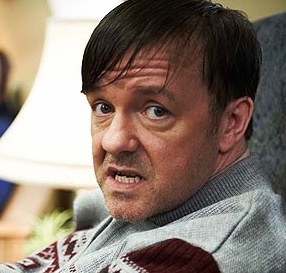
If one were looking for a programme that perfectly demonstrated the precipitate decline of British television since 1970, one could hardly have asked for a more complete example than Derek. I do not, of course, refer to Isaac Julien’s rapturous film of that name of 2008, a portrait of Derek Jarman. Rather I mean the 24-minute comedy drama shown on Channel 4 recently. There can be no doubt to whom the responsibility for this programme attaches: writer, director, executive producer and leading actor were all Ricky Gervais, and the credited production company was styled Derek Productions, so we may assume that Gervais conducted the deal that led to C4 bankrolling this – let us call a spade a spade – vanity project.

Gervais as Derek

The eponym was a worker in a residential home for the elderly. The residents barely registered, save in relation to Derek and then in over-familiar and demeaning terms. The plotting, such as it was, merely served to construct a portrait of Derek’s persona. Unhappily, though, Derek himself was a hand-me-down sketch, a largely unexplored type of inadequacy. Gervais’ preoccupation with inadequacy as a subject is a matter for him and his analyst, but insofar as it dominates his output it is a more serious matter for commissioning editors – it is well past the time when they should be asking more of this talent who appears more interested in revealing his antic spirit in personal appearances than in the more substantial business of hard creative work.

I do not take this line out of any antagonism to Gervais’ work to date or to his handling of his fame. Never knowingly having set eyes on him before, I was completely in tune with The Office from its opening seconds. Its cod-documentary style has become pretty much the default position for television comedy (Come Fly with Me, Modern Family), though this is not to suggest that Gervais invented it: Orson Welles, Woody Allen and Christopher Guest (among others) were there long before.

But just imagine what might have been done with this basic premise by a politically engaged writer or director working in the 1960s or ‘70s: Jeremy Sandford, Nell Dunn, Jim Allen, Trevor Griffiths, Dennis Potter, Howard Brenton, Caryl Churchill, Ken Loach, Alan Clarke, Roy Battersby. What struck me most forcibly about Derek was its lack of what psychologists call affect. To achieve affect – the impact on emotion of ideas – you need ideas. And Derek had none. It was no more than a half-arsed attempt to be simultaneously funny and poignant, saleable purely by being a star vehicle. It exquisitely fulfilled the aim of Mary Whitehouse: it entirely eschewed thought. And that’s just where British television is at.

Thursday, January 15, 2009

AS FAR BACK AS I CAN REMEMBER

Rewind thirty years and a few more. I was then working as television editor at Time Out, the London listings magazine. TO was at the absolute zenith of its success and the magazine had considerable influence in the corridors of television power because it was virtually out on its own – the boom in press coverage of the medium was still in the future. I was working alongside Patricia Williams who was on the section before my return to the magazine to take up the television post. By rights she should have become section editor but Tony Elliott, the proprietor and sometime magazine editor, was notably leery of politically articulate women.

Happily, Pattie and I hit it off and, with complementary qualities, quickly became a successful team. We built up the amount of insider information that the section ran. A BBC producer told me that each week Television Centre went silent for half the morning while everybody digested the new Time Out television section. Someone at the mag cut out a headline from The Guardian about Bruce Forsyth – “the most important man in television” – and pinned it over my pigeonhole in the mail rack. Heady times.

It got headier. After barely a year, I was invited to join The Observer, which was greatly expanding its coverage of broadcasting. All the national newspapers were looking at TO’s success and learning the lessons. I was, I believe, the first TO journalist to “graduate” to Fleet Street, as the industry was still called in those days – by no means all the national newspapers were located on Fleet Street even then; indeed The Observer was on St Andrew’s Hill at Blackfriars.

The obvious succession was for Tony to pick Pattie, but once again he flinched at the thought of an editor who, as he saw it, talked a different language from him. Pattie sportingly suggested that seeing her as “too political” was a slight upon me. At any rate, Tony made a totally unexpected move. He appointed a beanpole newly graduated from Oxford as the next television editor. His name was John Wyver. Pattie was rapidly scooped up elsewhere: she was offered the editorship of the trade magazine Broadcast, which she gladly accepted and of which she made a fine fist. We all felt that this was one in the eye for Tony Elliott.

In my own role at The Observer, I inevitably came across young Wyver immediately and then regularly. It was natural to me to treat him with decency – after all, he wasn’t the cause of Pattie being passed over and anyway he was a fait accompli. He was well aware that his appointment was controversial and handled it and himself with grace and poise. I gave him all the help I could to find his feet.

Now fast forward to rather more than a decade ago. I was about to publish my critical biography of the television playwright Dennis Potter. It seemed to me that a television programme off the back of publication would be a good idea, both for the book and for, say, Channel 4. I had appeared on television in a few fleeting capacities but had never fronted a programme. Still, I considered myself wholly capable of doing so. During the intervening years, I had worked as a television producer for the BBC and some independent production companies – I had hardly been at The Observer a year before I was headhunted by the BBC as a producer, surely the least qualified person (as I observed at the time) to be a producer since the pioneering days of some 25 years earlier.

Meanwhile, there had been a fracture at Time Out, the political contradictions at its heart inevitably coming to the surface. Many of the staff, including Wyver, had left to found a rival publication, City Limits. It lasted a while but was never distinctive enough and eventually folded. In the new television world after the birth of C4, Wyver had formed a production company, Illuminations, which carved itself a useful and evidently pretty lucrative niche in arts programming. So it was Wyver whom I approached with the notion of a programme about Potter.

We did lunch. I hadn’t seen him in a long time and I was astonished. The beanpole had turned into Robert Maxwell. A vast expense-account stomach sloped away from his still bony shoulders. Underneath this weird disguise, John remained the same slightly bashful, rueful boy I remembered, still looking slightly shocked to be having his career. We chewed over the proposal and John told me to put it down on a sheet of paper and drop it in. Then he took me back to his suite of offices and, less boyish now, showed me round with a proprietorial air. At one point, he introduced me to a woman working at a computer screen and murmured “Truly my mentor”. “Oh,” I said to her, “then I’m very pleased to meet you”. “No,” snapped John, rather irritated as he evidently suspected that I was sending him up. “You are”. It was a wholly genuine misunderstanding on my part. I hadn’t seen it coming and it’s often hard to tell if people hold you in high regard, even when they do. We all know those occasions when everyone is celebrating someone newly dead and we wish the departed could hear this and wonder if she or he would credit it.

I posted off my proposal the next day (the time had yet to come when all communication was by email). John called me to acknowledge receipt and said he’d look it over and call me by the end of the week. After a fortnight, I phoned to enquire if he’d had a look at it yet and he said he was really sorry, he’d been very busy and he’d be sure to get back to me by the end of the following week. That was fourteen years ago. I have neither heard from him nor seen him since. Just occasionally, when I’m feeling a little bruised, I wonder how, if that’s how he looks after his mentor, he behaves towards his enemies.

Now let’s come into this century. My partner and I had moved out of London and I had set about the task of attracting some income by writing what I wanted to write rather than what an editor – in journalism or book publishing – wanted. One day I got a letter from a chap called Simon Farquhar who was writing a book about television drama. He said he had read my play Circle Line and loved it. This play began my professional career. I was at university when the BBC announced a playwriting competition open solely to college students. I had been going to write the play anyway and it was about a student: what could be more suitable? The play won the competition, was put into production and, after a delay while the BBC decided to fret about certain of its content, was broadcast in the first season of Play for Today in January 1971.

Simon could only read the script because that is all that survives of it. About three months after its sole transmission, the annual list came round to BBC heads of department from which they were obliged to choose which of their output from the year should be archived. The Head of Plays, Gerald Savory (back in the 1930s the white hope of drawing-room comedy with his one stage success George and Margaret), looked down the list and didn’t check Circle Line. So the master tape was duly wiped. A friend had made an audiotape of the broadcast – characteristically he’d missed the first few seconds – and I had the copy of that … somewhere … in a box.

I found that Simon had an astonishing encyclopaedic knowledge of vintage teledrama, all of it broadcast before his time: he was in his early 30s. We took to swapping anecdotes, firm opinions, memories on my side for research findings on his. I had always intended to write a book of my own on teledrama, a field on which I reckoned myself a bit of an expert. Simon both drew on and bolstered my own knowledge. And he was clearly in earnest about his book and the place of Circle Line. Though he’s never completed the book and so of course never published it, he showed me the chapter that treats of the play and it was extremely gratifying, not least because it was such an intelligent assessment.

Meanwhile, Simon’s own writing career was blossoming. He had a couple of radio plays produced and then the Royal Court bought his play Rainbow Kiss and gave it a run at the Theatre Upstairs. He was in his element. Knowing that I had an unproduced stage musical kicking around, he persuaded his leading man, who had some track record in the field, to make off with a copy of the show. This was clearly a mutually beneficial friendship (though, not too surprisingly, nothing has come of the actor having my musical).

A different thread comes into my story here, but it will interweave, so be patient. Some eighteen months ago, I was beginning to feel that there might be a television programme in my own burgeoning disenchantment with the medium that I had championed so keenly in my youth. I alighted on the title British Television: A Dim View. After all, every programme title these days has to feature a colon. It would be what is called in the biz an authored piece, which to say a report that is shaped by the reporter’s opinion rather than a (supposedly) impartial documentary with voice-over by an actor. I kicked the idea around for a while and then tried it out on my old compadre Pattie Williams.

During the intervening years, Pattie and I had drifted a little but had connected up again in the 1990s when I sketched out an idea for a series about the history of television drama. By this time, Pattie had her own production company, Case Television, which was very effective across a wide range of programming. The series was offered to BBC Knowledge, the forerunner of BBC4, but eventually declined. Now Pattie had just wound up her company but that, it seemed to me, was an asset in my quest to make a really hard-hitting programme about the parlous state of British television. I had no ambitions of my own in the medium, Pattie now had none either, so we could both offend anyone we wished without fear of career damage.

Dealing with Pattie over the proposal became a long drawn-out business and it took me fully a year finally to get her to admit that her heart wasn’t really in it. While I was waiting for her to come to this realisation, I wrote a new stage play, a four-hander revisiting the student life of the late 1960s that had informed Circle Line. It was called Observations from a Hill, after a number by a rock group that we adored at the time, Family. I was pleased with it and the few people I allowed to read it (including Simon Farquhar) were complimentary and supportive of it. But I couldn’t get any theatre to take it on.

Finally, Simon told me of a friend of his who was stretching his wings as a director. He had an in at the King’s Head Theatre in Islington and if he liked the play he might be able to persuade the artistic director to take it on. His name was Jason Lawson. I duly met up with Simon and Jason at the King’s Head where we watched the current production together. Jason was charming and very polite. He was about to start work on a new production but as soon as that was put to bed he would take a look at mine. At the end of the evening, he made off with a copy of my play. Meanwhile, Simon had told me a tale about how he owed a large sum of money and had been faced with threats of violence. He seemed truly scared. I immediately promised to pay off the debt for him but gave him to understand that he would have to repay me by the end of that year, 2008.

Jason duly read the play, said he liked it and thought it was very doable. I had hoped to see the production that he had been working on but he had never given me the details and it finally emerged that he was only the assistant director so seeing it would have taught me little. But we had a meeting to talk it over and I felt very bucked up. He asked all the right questions and he put his finger precisely on what was needed to improve the play. I came home and did some more work on it and posted off the rewrites. I was not alone in believing that I’d made an important difference to the play but Jason was not very forthcoming about what I sent him. However, he said that he would set up a reading with some actor friends.

That was last June. Since then all communication between us has been at my initiative and at greater and greater intervals. Jason remains elusive and nothing happens concerning the play. I sent him a Christmas card, which he did not reciprocate, and now I have given up on him.

Through the summer, the subject upon which Jason was most forthcoming was that of Simon Farquhar. I had not seen him since that evening at the King’s Head in March. His emails, at one time arriving almost daily, dried up. It turned out that he had moved house, though this had always been a regular occurrence. Jason, to whom it seemed he also owed money, tracked him down to a pub on the Hammersmith Embankment where he was said to be working. After many attempts to reach him by email, phone and text, I finally had a phone conversation with Simon in the summer, during which he enthused about his new job as a barman and reckoned the publican had taken to him, was appointing him assistant manager and was about to install him in the pub flat. Pub life, he maintained, was terrific grist to the mill of his writing, which he intended to resume before long. We didn’t speak of his debt to me.

Since then nothing. The deadline for his repayment to me has passed. A friend familiar with Rainbow Kiss reminded me that the main character in that play had unpaid debts and was threatened. Was Simon perhaps testing me to see if I was paying attention? Were he and Jason in cahoots to rob me? Well, tomorrow I go to town for a social event at the weekend and I shall take the opportunity to trawl the pubs of Hammersmith Embankment and find this ne’er-do-well. He will not find me sympathetic on this occasion.

After Pattie passed on British Television: A Dim View, I sought out an old chum from television days, Paul Kerr. I knew that, like so many of our generation, he was teaching media to university students – or, as he put it, teaching them to read and write – but he still took a bit of raising. We finally made contact and then met up. To no surprise on my part, we were of one mind on the state of British television. I was also glad to learn that his college was keen for him to continue to make occasional programmes. We agreed that I should set out some more of the proposal on paper and that he would look it over. I sent it off on October 7th and, after some chiding from me, he promised to read it in the first week of November. At the end of the week after that, I wrote to him expressing my disappointment at his silence. There was a distinct snappiness in his reply and since then he’s gone completely silent. I feel as if I am being punished.

In the summer, as the prospects for Observations from a Hilll dwindled, I came to the conclusion that I was going to retire from trying to make a living as a writer. Nothing since then has done other than reinforce that conclusion. The fact is that there is really nobody in the business in a position to determine that I get work whom I trust or on whom I feel that I can rely. Those very few organisations that are willing to consider unsolicited work, be it prose or drama, do not have readers who know how to read. In the early 1970s, I was trained to read scripts in the BBC Script Unit, a whole department set up to process unsolicited submissions. But of course that department was closed years ago and nobody now learns how to read, they just cast an unpractised eye over the work and guess at a response. I know from the rejection letters I receive – those few that risk any sort of assessment – that the reader has really no idea what a script assessment is. And frankly what is the point of trying to forge alliances with like-minded people in the business who then don’t have the time to deal with you, the kindness or courtesy to tell you where you stand or the conscience that would stop them treating you shabbily.

It was a hard and a quite emotional decision to give it all up. After all, to paraphrase Ray Liotta’s character at the outset of Scorsese’s Goodfellas: “As far back as I can remember, I wanted to be a writer”. I started to write my first novel when I was seven and I must have completed two whole, if rather short, chapters. That my first income from writing came from a play that I wrote at 21 was no surprise to me or to my parents. The surprise, I think, has been at how difficult it has been to sustain a career as a writer.

The rebuffs and disappointments over the 40 years since I was 21 are too long to rehearse in a blog posting and at present too painful as well. I have contemplated a book about failing as a writer – that’s not something I’ve read so I’m hoping it would have some prospect of at least being an original idea. I have its title – it’s from Stephen Sondheim’s wonderful song 'I’m Still Here', which the character Carlotta sings in Follies: “Then You Career from Career to Career”. But of course nobody will publish such a book. I’m not a comedian or a footballer or a graduate of the Big Brother house. And although such a book would be written out of my ever-sunny disposition, editors will reason that people don’t want to read about failure and the business doesn’t want books that suggest that those who run the business are less than brilliant. So I don’t suppose I will write it, even if I could afford to do so.

You see, I do have to earn. I am retraining, something that doesn’t come easy at my age but needs must. More about that can wait for a future posting. Meanwhile, I won’t stop writing the blog because it keeps my hand in. It’s just that the novels and plays and scripts and non-fiction books that are at various stages in my head will stay there, unwritten. I still have the pleasure of them and, if no one else ever does, that sure as hell ain’t my fault.