POOR’s SHOW
Ever since the decline of European Socialism in the 1980s and the collapse of the Soviet Union in the ’90s, capitalism has considered itself king of the world and has behaved accordingly. In Britain especially, the triumph of capitalism has been celebrated by successive governments, whether Conservative or nominally Labour. Under the spell of the Chicago school of economic theory, Margaret Thatcher played a key role, greatly accelerating the switch from a manufacturing to a service economy begun by Harold Wilson and James Callaghan. This switch was in part motivated by a desire – yelled by Tories, whispered by Labour – to “smash” the unions that had, in the Westminster demonology, “held the country to ransom”.
This melancholy history reaches its latest chapter in the exercise of the veto by David Cameron at the European summit that was designed to save the euro, the Eurozone and indeed the national economies of the member states. Cameron’s sound-bite summary, parroted endlessly by ministers, is that he stepped out of line “to protect the national interest”. Even were that the whole story, it hardly presents Britain as a welcome player in a mutually beneficial alliance of nations, as communitaire.
But of course his stance does nothing to benefit you and me. Cameron’s only desire has been to protect the interests of the city, which is to say the interests of his party’s paymasters. The banks feared new regulation from Brussels. Cameron claims to intend to impose his own regulation but we will believe it when we see it – don’t hold your breath.
There is nothing in these quixotic dramatics that bodes any good for Britain’s dwindling manufacturing sector, or indeed for our export drive and hence our growth prospects. And as for realpolitik, it is a blunder of astonishing puerility. If the Eurozone does not quickly recover its equilibrium, Merkel and Sarkozy will persuasively blame Cameron. If the Eurozone climbs back onto its feet, no one will thank Cameron and it will occur to no one to reward Britain with increased trade. It’s a lose-lose result. As former President of the European Commission and Italian prime minister Romano Prodi put it, “Britain has gained freedom and lost power”.
The financial sector continues to bewitch politicians, not just in Britain but across the globe. In Durban, the climate change talks inevitably reached the conclusion that international short-termist capital wanted: ineffectual muddle. Despite menacing and even sometimes angry noises from governments, the money markets continue to enjoy a lack of supervision that must make the black economy green with envy.
Why is this? Is the path being made smooth by under-the-counter “considerations”? Or is the general run of ministers too finance-illiterate to know how far the speculators and their accountants and lawyers are taking them for patsies? Why is it that nothing uttered or threatened by banks and financial consultants is taken with a whole sackful of salt? Do politicians not understand that, of all the lobbyists and vested interests with which they deal day in and day out, the city is the most powerful and the most sophisticated, with deep enough pockets to set any hare running, however fantastical, and confidently to expect the desired outcome?
Consider the credit ratings agencies. The best-known, largest and most powerful is Standard & Poor’s, but there are others: last month, the US government tripled the number of such agencies that it recognises. S&P’s has been busy of late. In August, it set the markets on their ears by downgrading the United States from its triple-A rating, the topmost rung. A couple of weeks ago, it downgraded France’s rating. And on the eve of the Eurozone summit, it declared that it was considering the ratings of fifteen of the member countries of the eurozone. These credit ratings determine the cost of governmental borrowing. Downgrading a nation’s ratings heaps vast extra expense on that nation’s costs.
So who are these people at Standard & Poor’s? Why should anybody pay them heed? Well, S&P’s finds its origins in charting and invigilating the books of America’s railroads. For getting on for half a century, it has been part of the portfolio of the dynastic publishing conglomerate McGraw-Hill. It makes its home in Manhattan, a short hop from Wall Street.
It’s important to note that S&P’s is just down the road from the speculators. It is not based in St Patrick’s Cathedral. It is not the voice of god. Nor is it infallible, as Archbishop Dolan would doubtless decree if it were indeed emanating from the Archdiocese of New York. Commenting on the agency’s musing-aloud about the Eurozone, The Wall Street Journal (prop: Rupert Murdoch) noted: “Less than five months after it made its dramatic decision to downgrade the biggest economy in the world, S&P’s has again put itself in the hot seat”.
Despite the ratings agencies’ edicts being unveiled by the news media as if they were carved in stone, these pronouncements are not only the frequent subject of dispute but also sometimes agreed even by the agencies themselves to be mistaken. For instance, Standard & Poor’s conceded a $2trillion error in the calculation that led it to downgrade the US rating. That ain’t peanuts. Perhaps to save a little face, S&P’s cleaved to its downgrade in spite of the error. But it speedily reversed its downgrading of France after the Élysée angrily rebutted the basis for the decision.
A long-term agency decision has occasioned a damaging disenchantment with credit ratings across the world’s markets, especially those in Europe. This was the maintenance of Greece’s status as a good risk for several years before the habitual imprudence of successive Greek governments was finally recognised in 2009 when the country had already experienced several months of civil unrest. Greece’s most supportive agency was Moody’s, another of the so-called Big Three in the credit-rating market (the third is Fitch). Moody’s, be it noted, was being paid half a million dollars a year by the Greek government. How far does a fat cheque condition the fixing of a favourable rating, do you suppose?
I repeat that the ratings issued by the self-appointed agencies do not have the force of either moral law or statutory application. They only become powerful because powerful people pay them heed. I do wonder what exactly constitutes the appeal process against a rating that costs a nation many millions of dollars in increased charges on national debt. Could a government sue an agency for damaging its economy and its freedom to trade? Is it possible to gain reparation for agency findings that impacted the finances of enterprises and individuals? After all, the agencies played a leading and inglorious role in the collapse of the American subprime mortgage market that led to the US government taking over the two leading government-sponsored enterprises in the mortgage field, popularly known as Freddie Mac and Fannie Mae.
The overarching problem with the world of financial services is that everything therein is driven by subjective readings of more or less subterranean manoeuvrings. We are routinely told that the markets are “nervous”, that capital is “in flight” from this or that enterprise, that traders “don’t like” this or that enactment of governmental policy. Those of us who live in a rather starker world of fixed prices and incomes, plying our various trades according to what we can get rather than what we would ask, are apt to lose patience every time the city is in the news. “Man up” we think, reluctantly using a phrase that the boy racers of the markets will perhaps understand.
Why is the security of national economies allowed to depend on the whims of consultants and speculators who anyway have their own axes to grind and who, for all we know, are delivering their verdicts with only the lining of their own pockets in mind? Regulation? We should elect a few governments who are ready to tear down the paper castles of the financial sectors and instead dedicate national economies to the welfare of the people. We should expect our representatives to reclaim what used to be called “the commanding heights of the economy”. Oh dear, I think I may be calling for a revival of Socialism.
Showing posts with label Fannie Mae/Freddie Mac. Show all posts
Showing posts with label Fannie Mae/Freddie Mac. Show all posts
Sunday, December 11, 2011


Saturday, October 09, 2010
A RATHER SUSCEPTIBLE SHADOW CHANCELLOR?
Alan Johnson as shadow Chancellor: hands up those who saw that coming. Not Johnson himself, evidently. He has no departmental background in economics, only (as many have been quick to point out) in spending. His genial joke – that his first move would be to “pick up a primer, Economics for Beginners” – was a heedless error that will come back to haunt the opposition as coalition members twit him with it at every opportunity.
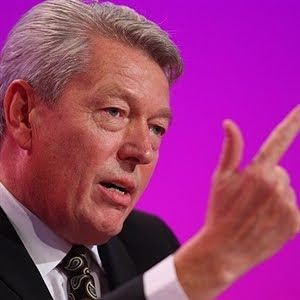 Alan Johnson is confident with one ...
What was Ed Miliband thinking? Too much, I venture. In making Johnson his choice (the positive part of the decision), he was certainly seeking to offer a contrast with the present Chancellor. This working class meritocrat has, at 60, seen some of the real world first hand and proved himself steady under fire in the latter years of Labour government. Some of his hitherto apparent niceness got rubbed off in his last government post as Home Secretary, where his stance on security, surveillance, police and drugs put him in the anti-progressive line of David Blunkett, Charles Clarke and John Reid. But along with his abiding amiability and self-deprecation, his ordinary-Joe image will draw attention to the 39 year-old George Osborne’s moneyed self-confidence and complete lack of any common touch. Johnson was also the first former minister to declare in favour of the leadership bid of David Miliband. In appointing him, leader Ed could hardly do more to appear properly conciliatory and collegiate.
 ... can get to two ...
The negative part of the decision was to exclude Mr & Mrs E Balls, not just from shadowing the Treasury but from any position the primary focus of which is economic. This indicates two threads: that Miliband intends to avoid any possibility of replicating the long war of attrition between Tony Blair as PM and Gordon Brown as Chancellor (a war now enshrined in legend whatever the truth of it) by handing economic policy to an ambitious factionalist and proven rival; and that he has no wish to pursue the Ballsian line of rewriting Alistair Darling’s economic policy.
 ... but three defeats him
It is intriguing that the three candidates who topped the shadow cabinet poll were, in order: Yvette Cooper, John Healey, the former housing minister, and Balls. All three were keen Ballsites in the leadership campaign. Miliband has made Healey shadow health secretary, safely away from economic policy. Cooper has the high-profile non-job (see earlier posting) of shadow Foreign Secretary. Balls will make a good fist of shadowing the Home Office and you can bet that Theresa May will not be sleeping easy this weekend.
Time will tell how far Miliband’s choice on economic policy is a missed opportunity. But with each day deepening the impression that Osborne and David Cameron – let alone the coalition government as a whole – have not wholly thought through the policies to address the deficit, Labour could have set to work to craft a distinctive and credible economic policy. Ed Balls – and by inference Yvette Cooper too, his wife also being an economist who long worked in the Treasury – had already begun the process of repositioning Darling’s approach as the centrepiece of his own leadership bid. There is a real danger now that the coalition will find itself forced to admit defeat in its attempt to eradicate the deficit before the next general election and that Labour will have accepted so many of the government’s measures that it will deprive itself of the widest ground on which to oppose Cameron’s re-election. Its position will be analogous to that of the Tories on the war against Iraq. I suspect that events are going to make Ed Balls’ proposals look more and more on-the-nose and Labour less and less smart in not pursuing them.
The government is running into trouble. How could they not have anticipated the nature and degree of the outrage that the announcement about child benefit provoked? Or if, as one or two commentators have suggested, Osborne did indeed see that reaction coming, why did he invite it ahead of the spending review rather than burying it among all the bad news that the big announcement will undoubtedly bring? The impression Cameron promptly gave of rowing back from the commitment and improvising ways of restoring some of the lost benefit looked merely amateurish.
And then how could they have imagined that ruthlessly culling quangos and other public bodies would simply be a clean and brutally efficient operation, inflicting pain only on the staffs of those organisations? Did it occur to no one that the functions performed by these bodies might be highly desirable and, in some cases, indispensable and that laying off well-remunerated people can be a costly business in at least the short term?
There are increasing indications that one or two ministers will not be able in all conscience to offer the demanded 25 percent cut in costs; Jeremy Hunt is not the only conscience-free member of the government, but he may not be in a large majority. One or two voices – Chris Huhne’s is the latest – have suggested gently that a goalpost or two might turn out to be moveable.
If Cameron is obliged to eat at least a side order of his words, it will not only be the Labour Party that is crowing. And ministerial contradictions and miscalculations are welcome in another way. They cannot credibly be blamed on the Labour government. An urgent task for Alan Johnson is to nail the history rewrite – in danger of being established by the coalition as generally accepted history – that the global recession was caused by Gordon Brown and Alistair Darling’s policies over the last thirteen years and nothing at all to do with the policies of the banks, the greed of the private sector or the sub-prime mortgage disaster. Tory supporters already appear to believe that Fannie Mae and Freddie Mac were Labour cabinet ministers who lost their seats at the general election.
The shadow cabinet certainly has an unfamiliar look. The obligation on Labour MPs to elect a minimum of six women candidates has propelled into the front line a number of women whose names mean nothing outside Westminster and the lobby. Indeed, Wikipedia is, at the time of writing, in the process of bringing its pages up to speed on the new women and only the last named of these new shadow cabinet members – Mary Creagh, Maria Eagle, Anne McKechin and Meg Hillier – has a facial likeness posted there. Maria Eagle is rather less well known than her twin Angela, partly because the latter has served longer in front line politics, partly because she was the first out lesbian in the house. The four newbies take as their respective portfolios rural affairs, transport, Scotland and energy. Angela Eagle takes over as shadow Chief Secretary to the Treasury from Liam Byrne who, having come last of those elected, is demoted to shadow the cabinet office.
 Mary Creagh
 Maria, the less blonde Eagle twin
 Anne McKechin
 and Meg Hillier
Should we deprecate the tokenism – if that is what it is – that elevates women at the expense of men of known talent: Stephen Twigg, David Lammy, Chris Bryant, Stephen Timms, Vernon Coaker, Chris Leslie, Gareth Thomas? Is it really of importance that women achieve some semblance of parity with men in the conduct of government? And is it useful and just to try to achieve it by manipulating eligibility for election? Some argue that no right ever won is as sure and satisfying if conceded by a benevolent dictatorship as when extracted by sustained guerrilla warfare. Anyway, who is to say that women are drawn to politicking and legislating and managing public affairs in such numbers as are men? And if they are not, is it because men and women broadly have distinct instincts and priorities or perhaps is it simply because the ascendancy of men has made the heights of politics an uncomfortable place for women to operate? I’m sure that the likes of Lady Astor, Margaret Bondfield and Ellen Wilkinson would have scoffed at quotas and all-women shortlists. But at the same time, all of them were constantly being undermined by male members and found that their sex was a daily issue.
Looking at the alphabetical list of those elected on Friday, before Miliband had dispensed their roles, I was struck by the fact that all the surnames came from the top half of the alphabet. Someone had a Guardian letter published about this today. My suspicion was that there are so many new members entitled to vote who know nothing of most of the candidates that they ticked names largely at random and ran out of votes before getting into the latter half of the ballot paper. In fact, however, it was a curious fluke of the field that only six of the 49 candidates possessed surnames beginning with a letter later than M. From among them, Miliband has preferred the unelected Shaun Woodward for his old portfolio of Northern Ireland, along with the also defeated Peter Hain shadowing his former role as Welsh Secretary. The only member of the late cabinet left with no front bench role is Ben Bradshaw. Rather sadly, Diane Abbott failed to get elected too. It remains to be seen whether Ed Miliband offers her a desirable second-rank post.
Will Miliband’s be a team to fight and frighten the coalition? I hope so because it’s vitally necessary. But I feel less than sanguine so far.
Alan Johnson as shadow Chancellor: hands up those who saw that coming. Not Johnson himself, evidently. He has no departmental background in economics, only (as many have been quick to point out) in spending. His genial joke – that his first move would be to “pick up a primer, Economics for Beginners” – was a heedless error that will come back to haunt the opposition as coalition members twit him with it at every opportunity.
 Alan Johnson is confident with one ...
What was Ed Miliband thinking? Too much, I venture. In making Johnson his choice (the positive part of the decision), he was certainly seeking to offer a contrast with the present Chancellor. This working class meritocrat has, at 60, seen some of the real world first hand and proved himself steady under fire in the latter years of Labour government. Some of his hitherto apparent niceness got rubbed off in his last government post as Home Secretary, where his stance on security, surveillance, police and drugs put him in the anti-progressive line of David Blunkett, Charles Clarke and John Reid. But along with his abiding amiability and self-deprecation, his ordinary-Joe image will draw attention to the 39 year-old George Osborne’s moneyed self-confidence and complete lack of any common touch. Johnson was also the first former minister to declare in favour of the leadership bid of David Miliband. In appointing him, leader Ed could hardly do more to appear properly conciliatory and collegiate.
 ... can get to two ...
The negative part of the decision was to exclude Mr & Mrs E Balls, not just from shadowing the Treasury but from any position the primary focus of which is economic. This indicates two threads: that Miliband intends to avoid any possibility of replicating the long war of attrition between Tony Blair as PM and Gordon Brown as Chancellor (a war now enshrined in legend whatever the truth of it) by handing economic policy to an ambitious factionalist and proven rival; and that he has no wish to pursue the Ballsian line of rewriting Alistair Darling’s economic policy.
 ... but three defeats him
It is intriguing that the three candidates who topped the shadow cabinet poll were, in order: Yvette Cooper, John Healey, the former housing minister, and Balls. All three were keen Ballsites in the leadership campaign. Miliband has made Healey shadow health secretary, safely away from economic policy. Cooper has the high-profile non-job (see earlier posting) of shadow Foreign Secretary. Balls will make a good fist of shadowing the Home Office and you can bet that Theresa May will not be sleeping easy this weekend.
Time will tell how far Miliband’s choice on economic policy is a missed opportunity. But with each day deepening the impression that Osborne and David Cameron – let alone the coalition government as a whole – have not wholly thought through the policies to address the deficit, Labour could have set to work to craft a distinctive and credible economic policy. Ed Balls – and by inference Yvette Cooper too, his wife also being an economist who long worked in the Treasury – had already begun the process of repositioning Darling’s approach as the centrepiece of his own leadership bid. There is a real danger now that the coalition will find itself forced to admit defeat in its attempt to eradicate the deficit before the next general election and that Labour will have accepted so many of the government’s measures that it will deprive itself of the widest ground on which to oppose Cameron’s re-election. Its position will be analogous to that of the Tories on the war against Iraq. I suspect that events are going to make Ed Balls’ proposals look more and more on-the-nose and Labour less and less smart in not pursuing them.
The government is running into trouble. How could they not have anticipated the nature and degree of the outrage that the announcement about child benefit provoked? Or if, as one or two commentators have suggested, Osborne did indeed see that reaction coming, why did he invite it ahead of the spending review rather than burying it among all the bad news that the big announcement will undoubtedly bring? The impression Cameron promptly gave of rowing back from the commitment and improvising ways of restoring some of the lost benefit looked merely amateurish.
And then how could they have imagined that ruthlessly culling quangos and other public bodies would simply be a clean and brutally efficient operation, inflicting pain only on the staffs of those organisations? Did it occur to no one that the functions performed by these bodies might be highly desirable and, in some cases, indispensable and that laying off well-remunerated people can be a costly business in at least the short term?
There are increasing indications that one or two ministers will not be able in all conscience to offer the demanded 25 percent cut in costs; Jeremy Hunt is not the only conscience-free member of the government, but he may not be in a large majority. One or two voices – Chris Huhne’s is the latest – have suggested gently that a goalpost or two might turn out to be moveable.
If Cameron is obliged to eat at least a side order of his words, it will not only be the Labour Party that is crowing. And ministerial contradictions and miscalculations are welcome in another way. They cannot credibly be blamed on the Labour government. An urgent task for Alan Johnson is to nail the history rewrite – in danger of being established by the coalition as generally accepted history – that the global recession was caused by Gordon Brown and Alistair Darling’s policies over the last thirteen years and nothing at all to do with the policies of the banks, the greed of the private sector or the sub-prime mortgage disaster. Tory supporters already appear to believe that Fannie Mae and Freddie Mac were Labour cabinet ministers who lost their seats at the general election.
The shadow cabinet certainly has an unfamiliar look. The obligation on Labour MPs to elect a minimum of six women candidates has propelled into the front line a number of women whose names mean nothing outside Westminster and the lobby. Indeed, Wikipedia is, at the time of writing, in the process of bringing its pages up to speed on the new women and only the last named of these new shadow cabinet members – Mary Creagh, Maria Eagle, Anne McKechin and Meg Hillier – has a facial likeness posted there. Maria Eagle is rather less well known than her twin Angela, partly because the latter has served longer in front line politics, partly because she was the first out lesbian in the house. The four newbies take as their respective portfolios rural affairs, transport, Scotland and energy. Angela Eagle takes over as shadow Chief Secretary to the Treasury from Liam Byrne who, having come last of those elected, is demoted to shadow the cabinet office.
 Mary Creagh
 Maria, the less blonde Eagle twin
 Anne McKechin
 and Meg Hillier
Should we deprecate the tokenism – if that is what it is – that elevates women at the expense of men of known talent: Stephen Twigg, David Lammy, Chris Bryant, Stephen Timms, Vernon Coaker, Chris Leslie, Gareth Thomas? Is it really of importance that women achieve some semblance of parity with men in the conduct of government? And is it useful and just to try to achieve it by manipulating eligibility for election? Some argue that no right ever won is as sure and satisfying if conceded by a benevolent dictatorship as when extracted by sustained guerrilla warfare. Anyway, who is to say that women are drawn to politicking and legislating and managing public affairs in such numbers as are men? And if they are not, is it because men and women broadly have distinct instincts and priorities or perhaps is it simply because the ascendancy of men has made the heights of politics an uncomfortable place for women to operate? I’m sure that the likes of Lady Astor, Margaret Bondfield and Ellen Wilkinson would have scoffed at quotas and all-women shortlists. But at the same time, all of them were constantly being undermined by male members and found that their sex was a daily issue.
Looking at the alphabetical list of those elected on Friday, before Miliband had dispensed their roles, I was struck by the fact that all the surnames came from the top half of the alphabet. Someone had a Guardian letter published about this today. My suspicion was that there are so many new members entitled to vote who know nothing of most of the candidates that they ticked names largely at random and ran out of votes before getting into the latter half of the ballot paper. In fact, however, it was a curious fluke of the field that only six of the 49 candidates possessed surnames beginning with a letter later than M. From among them, Miliband has preferred the unelected Shaun Woodward for his old portfolio of Northern Ireland, along with the also defeated Peter Hain shadowing his former role as Welsh Secretary. The only member of the late cabinet left with no front bench role is Ben Bradshaw. Rather sadly, Diane Abbott failed to get elected too. It remains to be seen whether Ed Miliband offers her a desirable second-rank post.
Will Miliband’s be a team to fight and frighten the coalition? I hope so because it’s vitally necessary. But I feel less than sanguine so far.
Friday, September 12, 2008
POWER BACK to the PEOPLE
The indiscreet executive from the power company E.On, one Mark Owen-Lloyd, was only confirming what most of us already knew when he affably remarked at an Ofgem seminar that the current rip-roaring price hike for electricity and gas was fine because “it will make more money for us”.
Ministers attacked Owen-Goal with incandescent fury. Hilary Benn raged that it was “not funny”. Gordon Brown poured the full weight of prime ministerial scorn on the remark, coruscating it as “inappropriate”. Of course the post-Thatcher and –Blair Labour Party knows that the point of business is to make profits. That’s what business is for. That’s why these ministers were implicitly criticising the tone of the remark rather than the substance.
Because ‘New’ Labour wants to keep business sweet, it will not – there was never any chance that it would – impose a windfall tax on the power companies. Left-inclined backbenchers who have been ‘demanding’ such a tax are not living in the real world, on two counts. First, because they think the government still might be susceptible to arguments about social justice. Second, because a windfall tax would defeat the purpose that they intend for it. For the power companies would simply pass it on to the customers.
Gordon Brown, ever a man for a ‘package’, has come up with one supposed to alleviate the poleaxing rises in power bills. “Lag Your Loft” may not rank with “Workers of the World Unite” as a rallying cry for the proletariat but it is not an unworthy basis for a programme of action. But of course the power companies, inasmuch as they are expected to fund cavity wall and loft insulation schemes, will quickly find ways of preventing these costs from reducing the profits for their shareholders. Those of us who do not need help with insulation will surely find ourselves paying for those who do, just as we will be called upon to subsidize the bills of the 600,000 poorest customers. This is not quite the kind of redistribution of wealth that Marx and Engels had in mind.
Any government that had any kind of nodding acquaintance with Socialism would be resolving this issue in the only way that makes any sense: it would take the public utilities back into public ownership. Renationalisation need be no more fraught a process than was the original nationalisation. After all, the administration in Washington, about as far from a Socialist outfit as a government can be, has just taken into public ownership two of the biggest US businesses, the Federal National Mortgage Association (FNMA) and the Federal Home Loan Mortgage Corporation (FHLMC), commonly known as Fannie Mae and Freddie Mac. Yes, these were failing concerns while the power companies are cash cows with the moo to fight any restraint of profit. But former utilities are in a special position, benefiting from the appearance (if not always the reality) of holding local monopolies. Private companies cannot construct a rival national grid any more than they can build their own rail network or telecommunications system.
The Tory governments of the 1980s and 1990s privatised British Airways, the British Airport Authority, British Rail, British Steel, British Telecom, the bus service, the coal industry and what remained public of British Petroleum as well as outsourcing gas, electricity and water. The Blair government accepted all this as a fait accompli, even resisting the overwhelming case made by the new rail operators’ inability to maintain a coherent service. The accepted bromide became ‘public-private partnership’ because, by leaving shareholders largely unscathed, Blair kept the support of an unprecedented proportion of business and the press.
I would venture that privatising the power companies would be the vote-winner that Gordon Brown so urgently needs. After all, only those who invested in them love the power companies and many of the companies that now own our utilities are based abroad. By taking these essentials back into public administration, Brown would demonstrate that his concern for the people’s welfare outweighs narrow party interest. And it would steal a terrific march on David Cameron.
The indiscreet executive from the power company E.On, one Mark Owen-Lloyd, was only confirming what most of us already knew when he affably remarked at an Ofgem seminar that the current rip-roaring price hike for electricity and gas was fine because “it will make more money for us”.
Ministers attacked Owen-Goal with incandescent fury. Hilary Benn raged that it was “not funny”. Gordon Brown poured the full weight of prime ministerial scorn on the remark, coruscating it as “inappropriate”. Of course the post-Thatcher and –Blair Labour Party knows that the point of business is to make profits. That’s what business is for. That’s why these ministers were implicitly criticising the tone of the remark rather than the substance.
Because ‘New’ Labour wants to keep business sweet, it will not – there was never any chance that it would – impose a windfall tax on the power companies. Left-inclined backbenchers who have been ‘demanding’ such a tax are not living in the real world, on two counts. First, because they think the government still might be susceptible to arguments about social justice. Second, because a windfall tax would defeat the purpose that they intend for it. For the power companies would simply pass it on to the customers.
Gordon Brown, ever a man for a ‘package’, has come up with one supposed to alleviate the poleaxing rises in power bills. “Lag Your Loft” may not rank with “Workers of the World Unite” as a rallying cry for the proletariat but it is not an unworthy basis for a programme of action. But of course the power companies, inasmuch as they are expected to fund cavity wall and loft insulation schemes, will quickly find ways of preventing these costs from reducing the profits for their shareholders. Those of us who do not need help with insulation will surely find ourselves paying for those who do, just as we will be called upon to subsidize the bills of the 600,000 poorest customers. This is not quite the kind of redistribution of wealth that Marx and Engels had in mind.
Any government that had any kind of nodding acquaintance with Socialism would be resolving this issue in the only way that makes any sense: it would take the public utilities back into public ownership. Renationalisation need be no more fraught a process than was the original nationalisation. After all, the administration in Washington, about as far from a Socialist outfit as a government can be, has just taken into public ownership two of the biggest US businesses, the Federal National Mortgage Association (FNMA) and the Federal Home Loan Mortgage Corporation (FHLMC), commonly known as Fannie Mae and Freddie Mac. Yes, these were failing concerns while the power companies are cash cows with the moo to fight any restraint of profit. But former utilities are in a special position, benefiting from the appearance (if not always the reality) of holding local monopolies. Private companies cannot construct a rival national grid any more than they can build their own rail network or telecommunications system.
The Tory governments of the 1980s and 1990s privatised British Airways, the British Airport Authority, British Rail, British Steel, British Telecom, the bus service, the coal industry and what remained public of British Petroleum as well as outsourcing gas, electricity and water. The Blair government accepted all this as a fait accompli, even resisting the overwhelming case made by the new rail operators’ inability to maintain a coherent service. The accepted bromide became ‘public-private partnership’ because, by leaving shareholders largely unscathed, Blair kept the support of an unprecedented proportion of business and the press.
I would venture that privatising the power companies would be the vote-winner that Gordon Brown so urgently needs. After all, only those who invested in them love the power companies and many of the companies that now own our utilities are based abroad. By taking these essentials back into public administration, Brown would demonstrate that his concern for the people’s welfare outweighs narrow party interest. And it would steal a terrific march on David Cameron.
Subscribe to:
Posts (Atom)

