Showing posts with label Margaret Thatcher. Show all posts

Saturday, August 15, 2015

COWARDS FLINCH and TRAITORS SNEER

Having laid a minefield, the Labour party seems doomed to march across it. Whatever the accuracy of opinion polls recording a potentially unassailable domination for Jeremy Corbyn in the contest for the party leadership, the result is clearly going to split the party. Corbynites will howl ‘foul’ if anyone but Corbyn wins. The danger that opinion polling entails is that people naturally set store by it. Corbynites understandably expect their man to win now. If he doesn’t, they will want to know why. I can’t imagine an answer that would satisfy them.

On the other side, there seems an increasing likelihood that the Anyone But Corbyn alliance – which is certainly predominant in the parliamentary party – will foreswear acceptance of democracy and dedicate itself to overturning the result of the vote. This is a rather more difficult position to argue rationally or logically. It is wholly dependent on the assertion that a Corbyn-led party could not win a general election. Nobody of course can prove such an assertion. Moreover, the evidence offered to support it is compromised by many other factors.

Michael Foot and Tony Benn are immediately offered as evidence. Well, there was no Footmania. Michael Foot was elected leader by a ballot only of MPs. There was no grassroots surge on his behalf. Indeed Denis Healey (98 at the end of this month) was so sure he would be elected leader that he refused to countenance any other result – I recall his smug face doing so on a television interview.

Foot and Healey

Foot had a slim victory over Healey. Great man though he was, he cut a remote, bookish and professorial figure. He didn’t play the best hand as leader. I found it hard to forgive him for announcing in the House that he was “an inveterate peacemonger” and then, just a fortnight later, committing the party to backing Thatcher on the Falklands. But the most damaging episode of Foot’s leadership was not something that Foot did. It was the defection of a number of MPs, led by the so-called Gang of Four, to form a new party, the Social Democrats. It was this fracturing of the anti-Tory force that kept Labour out of power for 18 years. The prediction that carries much more conviction than that of Corbyn’s unelectability is that a party riven by internal strife is unelectable.

As for Tony Benn, a rosy glow has settled over him since his death nearly eighteen months ago. His candour and courage and wisdom are now remembered with great affection. Of how many politicians do you hear the phrase “national treasure” used without irony or apology? That he was Corbyn’s mentor is benefiting both his own legend and Corbyn’s present reputation.

The Gang of Four

Look again at the argument that Corbyn would be unelectable at a general election. Whatever you argue, you cannot gainsay that he has enthused a lot of people. Many of them are young, the very constituency hitherto most alienated from mainstream politics. And many of them are long-suffering Labour supporters who consider that the party has gradually drifted away from core values. These are real assets for the Labour party. There is not much evidence that Burnham, Cooper and Kendall are bringing in new support.

That leads me to the vexed question of ‘entryism’. The distinction between entryism and recruitment is difficult to plot or to argue. If someone has left Labour in despair and joined a new grouping on the left or the LibDems, the Greens or the SNP, why would her return not be welcomed with open arms? Nobody in the PLP objects if someone who, at the previous general election, voted for the Tories or Ukip or the Monster Raving Loony Party now wants to vote Labour. Such a voter does not get her motives questioned, even though her previous vote might have been ‘tactical’ and hence perhaps suspect in the purists’ eyes. I voted LibDem in May because I didn’t want the Tories to take the seat from the LibDems. There was absolutely no chance of Labour taking it, even in a good year. That doesn’t mean I am not a Labour supporter. You do what you have to do.

Kendall and Corbyn; the knife is out of sight

Attempts to stymie Corbyn’s leadership are nothing but self-defeating. If he is replaced by Cooper or Burnham before the next election, the Tories will say that the new Labour leader couldn’t even get elected in the party so why would the country be impressed? If David Miliband is rushed in at a by-election simply in order to replace Corbyn with a supposedly electable alternative, the term ‘carpetbagger’ will be forever attached to him. As for the stabbing-in-the-back legend, that would be turned on its head. Moreover, the half-buried issue of extraordinary rendition, on which Miliband has yet to be fully candid, would come back with a vengeance.

All this may still be avoided, however. Remarkably, a poll released last night finds that Jeremy Corbyn easily leads among the candidates on the question “which leader would make you more likely to vote Labour in the next general election?”. He has 32% to the 25% of his nearest rival, Andy Burnham. Yvette Cooper, increasingly put forward as the best compromise candidate by the party’s mainstream, comes last with 20%. This is a poll not of Labour supporters but of the wider electorate. I always doubt opinion polls; this is not what the ABC crowd wants to hear, however.

Last night's poll

It’s unfortunate, but the success or otherwise of Corbyn’s leadership of the party rests largely in the hands of his enemies. His own democratic instincts mean that he will surrender choice of the shadow cabinet team back to the PLP; the chances are that they will heavily load the team with Blairites and other malcontents. Then he has said he will re-offer himself for confirmation before the 2015 general election. Will that be to the PLP or to the whole party?

However it falls out, the Blairites need to tread carefully. Unless they are to reveal themselves as mere opportunists, they will not join the Tories or the LibDem rump. Will they set up a new party? The danger is that they would fail to find a space to carve between the existing parties. The impact of the SDP, which anyway turned out to be shortlived, is unlikely to be replicable. In any case, the absence of Blairites in the Labour party would allow Corbyn to carry more of his policy positions. The more parties ranged against a Corbynite Labour party, the less impact each can have. But if they stay, the ABC-ers must be smart about rocking the boat. New leaders are entitled at least to a honeymoon period. Soon enough, Corbyn will get an opportunity to test his leadership at the ballot box, in the Holyrood elections next May and then the EU referendum across the UK, if not at a by-election. A premature party split would mean that the split itself would be the only aspect of Labour that voters judged.

Monday, August 10, 2015

TEN PRACTICAL REASONS to ELECT JEREMY CORBYN as LABOUR LEADER

1) He is a game-changer. Neither before nor immediately after the general election, did anybody anticipate that by the end of July the bookies’ favourite to lead the party would be a career backbencher of more than three decades’ standing who is comfortable discussing Marx on television (as he did with Andrew Marr). So already the political landscape has changed and when that happens it doesn’t only affect the party in question. As Matthew d’Ancona shrewdly described in The Guardian (july 27), apprehension has grown among thoughtful Tories that Corbyn is not to be dismissed lightly.
2) He is a vote-winner. His seat, Islington North, is the smallest in area and the most densely populated in Britain and his majority there has risen from 6,700 in 2005 to 12,400 in 2010 and 21,200 this year. The overblown issue of entryism does not detract from the fact that party membership, both full and associate, has grown greatly since the election and reflects the particular enthusiasm for Corbyn’s campaign among the hitherto disenchanted young and rejuvenated veterans like me. People understand that Corbyn represents something to vote FOR.
3) He is what the electorate have been waiting for. For years the media told us that people have given up believing politicians, that they think they’re all the same, that they’ve all got their noses in the trough, that they don’t know what ordinary lives are like, that they’re only out for themselves, that they bend to every passing wind and think only in soundbites. Now along comes a politician who counters all these notions. What’s not to like? Yet the same media tell us that he’s a dinosaur, an extremist, a dreamer who can’t possibly get elected. Corbyn is disrupting the conventional wisdom.
4) He is not Michael Foot and he is unlikely to split the party. The circumstances now are very different from those that obtained when a group of Labour MPs broke away to form the SDP in 1981. At the previous election (in 1979), only three parties had received more than one million votes; this year six parties did. In the House in 1981, there were only 27 members who were not from the Conservative or the Labour parties. Now there are 68. This is not propitious for the formation of a new party, which would have difficulty finding available ground to occupy. But which existing party could they join? For all sorts of reasons, none is attractive for an ambitious Labour MP. And could they cross the floor without embracing the logic of a by-election to confirm the change, as Douglas Carswell and Mark Reckless did when they defected to Ukip? This far from a future general election, they would be mercilessly pilloried without it. Moreover, changing colours rarely improves the fortunes of the changer. None of the founders of the SDP ever held ministerial office again.
5) He can win general elections from the left. It’s been done before. The Observer quoted Liz Kendall dismissing Jeremy Corbyn’s supporters as not old enough to remember Labour losing “election after election in the 1980s” (August 2). Well, selective citing of history may be made to support any position. At the time of the Labour split that led to the formation of the SDP, Kendall herself was ten years of age. I am old enough to remember the horror with which the Gaitskellite wing of the party contemplated the Bevanite (“left wing”) Harold Wilson becoming leader in 1963 (I was 15). Wilson held the party together pretty effectively and won four general elections, one more than Tony Blair and without seeing his majority dwindle successively. And the canard that elections can only be won from the centre ground has been disproved since Wilson. That snorting sound you hear comes from the grave of Margaret Thatcher.
6) He will survive opposition within the party. As he has already made clear, Corbyn would put himself up for re-election as leader at least once before 2020, possibly annually. The anti-Corbynites would have a problem squaring a refusal to accept that such a provision is sufficient with any claim to respecting democracy. By the time Corbyn were re-confirmed in office, Chuka Umunna might have decided that he would do better to be inside the tent looking out than outside looking in, unless of course his alternative career in the city were too lucrative to pass up.
7) He will oblige David Cameron to be a more serious, consistent and transparent prime minister. The sneering and patronising that Cameron relied on against Ed Miliband and deploys now (though less so) against Harriet Harman will cut no ice with Corbyn. Every ducked question will be conspicuous and will be hunted down, every scripted semi-joke will fall flat, every ‘politician’s answer’ will look shifty beside Corbyn’s candour and forthrightness.
8) He will neutralise Ukip. Nigel Farage’s vehicle in this parliament will be the EU referendum. Cameron already has his work cut out to cobble together a manifesto that persuasively suggests that he has secured genuine change in Europe, especially given the number of Tory MPs who will believe that no re-negotiation can ever be enough. I’m guessing that Corbyn will allow his party to vote according to individual conscience and will eschew a three-line whip over the referendum. He is not so root-and-branch opposed to the EU as his mentor Tony Benn, but of all the leadership candidates, he is the one most likely to propose voting to leave the EU if he assesses that Cameron’s manifesto is inadequate. Whichever way it falls out, Farage will no longer have a monopoly on Euroscepticism.
9) He will work with the SNP. I would not be at all surprised if he appointed a Shadow Scottish secretary from within the SNP ranks, and perhaps one of two other frontbenchers from the SNP, the LibDems and Caroline Lucas. Corbyn understands that Labour’s route back to being relevant in Scotland will not be identified in terms of differences with the Nationalists. I wouldn’t rule out a pact, even a merger between the SNP and Labour in Scotland. Corbyn’s and Nicola Sturgeon’s positions across a wide range of policy are closer than Corbyn’s and Liz Kendall’s.
10) He will weather the storms. As a rank outsider needing the nominations of MPs who averred that they weren’t actually going to vote for him in order to get on the ballot paper, Corbyn has nothing to lose. If he weren’t already stoic, battle-hardened and dauntless, he would still have no instinct to be fearful. The Tory press will find that he can shrug off or effectively counter their propaganda much more readily than most of his predecessors did. Moreover, any opinion polls suggesting that the public were taking time to give him their trust would be much easier to dismiss after the pig’s ear that they all made of the general election. A couple of stonking by-election wins, especially against turncoat Labour backbenchers in new colours, will soon confirm what I am proposing here, that Corbyn will be the smartest move Labour has made for very many years.

Monday, April 08, 2013

IRON in the SOUL

On a Wednesday in November 1990, I was sitting in my office at Greenford. We were on location shooting the Euston Films series Minder, of which I was then script editor. The phone rang, I picked up the receiver and a voice said two words. I needed no explanation of who the caller was, his voice being so familiar as the senior writer on the series, David Yallop. Nor did I need any more explanation than his two words: “She’s gone”.

Now she’s finally, definitively gone. She’s never coming back, though god knows she’s going to go on in legend. No national leader since World War II has cut quite so divisive a figure, not Francisco Franco nor Hugo Chavez nor Hendrik Verwoerd nor Mao Zedong nor Fidel Castro nor Alexander Dubcek nor Robert Mugabe nor Radovan Karadzic nor Charles de Gaulle nor Richard Nixon nor Idi Amin nor even her great chum Agusto Pinochet. Perhaps the only credible suggestion to trump her is Stalin.

That she should have contrived to become and remain so divisive sits amusingly with the famous quote she had readied for her first walk up Downing Street as newly elected Prime Minister in 1979: “I would just like to remember some words of St Francis of Assisi which I think are really just particularly apt at the moment. ‘Where there is discord, may we bring harmony, where there is error, may we bring truth, where there is doubt, may we bring faith, and where there is despair, may we bring hope’. And to all the British people – howsoever they voted –may I say this. Now that the election is over, may we get together and strive to serve and strengthen the country of which we're so proud to be a part. And finally, one last thing: in the words of Airey Neave whom we had hoped to bring here with us, ‘There is now work to be done’.” (Note the use of 'we' throughout. She was imperious and monarchical long before her bizarre announcement "we are a grandmother").


Millar

The quote was found and rewritten for her by her favourite speechwriter, Ronald Millar, whom she later knighted. Millar was a jobbing playwright and former actor, the products of whose day job have not stood the test of time. (His best-known works, the play Abelard and Heloise and the musical Robert and Elizabeth, both draw upon the inspirations of others). It’s intriguing that David Cameron also depends for speech material on an old-fashioned dramatist and former actor whose work is unlikely to last – Julian Fellowes.

Millar also came up with one of Thatcher’s most quoted lines: “You turn if you want to. The lady’s not for turning”. This is a gloss on the title of Christopher Fry’s verse play of 1948, The Lady’s Not for Burning, which was already forgotten by the time of Thatcher’s reference in 1980. Indeed, the PM herself had no more heard of it than she knew of the St Francis quote. And she delivered the line with no suggestion that she expected anyone to find it witty or smart; but then nobody claims that any sort of sense of humour was part of her make-up. That she didn’t have the smarts to see the bear-trap that she was digging for herself when she declared of her dependable deputy William Whitelaw “every Prime Minister needs a Willie” speaks volumes.

Thatcher’s unparalleled divisiveness derived from her uniquely uncompromising approach to government. She is routinely accounted, by enemy and ally alike, “a conviction politician”. An alternative gloss would be to call her blinkered. At any rate, she was the antithesis of the politician embodied by RA Butler in his summary of government as being “the art of the possible”. Thatcher never talked in those terms. She preferred such nostrums as “there is no alternative”. She judged Tories more severely than those of rival parties – “is he one of us?” – and she dismissed consensus-seeking Tories as ‘wets’. When Chris Patten, then Chairman of the Party under John Major’s leadership, lost his Bath seat at the 1992 general election, Thatcher did nothing to refute the widely circulated claim that the gathering for the results at the Thatcher home had cheered.


But though all other leaders of major British political parties in the modern era have consciously sought to build consensus and to appeal to the supposed centre ground of the electorate, Thatcher’s own triple electoral success evidently commends itself to subsequent party leaders. Thatcher was the first former leader of any party to be invited to take tea at Downing Street with, in succession, Tony Blair, Gordon Brown and David Cameron. You might think that Blair would first welcome Jim Callaghan, that (after the latter’s death) he or Brown would invite Neil Kinnock or Michael Foot, but doubtless the fact that none of the three won a general election counted against them.

By the same token, Cameron might have first welcomed John Major, but I suppose by 2010 he was completely out of favour. Or he might have invited Michael Howard, the only one of his predecessors as opposition leader not to join the cabinet (and it was Howard who brought both Cameron and George Osborne onto the front bench). In fact, following the logic of Blair and Brown’s respective embrace of Thatcher, the obvious first guest for Cameron would have been Blair himself, in whose mould Cameron has consciously moulded himself and to whose pragmatic politics Cameron is rather closer than to Thatcherism.

Margaret Thatcher came to the leadership of the Conservative Party by means of a daring coup. She was part of a loose grouping in the party in the early 1970s that was disenchanted with Edward Heath who was seen as being ideologically weak, managerially inept and lamentably Europhiliac. Heath had lost both the general elections of 1974, conducted initially to answer the question “who governs Britain?” and to invite the response “the government, not the unions”. Not many – certainly not Heath himself – saw a decisive challenge coming from the far right of the party and especially not one to promote the candidature of Heath’s widely disparaged education secretary (“Margaret Thatcher, milk-snatcher”).


But Thatcher was seen to have the legs for it by a faction whose membership ebbed and flowed but who came to be dubbed by the press ‘the gang of four’, after the cabal that surrounded the widow of Chairman Mao. Its staunchest members were Airey Neave, Norman Tebbit, George Gardiner and Nigel Lawson. Thatcher’s own particular ideological guru was the Jewish intellectual baronet, Keith Joseph.

Some time in 1974 – I cannot recall when exactly but it might have been between the February and October elections – my mother visited me in London and took me to lunch at a splendid restaurant, L’épicure, which sadly no longer exists. Margaret Thatcher was at the adjoining table, dining à deux with a man whom we later were able to identify as Airey Neave. I wish now that we had eavesdropped more diligently. They must certainly have been plotting.

During Thatcher’s term as leader of the opposition, Neave was killed while driving out of the House of Commons car park – an IRA bomb had been planted on his car. The Thatcher circle was targeted more than any other establishment political grouping: the 1984 bomb at the Brighton Grand Hotel was intended to get her and might well have done; her old ally Ian Gow was killed in his own driveway. No British politician was more hated by Irish Republicans than Thatcher.

Trade unionists hated her too, none more than the miners, whose livelihood as well as power Thatcher intended to destroy. The British coal industry never recovered from the long-drawn-out and fiercely contested strike of 1984 and those parts of the country that formerly depended on mining are now among the most deprived.

Thatcher’s ogre-like reputation among mining communities gave rise to a song lyric that is more venomously disposed towards a politician than any other I know. It was written by Lee Hall (to music by Elton John) for the stage musical version of Billy Elliott and the chorus goes: “So merry Christmas Maggie Thatcher./
May God's love be with you.
/We all sing together in one breath:
/Merry Christmas Maggie Thatcher./
We all celebrate today,/
'Cause it's one day closer to your death”. American tourists who flock to the show in London must be astounded to hear such a sentiment about a woman who they think of as an English heroine.

It’s clear that Thatcher never gave two hoots for any idea of rapprochement with miners or any other kind of blue-collar worker. Despite her Franciscan sentiment of 1979, she never sought or expected to be supported by the votes of people whose lives were alien to hers. Making an early television appearance as pensions minister, Thatcher was told by her interviewer that “it has been said that Britain is a fine place to live if you are neither very poor nor black”, to which she responded “well, what has that to do with me?” There is no evidence that she ever sought the vote of anyone very poor or non-white.


Another remark attributed to Thatcher is to the effect that “a man who, beyond the age of 26, finds himself on a bus can count himself a failure”. The reliability of this quote is contested but it says a good deal about Thatcher that anyone would believe her capable of saying it.

Her absence of empathy with people who lacked the drive and ruthlessness that she herself embraced made her the most unpopular Prime Minister in history in the course of her third year in power, as unemployment rates reached unimagined heights. But the invasion of the Falklands changed all that. Thatcher was unbelievably fortunate to have such a cause fall into her lap and, despite such unforgiveable decisions as the gratuitous sinking of the Argentinian cruiser the General Belgrano with the loss of more than 300 lives, she reaped a colossal electoral advantage that sustained her until the second, post-Poll Tax collapse of support, this time fatally, in 1990 when, on Wednesday November 22nd, she bowed to the inevitable and announced that she would stand down. The lamentable legacy of the Falklands War was that leaders across the planet began to believe that waging war was the best means of reversing domestic unpopularity, a theory that Blair went on to test on five separate occasions. No doubt he still doesn’t understand why Iraq was not his own Port Stanley.

The most far-reaching and destructive effect of the Thatcher governments was the transformation of the nature of the British economy, with state assets sold off, financial regulation abolished and the “loads-a-money” mentality fostered. It’s hard now not to think of the 1980s rather than the 1930s as being the “low, dishonest decade” of Auden’s description.

Tragically, it seems unlikely that Labour will ever seek to reverse this transformation. However greedy the privatized utilities become, Labour is not about to take them back into state control, nor is it likely to find the gumption to bring the banks and the so-called financial services industry to heel. Ed Miliband’s party is as post-Thatcherite as Cameron’s is.

Indeed, there remains more residual resentment of Thatcherism in the not-entirely-moribund tradition of shire Tories than survives in any other part of the political forest. I cannot resist the feeling that Peter Carrington, Jim Prior and Michael Heseltine will all take some grim satisfaction in having seen her out. But I bet not even Denis Healey took pleasure from the demise of Michael Foot, the nearest Labour has ever come (and it’s not very near) to a conviction-politician leader comparable to Thatcher.

Monday, March 12, 2012

The ELEPHANT is STILL in the ROOM

Yes, of course the best political entertainment this year has been the tussle for the nomination to represent the Republican Party in November’s US presidential election. Democrat Party supporters, the chattering classes and enlightened, informed people everywhere have pointed and laughed to scorn, while Barack Obama – no slouch he – has quietly got on with amassing the most gigantic electoral war-chest in global history and turning every public appearance into a stump speech.

The Republicans have no one to blame but themselves if they appear to be careering to defeat. Since the 2008 election, they have allowed the Tea Party and its bankrollers to annexe the GOP agenda and to muscle in on its choice of candidates. Both in their general demeanour and in the kind of candidate behind whom they have lined up, Tea Partiers have been blithely unafraid of looking like the lunatic fringe. Unhappily for them, this has paid diminishing returns as the months roll inexorably towards judgment day.

The Republican elephant – or possibly a mammoth

Candidates with uncompromising, irrational views tend to look wilder and flakier the more they are exposed to public scrutiny. And the unblinking attention of the media, even when it is that of Fox News, is merciless in cutting these numbskulls down to size. The Sarah Palin phenomenon seems to have burned out at last. Her successors as the darlings of the right – Michele Bachmann, Rick Perry, Herman Cain – quickly proved utterly inadequate to the task. Those still standing – Mitt Romney, Rick Santorum, Newt Gingrich and Ron Paul – have failed to gather irresistible momentum beyond their respective (and very distinct) core support.

Romney is the establishment choice, precisely because he isn’t a product of the Tea Party bubble. Like his father, George W Romney, he was a liberal Republican governor of a northern state (though Mitt stood down after one term) and, eerily repeating history, the son is also the front-runner in a race for the candidature but prone to hobbling his own case, just like the father. In 1968, George W allowed himself to be decisively overtaken by Richard Nixon. Unlike his father, Mitt has built ruthlessly on inherited wealth – George W was a self-made man -– and his financial ethics have been talked up as a potent liability by his Republican rivals, most usefully for the Democrats’ electoral machine. Mitt’s own uncanny knack for sounding the wrong kind of sang froid about his wealth and thus making his business success seem even more of a millstone may yet deny him the party nomination in August. A lot can happen in five months.

The Democrats' donkey (now retired)

It’s a curiosity of American iconography that the major political parties’ emblems are arse about face. The Grand Old Party presents itself as an elephant but its ability to forget – to rewrite history and move rapidly on – is unrivalled. The Democratic Party has dropped the donkey as its emblem, perhaps finally aware that it was ever incapable of delivering the donkey’s proverbial backwards kick. Since World War II, both parties have run with candidates who stood no chance – George McGovern (still around, rising 90) and Fritz Mondale for the Democrats, Barry Goldwater and Bob Dole for the Republicans – but the ferocity with which the doomed candidate’s party rivals slug it out cannot be compared. For instance, the story of George W Romney’s opposition to the candidacy of the right-wing fundamentalist Goldwater in 1964 is worth seeking out. Mitt lacks Dad’s killer instinct.

Not so great after all: the other George W

When it comes to the crunch, the Republican Party – like Britain’s Tories – is most always mindful of its own best interests and ruthless in the despatch with which it divests itself of a candidate it knows cannot win. Don’t discount the possibility of someone not now running being drafted to rescue the cause. In this campaign, the GOP has faced an unprecedented dilemma because the immeasurable power of the Tea Party makes everything so uncertain. The invisible Koch Brothers, without whose billions the Tea Party would be nothing, exert huge power but lack the practical political skills to see what both the immediate and the long-term effects of that power might be. And the Washington elite has not had to deal with such incoming power before. There is no roadmap for what is going down.

In a provocative assessment, widely circulated, George Monbiot credits the eccentric Russian émigrée writer Ayn Rand (who died thirty years ago this month) as the source of much current right-wing philosophy in the US. I do not doubt for a moment that Rand has had her adherents – many of them, intriguingly, in Silicon Valley – but Monbiot quotes a Zogby survey (which I cannot locate on the internet) to the effect that one American in three has read Rand’s notorious philosophical treatise, Atlas Shrugged. I apologise – disputing with George Monbiot is not to be undertaken lightly – but one-third of the US has certainly not heard of Rand, let alone read her. I should be more persuaded by a finding that one in three Americans has not read a book of any kind since leaving high school.

Atlas Puffed: Ayn Rand

Rand was undeniably influential – let’s not forget that Alan Greenspan, who ran the Federal Reserve for twenty years, was a close protégé – but in terms of public recognition she was no Oprah Winfrey. She constructed her own slant on the American dream but she did not originate or even embody the articulation of that dream. James Truslow Adams’ 1931 treatise Epic of America attempts a summary that still serves: “that dream of a land in which life should be better and richer and fuller for everyone, with opportunity for each according to ability or achievement … It is not a dream of motor cars and high wages merely, but a dream of social order in which each man and each woman shall be able to attain to the fullest stature of which they are innately capable and be recognised by others for what they are, regardless of the fortuitous circumstances of birth or position”.

The peculiar contribution Rand made to the dream was to argue that opportunity and attainment are constrained by regulation and concern for others, that the American dreamer should shrug off the pettifogging attentions of authority and government and the finer feelings of his neighbours and ruthlessly pursue the dream. It was a more incisive spin on a staple, age-old figure from American myth and literature, offered again and again to the public especially through the medium of cinema: the romantic individualist, the maverick, the heroic outlaw, the lawman who breaks all the rules, the righteous man of action.

Mitt marries his Ann, 1969

Truslow Adams perceived that the American dream was inherently a repudiation of European class and caste, hierarchy and inheritance. In the American dream, all might rise – in the pre-feminist legend, any boy could grow up to be President – and birth, school, club and all such masonic connections would count for nothing. Rand took this further, preaching that community and social interdependence also counted for nothing. There is a clear echo in Margaret Thatcher’s famous retort during a 1987 interview for Woman’s Own: “[people] are casting their problems on society and who is society? There is no such thing! There are individual men and women and there are families. And no government can do anything except through people and people look to themselves first. It is our duty to look after ourselves and then also to help look after our neighbour”.

Santorum: "Some gay men are this big"

Barack Obama has been widely “accused” of being a Socialist – not, of course, by Europeans who know what a Socialist is, but by Americans. That is because Obama has made a few small gestures towards trying to relieve the plight of the poor and the unemployed and those who cannot afford health cover. Even with the prevailing philosophy of the post-Blairite governing class in Britain, wherein more and more social provision is either outsourced to racketeers or withdrawn altogether, Obama’s achievements look small beer. By a rich piece of irony, Mitt Romney introduced health care measures in Massachusetts during his governorship that in many ways provided the model for Obama’s federal health care reform of 2010. Romney is no more a Randian by nature than is Obama.

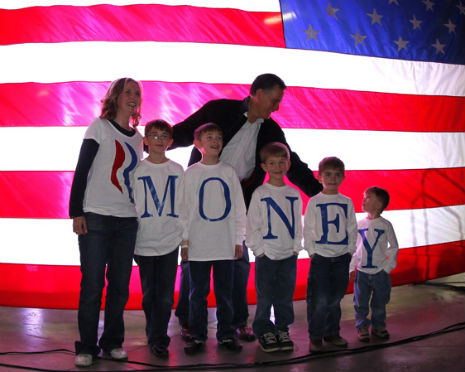
The letters of 'Mint' Romney's name come sadly adrift: even if, as some claim, it's photoshopped, it's still right on the money

Now Obama is indicating that those with enormous wealth might reasonably be called upon to contribute a larger proportion of the tax that they might expect to pay if they didn’t have accountants. In this, he is in step with European politicians, even Conservative ones. In the light of the economic conditions under which most of us struggle, it seems a mild enough line to take. Obama clearly hopes to outflank right-wingers like Santorum and Gingrich who think economic salvation derives from private enterprise having the freedom to exploit and to reward itself disproportionately. Handily, it also undercuts Romney because Romney is so very, very rich – were he to become President, he would be the second richest man ever to enter the Oval Office (the richest was John F Kennedy).

And here I enter a note of caution. That American dream is still very potent. Millions of Americans – and not just right-wing fundamentalists in the south and mid-west – take the view that untold wealth might be just around their own corner, and if they could just get a break they would soon feature in the Forbes list. They know rationally that this is very unlikely to happen, that for every lucky son-of-a-gun who strikes gold there are thousands upon thousands who only sift soil and stones, including themselves. But they still dream and – in a notion that Obama will remember – they hope. It’s quite a universal impulse really. Europeans also subscribe to it when they play the lottery.

Gingrich sought to bring down Bill Clinton for sexual peccadilloes but is a notorious hound himself

It’s my contention that many Americans – the ones who, while they may not read or follow Ayn Rand, still revere the all-American maverick – are actually repelled by any idea that the wealthy should be, as the rich will claim, “soaked” or “punished” in being more heavily taxed. If you cling to a dream of untold wealth, your dream is tarnished by any suggestion that the IRS might then take it away again. So you don’t resent the other guy’s riches – good luck to him. Let him screw the government for all he can get.

Santorum wants less regulation, except in the bedroom

Barack Obama had better beware that he doesn’t characterise the wealthy paying a greater share in such a way that the Koch brothers are able to galvanise a wave of militant sympathy for the poor bloody rich to sweep through the Tea Party and wash a man whom that movement cordially loathes into the White House. It would be a poor Obaman legacy to find that his second term is supplanted by a chief who would be ripe for Dick Cheney-like manipulation on a grand scale, a hapless President Romney.

Tuesday, November 08, 2011

The INCONTINENT of EUROPE

“England has saved herself by her exertions,” William Pitt the Younger once declared, “and will, as I trust, save Europe by her example”. As William Hague is something of an expert on Pitt, it surprises me that the Foreign Secretary has evidently yet to point out this superior remark to his leader. That David Cameron sees himself as saviour of Britain by exertion and Europe by example is surely the least part of his self-image.

As a political issue, the management of Europe is never as straightforward as it is deemed to be by those, each as passionate as the other, who espouse or decry the Union. The calamitous G20 summit in Cannes – planned as a great pre-election showcase for Nicolas Sarkozy who is far from assured of winning a second term – left the French president impatient, frustrated and (perhaps worst of all, given his electorate) graceless.

Sarkozy: harrumph

Much (but not all) of the source of Sarkozy’s malheur was the so-called Greek tragedy, wherein the charming and urbane prime minister, George Papandreou, eventually decided (wisely, you might think) to hand on the reins of a bolting crisis for that part of the euro that was once called the drachma.

Ever-genial Papandreou

Meanwhile, the basso buffo of contemporary Europe, Silvio Berlusconi, has said he will go, but (at the time of writing) clings to the wreckage of the Italian economy, having spent the past few years fiddling (evidently with under-age prostitutes) while the Via XX Settembre HQ of the Ministry of Economy and Finance burned.

Berlusconi: the latest official photograph

A week or two earlier, Cameron suffered the humiliation – I don’t think the term is too strong – of a rebuff from very nearly 80 of his own backbenchers over the offer of a referendum on Europe to the British electorate. Cameron, his coalition allies and the Labour opposition are against such a referendum precisely because they all fear that the electorate would vote to opt out of the European Union. It sticks in many a craw, not just those of little Englanders, that Cameron was passionately advocating a referendum on the Lisbon Treaty just two years ago when leader of the opposition.

The Ministry of Economy and Finance in Rome

Referendums on European Union issues have proved treacherous. The new European Constitution, signed into being in Rome in 2004, had to be abandoned once it had been repudiated by Dutch and French voters. The ratification of the Lisbon Treaty was delayed for a year because of an initial rejection of it at a referendum in the Republic of Ireland. And it was Papandreou’s unexpected proposal of a referendum on Europe’s package of measures to tackle the Greek deficit that threw his fellow Eurozone leaders into panic and brought his own premiership to an end. As Israel’s allies could not disguise when the Palestinians elected Hamas, democracy is fine (even in its Greek cradle) so long as it produces the result you want.

On Europe as on so many issues, Cameron is an opportunist rather than an ideologue – what Harold Wilson called a pragmatist. While this is seen by some as a usefully light-footed approach to the “art of the possible” nature of government, the PM does find himself surrounded by ministers and backbenchers who, when push comes to shove, have no intention of trimming on the matter of Europe.

Cameron: I see no Euro-rebellion

Just as the name of Calais would, she averred, be found inscribed upon the heart of Queen Mary, so the names of Brussels, Luxembourg and Strasbourg might well be found slashed onto the pericardium of the Conservative Party … if, that is, the party actually ran to a heart. Most Tory Prime Ministers since the War – Churchill, Macmillan, Heath, Major, Cameron – have been rather more communitaire than large sections of their party and have found this dichotomy to be a running sore, never healed.

The only Tory PM close to anti-European Union backbench opinion was Margaret “no, no, no” Thatcher who summarised her view in the notorious Bruges speech of 1988: “To try to suppress nationhood and concentrate power at the centre of a European conglomerate would be highly damaging and would jeopardise the objectives we seek to achieve”. Her speechwriter (Sir Ronald Millar?) will have chosen the word “conglomerate” to allow his boss to express her scorn. A mere four years later, non-smoker Thatcher was hired at a reputed million dollars a year as “international political consultant” to tobacco giant Philip Morris which, with its beverage-to-processed cheeses portfolio, is nothing if not a conglomerate. But irony is the abiding humour under which European affairs are conducted.

This bizarre image is allegedly of a pre-Eurosceptic Thatcher

Anti-Union sentiment is widely encountered across the member nations. A primary engine of that sentiment is undoubtedly an admixture of xenophobia and racism. If nationalist parties throughout the world have one instinct in common, it is suspicion of and hence hatred for their nation’s equivalent of Johnny Foreigner. This is clearly true of English nationalist parties of varying degree of disreputability. Interestingly, it seems very much less true of Scotland where, although contempt for the English often runs white hot, attitudes to continental Europe are considerably more benign. This may well be a product of the “auld alliance” with France that has held sway in varying degrees for upwards of seven centuries.

Suspicion and hatred can readily be traced back to ignorance. As one who feels perfectly comfortable in the company of any race or nationality, I generally account myself a citizen of the world rather than of England, Britain, the UK or Europe. (Conduct, class and creed are altogether a different consideration). But an instinctive scepticism about Europe, if deplorable, is entirely comprehensible. Such multi-national comfort is perhaps relatively rare.

My own instincts favour continuing to be a part of the European Union. Those instincts suggest that withdrawal would prove a disaster for Britain’s trading position and for those hard-won rights and entitlements that are underwritten by European law. The menaces being made by the Tory half of the coalition against the European Court of Human Rights, for instance, make me even surer that I want us to stay in the Union.

The anti-Europeans have never, to my knowledge, made any coherent economic case for the UK’s departure from Europe, probably because there is no such case. Relying on horror stories about bureaucratic foibles reported in the Daily Mail is not a credible substitute. The most honourable living anti-European, Tony Benn, has (it seems to me) moderated his opposition in recent years or at least found other, more compelling campaigns.

But the anti-Europeans are not alone in failing to make a case that resonates intellectually. I have waited some fifty years to hear an argument that I can fillet and reproduce on behalf of the case for a European role for Britain. I have still to hear it. It is as though the pro-Europeans believe that, to coin a phrase, mere “common sense” makes the case for being in Europe.

The ever-pensive Roy Jenkins

Perhaps it is a prejudice about the supremely pro-European British politician of the modern era, Roy Jenkins, that leaves me feeling that communitaire means in its essence no more than the favouring of Dante and Schiller over Norman Mailer and Jacqueline Suzann, Velasquez and Van Gogh over Andrew Wyeth and Roy Lichtenstein, Dvorak and Sibelius over Edward MacDowell and Nico Muhly, Gewürztraminer and Pont-l’Évêque over Jack Daniels and Chicken McNuggets (you see how brutal are the terms of battle). The suspicion remains that the pull of the Old World commands a sentimental clout that “civilised” people cannot resist. Robert Hughes’ unbeatable description of the “cultural epiphany” that Europe represented for 19th-century Americans catches it exactly: “six weeks of vomiting at sea, and then – Chartres”.

Jenkins’ well-attested penchant for claret was, I assume, not the sole motor for his rise to the Presidency of the European Commission, a role he played from 1977 to 1981. During his tenure, the articles that led to the creation of the Eurozone were put in place. But also during his time in Brussels, Jenkins began to float an alternative to both the Labour Party (his ancestral home) and the Liberals, with whom he had not previously been known to flirt. His Dimbleby Lecture of 1979, entitled (disingenuously, one might think) ‘Home Thoughts from Abroad’, laid down the ground on which was built the new Social Democrat Party, subsequently set up with three other refugees from Labour: David Owen, Shirley Williams and William Rodgers. The most significant mission to unite the so-called Gang of Four was a commitment to the European ideal.

The Gang of Four: Rodgers, Owen, Jenkins, Williams

The SDP survived as a separate political entity only for seven years before merging with the Liberal Party (which is why that party is now known as the Liberal Democrats). It would be hard to argue that anything of the SDP’s much-vaunted “breaking the mould” still may be detected in Nick Clegg’s Lib Dems. Doubtless the Liberals would function as the Euroconscience of the present coalition government even if the SDP blip had never come about.

Meanwhile, those of us who sense – I cannot in conscience put it stronger – that Europe is where the UK ought to be still await Clegg, Cameron or some other European advocate making a case that we can understand and carry triumphantly against the xenophobes, Little Englanders and sceptics. It’s not a big ask.

Tuesday, October 18, 2011

FRANKLY, DEBT (TORY) is RIDING HIGH

“The only way out of a debt crisis is to deal with your debts. That means households – all of us – paying off the credit card and store card bills”. Common sense or what? The words are from a speech by the Prime Minister but they were never delivered. Somebody among his many advisors explained gently to him that if every household paid off its debts instead of spending the money on other things, the economy would collapse. Mr Cameron, certainly no economist he, hadn’t realised that. Unfortunately for him, the text of his keynote address to the Tory party conference the other week had already been released. Consequently, the two sentences he didn’t read out became the most remarked upon in the speech.

The government is all at sea over the question of debt and hence all at sea over the whole of the national economy. Today (Tuesday) the September rate of inflation as measured by the government’s favoured method, known as the Consumer Prices Index, was announced. At 5.2 percent, it is the highest it has ever been since the method was adopted 14 years ago.

Public Sector Net Debt

Effectively, then, what we have now is what is called stagflation: a high and rising rate of inflation, a high and rising rate of unemployment and zilch growth. It’s a combination that reduces the value of money. And the usual counter to it is to increase interest rates. But to do that (which of course makes borrowing more expensive) will further reduce growth. The government has been relying on private sector growth to obviate the need for a level of public service and welfare cuts that will redound on ministers both on the street and in the ballot box. And it has made such a fetish of cutting government borrowing that to resort to Plan B or even Plan A-minus would be the most humiliating economic climb-down since Norman Lamont’s Black Wednesday. Cameron and George Osborne have steered us into a perfect storm and it’s hard to see that they are in any way equipped to ride it.

I got into a punishing level of personal debt in the 1990s. It’s bad enough when everything you purchase is expensive but when you have to purchase the money you need to make those purchases it soon becomes a vicious spiral. Running a debt on a credit card creates an illusion of painlessly burying debt. In reality, the proportion of the debt on the card that is the interest payment grows each month until it is the greater part of what you owe the bank. Banks were a lot happier to let their customers run debts then than they are now. And of course one’s chances of being allowed to slide into debt are greatly reduced if one’s prospects of securing future income are slight.

That is the main difference between the dangerously illusory debt of individuals and households – a road that can lead to repossession of one’s home if one’s home is no longer an asset that one holds – and the indebtedness that is the engine of capitalism. In business and finance, debt is called investment. Enterprises attract credit by looking as if such investment will help to grow the business and hence produce a healthy return. It’s a gamble, of course, and capitalism’s equivalent of homelessness is bankruptcy.

The present economic climate discourages investment. Hence existing indebtedness cannot be fed into something encouraging. Interest rates may be historically low but so is investment. Without growth, there is more homelessness and bankruptcy and the increasing incidence of these fell fates further discourages lending: another vicious spiral.

Osborne, Cameron and especially Business Secretary Vince Cable regularly exhort the banks to lend more money. But the banks pay no heed. The banks are afraid that they will be caught holding the bad debts when the music stops, an understandable fear. They also insist on paying their management teams grotesquely inflated salaries, bonuses, “golden handshakes” and “golden hellos”, even though many of these banks are owned at least in part by the government.

Cable itches to regulate the banks and cap the in-house rewards but Osborne and Cameron won’t let him. When Labour urges him to give Cable his head, Cameron chants his usual mantra, that Labour didn’t regulate the banks so they can’t talk. The PM subscribes to an unusual philosophy: two wrongs do make a right.

Debt as Percentage of GDP

Like business and the financial sector, government also speculates and invests. So the indebtedness that fuels capitalism also is utilised by government. It is normal for government to operate a deficit. But there is a distinction, not always kept clear, between the deficit and the National Debt. Cameron wants to reduce both and there is some controversy over whether such reduction is truly necessary.

The National Debt is the net accumulation of government borrowing. 80 or 90 years ago, that debt was greater than the whole of Gross Domestic Product, which is the global market value of the national output. That was the age of the Great Depression, when poverty and unemployment were rife in Europe and the United States, and hyperinflation sent prices out of ordinary people’s reach. While the Great War had fanned global interest in revolution and Socialism, the Depression sowed the seeds of dictatorship and fascism. After World War II, Britain’s National Debt was 250 percent of GDP – hence the austerity programme instigated by the Attlee government. It didn’t prevent that government implementing Rab Butler’s Education Act, Nye Bevan’s National Health Service and Lord Beveridge’s welfare state.

At the beginning of 2011, the National Debt was 60 percent of GDP and Cameron made – and still makes – great play of Labour’s “failure” to control this figure. But under Margaret Thatcher, the National Debt was well above 50 percent of GDP and, because inflation was so much higher than the negligible rate that it fell to successively under Tony Blair and Gordon Brown, the cost of servicing that debt was much more punishing. Some twelve percent of tax revenue was swallowed in paying down the interest on Thatcher’s debt. As Chancellor, Brown made the reduction of the debt his top priority and, as a result of his much-vaunted “prudence”, the percentage of tax revenue required to service the debt by the time the coalition came to power was nearer three percent. Cameron infrequently gives Labour credit for that.

Here’s a further measure, found in the most recent figures courtesy of the Office of National Statistics. The current national budget deficit “excluding the temporary effects of financial interventions” was £13.8 billion as of August. The net borrowing with the same exclusions was £15.9 billion and the net debt £944.5 billion, equivalent to 61.4 percent of GDP. Two years previously, under Labour and after nearly a year of global economic turmoil, the equivalent figures were £12.8 billion, £16.1 billion and £804.8 billion, 57.5 percent of GDP.

A different measure of the economy is the balance of trade. Again taking ONS stats, one finds that the seasonally adjusted deficit on trade in goods and services in August this year was £1.9 billion. This raw figure masks a vast difference between the two halves of the economy. Trade in goods was in deficit by £7.8 billion whereas trade in services was in surplus by £5.9 billion. That disparity starkly demonstrates how Britain’s manufacturing base has shrunk and why the government is running scared when bankers and other city slickers threaten to take their business elsewhere if their bonuses are culled and if the government doesn’t abolish the 50 percent tax rate.

Government Debt per Person

The figures from exactly a decade earlier make an interesting contrast. Then the trade deficit was £2.4 billion and no one was screaming about an economic crisis. But the two halves of the economy were rather closer together. The deficit in goods was £3.3 billion, the surplus on services £904 million.

On the basis of these figures, it is not unreasonable to surmise that, far from reducing the National Debt, the coalition is in fact increasing it. A flat-lining economy means that government revenue is stalled. Rising inflation this month causes increases in welfare payments to kick in next year. The debacle of tuition fees has led to the great majority of institutions of further education electing to charge the maximum for their courses, thereby requiring higher and higher lending by the government to students who are plunged further and further into the personal debt that Cameron affects to scorn.

Many of the government’s policies for cutting expenditure have proved to be so ill-conceived that they result in increased expense for smaller return. The savings that Osborne – like all in-coming Chancellors before him – was determined to make by cutting “waste” have proved to be a fantasy, as Osborne’s predecessors also found. And of course Cameron decided to add the excursion into Libya to the continuing unwinnable war in Afghanistan, at far greater cost than the government is prepared to divulge. The pain that has so far been inflicted on the electorate through cuts in public services and welfare has not been matched by any visible reduction in government borrowing. Ed Miliband ought to start using a mantra of his own, that “as usual Labour will have to come in after the Tories to clear up the mess”.

The pity of it is that Labour has not sought to put clearer ground between itself and the coalition. Miliband and Ed Balls have done little to discourage the belief that, had they been in government, they would have pursued similar policies of slash and burn, only slower. But is the reduction of the deficit and the National Debt so desirable or indeed at all necessary?

The Nobel Prize-winning economist Paul Krugman, who praised Gordon Brown’s leadership of Europe’s handling of the 2008-09 recession and who remains a trenchant critic of present policies pursued in both Washington and London, wrote that the Republican Party in the US “never cared about the deficit – not a bit. It has always been nothing but a club with which to beat down opposition to an ideological goal, namely the dissolution of the welfare state. They’re not interested, at all, in a genuine deficit-reduction deal if it does not serve that goal” [New York Times, June 24th 2011]. Looking at Andrew Lansley’s ham-fisted assault on the NHS and the coalition’s handling of education, the police, the BBC, local government and other public services, it’s hard to avoid the suspicion that the recently posited links between the Tories and the Tea Party go a lot further than agreement about fiscal policy.

Cameron and Osborne would do well to mark Keynes’ phrase “the paradox of thrift”. Keynes anticipated the error that Cameron excised from his conference speech at the last minute, that if people eschew spending in a recession (as Cameron almost advocated) the fall in demand leads to a fall in activity and so a recession becomes a depression. If the government doesn’t spend on promoting growth, it will have to spend more on saving the unemployed and their dependents from penury. This is the fundamental error that the Irish government committed last year and that the Greek government is sliding into now. And the people don’t thank their governments for making such poor judgments.

Sunday, May 01, 2011

The LOUD LAUGH that SPOKE the VACANT MIND

In today’s Daily Telegraph, the columnist I love to hate, Simon Heffer, has once again voyaged into a subject of which he knows nothing: humour. Here is the link:

http://bit.ly/k4klbX

I shall now make Mr Heffer chuckle uncontrollably (given his susceptible funny bone) by revealing that my own name for him is Siphon Effluent. Did you see what I did there, Simon? Good, isn’t it.

The occasion of Mr Effluent’s latest outpouring was the wonderfully witty and hilarious wisecrack delivered in the house at Prime Minister’s Questions when the PM advised shadow minister Angela Eagle to “calm down, dear”. He and his backbenchers thought this so much funnier than the complete works of Oscar Wilde, SJ Perelman, PG Wodehouse and Stephen Fry rolled into one that Mr Cameron felt called upon to repeat the joke a further six times. Laugh? I thought I’d have to bite the television remote.

Siphon Effluent with his beloved Thatch

Laughter in the house is not like laughter anywhere else (except probably the Bullingdon Club and the Oxford Union). It is a mirthless howl, the kind of har-har-har braying, accompanied by forced slapping of fat hams, that speaks not at all of appreciative and judicious admiration for a finely-turned phrase but entirely of bullies putting in the boot after their loudest mouth (whom they fear, or at least require to impress with “loyalty”) has played to the lowest common denominator by landing on an opponent a blow to the solar plexus. This kind of knee-jerk oinking is certainly not the prerogative of Flashmanesque Tories. All the other party cannon-fodder do it too, even (I shouldn’t wonder) the Greens. It was noticeable though that, while George Osborne hooted like a hairdresser at a Cher concert, Nick Clegg sat stony-faced throughout the entire episode.

Politicians as a breed are not all that amusing. Even some quite smooth orators, while skilled at rousing an audience, cannot deliver a funny line. Those politicos who are able to reveal a responsive sense of humour in a general way can indeed be funny themselves, regardless of political inclination: Heseltine, Kinnock, Kennedy, Hattersley, Portillo, Skinner, Widdecombe (the latter, perhaps, unintentionally). Ed Miliband shows encouraging signs of being able to mock thoughtfully, helped by some evidence that he doesn’t take himself too seriously all of the time. John Smith had a charmingly deprecating sense of humour.

Angela Eagle: shot down by Cameron's deadly wit

In earlier generations, Harold Macmillan had a dry clubman’s wit, often quite lethal. Harold Wilson could be witheringly funny. Jo Grimond and Jeremy Thorpe were both quick-witted and smart Liberal Party leaders. I remember an edition of Any Questions? celebrating some early anniversary, during which Thorpe astonished all by his pitch-perfect and brilliantly “scripted” impersonations of some of the programme’s stalwarts not present in that edition: Ralph Whiteman, Ted Leather, Gerald Nabarro.

Winston Churchill’s many witticisms have gone down in legend, though some of them would fail modern tests of acceptability. No PM since has matched Churchill’s style, timing and sheer sense of mischief – “Bossom?” he sniffed at the surname of a new member. “Neither one thing nor the other”. But at least one contemporary statesman can deliver a witty speech with perfect timing and aplomb. Go to
http://bit.ly/jDop1g
to laugh out loud at Barack Obama's speech to yesterday's White House correspondents' dinner.

Typically, politicians have ‘jokes’ written for them, which they proceed to mangle in delivery, yet the faithful roar with simulated delight anyway. Tony Blair thought himself jolly good-humoured but the kind of thing that made him weep with laughter was that singing fish novelty that was all the rage among people with no taste for a day and half some time in the late ‘90s. Gordon Brown’s delivery of a joke was as leaden as John Major’s or Edward Heath’s. And Siphon Effluent’s great heroine, Margaret Thatcher, had no sense of humour whatsoever. The antediluvian playwright Sir Ronald Millar – don’t hold your breath for a revival of his plays – wrote the “you turn if you want to – the lady’s not for turning” shtik, a desperately laborious conceit even in skilled hands, but it brought a Tory conference to its knees weeping with uncontrollable mirth, despite that the dear leader had performed it with considerably less panache than Neville Chamberlain announcing “consequently this country is at war with Germany”.

Siphon Effluent: the HL Mencken de nos jours

Siphon Effluent himself does make me laugh, mostly because he contrives to present the appearance of a sugar pig with marmalade smeared on his head. But his writing is dominated by his desire to be disobliging and, if he ever threatens to try for humour, it never ventures further than peevish scorn. He always refers to Mr Cameron as “Dave” – this is known in the trade as a “running gag” – presumably because he disdains a Tory leader who is not Thatcher and because some of the PM’s intimates appear to refer to him by this builder’s-mate moniker. (Not least of these intimates is the first lady, Samantha Cameron. There again, her sense of humour was revealed yesterday when she appeared to think it a jolly jape to roll up at a formal state occasion dressed for a constituency coffee morning; gratifyingly, she was comprehensively outshone by the effortlessly chic Miriam Clegg).

Bernard Manning: evidently he and Effluent were separated at birth

In his piece on humour, Effluent makes a strenuous joke in calling Angela Eagle “a harridan”. He was so pleased with this that he repeated it. Now, Effluent is very keen on the correct use of English. Indeed, he is the in-house English monitor at The Telegraph, apt to send stinging emails to hapless journalists who have offended his sensibilities. So I find myself surprised that he should use the term “harridan”, which is defined by the OED as “a haggard old woman”, of a personable female of just 50.

Effluent writes further: “I suspect even Dave has the manners not to address a woman with whom he is not well acquainted as ‘dear’ except in jest” and later, on a different matter, “This column prides itself on its gallantry towards the ladies”. Yet he himself has the ungallant lack of breeding to write of a woman with whom he is not well acquainted in such an insulting manner. I think he should stand in the corner.

With brilliant skill and dazzling wit, Effluent turns what his admirers might have feared was a mortal thrust at “Dave” into an all-guns-blazing assault on Labour and “lefties” in general: “His [Cameron’s] mistake, however, was to think that these people are easy-going types who like a laugh. He has, at least, now admitted he realises that the Left doesn't have a sense of humour”.

Jim Davidson: also seems to come in a similar shade to Effluent

Ah yes, the age-old canard that “lefties” have “no sense of humour”. It is of course fair and just to observe that there are individuals who are earnest and single-minded about their politics, but I never found that this degree of dedication was confined to the left. Had it been, we might now live in a more enlightened world. But the myth persists: on Any Questions? this weekend, UKIP leader Nigel Farage spoke of “po-faced Republicans”.

It can be argued – I have argued it myself – that comedy is fundamentally reactionary because it requires a reliable and enduring establishment, status quo, conventional wisdom against which to bounce. So, while pretending to subvert and mock, comedy really reinforces and humanises. It’s Lear’s Fool syndrome – the absolute monarch permits an all-licensed jester precisely because he is absolute and therefore the jester cannot draw blood, only wry smiles.

But there are many conventional wisdoms. Changes of government do not signal the end of satire. Effluent seems to imagine that only reactionary people are capable of being funny. “Comedians who are not Leftists” essays Effluent “have more or less been driven out of business. Bernard Manning was martyred in this cause. Jim Davidson is in the process of following him, not because he isn't funny, but because he was a strong supporter of Mrs Thatcher. Long after she left office, the spiteful little creeps who form the ‘comedy’ establishment of this country would get laughs from their bovine audiences simply by mentioning her name”.

Tom Lehrer: 'We Will All Go Together When We Go'

If Effluent sees himself as a comedian, this is certainly his most laughable passage. The idea that Manning was “martyred” is preposterous. He may have fallen out of television fashion – many entertainers do and politics has nothing to do with it – but his club work (including at his own club) continued to bring him a handsome income. And I can’t help wondering how often Effluent was to be seen knocking back pints with hoi polloi at Manning’s place, roaring with delight and slapping his hams at “fookin’ Paki” so-called “gags”. If nothing else, the vulgarity of it all seems extremely unlikely to have appealed to Mr & Mrs Effluent as an alternative to their beloved Wagner, any more than one can picture them tripping to the end of a pier to rock with joy at Jim Davidson’s version of fun.

Perhaps Effluent is thinking of Ben Elton when he writes of “the spiteful little creeps” mentioning Thatcher’s name for a laugh. Elton certainly used to do stuff about the woman he called Thatch but that was back in the ‘80s in his spangly-suited phase. I would gently suggest that if Effluent were to take tea with Elton at the Ritz and probe him for his present political views, he might find that they have more in common than he imagines.

Roy Battersby: as you see, an archetypal po-faced leftie

There have been plenty of intelligent, thoughtful and far from spiteful comics who are not reactionaries. In Effluent’s youth, he might have been aware of the American Tom Lehrer, a finely witty, talented and scrupulous social satirist who announced his retirement when Henry Kissinger was awarded the Nobel Peace Prize, on the grounds that the award rendered satire obsolete.

But even staunchly committed left-wingers have sprightly senses of humour. Tariq Ali, whom I knew a bit at one time, is a warmly funny and witty man. My old chum Roy Battersby would certainly fill the bill for Effluent when looking for a fully paid-up leftie. Roy was a key member of the Workers’ Revolutionary Party in the 1970s and ‘80s, took five years out of his directing career to work full-time for the party as its chief representative on the Palestinian question (he made a moving documentary called The Palestinian, fronted by Vanessa Redgrave), stood for parliament and was involved in the supposedly notorious Red House centre which was a constant target for MI6. Yet my abiding image of him is of a man wreathed in a beatific smile, relishing the pleasures of life and laughing uproariously at its manifold absurdities.

There is an unbridgeable gulf between, on the one hand, Roy, Tariq and Tom Lehrer and, on the other, a Simon Heffer whose idea of a comedian is Manning or Davidson and a David Cameron who thinks he’s being witty by quoting someone as repellent as Michael Winner in something as low class as a television advertisement and claims that anyone who cannot see such rubbish as meritorious lacks a sense of humour. I can’t imagine finding anything in common (humorous or otherwise) with anyone who would rather reside on the Heffer/Cameron/Manning side.

Saturday, March 19, 2011

LIBYA – RATION the RHETORIC

Yesterday, on the eighth anniversary of the Commons vote in favour of the illegal invasion of Iraq, David Cameron laid before parliament the rationale for the United Nations’ resolution to impose a so-called no-fly zone on Libya. From the moral high ground on which Cameron plants his feet, the issue is so very simple. Gaddafi is a bad man and he must be taught a lesson. Primary schoolchildren could articulate the position just as persuasively. It is what I call The Bogie Man Theory of History, or, as the Americans would call it, The Boogey Man Theory.

Not that there is any significant opposition to this in the House. It has been observed before (though I am unable to verify an attribution) that “when the House is united, it is invariably wrong”. Yesterday confirmed that sentiment. Nick Clegg, whose party opposed the Iraq invasion, sat doing the gravely nodding dog act beside his coalition leader. Ed Miliband rushed to sound as resolute and determinedly courageous as Cameron, as if anybody gives a tuppenny damn what the British Labour Party says about the issue. You cannot expect sense from Labour on matters of British imperialism. I can never forget that, just a fortnight after describing himself as “an inveterate peacemonger”, Michael Foot (of all people) was unconditionally supporting Margaret Thatcher’s adventure in the south Atlantic, an exercise that, by itself, almost certainly kept the Tories in power (and so Labour out of office) for the following fifteen years.

Cameron in the Gulf States last month

Britain cannot stand idly by, is Miliband’s argument, while Gaddafi massacres his own people. Well, I want to ask: why not? What do the ambassadors of, for the sake of argument, Hungary, Barbados, Venezuela, Laos and Gabon have to say about the implied criticism that they are indeed perfectly happy to stand idly by? Why does Britain have to be the one who takes it upon herself to punish the bogie man of the sands? Apart from being the most extensive supplier in history of armaments to the country, Britain has no particular historical links with Libya, certainly none comparable to those of Italy, of which Libya was a colony for most of the first half of last century. Yet Silvio Berlusconi’s input into the no-fly zone argument is not widely recorded. Perhaps he has been too busy entertaining under-age women this week (as every other week).

Gaddafi cultivates the Ruritanian look

Throughout the thrilling people’s revolution that toppled Hosni Mubarak earlier this year, we heard daily about how wonderful is the Egyptian army. So why didn’t the UN put pressure on Egypt to send its fabled troops over the border to repel Gaddafi? Other member states of the Arab League – Jordan, Kuwait and Morocco, for instance – have disciplined military strength. It makes considerably more geopolitical sense for Arab nations physically to lead the campaign to bring Gaddafi to heel.

Cameron, basking in evidently widespread approval for having played a supposedly canny hand with both the UN and the US, assures that he is not “grandstanding” on this matter. Of course he is. Cameron veers between invoking the “moral” argument that Miliband articulated and reassuring his political base that it is “in Britain’s interests” to lead the world’s reaction to Gaddafi’s rush towards civil war. These interests begin and end with the international supply and cost of oil. At least when he concedes that much, Cameron is approaching a soupçon of candour.

The argument about morality is bankrupt. When, on the BBC News last night, Nick Robinson asked the PM about his position on Bahrain, Cameron waved it away: different problem, different dynamic, different order of morality. Here’s a significant difference: picking a fight with the Saudi forces now called into the Bahraini kingdom to put down the rebellion is much more challenging than picking a fight with Gaddafi’s raggle-taggle air force of conscripted peasants and Saharan mercenaries. Clearly, the military might of a consortium consisting of Britain, France and – in the second wave perhaps – the USA is not going to have much trouble wiping out Libya’s military might.

Gaddafi visiting Berlusconi in Rome, 2009

Or is it? The invaders of Iraq and Afghanistan figured it would be the work of a few weeks at most. Libya might be as straightforward to quell as Serbia or it might not. Gaddafi has not lasted this long in power without being a wily and tough operator. The ceasefire announced yesterday by his foreign minister, the wonderfully named Mussa Kussa, is certainly a sham. But it has already had the desired effect. It has wrong-footed the west and sent governments into a further huddle. There will be more of this.

So Britain has embarked on another military interference in the internal affairs of another sovereign nation with consequences just as unknowable as they always are. The hubris – of the very interference, of the self-aggrandisement, of the cloak of proclaimed morality, of the certainty of military superiority – is breathtaking.

And then, seeing as no one seems yet to have asked, I ask it: who pays? Simple. We do. Today’s Daily Telegraph, while busy lining up Cameron for canonisation as a war leader, gaily trumpets on its front page that “some families will have £3,500 wiped off their annual incomes next month because of tax increases and cuts to benefits”. Oh good. How much less pain they will feel to know that this loss of income will now be largely spent on an utterly unpredictable big-willy experiment in the North African desert. How can a government that is in the throes of undermining – in some cases fundamentally undermining – every public enterprise in Britain gaily decide to throw money at a totally unnecessary interference in a foreign civil war?

Intimates no more – Sarkozy and Gaddafi in 2007

Well, you may say, what would you do? Just sit back and let Gaddafi massacre his brave populace? I am not a politician, nor about to be one. I don’t have to have a foolproof bill of fare ready to execute tomorrow. Nor do I have to accept the convention of starting from here. I do have a long-term proposal that, had it been put into effect when I first proposed it five years ago, might have avoided the situation that we now face. Here it is.

We must give the United Nations actual power and that of course means power greater than that of any one member. The UN charter, still almost exactly as written in 1945, needs substantial revision. The permanent members of the Security Council must agree to surrender their veto, the prerogative of the bully over the powerless. No member can be allowed exemption.

The veto means that the UN has no muscle to flex against the US or China or the other elite nations. Which of them will volunteer to forego a veto? It would need a visionary party leader or presidential candidate to carry the case with his own electorate, so as to take a mandate to the other Security Council members; a diplomat of rare persuasive power, who implicitly understands the global gain of a truly powerful UN, to convert even one of the holders of the veto. But someone needs to attempt it. What is political power for if not to change the world?

Tony Blair enjoys a quick two-step with his good pal

The point of this exercise is to create a UN capable of credibly policing the behaviour of all member states. UN peacekeeping forces, made up of recruits from any and every member state, handsomely rewarded by all the members in proportion to their GDP, must be the only troops permitted to move freely across the territories of the disputing nations. And this should apply to internal, tribal and internecine strife as well as that between separate nations. Meanwhile, the remit of the UN’s International Court of Justice needs to be widened so as not to depend on the consent of those states that are party to a dispute, another tough sell.

The UN should assume the power to order the immediate cessation of hostilities between member states. Waging war must be against the UN’s bedrock principles. Any member visiting warfare on another should be suspended forthwith from UN membership. In practice this must mean that all other member states, including those sympathetic to the miscreant’s cause, suspend all trade and other dealings with the suspended member. A blanket economic freeze would soon encourage a government to halt hostilities. The UN must then have the resources to assume control of negotiation of a settlement between the disputatious nations. Warfare must be a gambit that is made impracticable because it makes each of the warring nations an international pariah. If both sides are taken out of benefit of UN membership, the issue of ‘blame’ is largely futile. The UN negotiators can then begin with a level playing field.

Libyan rebels on the Benghazi road

The UN’s power to intervene in a sovereign nation’s internal affairs would be a more complex matter than preventing state-to-state confrontation. The UN’s remit should be truly global and therefore probably cannot be automatically parochial. Matters such as the suppression of a particular tribal or religious grouping within a nation state would have to be confronted on a case-by-case basis. But a case like that of Libya or indeed Bahrain is not so complex as to be beyond a newly-constituted UN to resolve. Moreover, the UN could hold sway over issues other than warfare. It could wield its power, no longer fettered by national vetoes, to impose restrictions on the activities that contribute so catastrophically to the destruction of the environment. But that is a road down which to travel on another occasion.

In the absence of a UN rebuilt along the lines that I propose, we have another potential disaster taking shape in a country that can ill afford to be ravaged by years of war. Today‘s self-satisfied certainties in London and in Paris and, more cautiously, in Washington, may well look rather less confident tomorrow or a week or a month hence. We shall see. But at this particular moment, I feel like invoking an angry cry of just eight years ago: Not In My Name.