COWARDS FLINCH and TRAITORS SNEER
Having laid a minefield, the Labour party seems doomed to march across it. Whatever the accuracy of opinion polls recording a potentially unassailable domination for Jeremy Corbyn in the contest for the party leadership, the result is clearly going to split the party. Corbynites will howl ‘foul’ if anyone but Corbyn wins. The danger that opinion polling entails is that people naturally set store by it. Corbynites understandably expect their man to win now. If he doesn’t, they will want to know why. I can’t imagine an answer that would satisfy them.
On the other side, there seems an increasing likelihood that the Anyone But Corbyn alliance – which is certainly predominant in the parliamentary party – will foreswear acceptance of democracy and dedicate itself to overturning the result of the vote. This is a rather more difficult position to argue rationally or logically. It is wholly dependent on the assertion that a Corbyn-led party could not win a general election. Nobody of course can prove such an assertion. Moreover, the evidence offered to support it is compromised by many other factors.
Michael Foot and Tony Benn are immediately offered as evidence. Well, there was no Footmania. Michael Foot was elected leader by a ballot only of MPs. There was no grassroots surge on his behalf. Indeed Denis Healey (98 at the end of this month) was so sure he would be elected leader that he refused to countenance any other result – I recall his smug face doing so on a television interview.
Foot and Healey
Foot had a slim victory over Healey. Great man though he was, he cut a remote, bookish and professorial figure. He didn’t play the best hand as leader. I found it hard to forgive him for announcing in the House that he was “an inveterate peacemonger” and then, just a fortnight later, committing the party to backing Thatcher on the Falklands. But the most damaging episode of Foot’s leadership was not something that Foot did. It was the defection of a number of MPs, led by the so-called Gang of Four, to form a new party, the Social Democrats. It was this fracturing of the anti-Tory force that kept Labour out of power for 18 years. The prediction that carries much more conviction than that of Corbyn’s unelectability is that a party riven by internal strife is unelectable.
As for Tony Benn, a rosy glow has settled over him since his death nearly eighteen months ago. His candour and courage and wisdom are now remembered with great affection. Of how many politicians do you hear the phrase “national treasure” used without irony or apology? That he was Corbyn’s mentor is benefiting both his own legend and Corbyn’s present reputation.
The Gang of Four
Look again at the argument that Corbyn would be unelectable at a general election. Whatever you argue, you cannot gainsay that he has enthused a lot of people. Many of them are young, the very constituency hitherto most alienated from mainstream politics. And many of them are long-suffering Labour supporters who consider that the party has gradually drifted away from core values. These are real assets for the Labour party. There is not much evidence that Burnham, Cooper and Kendall are bringing in new support.
That leads me to the vexed question of ‘entryism’. The distinction between entryism and recruitment is difficult to plot or to argue. If someone has left Labour in despair and joined a new grouping on the left or the LibDems, the Greens or the SNP, why would her return not be welcomed with open arms? Nobody in the PLP objects if someone who, at the previous general election, voted for the Tories or Ukip or the Monster Raving Loony Party now wants to vote Labour. Such a voter does not get her motives questioned, even though her previous vote might have been ‘tactical’ and hence perhaps suspect in the purists’ eyes. I voted LibDem in May because I didn’t want the Tories to take the seat from the LibDems. There was absolutely no chance of Labour taking it, even in a good year. That doesn’t mean I am not a Labour supporter. You do what you have to do.
Kendall and Corbyn; the knife is out of sight
Attempts to stymie Corbyn’s leadership are nothing but self-defeating. If he is replaced by Cooper or Burnham before the next election, the Tories will say that the new Labour leader couldn’t even get elected in the party so why would the country be impressed? If David Miliband is rushed in at a by-election simply in order to replace Corbyn with a supposedly electable alternative, the term ‘carpetbagger’ will be forever attached to him. As for the stabbing-in-the-back legend, that would be turned on its head. Moreover, the half-buried issue of extraordinary rendition, on which Miliband has yet to be fully candid, would come back with a vengeance.
All this may still be avoided, however. Remarkably, a poll released last night finds that Jeremy Corbyn easily leads among the candidates on the question “which leader would make you more likely to vote Labour in the next general election?”. He has 32% to the 25% of his nearest rival, Andy Burnham. Yvette Cooper, increasingly put forward as the best compromise candidate by the party’s mainstream, comes last with 20%. This is a poll not of Labour supporters but of the wider electorate. I always doubt opinion polls; this is not what the ABC crowd wants to hear, however.
Last night's poll
It’s unfortunate, but the success or otherwise of Corbyn’s leadership of the party rests largely in the hands of his enemies. His own democratic instincts mean that he will surrender choice of the shadow cabinet team back to the PLP; the chances are that they will heavily load the team with Blairites and other malcontents. Then he has said he will re-offer himself for confirmation before the 2015 general election. Will that be to the PLP or to the whole party?
However it falls out, the Blairites need to tread carefully. Unless they are to reveal themselves as mere opportunists, they will not join the Tories or the LibDem rump. Will they set up a new party? The danger is that they would fail to find a space to carve between the existing parties. The impact of the SDP, which anyway turned out to be shortlived, is unlikely to be replicable. In any case, the absence of Blairites in the Labour party would allow Corbyn to carry more of his policy positions. The more parties ranged against a Corbynite Labour party, the less impact each can have. But if they stay, the ABC-ers must be smart about rocking the boat. New leaders are entitled at least to a honeymoon period. Soon enough, Corbyn will get an opportunity to test his leadership at the ballot box, in the Holyrood elections next May and then the EU referendum across the UK, if not at a by-election. A premature party split would mean that the split itself would be the only aspect of Labour that voters judged.
Saturday, August 15, 2015
Wednesday, August 12, 2015
GOLD STANDARD
Until I saw the Guardian obituary today, I hadn’t registered the death of Jack Gold at 85. His career exactly spanned my own obsession with television. Watching his film Death in the Morning, made in 1964 for the early-evening magazine programme Tonight, was a pivotal moment in viewing for me. At 16, I was beginning to understand that there was a correlation between the credits I saw on programmes and movies – especially those of the writer and director and sometimes too of the producer – and the effectiveness of the work. Alan Whicker fronted the film, but it was Gold’s producer credit (which meant director in current affairs parlance) that I remembered.
Death in the Morning was arguably the spur that kicked off the anti-fox-hunting movement. It undoubtedly referenced the dazzling hunt sequence in Tony Richardson’s feature film Tom Jones, made the previous year. But it put this visceral excitement to decided polemical use. That it was a true innovation in engaged documentary was recognised by its winning of a SFTA award (the forerunner of BAFTA).
Gold made a memorable record of Malcolm Muggeridge’s lecture tour of the States before joining the roster of directors on The Wednesday Play. He immediately slipped into the Ken Loach mould with The Lump (written by Loach regular Jim Allen), though he made it his own by brilliantly casting a very grand actor, Leslie Sands, in the lead rather than the earthier type that Loach would have favoured (Bill Dean or Peter Kerrigan).
One of the most successful (if least characteristic) Wednesday Plays was Mad Jack, Tom Clarke’s play that covered similar ground to Pat Barker’s subsequent Booker Prize-winning novel Resurrection. It was on a re-teaming of Gold and Clarke, Stocker’s Copper, that I met Jack Gold. I was then a BBC trainee. Jack was reserved, watchful and serious; the part of the production that I shadowed was the recording and dubbing on of music, so the very different character of the composer Carl Davis – loud, garrulous, ebullient – somewhat eclipsed Jack. I never doubted his authority and control, however.
Jack almost invariably chose scripts by writers of the very first rank: Charles Wood, John McGrath, Jack Rosenthal, Julia Jones, Howard Barker, Peter Nichols, Adrian Mitchell, Andrew Davies. But, as all his generation of directors experienced, the movies proved less rewarding than the golden age of television – though Jack made more than most – and the golden age dwindled and died in the late 1970s.
The last time I saw Jack was on a bus in Crouch End and he mistook me for Enn Reitel, not the most flattering of misperceptions. I can forgive him that. His career was as effective and discriminating as any director of his generation and he’s left a fine legacy.
Until I saw the Guardian obituary today, I hadn’t registered the death of Jack Gold at 85. His career exactly spanned my own obsession with television. Watching his film Death in the Morning, made in 1964 for the early-evening magazine programme Tonight, was a pivotal moment in viewing for me. At 16, I was beginning to understand that there was a correlation between the credits I saw on programmes and movies – especially those of the writer and director and sometimes too of the producer – and the effectiveness of the work. Alan Whicker fronted the film, but it was Gold’s producer credit (which meant director in current affairs parlance) that I remembered.
Death in the Morning was arguably the spur that kicked off the anti-fox-hunting movement. It undoubtedly referenced the dazzling hunt sequence in Tony Richardson’s feature film Tom Jones, made the previous year. But it put this visceral excitement to decided polemical use. That it was a true innovation in engaged documentary was recognised by its winning of a SFTA award (the forerunner of BAFTA).
Gold made a memorable record of Malcolm Muggeridge’s lecture tour of the States before joining the roster of directors on The Wednesday Play. He immediately slipped into the Ken Loach mould with The Lump (written by Loach regular Jim Allen), though he made it his own by brilliantly casting a very grand actor, Leslie Sands, in the lead rather than the earthier type that Loach would have favoured (Bill Dean or Peter Kerrigan).
One of the most successful (if least characteristic) Wednesday Plays was Mad Jack, Tom Clarke’s play that covered similar ground to Pat Barker’s subsequent Booker Prize-winning novel Resurrection. It was on a re-teaming of Gold and Clarke, Stocker’s Copper, that I met Jack Gold. I was then a BBC trainee. Jack was reserved, watchful and serious; the part of the production that I shadowed was the recording and dubbing on of music, so the very different character of the composer Carl Davis – loud, garrulous, ebullient – somewhat eclipsed Jack. I never doubted his authority and control, however.
Jack almost invariably chose scripts by writers of the very first rank: Charles Wood, John McGrath, Jack Rosenthal, Julia Jones, Howard Barker, Peter Nichols, Adrian Mitchell, Andrew Davies. But, as all his generation of directors experienced, the movies proved less rewarding than the golden age of television – though Jack made more than most – and the golden age dwindled and died in the late 1970s.
The last time I saw Jack was on a bus in Crouch End and he mistook me for Enn Reitel, not the most flattering of misperceptions. I can forgive him that. His career was as effective and discriminating as any director of his generation and he’s left a fine legacy.
Tuesday, August 11, 2015
The ONLY POLL THAT MATTERS is the VOTE
Anybody who's ever discussed politics with me knows that I set no store by the pseudo-science of opinion polling. The growth of this egregiously parasitical activity answers the media's obsession with prediction and anticipation, itself a reaction to the decline of the printed press as a source of overnight news. It matters little if the forecasting of sports events or culture awards proliferates and either drains the results of excitement or makes the misguided forecasters look fools. But pollsters have got elections badly wrong in Britain – in 1970, 1983, 1992 and 2015 – and in the States – Bob Worcester himself "called" the 2004 election for John Kerry. This is noxious because, as polling day approaches, it manipulates the electorate and affects the results.
YouGov, the polling organisation set up by the political journalist Peter Kellner, is now saying that Jeremy Corbyn is on course to win the Labour leadership on the first ballot. That's a very dangerous finding and I fear it will have a bad effect on the general behaviour of the Labour Party, both among those who (like Alastair Campbell) have started the ABC movement (Anyone But Corbyn) and among those who plan to vote only for Corbyn and may find their ballot papers discounted if they just put an X by his name. Corbyn's team need to work up to the wire to give their candidate the best chance. Over-confidence now could prove fatal.
Like all opinion pollsters, YouGov supply their paymasters with what they want, including the massaged results that they want. Kellner, remember, was the pollster who asked voters whether they thought Ed Miliband was "weird", a vilely loaded question and, it seemed to me, a good example of pot, kettle and black (see above). But this finding and others that re-enforce it set up a highly damaging possibility. If now Corbyn fails to become Labour leader there will be thousands of Labour supporters who smell a very big fix and the consequences of that could be very far-reaching.
Anybody who's ever discussed politics with me knows that I set no store by the pseudo-science of opinion polling. The growth of this egregiously parasitical activity answers the media's obsession with prediction and anticipation, itself a reaction to the decline of the printed press as a source of overnight news. It matters little if the forecasting of sports events or culture awards proliferates and either drains the results of excitement or makes the misguided forecasters look fools. But pollsters have got elections badly wrong in Britain – in 1970, 1983, 1992 and 2015 – and in the States – Bob Worcester himself "called" the 2004 election for John Kerry. This is noxious because, as polling day approaches, it manipulates the electorate and affects the results.
YouGov, the polling organisation set up by the political journalist Peter Kellner, is now saying that Jeremy Corbyn is on course to win the Labour leadership on the first ballot. That's a very dangerous finding and I fear it will have a bad effect on the general behaviour of the Labour Party, both among those who (like Alastair Campbell) have started the ABC movement (Anyone But Corbyn) and among those who plan to vote only for Corbyn and may find their ballot papers discounted if they just put an X by his name. Corbyn's team need to work up to the wire to give their candidate the best chance. Over-confidence now could prove fatal.
Like all opinion pollsters, YouGov supply their paymasters with what they want, including the massaged results that they want. Kellner, remember, was the pollster who asked voters whether they thought Ed Miliband was "weird", a vilely loaded question and, it seemed to me, a good example of pot, kettle and black (see above). But this finding and others that re-enforce it set up a highly damaging possibility. If now Corbyn fails to become Labour leader there will be thousands of Labour supporters who smell a very big fix and the consequences of that could be very far-reaching.
BREAKING FREELANCE
At the weekend, I spent 24 fascinating hours in London Town. On the Saturday night, it was dinner with old (and one new, lovely) journo friends from three continents. We covered pretty much everything you might name, much spiced by one of our number being able to move at will inside the DC beltway. This is what connections are for.
Sunday was spent at The Guardian, attending a so-called Masterclass on The Essentials of Freelance Journalism. Now, I've been a freelance journo for more than 40 years (longer than any of the day's four speakers has been alive) but I haven't placed a piece in more years than I care to count so I figure that ... er ... You're Never Too Old to Learn. I went prepared to be the speccy kid at the front, putting his hand up at every verse end and being utterly obnoxious. My opening line was going to be that I felt like Matt Dillon in Wayward Pines. Probably just as well that I didn't get to use it. The speakers were all quick-witted and sympathetic, though all cut from the same cloth: wry, self-deprecating, self-congratulatorily giggly, unpretentious. Their argot is the one that now dominates journalism and television presentation: banter. If you don't do banter, you can kiss goodbye to a career.
This is bitter aloes to me. The first speaker, Stuart Heritage, had a piece in G2 the other day, followed by another piece by Ian Martin. Both were about Jeremy Corbyn, both were crippled by their jokes shouldering each other out of the way, and Martin's went second because his jokes were that much more outré and gratuitous. I longed for something about Corbyn that I could engage with. I guess I'll have to offer it to G2.
Still, there was a lot of good stuff passed on. I amassed a mass of details that I didn't know or hadn't considered or had overlooked. I feel newly armed for the battle. And for £129 (including a decent lunch and continuous tea/coffee) it wasn't bad value – some of the plusher Masterclasses charge in the high four figures. This is a smart service for The Guardian to offer and also a useful one. Of course, as always, I march away newly determined and within two days the rest of life has crowded in and good intentions fall behind old habits. Perhaps I'll write myself a note.
At the weekend, I spent 24 fascinating hours in London Town. On the Saturday night, it was dinner with old (and one new, lovely) journo friends from three continents. We covered pretty much everything you might name, much spiced by one of our number being able to move at will inside the DC beltway. This is what connections are for.
Sunday was spent at The Guardian, attending a so-called Masterclass on The Essentials of Freelance Journalism. Now, I've been a freelance journo for more than 40 years (longer than any of the day's four speakers has been alive) but I haven't placed a piece in more years than I care to count so I figure that ... er ... You're Never Too Old to Learn. I went prepared to be the speccy kid at the front, putting his hand up at every verse end and being utterly obnoxious. My opening line was going to be that I felt like Matt Dillon in Wayward Pines. Probably just as well that I didn't get to use it. The speakers were all quick-witted and sympathetic, though all cut from the same cloth: wry, self-deprecating, self-congratulatorily giggly, unpretentious. Their argot is the one that now dominates journalism and television presentation: banter. If you don't do banter, you can kiss goodbye to a career.
This is bitter aloes to me. The first speaker, Stuart Heritage, had a piece in G2 the other day, followed by another piece by Ian Martin. Both were about Jeremy Corbyn, both were crippled by their jokes shouldering each other out of the way, and Martin's went second because his jokes were that much more outré and gratuitous. I longed for something about Corbyn that I could engage with. I guess I'll have to offer it to G2.
Still, there was a lot of good stuff passed on. I amassed a mass of details that I didn't know or hadn't considered or had overlooked. I feel newly armed for the battle. And for £129 (including a decent lunch and continuous tea/coffee) it wasn't bad value – some of the plusher Masterclasses charge in the high four figures. This is a smart service for The Guardian to offer and also a useful one. Of course, as always, I march away newly determined and within two days the rest of life has crowded in and good intentions fall behind old habits. Perhaps I'll write myself a note.
Labels:
banter,
freelance,
G2,
Ian Martin,
journalists,
London,
Matt Dillon,
Stuart Heritage,
The Guardian,
Washington DC
Monday, August 10, 2015
TEN PRACTICAL REASONS to ELECT JEREMY CORBYN as LABOUR LEADER
1) He is a game-changer. Neither before nor immediately after the general election, did anybody anticipate that by the end of July the bookies’ favourite to lead the party would be a career backbencher of more than three decades’ standing who is comfortable discussing Marx on television (as he did with Andrew Marr). So already the political landscape has changed and when that happens it doesn’t only affect the party in question. As Matthew d’Ancona shrewdly described in The Guardian (july 27), apprehension has grown among thoughtful Tories that Corbyn is not to be dismissed lightly.
2) He is a vote-winner. His seat, Islington North, is the smallest in area and the most densely populated in Britain and his majority there has risen from 6,700 in 2005 to 12,400 in 2010 and 21,200 this year. The overblown issue of entryism does not detract from the fact that party membership, both full and associate, has grown greatly since the election and reflects the particular enthusiasm for Corbyn’s campaign among the hitherto disenchanted young and rejuvenated veterans like me. People understand that Corbyn represents something to vote FOR.
3) He is what the electorate have been waiting for. For years the media told us that people have given up believing politicians, that they think they’re all the same, that they’ve all got their noses in the trough, that they don’t know what ordinary lives are like, that they’re only out for themselves, that they bend to every passing wind and think only in soundbites. Now along comes a politician who counters all these notions. What’s not to like? Yet the same media tell us that he’s a dinosaur, an extremist, a dreamer who can’t possibly get elected. Corbyn is disrupting the conventional wisdom.
4) He is not Michael Foot and he is unlikely to split the party. The circumstances now are very different from those that obtained when a group of Labour MPs broke away to form the SDP in 1981. At the previous election (in 1979), only three parties had received more than one million votes; this year six parties did. In the House in 1981, there were only 27 members who were not from the Conservative or the Labour parties. Now there are 68. This is not propitious for the formation of a new party, which would have difficulty finding available ground to occupy. But which existing party could they join? For all sorts of reasons, none is attractive for an ambitious Labour MP. And could they cross the floor without embracing the logic of a by-election to confirm the change, as Douglas Carswell and Mark Reckless did when they defected to Ukip? This far from a future general election, they would be mercilessly pilloried without it. Moreover, changing colours rarely improves the fortunes of the changer. None of the founders of the SDP ever held ministerial office again.
5) He can win general elections from the left. It’s been done before. The Observer quoted Liz Kendall dismissing Jeremy Corbyn’s supporters as not old enough to remember Labour losing “election after election in the 1980s” (August 2). Well, selective citing of history may be made to support any position. At the time of the Labour split that led to the formation of the SDP, Kendall herself was ten years of age. I am old enough to remember the horror with which the Gaitskellite wing of the party contemplated the Bevanite (“left wing”) Harold Wilson becoming leader in 1963 (I was 15). Wilson held the party together pretty effectively and won four general elections, one more than Tony Blair and without seeing his majority dwindle successively. And the canard that elections can only be won from the centre ground has been disproved since Wilson. That snorting sound you hear comes from the grave of Margaret Thatcher.
6) He will survive opposition within the party. As he has already made clear, Corbyn would put himself up for re-election as leader at least once before 2020, possibly annually. The anti-Corbynites would have a problem squaring a refusal to accept that such a provision is sufficient with any claim to respecting democracy. By the time Corbyn were re-confirmed in office, Chuka Umunna might have decided that he would do better to be inside the tent looking out than outside looking in, unless of course his alternative career in the city were too lucrative to pass up.
7) He will oblige David Cameron to be a more serious, consistent and transparent prime minister. The sneering and patronising that Cameron relied on against Ed Miliband and deploys now (though less so) against Harriet Harman will cut no ice with Corbyn. Every ducked question will be conspicuous and will be hunted down, every scripted semi-joke will fall flat, every ‘politician’s answer’ will look shifty beside Corbyn’s candour and forthrightness.
8) He will neutralise Ukip. Nigel Farage’s vehicle in this parliament will be the EU referendum. Cameron already has his work cut out to cobble together a manifesto that persuasively suggests that he has secured genuine change in Europe, especially given the number of Tory MPs who will believe that no re-negotiation can ever be enough. I’m guessing that Corbyn will allow his party to vote according to individual conscience and will eschew a three-line whip over the referendum. He is not so root-and-branch opposed to the EU as his mentor Tony Benn, but of all the leadership candidates, he is the one most likely to propose voting to leave the EU if he assesses that Cameron’s manifesto is inadequate. Whichever way it falls out, Farage will no longer have a monopoly on Euroscepticism.
9) He will work with the SNP. I would not be at all surprised if he appointed a Shadow Scottish secretary from within the SNP ranks, and perhaps one of two other frontbenchers from the SNP, the LibDems and Caroline Lucas. Corbyn understands that Labour’s route back to being relevant in Scotland will not be identified in terms of differences with the Nationalists. I wouldn’t rule out a pact, even a merger between the SNP and Labour in Scotland. Corbyn’s and Nicola Sturgeon’s positions across a wide range of policy are closer than Corbyn’s and Liz Kendall’s.
10) He will weather the storms. As a rank outsider needing the nominations of MPs who averred that they weren’t actually going to vote for him in order to get on the ballot paper, Corbyn has nothing to lose. If he weren’t already stoic, battle-hardened and dauntless, he would still have no instinct to be fearful. The Tory press will find that he can shrug off or effectively counter their propaganda much more readily than most of his predecessors did. Moreover, any opinion polls suggesting that the public were taking time to give him their trust would be much easier to dismiss after the pig’s ear that they all made of the general election. A couple of stonking by-election wins, especially against turncoat Labour backbenchers in new colours, will soon confirm what I am proposing here, that Corbyn will be the smartest move Labour has made for very many years.
1) He is a game-changer. Neither before nor immediately after the general election, did anybody anticipate that by the end of July the bookies’ favourite to lead the party would be a career backbencher of more than three decades’ standing who is comfortable discussing Marx on television (as he did with Andrew Marr). So already the political landscape has changed and when that happens it doesn’t only affect the party in question. As Matthew d’Ancona shrewdly described in The Guardian (july 27), apprehension has grown among thoughtful Tories that Corbyn is not to be dismissed lightly.
2) He is a vote-winner. His seat, Islington North, is the smallest in area and the most densely populated in Britain and his majority there has risen from 6,700 in 2005 to 12,400 in 2010 and 21,200 this year. The overblown issue of entryism does not detract from the fact that party membership, both full and associate, has grown greatly since the election and reflects the particular enthusiasm for Corbyn’s campaign among the hitherto disenchanted young and rejuvenated veterans like me. People understand that Corbyn represents something to vote FOR.
3) He is what the electorate have been waiting for. For years the media told us that people have given up believing politicians, that they think they’re all the same, that they’ve all got their noses in the trough, that they don’t know what ordinary lives are like, that they’re only out for themselves, that they bend to every passing wind and think only in soundbites. Now along comes a politician who counters all these notions. What’s not to like? Yet the same media tell us that he’s a dinosaur, an extremist, a dreamer who can’t possibly get elected. Corbyn is disrupting the conventional wisdom.
4) He is not Michael Foot and he is unlikely to split the party. The circumstances now are very different from those that obtained when a group of Labour MPs broke away to form the SDP in 1981. At the previous election (in 1979), only three parties had received more than one million votes; this year six parties did. In the House in 1981, there were only 27 members who were not from the Conservative or the Labour parties. Now there are 68. This is not propitious for the formation of a new party, which would have difficulty finding available ground to occupy. But which existing party could they join? For all sorts of reasons, none is attractive for an ambitious Labour MP. And could they cross the floor without embracing the logic of a by-election to confirm the change, as Douglas Carswell and Mark Reckless did when they defected to Ukip? This far from a future general election, they would be mercilessly pilloried without it. Moreover, changing colours rarely improves the fortunes of the changer. None of the founders of the SDP ever held ministerial office again.
5) He can win general elections from the left. It’s been done before. The Observer quoted Liz Kendall dismissing Jeremy Corbyn’s supporters as not old enough to remember Labour losing “election after election in the 1980s” (August 2). Well, selective citing of history may be made to support any position. At the time of the Labour split that led to the formation of the SDP, Kendall herself was ten years of age. I am old enough to remember the horror with which the Gaitskellite wing of the party contemplated the Bevanite (“left wing”) Harold Wilson becoming leader in 1963 (I was 15). Wilson held the party together pretty effectively and won four general elections, one more than Tony Blair and without seeing his majority dwindle successively. And the canard that elections can only be won from the centre ground has been disproved since Wilson. That snorting sound you hear comes from the grave of Margaret Thatcher.
6) He will survive opposition within the party. As he has already made clear, Corbyn would put himself up for re-election as leader at least once before 2020, possibly annually. The anti-Corbynites would have a problem squaring a refusal to accept that such a provision is sufficient with any claim to respecting democracy. By the time Corbyn were re-confirmed in office, Chuka Umunna might have decided that he would do better to be inside the tent looking out than outside looking in, unless of course his alternative career in the city were too lucrative to pass up.
7) He will oblige David Cameron to be a more serious, consistent and transparent prime minister. The sneering and patronising that Cameron relied on against Ed Miliband and deploys now (though less so) against Harriet Harman will cut no ice with Corbyn. Every ducked question will be conspicuous and will be hunted down, every scripted semi-joke will fall flat, every ‘politician’s answer’ will look shifty beside Corbyn’s candour and forthrightness.
8) He will neutralise Ukip. Nigel Farage’s vehicle in this parliament will be the EU referendum. Cameron already has his work cut out to cobble together a manifesto that persuasively suggests that he has secured genuine change in Europe, especially given the number of Tory MPs who will believe that no re-negotiation can ever be enough. I’m guessing that Corbyn will allow his party to vote according to individual conscience and will eschew a three-line whip over the referendum. He is not so root-and-branch opposed to the EU as his mentor Tony Benn, but of all the leadership candidates, he is the one most likely to propose voting to leave the EU if he assesses that Cameron’s manifesto is inadequate. Whichever way it falls out, Farage will no longer have a monopoly on Euroscepticism.
9) He will work with the SNP. I would not be at all surprised if he appointed a Shadow Scottish secretary from within the SNP ranks, and perhaps one of two other frontbenchers from the SNP, the LibDems and Caroline Lucas. Corbyn understands that Labour’s route back to being relevant in Scotland will not be identified in terms of differences with the Nationalists. I wouldn’t rule out a pact, even a merger between the SNP and Labour in Scotland. Corbyn’s and Nicola Sturgeon’s positions across a wide range of policy are closer than Corbyn’s and Liz Kendall’s.
10) He will weather the storms. As a rank outsider needing the nominations of MPs who averred that they weren’t actually going to vote for him in order to get on the ballot paper, Corbyn has nothing to lose. If he weren’t already stoic, battle-hardened and dauntless, he would still have no instinct to be fearful. The Tory press will find that he can shrug off or effectively counter their propaganda much more readily than most of his predecessors did. Moreover, any opinion polls suggesting that the public were taking time to give him their trust would be much easier to dismiss after the pig’s ear that they all made of the general election. A couple of stonking by-election wins, especially against turncoat Labour backbenchers in new colours, will soon confirm what I am proposing here, that Corbyn will be the smartest move Labour has made for very many years.
Sunday, October 06, 2013
FIEFDOM of the PRESS
In the vast fields of cant and humbug, few notions are cantier and more humbuggy than that mantra of holy writ “the freedom of the press”. It is trotted out at every verse end as a supposedly unanswerable Good Thing. But think about it for a moment: is it even remotely true that the press is free?
“The function of the press in society is to inform,” wrote the great American columnist AJ Liebling in 1947, “but its role is to make money”. And so it is. British newspapers like to characterise themselves as the fourth estate, the next power in the body politic after the peers, the bishops and the Commons. In truth, they constitute no such civic, disinterested thing: more accurately, they are the first snouts in the free market trough.
Like football teams, hotels, theatres, airlines and television companies, newspapers are speculative ventures available only to those with money to burn. They can be cash cows but they can also harmorrhage capital. Consequently, newspaper proprietors (like their coevals in the big, chancy project game) are apt to seek to avoid paying tax. Most owners of British newspapers live abroad for tax purposes. They have a vested interest in the editorial lines of their organs being angled in favour of politicians who may be expected to allow them to continue to benefit from tax loopholes.
Ed and Ralph Miliband
Their own survival as hobbies for non-doms is a powerful incentive for newspapers to back parties that preach low-tax, deregulated, small-government, liberal economies. For them, the left in general and regulation in particular are the sworn enemies. It follows that all notions associated with change in the balance of power and of benefit are anathema to most of the public sheets.
How can they claim to be a free press? Try to place a piece excoriating capitalism in The Daily Telegraph or an article advocating progressive social values in the Daily Express. Well, good luck with that. The greater part of the muster of national newspapers is called, for good reason, “the Tory press”.
The moniker can be misleading, though. Several titles have habitually given David Cameron a roughish ride because they consider him a trimmer and they oppose his positions on coalition, on Europe and on social issues, particularly same-sex marriage. Cameron is not Tory enough for them. Yet the News International papers, at their proprietor’s bidding, shifted away from the Tories when Tony Blair had practised sufficient bowing and scraping to Rupert Murdoch to convince the old rogue that his businesses had nothing to fear from a less principled – particularly on Europe – party leader than the then Tory prime minister, John Major.
Simply put, right wing and compliant political leaders get a kindly press; reformist, liberal or supposedly ‘weak’ leaders get hammered. Harold Wilson, Edward Heath, Jim Callaghan, Michael Foot, Neil Kinnock, John Major, William Hague, Gordon Brown, David Cameron and now Ed Miliband became victims of wave after wave of black propaganda, though given a choice between Cameron and Miliband the papers obviously favour the former. Margaret Thatcher scampered up and down Fleet Street bestowing knighthoods and tax breaks to all and sundry and they loved her for it. Tony Blair, Ian Duncan Smith and Michael Howard all were broadly supported.
But politics doesn’t especially shift copies, especially when (as now) the owners don’t care for any of the leaders. Consequently, all the papers have become more brutish about what they see as their right to cover anything and everything. In a telling television documentary, Michael Jackson and the Boy He Paid Off, made by Blast! Films for the BBC in 2004 (before the extended court case that cleared Jackson of abuse), two American views provided a chilling insight into the behaviour of UK hacks. “I think all of Fleet Street loaded up all their money and put it in a 747 and flew it to the United States to start the buying of information” said journalist Don Ray. And Ray Chandler, the uncle of the eponymous boy, reported that “it was mostly the British tabloids that would invade your privacy. Most of the press was pretty good. They stayed on the public street. But the Brits don’t seem to have much concern for that. So they’re definitely the most aggressive”.
It’s this right to report, however unwelcome to whomever, that the papers claim. “Freedom of the press” Liebling observed drily “is guaranteed only to those who own one”. And the freedoms that the monkeys of those owners claim are the freedoms to lie, to distort, to invade people’s privacy, to blackguard and traduce anyone they fancy to be fair game, preferably public figures who sell more copies but, if not, hitherto obscure people. The countervailing right – to be left alone – is not one that the press feel a need to champion.
Cutting edge journalism from the Mail
Not that I wish a return to the bad old days, when the only readers denied knowledge of Edward VIII’s determination to wed a divorced woman were those in his own country. Such a matter is a legitimate public concern. But people in the public eye ought to be able to lead their lives, even if reprehensibly in a moral sense, without papers buying the tittle-tattle of their intimates. Unbridled chequebook journalism makes privacy impossible for public people.
Whether a footballer committed adultery is of no interest to me and I genuinely wish it were of no interest to anyone else. Editors will throw up their hands in mock innocence and say that this salacious gossip is what the readers want.
Well, the press created the appetite for it in the first place. Now scurrility is an industry, presided over by its laughing-all-the-way-to-the-bank king, Max Clifford. Whenever you see this PR man interviewed on location, you always glimpse a palatial home in the background. He has negotiated another silly-money fee from a tabloid and pocketed his handsome cut. No wonder those who have had sex with the famous are tempted to betray them. How poetic that the worm may have turned and Clifford himself be feeling the bite.
The treachery is much grubbier when perpetrated by a former employee, especially one with whom many moments of personal pain have been shared. If anybody embodies the debased spirit of the age, it is surely the former butler to the royal household, Paul Burrell. His comprehensive duplicity and flagrant lack of taste, judgment or modesty set a new low no doubt to be aped by others who, in another age, would have been dismissed as cads and bounders.
There is an exception to the right of public figures to keep their family and personal considerations private. When politicians parade their spouses and children in their election literature and on the stump, the electorate are entitled to be appraised if this happy image turns out to be a sham. Cæsar’s wife must be above suspicion as Plutarch is so often quoted as having it (“I thought that my wife should not even come under suspicion” Plutarch has the Emperor say in The Life of Julius Cæsar). By making an electoral convenience of an image of a conventional home life, politicians do surrender any right to betray that home life with impunity.

Ralph Miliband served in the Royal Navy during the war and took part in the Normandy landings
Which brings me, sideways-on, to the business of the Daily Mail and Ralph Miliband, the late father of Ed and David. On September 28th, the Mail ran a piece, credited to an in-house hack called Geoffrey Levy, about the politics of Ralph Miliband. The piece was highly selective, calculatedly nasty and designed to affront Ed. It was just the sort of piece that alienates those who believe the paper to be a scurrilous, biased mouthpiece for the archetypal blowhard barfly who knows nothing but has a loud and definite opinion about everything. The Mail doesn’t care about that. It doesn’t seek such people as readers.
The article used terms like ‘determined’, ‘uncompromising’ and ‘cause’ as though they proved that Ralph Miliband was a dangerous fanatic, as though such terms could never attach themselves to the Mail’s character. Even his “quickly learning English” implied something sinister, rather than an example of the self-discipline that the paper would ordinarily expect of immigrants and refugees like Miliband.
The former Labour spin-doctor Damian McBride was quoted, not my own choice for a reliable source. Indeed, McBride was described as a degenerate, a curious way for a paper to treat a man after happily publishing extracts from his book for which Paul Dacre, the editor, paid a six-figure sum.
Trying to link Ralph’s Marxism to Ed, the piece singled out “giving councils draconian new powers to seize into public ownership land held by developers who fail to build on it”. As it happens, this dangerously revolutionary Miliband policy is also proposed by that notoriously unreconstructed Leninist Boris Johnson.
And of course the kind of IVth-form psychology that always has a place in tabloid smears was not forgotten: “One is entitled to wonder whether Ralph Miliband’s Marxism was actually fuelled by a giant-sized social chip on his shoulder as he lived in his adoptive country”. Ah yes, the Mail unerringly gets to the nub of it: envy of the sort of inherited wealth enjoyed by the Rothermeres through their ownership of the Mail produces an inferiority complex in those unfortunate enough to be anything other than stout-hearted, god-fearing Englishmen.
Paul Dacre, editor. His father Peter was eligible for call-up in the war but was excused thanks to his connections with Lord Beaverbrook. He loved this country, though
Much more calculated, nasty and offensive than anything in Levy’s paste-together were the headline (which Ed Miliband reasonably called “lurid”) and the standfirst put above the article: “The man who hated Britain: Red Ed’s pledge to bring back socialism is a homage to his Marxist father. So what did Miliband Snr really believe in? The answer should disturb everyone who loves this country”. Paul Dacre knows what he’s doing. He knows that headlines are what stick in the memory. “The man who hated Britain” and its association with Ed Miliband will resound in the subconscious of many who see it. It of course carries a whiff of xenophobia, a stance that always plays well with the Mail’s readership, but the Jewish name of the author of the piece acts as a beard to cover that possibility.
Ed Miliband was inevitably faced with a dilemma. Rising to the bait risked projecting the story’s impact far beyond the readership of the paper. The matter of press regulation is about to come back into the public consciousness with the privy council due to pronounce on the proprietors’ proposal for continued self-regulation of the press on October 9th. Miliband has already made an enemy of News International over phone-hacking. The argument that he is a threat to “press freedom” is likely to be made far beyond the editorial offices of the Mail.
On the other hand, the Tory press and party like to try to characterise him as weak, even though he has made several moves that Cameron would not have dared to make. He went with his instinct and requested a right to reply in the paper, which took his piece but reprinted the offending article alongside it and ran an editorial (smacking of Dacre’s own hand) that began, in demeaning and puerile fashion: “Red Ed’s in a strop with the Mail” and went on to refer to “his tetchy and menacing response”, which account could only have been swallowed by readers who didn’t read the Miliband.
Alex Brummer, who wants an apology from the Labour Party
The paper also described its original piece as an “exposé of [Ralph Miliband’s] political philosophy” as if it had hitherto been some kind of secret that he was a Marxist. “As for the Falklands war,” continued the editorial, “our [sic] defence of British sovereignty so appalled him that it moved him to four-letter words of disgust”. Be assured that no such outrage has ever sullied the editorial floor of the Daily Mail.
Another absurd reference was to Miliband’s “attacks on us, repeated ad nauseam by a gleeful BBC”. To characterise Miliband’s measured response to a pre-emptive personal strike initiated by the paper as “attacks” is plain silly. As for the BBC, no chance to take a pop at that institution is ever turned down, even when, as here, there is no justification for it. The BBC’s coverage has bent over backwards to balance the Mail’s view with that of its opponents – who have emerged from all parts of the political spectrum – and it has returned to the story no more regularly than any other news outlet.
Last Friday, on the 6 o’clock and 10 o’clock news bulletins on BBC1, the Mail’s city editor, Alex Brummer, was put up to speak for the paper. That Brummer is the son of refugee Jewish immigrants and a former Guardian man did not escape notice. Here’s what Brummer had to say: “I think the Labour Party’s stepped over a line by turning its guns on us over a whole week. I mean, we addressed the problem, we gave Ed Miliband space in the paper to rebut the charges against him. He’s chosen now to turn it into a political argument. He’s using his own family to turn it into a political argument against our paper. I think we should be robust and resist that”. The final sentence was cut from the later broadcast.
The saying “what planet is he living on?” springs to mind. By Friday, the matter had only been news beyond the paper and Ed Miliband for four days, not “a whole week”, and the Labour Party has played less than a walk-on part. The paper’s “charges” were against Ralph, not Ed Miliband, and Ed rebutted only the lies about his father; David Cameron rapidly remarked that he would do the same. As for “using his own family”, this is just preposterous. Did Brummer miss the references to Miliband’s father in the offending article that kicked off the episode? That original piece said: “Like all left-wing thinkers, Ralph Miliband knew how to explain away awkward events”. It’s a skill Brummer might usefully acquire.
Here’s what I would say to Brummer. The Labour Party does actually punch very hard, not physically but using its skills as a political organisation which appeals to a huge number of people in this country. And this scares the press. They then say “I’m being bullied”. Oh for heaven’s sake, grow up, y’know. I just don’t have much sympathy.
The veteran Mail reporter Ann Leslie was also on the early BBC bulletin. I’m glad the Blair government gave her a damehood because she always sports so much slap that she looks like a pantomime dame – neither George Lacey nor Douglas Byng ever favoured such maquillage. Here’s what the dame had to say: “The Daily Mail does actually punch very hard, not physically but using its skills as a newspaper which appeals to a huge number of people in this country. And this scares the left. They then say ‘I’m being bullied’. Oh, for heaven’s sake, grow up,’ y’now. I just don’t have much sympathy”. For the record, the Mail’s circulation is a little over 1.5 million. The number who voted Labour in the 2010 general election was a little over 8.6 million.
Brummer wrote a piece for the Mail defending the paper against suggestions that its attack on the Milibands was anti-semitic. He referred to the “knee-jerk anti-Zionism shown by the left”. Brummer knows better than I do that there is anti-semitism, there is anti-the-existence-of-the-state-of-Israel, there is anti-Zionism and there is anti-the-(present)-government-of-Israel and that these four stances are very different from each other. There is plenty of anti-Netanyahu sentiment on the left, that’s for sure, and most of it is among Israelis. There is anti-Zionism in the sense that many on the left deplore Israel’s unique capacity to continue to break international law (over settlements) with total impunity. But to imply that there is inbred suspicion of or even hatred of the Jews on the left is as wicked a lie as to suggest that there is similar sentiment against Islam on the right.
Ann Leslie about to go on as Widow Twankey
On the other hand, it’s disingenuous of Brummer to pretend that there is no suggestion of xenophobia in the way the Mail has characterised Ralph Miliband and, by implication, his son. As the Milibands are Jews, that xenophobia by definition shades into antisemitism. The fact that Brummer and Levy and Melanie Phillips find a happy home on the paper doesn’t cancel out that ingredient in the Mail’s stance.
As it has panned out, the Mail emerges looking distinctly queasy from this encounter. It will not have bargained for two former Thatcher ministers fiercely attacking it and defending Ralph Miliband. The statements of Brummer and Leslie look a little wary and defensive. Paul Dacre has studiedly kept his head below the parapet and been mocked for it. Readers of the paper have taken to the internet in droves to complain and scorn.
In the paper’s editorial, there was a passing remark that the Mail is not Pravda. It was a heedless thing to say. Pravda means ‘truth’.
In the vast fields of cant and humbug, few notions are cantier and more humbuggy than that mantra of holy writ “the freedom of the press”. It is trotted out at every verse end as a supposedly unanswerable Good Thing. But think about it for a moment: is it even remotely true that the press is free?
“The function of the press in society is to inform,” wrote the great American columnist AJ Liebling in 1947, “but its role is to make money”. And so it is. British newspapers like to characterise themselves as the fourth estate, the next power in the body politic after the peers, the bishops and the Commons. In truth, they constitute no such civic, disinterested thing: more accurately, they are the first snouts in the free market trough.
Like football teams, hotels, theatres, airlines and television companies, newspapers are speculative ventures available only to those with money to burn. They can be cash cows but they can also harmorrhage capital. Consequently, newspaper proprietors (like their coevals in the big, chancy project game) are apt to seek to avoid paying tax. Most owners of British newspapers live abroad for tax purposes. They have a vested interest in the editorial lines of their organs being angled in favour of politicians who may be expected to allow them to continue to benefit from tax loopholes.
Ed and Ralph Miliband
Their own survival as hobbies for non-doms is a powerful incentive for newspapers to back parties that preach low-tax, deregulated, small-government, liberal economies. For them, the left in general and regulation in particular are the sworn enemies. It follows that all notions associated with change in the balance of power and of benefit are anathema to most of the public sheets.
How can they claim to be a free press? Try to place a piece excoriating capitalism in The Daily Telegraph or an article advocating progressive social values in the Daily Express. Well, good luck with that. The greater part of the muster of national newspapers is called, for good reason, “the Tory press”.
The moniker can be misleading, though. Several titles have habitually given David Cameron a roughish ride because they consider him a trimmer and they oppose his positions on coalition, on Europe and on social issues, particularly same-sex marriage. Cameron is not Tory enough for them. Yet the News International papers, at their proprietor’s bidding, shifted away from the Tories when Tony Blair had practised sufficient bowing and scraping to Rupert Murdoch to convince the old rogue that his businesses had nothing to fear from a less principled – particularly on Europe – party leader than the then Tory prime minister, John Major.
Simply put, right wing and compliant political leaders get a kindly press; reformist, liberal or supposedly ‘weak’ leaders get hammered. Harold Wilson, Edward Heath, Jim Callaghan, Michael Foot, Neil Kinnock, John Major, William Hague, Gordon Brown, David Cameron and now Ed Miliband became victims of wave after wave of black propaganda, though given a choice between Cameron and Miliband the papers obviously favour the former. Margaret Thatcher scampered up and down Fleet Street bestowing knighthoods and tax breaks to all and sundry and they loved her for it. Tony Blair, Ian Duncan Smith and Michael Howard all were broadly supported.
But politics doesn’t especially shift copies, especially when (as now) the owners don’t care for any of the leaders. Consequently, all the papers have become more brutish about what they see as their right to cover anything and everything. In a telling television documentary, Michael Jackson and the Boy He Paid Off, made by Blast! Films for the BBC in 2004 (before the extended court case that cleared Jackson of abuse), two American views provided a chilling insight into the behaviour of UK hacks. “I think all of Fleet Street loaded up all their money and put it in a 747 and flew it to the United States to start the buying of information” said journalist Don Ray. And Ray Chandler, the uncle of the eponymous boy, reported that “it was mostly the British tabloids that would invade your privacy. Most of the press was pretty good. They stayed on the public street. But the Brits don’t seem to have much concern for that. So they’re definitely the most aggressive”.
It’s this right to report, however unwelcome to whomever, that the papers claim. “Freedom of the press” Liebling observed drily “is guaranteed only to those who own one”. And the freedoms that the monkeys of those owners claim are the freedoms to lie, to distort, to invade people’s privacy, to blackguard and traduce anyone they fancy to be fair game, preferably public figures who sell more copies but, if not, hitherto obscure people. The countervailing right – to be left alone – is not one that the press feel a need to champion.
Cutting edge journalism from the Mail
Not that I wish a return to the bad old days, when the only readers denied knowledge of Edward VIII’s determination to wed a divorced woman were those in his own country. Such a matter is a legitimate public concern. But people in the public eye ought to be able to lead their lives, even if reprehensibly in a moral sense, without papers buying the tittle-tattle of their intimates. Unbridled chequebook journalism makes privacy impossible for public people.
Whether a footballer committed adultery is of no interest to me and I genuinely wish it were of no interest to anyone else. Editors will throw up their hands in mock innocence and say that this salacious gossip is what the readers want.
Well, the press created the appetite for it in the first place. Now scurrility is an industry, presided over by its laughing-all-the-way-to-the-bank king, Max Clifford. Whenever you see this PR man interviewed on location, you always glimpse a palatial home in the background. He has negotiated another silly-money fee from a tabloid and pocketed his handsome cut. No wonder those who have had sex with the famous are tempted to betray them. How poetic that the worm may have turned and Clifford himself be feeling the bite.
The treachery is much grubbier when perpetrated by a former employee, especially one with whom many moments of personal pain have been shared. If anybody embodies the debased spirit of the age, it is surely the former butler to the royal household, Paul Burrell. His comprehensive duplicity and flagrant lack of taste, judgment or modesty set a new low no doubt to be aped by others who, in another age, would have been dismissed as cads and bounders.
There is an exception to the right of public figures to keep their family and personal considerations private. When politicians parade their spouses and children in their election literature and on the stump, the electorate are entitled to be appraised if this happy image turns out to be a sham. Cæsar’s wife must be above suspicion as Plutarch is so often quoted as having it (“I thought that my wife should not even come under suspicion” Plutarch has the Emperor say in The Life of Julius Cæsar). By making an electoral convenience of an image of a conventional home life, politicians do surrender any right to betray that home life with impunity.

Ralph Miliband served in the Royal Navy during the war and took part in the Normandy landings
Which brings me, sideways-on, to the business of the Daily Mail and Ralph Miliband, the late father of Ed and David. On September 28th, the Mail ran a piece, credited to an in-house hack called Geoffrey Levy, about the politics of Ralph Miliband. The piece was highly selective, calculatedly nasty and designed to affront Ed. It was just the sort of piece that alienates those who believe the paper to be a scurrilous, biased mouthpiece for the archetypal blowhard barfly who knows nothing but has a loud and definite opinion about everything. The Mail doesn’t care about that. It doesn’t seek such people as readers.
The article used terms like ‘determined’, ‘uncompromising’ and ‘cause’ as though they proved that Ralph Miliband was a dangerous fanatic, as though such terms could never attach themselves to the Mail’s character. Even his “quickly learning English” implied something sinister, rather than an example of the self-discipline that the paper would ordinarily expect of immigrants and refugees like Miliband.
The former Labour spin-doctor Damian McBride was quoted, not my own choice for a reliable source. Indeed, McBride was described as a degenerate, a curious way for a paper to treat a man after happily publishing extracts from his book for which Paul Dacre, the editor, paid a six-figure sum.
Trying to link Ralph’s Marxism to Ed, the piece singled out “giving councils draconian new powers to seize into public ownership land held by developers who fail to build on it”. As it happens, this dangerously revolutionary Miliband policy is also proposed by that notoriously unreconstructed Leninist Boris Johnson.
And of course the kind of IVth-form psychology that always has a place in tabloid smears was not forgotten: “One is entitled to wonder whether Ralph Miliband’s Marxism was actually fuelled by a giant-sized social chip on his shoulder as he lived in his adoptive country”. Ah yes, the Mail unerringly gets to the nub of it: envy of the sort of inherited wealth enjoyed by the Rothermeres through their ownership of the Mail produces an inferiority complex in those unfortunate enough to be anything other than stout-hearted, god-fearing Englishmen.
Paul Dacre, editor. His father Peter was eligible for call-up in the war but was excused thanks to his connections with Lord Beaverbrook. He loved this country, though
Much more calculated, nasty and offensive than anything in Levy’s paste-together were the headline (which Ed Miliband reasonably called “lurid”) and the standfirst put above the article: “The man who hated Britain: Red Ed’s pledge to bring back socialism is a homage to his Marxist father. So what did Miliband Snr really believe in? The answer should disturb everyone who loves this country”. Paul Dacre knows what he’s doing. He knows that headlines are what stick in the memory. “The man who hated Britain” and its association with Ed Miliband will resound in the subconscious of many who see it. It of course carries a whiff of xenophobia, a stance that always plays well with the Mail’s readership, but the Jewish name of the author of the piece acts as a beard to cover that possibility.
Ed Miliband was inevitably faced with a dilemma. Rising to the bait risked projecting the story’s impact far beyond the readership of the paper. The matter of press regulation is about to come back into the public consciousness with the privy council due to pronounce on the proprietors’ proposal for continued self-regulation of the press on October 9th. Miliband has already made an enemy of News International over phone-hacking. The argument that he is a threat to “press freedom” is likely to be made far beyond the editorial offices of the Mail.
On the other hand, the Tory press and party like to try to characterise him as weak, even though he has made several moves that Cameron would not have dared to make. He went with his instinct and requested a right to reply in the paper, which took his piece but reprinted the offending article alongside it and ran an editorial (smacking of Dacre’s own hand) that began, in demeaning and puerile fashion: “Red Ed’s in a strop with the Mail” and went on to refer to “his tetchy and menacing response”, which account could only have been swallowed by readers who didn’t read the Miliband.
Alex Brummer, who wants an apology from the Labour Party
The paper also described its original piece as an “exposé of [Ralph Miliband’s] political philosophy” as if it had hitherto been some kind of secret that he was a Marxist. “As for the Falklands war,” continued the editorial, “our [sic] defence of British sovereignty so appalled him that it moved him to four-letter words of disgust”. Be assured that no such outrage has ever sullied the editorial floor of the Daily Mail.
Another absurd reference was to Miliband’s “attacks on us, repeated ad nauseam by a gleeful BBC”. To characterise Miliband’s measured response to a pre-emptive personal strike initiated by the paper as “attacks” is plain silly. As for the BBC, no chance to take a pop at that institution is ever turned down, even when, as here, there is no justification for it. The BBC’s coverage has bent over backwards to balance the Mail’s view with that of its opponents – who have emerged from all parts of the political spectrum – and it has returned to the story no more regularly than any other news outlet.
Last Friday, on the 6 o’clock and 10 o’clock news bulletins on BBC1, the Mail’s city editor, Alex Brummer, was put up to speak for the paper. That Brummer is the son of refugee Jewish immigrants and a former Guardian man did not escape notice. Here’s what Brummer had to say: “I think the Labour Party’s stepped over a line by turning its guns on us over a whole week. I mean, we addressed the problem, we gave Ed Miliband space in the paper to rebut the charges against him. He’s chosen now to turn it into a political argument. He’s using his own family to turn it into a political argument against our paper. I think we should be robust and resist that”. The final sentence was cut from the later broadcast.
The saying “what planet is he living on?” springs to mind. By Friday, the matter had only been news beyond the paper and Ed Miliband for four days, not “a whole week”, and the Labour Party has played less than a walk-on part. The paper’s “charges” were against Ralph, not Ed Miliband, and Ed rebutted only the lies about his father; David Cameron rapidly remarked that he would do the same. As for “using his own family”, this is just preposterous. Did Brummer miss the references to Miliband’s father in the offending article that kicked off the episode? That original piece said: “Like all left-wing thinkers, Ralph Miliband knew how to explain away awkward events”. It’s a skill Brummer might usefully acquire.
Here’s what I would say to Brummer. The Labour Party does actually punch very hard, not physically but using its skills as a political organisation which appeals to a huge number of people in this country. And this scares the press. They then say “I’m being bullied”. Oh for heaven’s sake, grow up, y’know. I just don’t have much sympathy.
The veteran Mail reporter Ann Leslie was also on the early BBC bulletin. I’m glad the Blair government gave her a damehood because she always sports so much slap that she looks like a pantomime dame – neither George Lacey nor Douglas Byng ever favoured such maquillage. Here’s what the dame had to say: “The Daily Mail does actually punch very hard, not physically but using its skills as a newspaper which appeals to a huge number of people in this country. And this scares the left. They then say ‘I’m being bullied’. Oh, for heaven’s sake, grow up,’ y’now. I just don’t have much sympathy”. For the record, the Mail’s circulation is a little over 1.5 million. The number who voted Labour in the 2010 general election was a little over 8.6 million.
Brummer wrote a piece for the Mail defending the paper against suggestions that its attack on the Milibands was anti-semitic. He referred to the “knee-jerk anti-Zionism shown by the left”. Brummer knows better than I do that there is anti-semitism, there is anti-the-existence-of-the-state-of-Israel, there is anti-Zionism and there is anti-the-(present)-government-of-Israel and that these four stances are very different from each other. There is plenty of anti-Netanyahu sentiment on the left, that’s for sure, and most of it is among Israelis. There is anti-Zionism in the sense that many on the left deplore Israel’s unique capacity to continue to break international law (over settlements) with total impunity. But to imply that there is inbred suspicion of or even hatred of the Jews on the left is as wicked a lie as to suggest that there is similar sentiment against Islam on the right.
Ann Leslie about to go on as Widow Twankey
On the other hand, it’s disingenuous of Brummer to pretend that there is no suggestion of xenophobia in the way the Mail has characterised Ralph Miliband and, by implication, his son. As the Milibands are Jews, that xenophobia by definition shades into antisemitism. The fact that Brummer and Levy and Melanie Phillips find a happy home on the paper doesn’t cancel out that ingredient in the Mail’s stance.
As it has panned out, the Mail emerges looking distinctly queasy from this encounter. It will not have bargained for two former Thatcher ministers fiercely attacking it and defending Ralph Miliband. The statements of Brummer and Leslie look a little wary and defensive. Paul Dacre has studiedly kept his head below the parapet and been mocked for it. Readers of the paper have taken to the internet in droves to complain and scorn.
In the paper’s editorial, there was a passing remark that the Mail is not Pravda. It was a heedless thing to say. Pravda means ‘truth’.
Saturday, August 24, 2013
The FIRST CASUALTY of WAR
The Syrian government has declared variously that the missile attack on the Ghouta suburbs of Damascus early on Wednesday did not take place at all, that it took place but that no chemical weapons were involved, and that chemical weapons were indeed involved but that they were inflicted by rebel forces. These statements cannot all be correct. Is any of them true?
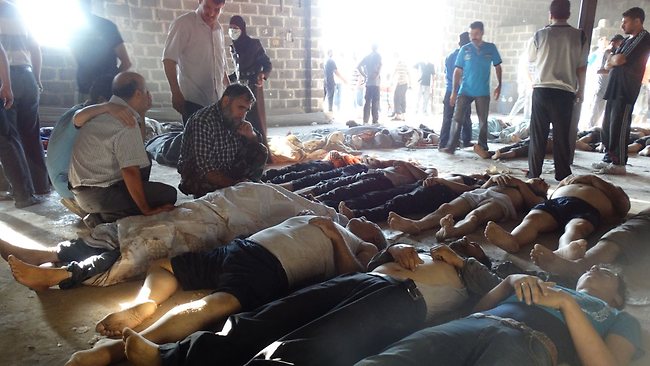
There can be no doubt that an attack did take place. Many civilians died; the opposition claims more than a thousand. That people did die is beyond argument. Also not disputed is that the area where they died is characterised by resistance to the government’s attempts to quell the civil unrest – let us not prejudge anything by calling it a civil war – for the last two years.
Dead Syrian children
Moreover, all the recorded evidence so far offered to the world shows people suffering in a way that is not commensurate with an attack by conventional weapons. The victims are not showing blast injuries. Their motor functions are affected, particularly the breathing instinct. The spread of this effect on humans is evidently much wider than any structural damage in the area. There can be no doubt that, whatever killed these people, it was not explosives.
Was it a chemical agent? Only an impartial examination at the site can determine this to general satisfaction. Whether such an examination is possible depends wholly on the Syrian government itself. If Assad denies the inspectors, we shall be entitled to draw a conclusion, as I will consider in a moment.
Meanwhile, I want to try to examine the government’s notion that the footage widely circulated across the world is, in some sense, a “fabrication”. Presumably that would mean that the convulsing children that we have seen are actors, that people are playing at being dead. Is this at all credible? I submit that it is not. Given the chaotic nature of what we see, it would require remarkable creativity to “stage” such chaos without any glitch that revealed deception. Is any of the material released at all questionable? If it were, wouldn’t someone have noticed by now?
Dead Syrian adults
So it seems pretty conclusive that these things are established: i) that there was an attack; ii) that many civilians died; iii) that some kind of non-blast weapon was responsible for the casualties.
Now we come to the bottom line for the Assad government: the attack was inflicted by the rebels themselves. Does this argument have any merit? Well, it is certainly possible to suggest a motive for the rebels: that they wish to blackguard the Assad regime and “shame” foreign governments into intervening on behalf of the insurrection. William Hague’s increasingly bullish statements since Wednesday morning suggest that, if that was the aim, it is having some traction, at least with the British government. Obama remains carefully non-committal.
But is it possible to stand up the argument that the rebels would inflict such a grotesque death on the families of its own people, even if the exercise could be held to have a chance of tipping the argument about intervention?
Hague: bullish
I am reminded of a Jewish friend with family in Israel who told me in all seriousness that, when Israeli planes attack the Gaza strip, Palestinians lay their small children on the roofs of their homes so that they are more likely to be killed and hence the Israelis can be accused of war crimes. Although she has a Cambridge degree and has worked in current affairs broadcasting all her adult life, she could not recognise black propaganda when it was offered. I gently pointed out the notorious precedent that the Nazis spread lies about the morality of the Jews in order to make them appear less than human and so more dispensable, but she wouldn’t make the connection. People are willing to believe anything, however far-fetched, if it reflects badly on their enemy.
If the Syrian rebels did this themselves, a lot of people would necessarily be in on the exercise. How could the rebels be sure that no one would expose the deception? Yet we still await the first report of any defector from the opposition’s cause, decrying the tactics of the rebels, whereas several highly-placed officials in the Assad regime have left the country in disgust. Moreover, it is known that the Syrian government has developed chemical weapons: that is not at issue. When would they deploy such weapons, then, if not in a situation that they themselves account a profound threat to the state? It is always possible that Syrian rebels have gained access to chemical weapons, but there is as yet no independent evidence of it.
The UN inspectors ought to have the expertise to determine whether chemical weapons are in opposition hands. They are presently in Syria but the government will not permit them to visit Ghouta. Why so? That there are inspectors in the country at all is only as a result of protracted negotiations. The government says it cannot guarantee the inspectors’ safety. The rebels have said they will ensure that the inspectors are safe in Ghouta. If the inspectors are prepared to go, what argument remains to Assad? We must conclude that he fears what they will discover. If he wants to stay credible, he needs to pre-empt that conclusion.
Obama: non-committal
If there were an international consensus that the Assad government used chemical weapons against its own people, that would change the game, if only in that (once hostilities cease, if they ever do) Assad could be brought before the international court to face charges of war crimes. But there is no such consensus. Alexander Lukashevich, the Russian foreign office spokesman, declared that a homemade rocket carrying unidentified chemical substances had been launched from an area controlled by the opposition.
“All this cannot but suggest that once again we are dealing with a pre-planned provocation,” his statement continued. “This is supported by the fact that the criminal act was committed near Damascus at the very moment when a mission of UN experts had successfully started their work of investigating allegations of the possible use of chemical weapons there ... Moscow considers important an objective and professional investigation into what happened. And we call on all those who have the possibility to influence armed extremists to make every effort to end provocations with chemical agents”.
Moscow mouthpiece Lukashevich
Of course, if the Russians want to argue that the occurrence of this “criminal act” at the time of the US inspectors’ visit argues for it being an attack by rebels, one might counter that it could just as well be a double bluff, that the Assad regime launched the attack fully intending to tell the inspectors that it must be the rebels’ action. If the rebels are capable of staging an atrocity to look like the work of the government, the reverse is just as feasible and even more likely to be doable.
Russia’s alliance with Syria ensures that the UN’s hands are tied in any attempt to approve some anti-Assad action through the security council. As with so many other international crises, the fact that certain powerful nations may wield a veto leaves the UN powerless and raises the stakes for those nations that would be prepared to make some intervention. I have argued before that the UN’s charter needs to be rewritten and, at the risk of exasperating my regular readers, I am now going to argue it again.
No substantial rewrite of the charter has occurred since it was first drawn up in 1945. The time has long past when the UN needs to be given power independent of individual member states, power greater than any individual member, indeed greater than the sum of individual members.
The veto has to be scrapped. No nation, neither China nor Russia nor the US, can be permitted to continue to block the business of the UN and to override the will of a majority of members. All nations should have the same stake in the global community.
Support for Assad
The UN needs to have the power – by which I mean the military power – to intervene in any breakdown of peaceful coexistence and to impose a cessation of hostilities. This might be between any two or more nations squaring up to each other – say, Israel and Lebanon or Azerbaijan and Armenia – or within a sovereign nation where the ruling party is fighting any kind of insurrection – Somalia or Colombia or Libya or Egypt. Where the UN deems it necessary, its troops would depose the government and take over the day-to-day management of the nation’s affairs. After all, whatever else you may believe about Assad, he has patently lost control of his nation. He is, to borrow Norman Lamont’s resonant words, “in office but not in power”.
How could the UN muster such power? I propose that each member nation be obliged to contribute to the UN’s peace-keeping forces the same level of funding, personnel and matériel that it commits to its own national defence. So if, for the sake of argument, the US’s total military budget were $800bn, it would be required to commit the same amount to the UN force. The Swiss government’s share of the UN force bill might be $4bn. In this way, the UN would be furnished with military might sufficient to overwhelm any conceivable national militia and its troops would be as international as possible. With a scheme like this in place, most nations would see both the necessity and the opportunity to scale down their domestic expenditure on what they term defence. That in itself would render the world a more stable place.
Such an imposition on all member states would profoundly alter the psychology of defence. The UN needs to establish as a baseline that any engagement in military combat is intolerable to the community of nations. As it is, the “just wars” are always those fought by a nation’s own troops. From the outside looking in, other nation’s wars are, at the very least, regrettable. More often they are indefensible. And, however righteous the combatants, all wars occasion atrocities on all sides. It is idle to pretend that other people’s wars are crueller and bloodier than those in which we take part.
But, I hear you object, you cannot ride roughshod over the sovereignty of individual nations. To that I say: the game has changed. Nations are no longer discrete entities whose disputes remain within their borders. Look at the flood of refugees from Syria into neighbouring countries. How can those countries, none of them wealthy, cope with the demands that Syria’s folly makes upon them? And why should they be required to do so? Furthermore, what is the cost to the planet of all this destruction visited upon it? Why should other nations be expected to clean up the mess of this – it needs to be stated – indulgence by the government and the citizenry of Syria?
The UN needs to be an organisation that holds as its core belief not only that waging war is destructive and regrettable but that waging war will not be tolerated by the community of nations, however wealthy and righteous and self-important the combatants might be. So my revamped UN would have the power – both judicially, by statute, and literally, by force of arms – to police the planet and snuff out any outbreak of hostilities within hours. All the members of the UN would have to agree to accept this awesome global authority and to isolate any nation in every practical manner until the UN deemed that its full membership of the community of nations had been earned again.
UN inspectors arrive in Damascus
If this dispensation had been in place, the hostilities in Syria would have been halted in the first week. Assad would have been obliged to resolve the contradictions in his nation or step down in favour of a temporary administration controlled by the UN that would have addressed the differences among the populace and set up fair and free elections. By the way, under my new model UN, every nation would be obliged to allow a comprehensive delegation from the UN to oversee and examine national elections and to declare whether they have been acceptable, the UN’s final judgment being paramount and not subject to appeal. Any head of state or indeed any individual candidate found to have transgressed would be barred from future office.
Imagine the different course of events in Egypt over the last two and a half years. Mubarak would have lost control of the country to a UN peace-keeping force. He might still have been tried and imprisoned by the courts. Free elections might still have brought the Muslim Brotherhood to power. Had there been demonstrations against Morsi, they would have been permitted. But what was, by any objective measure, a military coup this summer would not have been allowed to take place. And so there would have been no massacre of protesters.
Well, you will say, none of the security council nations is going to surrender its veto, so this is a pipe-dream. I could simply snap back: ok, so what’s your solution that won’t simply make matters worse? At least I am making a concrete, constructive proposal that has yet to be tried and found wanting.
I am realistic, though. There is only one means by which what I propose could be achieved. Someone would have to run for the US presidency on a programme that included this proposal for the revamping of the UN. The chorus of abuse that would argue that this would be an abject surrender of American power and self-importance would need to be argued down. The candidate would have to win the argument and win the election and then embark on a long and hugely testing round of diplomacy to persuade sufficient of the other security council nations to agree. Yes, it’s a big ask. But what is the point of going into politics if it is not with the intention of changing the world?
The Syrian government has declared variously that the missile attack on the Ghouta suburbs of Damascus early on Wednesday did not take place at all, that it took place but that no chemical weapons were involved, and that chemical weapons were indeed involved but that they were inflicted by rebel forces. These statements cannot all be correct. Is any of them true?
There can be no doubt that an attack did take place. Many civilians died; the opposition claims more than a thousand. That people did die is beyond argument. Also not disputed is that the area where they died is characterised by resistance to the government’s attempts to quell the civil unrest – let us not prejudge anything by calling it a civil war – for the last two years.
Dead Syrian children
Moreover, all the recorded evidence so far offered to the world shows people suffering in a way that is not commensurate with an attack by conventional weapons. The victims are not showing blast injuries. Their motor functions are affected, particularly the breathing instinct. The spread of this effect on humans is evidently much wider than any structural damage in the area. There can be no doubt that, whatever killed these people, it was not explosives.
Was it a chemical agent? Only an impartial examination at the site can determine this to general satisfaction. Whether such an examination is possible depends wholly on the Syrian government itself. If Assad denies the inspectors, we shall be entitled to draw a conclusion, as I will consider in a moment.
Meanwhile, I want to try to examine the government’s notion that the footage widely circulated across the world is, in some sense, a “fabrication”. Presumably that would mean that the convulsing children that we have seen are actors, that people are playing at being dead. Is this at all credible? I submit that it is not. Given the chaotic nature of what we see, it would require remarkable creativity to “stage” such chaos without any glitch that revealed deception. Is any of the material released at all questionable? If it were, wouldn’t someone have noticed by now?
Dead Syrian adults
So it seems pretty conclusive that these things are established: i) that there was an attack; ii) that many civilians died; iii) that some kind of non-blast weapon was responsible for the casualties.
Now we come to the bottom line for the Assad government: the attack was inflicted by the rebels themselves. Does this argument have any merit? Well, it is certainly possible to suggest a motive for the rebels: that they wish to blackguard the Assad regime and “shame” foreign governments into intervening on behalf of the insurrection. William Hague’s increasingly bullish statements since Wednesday morning suggest that, if that was the aim, it is having some traction, at least with the British government. Obama remains carefully non-committal.
But is it possible to stand up the argument that the rebels would inflict such a grotesque death on the families of its own people, even if the exercise could be held to have a chance of tipping the argument about intervention?
Hague: bullish
I am reminded of a Jewish friend with family in Israel who told me in all seriousness that, when Israeli planes attack the Gaza strip, Palestinians lay their small children on the roofs of their homes so that they are more likely to be killed and hence the Israelis can be accused of war crimes. Although she has a Cambridge degree and has worked in current affairs broadcasting all her adult life, she could not recognise black propaganda when it was offered. I gently pointed out the notorious precedent that the Nazis spread lies about the morality of the Jews in order to make them appear less than human and so more dispensable, but she wouldn’t make the connection. People are willing to believe anything, however far-fetched, if it reflects badly on their enemy.
If the Syrian rebels did this themselves, a lot of people would necessarily be in on the exercise. How could the rebels be sure that no one would expose the deception? Yet we still await the first report of any defector from the opposition’s cause, decrying the tactics of the rebels, whereas several highly-placed officials in the Assad regime have left the country in disgust. Moreover, it is known that the Syrian government has developed chemical weapons: that is not at issue. When would they deploy such weapons, then, if not in a situation that they themselves account a profound threat to the state? It is always possible that Syrian rebels have gained access to chemical weapons, but there is as yet no independent evidence of it.
The UN inspectors ought to have the expertise to determine whether chemical weapons are in opposition hands. They are presently in Syria but the government will not permit them to visit Ghouta. Why so? That there are inspectors in the country at all is only as a result of protracted negotiations. The government says it cannot guarantee the inspectors’ safety. The rebels have said they will ensure that the inspectors are safe in Ghouta. If the inspectors are prepared to go, what argument remains to Assad? We must conclude that he fears what they will discover. If he wants to stay credible, he needs to pre-empt that conclusion.
Obama: non-committal
If there were an international consensus that the Assad government used chemical weapons against its own people, that would change the game, if only in that (once hostilities cease, if they ever do) Assad could be brought before the international court to face charges of war crimes. But there is no such consensus. Alexander Lukashevich, the Russian foreign office spokesman, declared that a homemade rocket carrying unidentified chemical substances had been launched from an area controlled by the opposition.
“All this cannot but suggest that once again we are dealing with a pre-planned provocation,” his statement continued. “This is supported by the fact that the criminal act was committed near Damascus at the very moment when a mission of UN experts had successfully started their work of investigating allegations of the possible use of chemical weapons there ... Moscow considers important an objective and professional investigation into what happened. And we call on all those who have the possibility to influence armed extremists to make every effort to end provocations with chemical agents”.
Moscow mouthpiece Lukashevich
Of course, if the Russians want to argue that the occurrence of this “criminal act” at the time of the US inspectors’ visit argues for it being an attack by rebels, one might counter that it could just as well be a double bluff, that the Assad regime launched the attack fully intending to tell the inspectors that it must be the rebels’ action. If the rebels are capable of staging an atrocity to look like the work of the government, the reverse is just as feasible and even more likely to be doable.
Russia’s alliance with Syria ensures that the UN’s hands are tied in any attempt to approve some anti-Assad action through the security council. As with so many other international crises, the fact that certain powerful nations may wield a veto leaves the UN powerless and raises the stakes for those nations that would be prepared to make some intervention. I have argued before that the UN’s charter needs to be rewritten and, at the risk of exasperating my regular readers, I am now going to argue it again.
No substantial rewrite of the charter has occurred since it was first drawn up in 1945. The time has long past when the UN needs to be given power independent of individual member states, power greater than any individual member, indeed greater than the sum of individual members.
The veto has to be scrapped. No nation, neither China nor Russia nor the US, can be permitted to continue to block the business of the UN and to override the will of a majority of members. All nations should have the same stake in the global community.
Support for Assad
The UN needs to have the power – by which I mean the military power – to intervene in any breakdown of peaceful coexistence and to impose a cessation of hostilities. This might be between any two or more nations squaring up to each other – say, Israel and Lebanon or Azerbaijan and Armenia – or within a sovereign nation where the ruling party is fighting any kind of insurrection – Somalia or Colombia or Libya or Egypt. Where the UN deems it necessary, its troops would depose the government and take over the day-to-day management of the nation’s affairs. After all, whatever else you may believe about Assad, he has patently lost control of his nation. He is, to borrow Norman Lamont’s resonant words, “in office but not in power”.
How could the UN muster such power? I propose that each member nation be obliged to contribute to the UN’s peace-keeping forces the same level of funding, personnel and matériel that it commits to its own national defence. So if, for the sake of argument, the US’s total military budget were $800bn, it would be required to commit the same amount to the UN force. The Swiss government’s share of the UN force bill might be $4bn. In this way, the UN would be furnished with military might sufficient to overwhelm any conceivable national militia and its troops would be as international as possible. With a scheme like this in place, most nations would see both the necessity and the opportunity to scale down their domestic expenditure on what they term defence. That in itself would render the world a more stable place.
Such an imposition on all member states would profoundly alter the psychology of defence. The UN needs to establish as a baseline that any engagement in military combat is intolerable to the community of nations. As it is, the “just wars” are always those fought by a nation’s own troops. From the outside looking in, other nation’s wars are, at the very least, regrettable. More often they are indefensible. And, however righteous the combatants, all wars occasion atrocities on all sides. It is idle to pretend that other people’s wars are crueller and bloodier than those in which we take part.
But, I hear you object, you cannot ride roughshod over the sovereignty of individual nations. To that I say: the game has changed. Nations are no longer discrete entities whose disputes remain within their borders. Look at the flood of refugees from Syria into neighbouring countries. How can those countries, none of them wealthy, cope with the demands that Syria’s folly makes upon them? And why should they be required to do so? Furthermore, what is the cost to the planet of all this destruction visited upon it? Why should other nations be expected to clean up the mess of this – it needs to be stated – indulgence by the government and the citizenry of Syria?
The UN needs to be an organisation that holds as its core belief not only that waging war is destructive and regrettable but that waging war will not be tolerated by the community of nations, however wealthy and righteous and self-important the combatants might be. So my revamped UN would have the power – both judicially, by statute, and literally, by force of arms – to police the planet and snuff out any outbreak of hostilities within hours. All the members of the UN would have to agree to accept this awesome global authority and to isolate any nation in every practical manner until the UN deemed that its full membership of the community of nations had been earned again.
UN inspectors arrive in Damascus
If this dispensation had been in place, the hostilities in Syria would have been halted in the first week. Assad would have been obliged to resolve the contradictions in his nation or step down in favour of a temporary administration controlled by the UN that would have addressed the differences among the populace and set up fair and free elections. By the way, under my new model UN, every nation would be obliged to allow a comprehensive delegation from the UN to oversee and examine national elections and to declare whether they have been acceptable, the UN’s final judgment being paramount and not subject to appeal. Any head of state or indeed any individual candidate found to have transgressed would be barred from future office.
Imagine the different course of events in Egypt over the last two and a half years. Mubarak would have lost control of the country to a UN peace-keeping force. He might still have been tried and imprisoned by the courts. Free elections might still have brought the Muslim Brotherhood to power. Had there been demonstrations against Morsi, they would have been permitted. But what was, by any objective measure, a military coup this summer would not have been allowed to take place. And so there would have been no massacre of protesters.
Well, you will say, none of the security council nations is going to surrender its veto, so this is a pipe-dream. I could simply snap back: ok, so what’s your solution that won’t simply make matters worse? At least I am making a concrete, constructive proposal that has yet to be tried and found wanting.
I am realistic, though. There is only one means by which what I propose could be achieved. Someone would have to run for the US presidency on a programme that included this proposal for the revamping of the UN. The chorus of abuse that would argue that this would be an abject surrender of American power and self-importance would need to be argued down. The candidate would have to win the argument and win the election and then embark on a long and hugely testing round of diplomacy to persuade sufficient of the other security council nations to agree. Yes, it’s a big ask. But what is the point of going into politics if it is not with the intention of changing the world?
Thursday, August 08, 2013
MORGAN, an UNSUITABLE CASE for TREATMENT
Is there a more wan figure on the world’s political stage than that of Morgan Tsvangirai? He has known Robert Mugabe for more than thirty years, having begun his political rise in Mugabe’s ZANU-PF party when he was immediately marked for preferment. Now, I have never met Mr Mugabe and I only know of his career through the highly partial medium of the British media. But this much I know: that Mugabe is the wiliest African leader since Jomo Kenyatta and the least scrupulous since Idi Amin. If I know that, Tsvangirai must know it too.
Morgan no free man
How come, then, that he has allowed himself to be so comprehensively outmanoeuvred in the Zimbabwean elections held at the end of last month? Did he not guess that Mugabe would stop at nothing to defeat him in the presidential ballot that has overwhelmingly extended the old fox’s rule for another five years to add to the 33 years he has already enjoyed? Mugabe is 89 years old.
In the presidential ballot, Mugabe defeated Tsvangirai by nearly two-to-one. In the House of Assembly, ZANU-PF won three times as many seats as Tsvangirai’s MDC grouping and hence has a sufficient majority to introduce whatever constitutional changes that Mugabe fancies. For the MDC, the election was an utter disaster.
Mugabe: giving nothing away – absolutely nothing
Whistling in the dark, Tsvangirai now says that “the fraudulent and stolen election has plunged Zimbabwe into a constitutional, political and economic crisis. Instead of celebration, there is national mourning”. In fact, there is remarkably little evidence of either crisis or mourning. Zimbabweans know that Mugabe stole the election but they also know that there is precious little that they can do about it. The wider world deplores the myriad scandals and manipulations that accompanied the vote but Obama and Putin, Cameron and Merkel have much more pressing problems to face.
Tsvangirai says that the MDC will “boycott government institutions” and challenge the election result through the courts. Good luck with that. The unspecified government institutions will not notice (save that, without an MDC presence, it will be that much simpler to carry out Mugabe’s wishes) and the courts will doubtless find the evidence of ballot theft inconclusive – after all, the judges are all Mugabe appointees. So unless something very unexpected happens, the outside world will hear no more of Morgan Tsvangirai and probably very little of Zimbabwe until such time as Robert Mugabe passes peacefully in office and we discover whether he has arranged anything effective about the succession.
A stylish poster campaign
The absurdity of it all is that, for the past five years, Tsvangirai has been Zimbabwe’s prime minster, in office and in power in a coalition with ZANU-PF under Mugabe’s presidency. Was he asleep at the wheel? Did he not anticipate that Mugabe would strain every sinew to ensure that the coalition would be ended at the 2013 election? Could he not have taken pre-emptive action to guard the sanctity of the election? Suddenly to bleat after the event that it’s turned out to be unfair seems, at the very least, ineffectual.
Democracy Zimbabwe style: but what's in those boxes?
Mugabe allowed observers of the ballot only from friendly neighbouring nations and, hearing their complacent views of the conduct of the election, you realise that they would not have been much of a challenge to buy off. Tsvangirai should have insisted that a large UN team be allowed to monitor the election. Indeed, it ought to be a condition of continued membership of the UN that all member nations allow UN observers to attend national elections. There is no country – not even Britain or the United States – where some sharp electoral practice cannot be detected.
What is an open secret in Harare is that Tsvangirai has spent considerably more of his time as prime minister in chasing women than in shoring up his power base and planning to try to outflank his ruthless opponent. His first wife Susan was killed in a head-on car crash that Tsvangirai was the only Zimbabwean outside ZANU-PF not to blame on Mugabe’s intelligence officers. Perhaps he was glad to be rid of her. He very quickly ceased to behave like a mourning widower and he remarried last autumn, though his philandering has evidently not been scaled down since.
Getting spliced for a second time
The tragedy is that the coalition of MDC and ZANU-PF achieved a fair amount in repairing the damage caused by Mugabe’s heedless conduct of the national economy while unrestrained by coalition. Tsvangirai, having ensured a fair ballot, could have fought on his economic record. He might even have won. Instead, he survives only as an ineffectual footnote to one of the longest and most destructive reigns in modern African history.
Is there a more wan figure on the world’s political stage than that of Morgan Tsvangirai? He has known Robert Mugabe for more than thirty years, having begun his political rise in Mugabe’s ZANU-PF party when he was immediately marked for preferment. Now, I have never met Mr Mugabe and I only know of his career through the highly partial medium of the British media. But this much I know: that Mugabe is the wiliest African leader since Jomo Kenyatta and the least scrupulous since Idi Amin. If I know that, Tsvangirai must know it too.
Morgan no free man
How come, then, that he has allowed himself to be so comprehensively outmanoeuvred in the Zimbabwean elections held at the end of last month? Did he not guess that Mugabe would stop at nothing to defeat him in the presidential ballot that has overwhelmingly extended the old fox’s rule for another five years to add to the 33 years he has already enjoyed? Mugabe is 89 years old.
In the presidential ballot, Mugabe defeated Tsvangirai by nearly two-to-one. In the House of Assembly, ZANU-PF won three times as many seats as Tsvangirai’s MDC grouping and hence has a sufficient majority to introduce whatever constitutional changes that Mugabe fancies. For the MDC, the election was an utter disaster.
Mugabe: giving nothing away – absolutely nothing
Whistling in the dark, Tsvangirai now says that “the fraudulent and stolen election has plunged Zimbabwe into a constitutional, political and economic crisis. Instead of celebration, there is national mourning”. In fact, there is remarkably little evidence of either crisis or mourning. Zimbabweans know that Mugabe stole the election but they also know that there is precious little that they can do about it. The wider world deplores the myriad scandals and manipulations that accompanied the vote but Obama and Putin, Cameron and Merkel have much more pressing problems to face.
Tsvangirai says that the MDC will “boycott government institutions” and challenge the election result through the courts. Good luck with that. The unspecified government institutions will not notice (save that, without an MDC presence, it will be that much simpler to carry out Mugabe’s wishes) and the courts will doubtless find the evidence of ballot theft inconclusive – after all, the judges are all Mugabe appointees. So unless something very unexpected happens, the outside world will hear no more of Morgan Tsvangirai and probably very little of Zimbabwe until such time as Robert Mugabe passes peacefully in office and we discover whether he has arranged anything effective about the succession.
A stylish poster campaign
The absurdity of it all is that, for the past five years, Tsvangirai has been Zimbabwe’s prime minster, in office and in power in a coalition with ZANU-PF under Mugabe’s presidency. Was he asleep at the wheel? Did he not anticipate that Mugabe would strain every sinew to ensure that the coalition would be ended at the 2013 election? Could he not have taken pre-emptive action to guard the sanctity of the election? Suddenly to bleat after the event that it’s turned out to be unfair seems, at the very least, ineffectual.
Democracy Zimbabwe style: but what's in those boxes?
Mugabe allowed observers of the ballot only from friendly neighbouring nations and, hearing their complacent views of the conduct of the election, you realise that they would not have been much of a challenge to buy off. Tsvangirai should have insisted that a large UN team be allowed to monitor the election. Indeed, it ought to be a condition of continued membership of the UN that all member nations allow UN observers to attend national elections. There is no country – not even Britain or the United States – where some sharp electoral practice cannot be detected.
What is an open secret in Harare is that Tsvangirai has spent considerably more of his time as prime minister in chasing women than in shoring up his power base and planning to try to outflank his ruthless opponent. His first wife Susan was killed in a head-on car crash that Tsvangirai was the only Zimbabwean outside ZANU-PF not to blame on Mugabe’s intelligence officers. Perhaps he was glad to be rid of her. He very quickly ceased to behave like a mourning widower and he remarried last autumn, though his philandering has evidently not been scaled down since.
Getting spliced for a second time
The tragedy is that the coalition of MDC and ZANU-PF achieved a fair amount in repairing the damage caused by Mugabe’s heedless conduct of the national economy while unrestrained by coalition. Tsvangirai, having ensured a fair ballot, could have fought on his economic record. He might even have won. Instead, he survives only as an ineffectual footnote to one of the longest and most destructive reigns in modern African history.
Labels:
coalition,
elections,
MDC,
Morgan Tsvangirai,
Robert Mugabe,
UN,
ZANU-PF,
Zimbabwe
Saturday, August 03, 2013
LORDS TEMPORAL and TEMPORARY
The appointment of thirty new peers this week has raised once again the concurrent debates about the undemocratic nature of the upper house, the dubious nature of political preferment for favours bestowed, the habit of successive governments of packing the benches with their placemen and women, the stalled nature of Lords reform and the absurdity that the chamber is nowhere near sufficiently capacious to seat every member on those occasions when most of them wish to attend simultaneously (for instance, at the state opening of parliament).
It will be no matter of surprise to my regular readers if I inform them that I have a solution to these problems that is practical and, as befitting the thrust of this blog, commonsensical. Here is that solution.
The Lords host the state opening
There remains a great deal to be said for a public body to which useful members of society may be appointed and where such people may avail themselves of a public platform and indeed of a vote on matters that are important to them. Ed Miliband’s raising of Doreen Lawrence to the peerage has been widely hailed and is considered a valuable widening of the upper house’s constituency far beyond the narrow considerations of party advantage. Many more of the new additions, however, look like unmerited rewards for donations and for party line-toeing.
So let party leaders continue to raise worthy individuals to the peerage, though under much stricter conditions – I will return to those. Meanwhile, let all members of the upper house submit themselves to election in the following manner. Once every five years – preferably at a mid-point between general elections – let all members of the upper house (including the Law Lords and the Lords Spiritual, but with exceptions that I will explain) be listed on a website, each one illustrated with a standardised face-on portrait and each permitted a short statement (with a strict word limit) as to why she or he should remain in the house.
Their party allegiance (or crossbench or other status) would be listed, along with their full baronial title and, where appropriate, a name by which they are more widely known. Their attendance and voting records should also be listed. Those not required so to submit themselves would be those peers recruited since the previous Lords ballot, so that no one would be obliged to submit to a vote whose service had been of less than five years.
Doreen Lawrence, now a baroness
Voters would be allowed to place a vote against, say, up to twenty individuals on the list. Then the votes would be counted and the members whose names appeared among, say, the bottom one hundred of the list would lose their seats. The number being rejected could be adjusted until the composition of the house was more suitable, though the five-yearly vote ought still to eliminate a significant number of the least popular members. During the years between votes, party leaders would be permitted to appoint new members, but without exceeding the overall limit that has been agreed and – a crucial point, this one – without altering by a single member the balance of allegiance that was achieved in the previous vote.
To make the upper house an elective assembly in this unprecedented manner has many strong points. Peers would know that they do not enjoy a ticket for life and that they will need to be seen to be useful members. The elections would not be the costly affairs that conventional localised ballots cannot avoid being; indeed, there is no advantage to be had in making the lords a second chamber of constituency-representing delegates. People who would be ornaments to the house but who have no appetite for jumping through the cost, time, media and abuse hoops that conventional election campaigns impose will still be able to enter the house easily and through a merit that may not be perceived by a wide public (because of specialist expertise, for instance); five and more years in the Lords would allow them to make their mark if they are so minded and to earn continued membership.
The upper house full and in session
Voting via the internet is a practical solution to the lack of local campaigning and local ballot boxes, but of course it would have to be rigorously policed. Voters would need to register on the election site, though they ought then to be able to vote anonymously. Some mechanism would have to be set up to prevent multiple voting, not so much by large numbers of people as from the same computer.
So it would have to be contrived that no more than (say) twenty votes (for twenty different candidates) can be cast from one source. No doubt every computer at Tory Central Office would be used to cast twenty votes for Tory peers, but these votes would be counter-balanced by the votes cast from the other party HQs. In any case, it would be a fine judgment how to configure dozens of votes among, in the Tory party’s present case, nearly 230 candidates. The size of the field would help to neutralise attempts to pack the vote.
This solution would be cost-effective, democratic (certainly more democratic than the arrangements obtaining now) and useful in challenging peers to justify their sinecures. But it retains – and indeed enhances – those characteristics of the upper chamber that make it an important foil for the Commons. I commend this proposal to the house.
The appointment of thirty new peers this week has raised once again the concurrent debates about the undemocratic nature of the upper house, the dubious nature of political preferment for favours bestowed, the habit of successive governments of packing the benches with their placemen and women, the stalled nature of Lords reform and the absurdity that the chamber is nowhere near sufficiently capacious to seat every member on those occasions when most of them wish to attend simultaneously (for instance, at the state opening of parliament).
It will be no matter of surprise to my regular readers if I inform them that I have a solution to these problems that is practical and, as befitting the thrust of this blog, commonsensical. Here is that solution.
The Lords host the state opening
There remains a great deal to be said for a public body to which useful members of society may be appointed and where such people may avail themselves of a public platform and indeed of a vote on matters that are important to them. Ed Miliband’s raising of Doreen Lawrence to the peerage has been widely hailed and is considered a valuable widening of the upper house’s constituency far beyond the narrow considerations of party advantage. Many more of the new additions, however, look like unmerited rewards for donations and for party line-toeing.
So let party leaders continue to raise worthy individuals to the peerage, though under much stricter conditions – I will return to those. Meanwhile, let all members of the upper house submit themselves to election in the following manner. Once every five years – preferably at a mid-point between general elections – let all members of the upper house (including the Law Lords and the Lords Spiritual, but with exceptions that I will explain) be listed on a website, each one illustrated with a standardised face-on portrait and each permitted a short statement (with a strict word limit) as to why she or he should remain in the house.
Their party allegiance (or crossbench or other status) would be listed, along with their full baronial title and, where appropriate, a name by which they are more widely known. Their attendance and voting records should also be listed. Those not required so to submit themselves would be those peers recruited since the previous Lords ballot, so that no one would be obliged to submit to a vote whose service had been of less than five years.
Doreen Lawrence, now a baroness
Voters would be allowed to place a vote against, say, up to twenty individuals on the list. Then the votes would be counted and the members whose names appeared among, say, the bottom one hundred of the list would lose their seats. The number being rejected could be adjusted until the composition of the house was more suitable, though the five-yearly vote ought still to eliminate a significant number of the least popular members. During the years between votes, party leaders would be permitted to appoint new members, but without exceeding the overall limit that has been agreed and – a crucial point, this one – without altering by a single member the balance of allegiance that was achieved in the previous vote.
To make the upper house an elective assembly in this unprecedented manner has many strong points. Peers would know that they do not enjoy a ticket for life and that they will need to be seen to be useful members. The elections would not be the costly affairs that conventional localised ballots cannot avoid being; indeed, there is no advantage to be had in making the lords a second chamber of constituency-representing delegates. People who would be ornaments to the house but who have no appetite for jumping through the cost, time, media and abuse hoops that conventional election campaigns impose will still be able to enter the house easily and through a merit that may not be perceived by a wide public (because of specialist expertise, for instance); five and more years in the Lords would allow them to make their mark if they are so minded and to earn continued membership.
The upper house full and in session
Voting via the internet is a practical solution to the lack of local campaigning and local ballot boxes, but of course it would have to be rigorously policed. Voters would need to register on the election site, though they ought then to be able to vote anonymously. Some mechanism would have to be set up to prevent multiple voting, not so much by large numbers of people as from the same computer.
So it would have to be contrived that no more than (say) twenty votes (for twenty different candidates) can be cast from one source. No doubt every computer at Tory Central Office would be used to cast twenty votes for Tory peers, but these votes would be counter-balanced by the votes cast from the other party HQs. In any case, it would be a fine judgment how to configure dozens of votes among, in the Tory party’s present case, nearly 230 candidates. The size of the field would help to neutralise attempts to pack the vote.
This solution would be cost-effective, democratic (certainly more democratic than the arrangements obtaining now) and useful in challenging peers to justify their sinecures. But it retains – and indeed enhances – those characteristics of the upper chamber that make it an important foil for the Commons. I commend this proposal to the house.
Wednesday, July 31, 2013
The AGE of UNREASON
Despite one hundred and fifty years of post-Darwinian scientific enquiry and discovery, vast numbers of the planet’s citizens are as bewitched as their ancestors ever were by the absurdities, fantasies and mendacities of supernatural superstition. I have argued before that the delusion that its sufferers call “faith” is the source of far greater suffering in the world – suffering through personal guilt and self-hatred, deprivation and oppression, persecution and mutilation, murder and genocide – than all the other abstractions – nationalism, tribalism, politics and ideology – put together. Paradoxically, the dominance of religious bigotry as a force for evil seems to grow ever stronger as the world becomes smaller and liberal education spreads further.
In an editorial of 1941 for Life magazine, the Time-Life publisher Henry Luce described his era as “the American century”. At different points in that time-frame, other candidates for the accolade briefly arose, but hindsight shows that Luce got it right: more than any other global player, the United States shaped the century. How will the present one be known? Already, there seem compelling arguments to dub it “the Muslim century”.
Luce talk
The millennium had barely begun when, “out of a clear blue sky”, the most profoundly world-shaking challenge was made to the confidence of American power, a challenge made specifically in the name of Islam. There are Muslim apologists who fend off the connection between the central tenets of Islam and the 9/11 atrocity, but they are confounded by the words of the Qur’an that I found and have quoted before: “Allah has bought from the believers their selves and their possessions against the gift of Paradise; they fight in the way of Allah; they kill and are killed; that is a promise binding upon Allah in the Torah and the Gospel and the Qur’an” [from Arthur J Arberry’s translation for OUP, though I have changed his own term ‘God’ to ‘Allah’]. It is, of course, no accident that the book of the Qur’an from which this passage comes (which is called, in English, ‘Repentance’) is book number 9 and the verse number is 111.
Islam has been at the centre of the world’s flashpoints in the first 163 months of the present century. A prime mover in the spread of Muslim fundamentalism has been the Deobandi wing of Sunni Islam. Deobandis are devotees of Sharia law, the most proscriptive interpretation of the Qur’an. This wing of Islam is, in every sense, the most aggressive. If it has not already become the dominant force in the Muslim community in Britain, it will do so before you know it. The Taliban are adherents of Deobandi practice. The word “Taliban” means “students”.
Saddam nuisance
Western forces invaded Afghanistan in 2001 in an initially successful attempt to overthrow the Taliban whose activists had dominated the country for five years. The pretext was “to keep the streets of America and Britain safe”, but the notion that the Taliban (rather than al-Qaida) was responsible for terrorist attacks in the west was never remotely credible. In any case, as everyone knows but no politician will acknowledge, the Taliban will again be ruling Afghanistan within a maximum of three months after western troops have finally withdrawn.
The American and British governments muddied the water and overstretched their own resources by adding an irrelevant invasion of Iraq to their military commitments, for no better reason than that George W Bush wanted to complete what he took to be “unfinished business” left over by his father following the Gulf War of 1990-1. Anxious to establish his profile on the world stage, Tony Blair joined this vain exercise.
Assad sack
Ten years on, Iraq is riven by inter-faith strife. This week, there have been more than 250 casualties of car bombs in Baghdad, at least fifty of them fatalities and almost all of them Shias, which means that the bombers were certainly Sunni Muslims. If that sounds a lot, consider that there have been fifty times that number of fatalities in sectarian attacks in Iraq in the past three months. So much for the west’s legacy.
The Shia are also Muslims and they form the government in Iraq, where they make up the largest demographic (the most dominant Shia representation anywhere in the world is in Iran, where about two-fifths of the world’s Shias live). Shia and Sunni Muslims have been in conflict for many centuries. Do not expect reconciliation any time soon.
The renewed struggle between Iraqi Shia and Sunni is wholly a product of the western invasion. Saddam Hussein was a Ba’athist. The Ba’ath Party, though Islamic, is notably liberal – it may be surprising to note – and opposes Muslim fundamentalism and Sharia law. In some ways, Alawite Islam parallels Ba’athist Islam. Bashar al-Assad of Syria is an Alawite. Like Saddam, he has been more exercised by Arab nationalism than by Islamic orthodoxy. If he falls in Syria, there must be a strong possibility that some form of Islamic fundamentalism will succeed him in that benighted country. This is the dilemma that stays the hand of the international community under pressure to intervene in the brutal Syrian civil war. Unthinkably, intervention might produce a result that had worse consequences for the Syrians, for the Arab world and for the wider world even than the reign of Assad.
Gadd-out-of-here
After all, there is the precedent of Libya as well as that of Iraq. Muammar Gaddafi’s regime was again far more concerned with Arab nationalism than with Islam – Gaddafi was raised as a Bedouin Muslim. Islamist factions infiltrated the anti-government forces in Libya as they have done in Syria. The present prime minister of Libya, Ali Zeidan, is a Sunni Muslim.
Many new Islamist factions have appeared in Libya since the war and several of the militias formed to fight Gaddafi have declined to disband. It was an Islamist cadre that attacked the American consulate in Benghazi last September, killing several people including the ambassador. Abdelsalam al-Mosmary, a critic of the Muslim Brotherhood’s activities in Libya, was assassinated just this week. Sporadic exchanges of fire and regular car bombs, particularly in Benghazi and Tripoli, continue to imperil the stability of Libya.
A Sunni outlook for Ali Zeidan
Through patient infiltration, al-Qaida has established itself in Pakistan, Kashmir, Iraq, Afghanistan, Yemen, Syria, Saudi Arabia, Egypt, Somalia, Eritrea, Sudan, Mali, Nigeria, Algeria, Mauritania, Morocco and Turkey. It is al-Qaida that still represents the most effective and most ruthless armed expression of Islamic fundamentalism. President Obama has been assiduous in concentrating on pre-emptive strikes against al-Qaida – controversially, more in Pakistan than anywhere – rather than diluting this effort with speculative engagements elsewhere.
But terrorism, guerrilla warfare and the fomentation of uprisings against secularist regimes are not the only methods by which Islamic fundamentalism exerts its muscle. Sharia rule profoundly circumscribes personal freedoms that citizens of liberal democracies take for granted. The judiciary wholly or largely imposes Sharia law in Afghanistan (even without Taliban rule), Pakistan, Muslim parts of India, Bangladesh, Yemen, Iraq, Iran, Jordan, Gaza and the West Bank, Saudi, Qatar, much of the UAE, Bahrain, Oman, Brunei, the Maldives, Muslim parts of Sri Lanka and Singapore and Indonesia, Sudan, Mauritania and for Muslims in Egypt, Algeria, Morocco, Ethiopia, Eritrea, Somalia, Tanzania, Uganda, Ghana, Nigeria, Kenya, Gambia, Djibouti and Comoros.
The late Abdelsalam al-Mosmary
Restrictions imposed by Sharia apply to everyone, including visitors, as unguarded tourists are apt to discover. Visiting a Muslim country is like staying with vegans: they serve you vegan food but, when they visit you, they expect you to serve them vegan food. So Islamists in non-Muslim countries go on demonstrations carrying placards on the theme of “death to the infidel”, but any reciprocal tolerance is unthinkable. How long would you stay alive if you brandished a poster with the legend “Death to Islam” in downtown Khartoum, Riyadh, Mogadishu or Islamabad?
More than any other issue, it is sexuality that brings out the feudal in Sharia law and Islamic fundamentalism. Sharia strictly interprets the Qur’an, so anything in that text that already seems oppressive is made more so by its application. This comes from the section on ‘Women’: “Men are the managers of the affairs of women for that Allah has preferred in bounty one of them over another, and for that they have expended of their property. Righteous women are therefore obedient, guarding the secret for Allah’s guarding. And those you fear may be rebellious admonish; banish them to their couches, and beat them” [book 4 verse 38]. Needless to say, the courts will always favour a man’s testimony over that of his wife.
Sweet 16 at the UN
The world knows of the case of Malala Yousafzai, the Sunni Muslim who, at 15, was the object of an assassination attempt by the Pakistani Taliban in the Swat Valley. Malala – her name means “grief-stricken” – had had the audacity to advocate full rights of education for girl pupils, an offence against Islamist views on the subjugation of women. Malala made a remarkable recovery and addressed a convocation of youth delegates at the UN on her sixteenth birthday. She has become a figurehead for women’s rights under Islam and was named by Time magazine in April as one of the “100 Most Influential People in the World”.
The brutal, iniquitous and unyielding nature of Sharia law is sufficient cause for opposing the spread of Islam in any of its guises. Hence the European Union’s continuing difficulty with the long-standing application to join made by Turkey, a nation that, while very nearly entirely sited in Asia, occupies a tiny area of southeastern Europe.
Though Turkey’s population is almost wholly Sunni Muslim, it is formally a secular nation. Several days of unrest in Istanbul in May were centred on the perception of encroaching Islamisation by Recep Tayyip Erdogan’s government. Informing this perception was an attempt by Erdogan to reduce the power of the army, widely seen as a significant force for secularism (like the army in Egypt). Several other recent government restrictions were read as Islamist.
Erdogan – not best pleased
The wearing of the hijab has been banned for the entirety of Turkey’s modern existence, a lot longer than in France, where the wearing of the burqa was addiitionally made illegal in 2010. France has a rapidly growing problem with Islam, which now counts a tenth of the country’s population among its supporters. It has been estimated that Muslims could be powerful enough to determine the outcome of presidential elections within thirty years.
Wherever you look, even in Europe, there is evidence of the encroachment of Islam on the very different philosophies, cultures and traditions that have survived strife and oppression in the past. It may be that Islam, that most proscriptive and intolerant of dogmas, is stronger than the rest and will eventually hold sway across the world. It won’t be in my lifetime and perhaps not in yours either, but the need to stem the tide is urgent now.
Despite one hundred and fifty years of post-Darwinian scientific enquiry and discovery, vast numbers of the planet’s citizens are as bewitched as their ancestors ever were by the absurdities, fantasies and mendacities of supernatural superstition. I have argued before that the delusion that its sufferers call “faith” is the source of far greater suffering in the world – suffering through personal guilt and self-hatred, deprivation and oppression, persecution and mutilation, murder and genocide – than all the other abstractions – nationalism, tribalism, politics and ideology – put together. Paradoxically, the dominance of religious bigotry as a force for evil seems to grow ever stronger as the world becomes smaller and liberal education spreads further.
In an editorial of 1941 for Life magazine, the Time-Life publisher Henry Luce described his era as “the American century”. At different points in that time-frame, other candidates for the accolade briefly arose, but hindsight shows that Luce got it right: more than any other global player, the United States shaped the century. How will the present one be known? Already, there seem compelling arguments to dub it “the Muslim century”.
Luce talk
The millennium had barely begun when, “out of a clear blue sky”, the most profoundly world-shaking challenge was made to the confidence of American power, a challenge made specifically in the name of Islam. There are Muslim apologists who fend off the connection between the central tenets of Islam and the 9/11 atrocity, but they are confounded by the words of the Qur’an that I found and have quoted before: “Allah has bought from the believers their selves and their possessions against the gift of Paradise; they fight in the way of Allah; they kill and are killed; that is a promise binding upon Allah in the Torah and the Gospel and the Qur’an” [from Arthur J Arberry’s translation for OUP, though I have changed his own term ‘God’ to ‘Allah’]. It is, of course, no accident that the book of the Qur’an from which this passage comes (which is called, in English, ‘Repentance’) is book number 9 and the verse number is 111.
Islam has been at the centre of the world’s flashpoints in the first 163 months of the present century. A prime mover in the spread of Muslim fundamentalism has been the Deobandi wing of Sunni Islam. Deobandis are devotees of Sharia law, the most proscriptive interpretation of the Qur’an. This wing of Islam is, in every sense, the most aggressive. If it has not already become the dominant force in the Muslim community in Britain, it will do so before you know it. The Taliban are adherents of Deobandi practice. The word “Taliban” means “students”.
Saddam nuisance
Western forces invaded Afghanistan in 2001 in an initially successful attempt to overthrow the Taliban whose activists had dominated the country for five years. The pretext was “to keep the streets of America and Britain safe”, but the notion that the Taliban (rather than al-Qaida) was responsible for terrorist attacks in the west was never remotely credible. In any case, as everyone knows but no politician will acknowledge, the Taliban will again be ruling Afghanistan within a maximum of three months after western troops have finally withdrawn.
The American and British governments muddied the water and overstretched their own resources by adding an irrelevant invasion of Iraq to their military commitments, for no better reason than that George W Bush wanted to complete what he took to be “unfinished business” left over by his father following the Gulf War of 1990-1. Anxious to establish his profile on the world stage, Tony Blair joined this vain exercise.
Assad sack
Ten years on, Iraq is riven by inter-faith strife. This week, there have been more than 250 casualties of car bombs in Baghdad, at least fifty of them fatalities and almost all of them Shias, which means that the bombers were certainly Sunni Muslims. If that sounds a lot, consider that there have been fifty times that number of fatalities in sectarian attacks in Iraq in the past three months. So much for the west’s legacy.
The Shia are also Muslims and they form the government in Iraq, where they make up the largest demographic (the most dominant Shia representation anywhere in the world is in Iran, where about two-fifths of the world’s Shias live). Shia and Sunni Muslims have been in conflict for many centuries. Do not expect reconciliation any time soon.
The renewed struggle between Iraqi Shia and Sunni is wholly a product of the western invasion. Saddam Hussein was a Ba’athist. The Ba’ath Party, though Islamic, is notably liberal – it may be surprising to note – and opposes Muslim fundamentalism and Sharia law. In some ways, Alawite Islam parallels Ba’athist Islam. Bashar al-Assad of Syria is an Alawite. Like Saddam, he has been more exercised by Arab nationalism than by Islamic orthodoxy. If he falls in Syria, there must be a strong possibility that some form of Islamic fundamentalism will succeed him in that benighted country. This is the dilemma that stays the hand of the international community under pressure to intervene in the brutal Syrian civil war. Unthinkably, intervention might produce a result that had worse consequences for the Syrians, for the Arab world and for the wider world even than the reign of Assad.
Gadd-out-of-here
After all, there is the precedent of Libya as well as that of Iraq. Muammar Gaddafi’s regime was again far more concerned with Arab nationalism than with Islam – Gaddafi was raised as a Bedouin Muslim. Islamist factions infiltrated the anti-government forces in Libya as they have done in Syria. The present prime minister of Libya, Ali Zeidan, is a Sunni Muslim.
Many new Islamist factions have appeared in Libya since the war and several of the militias formed to fight Gaddafi have declined to disband. It was an Islamist cadre that attacked the American consulate in Benghazi last September, killing several people including the ambassador. Abdelsalam al-Mosmary, a critic of the Muslim Brotherhood’s activities in Libya, was assassinated just this week. Sporadic exchanges of fire and regular car bombs, particularly in Benghazi and Tripoli, continue to imperil the stability of Libya.
A Sunni outlook for Ali Zeidan
Through patient infiltration, al-Qaida has established itself in Pakistan, Kashmir, Iraq, Afghanistan, Yemen, Syria, Saudi Arabia, Egypt, Somalia, Eritrea, Sudan, Mali, Nigeria, Algeria, Mauritania, Morocco and Turkey. It is al-Qaida that still represents the most effective and most ruthless armed expression of Islamic fundamentalism. President Obama has been assiduous in concentrating on pre-emptive strikes against al-Qaida – controversially, more in Pakistan than anywhere – rather than diluting this effort with speculative engagements elsewhere.
But terrorism, guerrilla warfare and the fomentation of uprisings against secularist regimes are not the only methods by which Islamic fundamentalism exerts its muscle. Sharia rule profoundly circumscribes personal freedoms that citizens of liberal democracies take for granted. The judiciary wholly or largely imposes Sharia law in Afghanistan (even without Taliban rule), Pakistan, Muslim parts of India, Bangladesh, Yemen, Iraq, Iran, Jordan, Gaza and the West Bank, Saudi, Qatar, much of the UAE, Bahrain, Oman, Brunei, the Maldives, Muslim parts of Sri Lanka and Singapore and Indonesia, Sudan, Mauritania and for Muslims in Egypt, Algeria, Morocco, Ethiopia, Eritrea, Somalia, Tanzania, Uganda, Ghana, Nigeria, Kenya, Gambia, Djibouti and Comoros.
The late Abdelsalam al-Mosmary
Restrictions imposed by Sharia apply to everyone, including visitors, as unguarded tourists are apt to discover. Visiting a Muslim country is like staying with vegans: they serve you vegan food but, when they visit you, they expect you to serve them vegan food. So Islamists in non-Muslim countries go on demonstrations carrying placards on the theme of “death to the infidel”, but any reciprocal tolerance is unthinkable. How long would you stay alive if you brandished a poster with the legend “Death to Islam” in downtown Khartoum, Riyadh, Mogadishu or Islamabad?
More than any other issue, it is sexuality that brings out the feudal in Sharia law and Islamic fundamentalism. Sharia strictly interprets the Qur’an, so anything in that text that already seems oppressive is made more so by its application. This comes from the section on ‘Women’: “Men are the managers of the affairs of women for that Allah has preferred in bounty one of them over another, and for that they have expended of their property. Righteous women are therefore obedient, guarding the secret for Allah’s guarding. And those you fear may be rebellious admonish; banish them to their couches, and beat them” [book 4 verse 38]. Needless to say, the courts will always favour a man’s testimony over that of his wife.
Sweet 16 at the UN
The world knows of the case of Malala Yousafzai, the Sunni Muslim who, at 15, was the object of an assassination attempt by the Pakistani Taliban in the Swat Valley. Malala – her name means “grief-stricken” – had had the audacity to advocate full rights of education for girl pupils, an offence against Islamist views on the subjugation of women. Malala made a remarkable recovery and addressed a convocation of youth delegates at the UN on her sixteenth birthday. She has become a figurehead for women’s rights under Islam and was named by Time magazine in April as one of the “100 Most Influential People in the World”.
The brutal, iniquitous and unyielding nature of Sharia law is sufficient cause for opposing the spread of Islam in any of its guises. Hence the European Union’s continuing difficulty with the long-standing application to join made by Turkey, a nation that, while very nearly entirely sited in Asia, occupies a tiny area of southeastern Europe.
Though Turkey’s population is almost wholly Sunni Muslim, it is formally a secular nation. Several days of unrest in Istanbul in May were centred on the perception of encroaching Islamisation by Recep Tayyip Erdogan’s government. Informing this perception was an attempt by Erdogan to reduce the power of the army, widely seen as a significant force for secularism (like the army in Egypt). Several other recent government restrictions were read as Islamist.
Erdogan – not best pleased
The wearing of the hijab has been banned for the entirety of Turkey’s modern existence, a lot longer than in France, where the wearing of the burqa was addiitionally made illegal in 2010. France has a rapidly growing problem with Islam, which now counts a tenth of the country’s population among its supporters. It has been estimated that Muslims could be powerful enough to determine the outcome of presidential elections within thirty years.
Wherever you look, even in Europe, there is evidence of the encroachment of Islam on the very different philosophies, cultures and traditions that have survived strife and oppression in the past. It may be that Islam, that most proscriptive and intolerant of dogmas, is stronger than the rest and will eventually hold sway across the world. It won’t be in my lifetime and perhaps not in yours either, but the need to stem the tide is urgent now.
Labels:
9/11,
Afghanistan,
al-Qaida,
Bashar Assad,
Henry Luce,
Iran,
Iraq,
Islam,
Libya,
Malala,
religious bigotry,
Saddam Hussein,
sexuality,
Sharia law,
Shia,
Sunni,
Syria,
Taliban,
The Qur'an,
turkey
Subscribe to:
Posts (Atom)