The ORIGINS of LABOUR’s CIVIL WAR
As the poisonous and potentially irrevocable conflict inside the Labour Party gathers pace, it seems a useful exercise to try to plot the origins of the animus. This analysis is written from the perspective of an unashamed supporter of Jeremy Corbyn; nonetheless, it is intended to be as factual and objective as possible and to avoid assumptions, speculations and accusations. Much of the heat in the present conflict is undoubtedly generated by the deployment of propaganda. The deconstruction of some of the myths that inform the anger is one of the aims of this essay.
What conventional wisdom would characterise as “a battle for the soul of the party” is nothing new; that it is not new is readily iterated. At its very inception, there was contention about the nature and direction of the Labour movement. To reduce the contention to convenient shorthand, the division may be said to be between Socialism and Social Democracy. The Independent Labour Party and the Labour Party squared up to each other along such lines. Arthur Henderson and Ramsay MacDonald took divergent views as to the means by which power might be taken and held. In living memory, Aneurin Bevan and Hugh Gaitskell, Harold Wilson and George Brown, Michael Foot and Denis Healey found more ground on which to divide than to unite.
Foot’s defeat of Healey for the party leadership in 1980 represented an unprecedented post-war ascent for that part of the Labour movement whose roots lay in the traditions of non-conformism and dissent: the Levellers, the Owenites, the Chartists, Tom Paine, Robert Tressell and, in that overlapping ground between politics and religious observance, the Presbyterians, the Unitarians and the Baptists. Foot espoused Socialism. Healey, like many in retreat from a more radical youth (Communism in his case), was a Social Democrat.
The history of Labour’s electoral fortunes under Foot’s leadership has been extensively rewritten and requires correction. Until the Falklands War of April 1982, Margaret Thatcher’s government was deeply unpopular. Despite Thatcher being propelled onto the international stage as a war leader and despite a palpable split in the party, Labour was able to take a seat from the Tories at the by-election in Birmingham Northfield six months after the war and eight months before the 1983 general election. What reduced Labour’s appeal to the electorate as the election became imminent was a systematic campaign by the Tory propaganda machine, the media and the Social Democrats within and outside the Labour Party to undermine Foot as – to use a term that has been revived under Corbyn’s leadership – “unelectable”. It's the archetypal self-fulfilling prophecy.
The split in the party had come two years before. In March 1981, the Limehouse Declaration heralded the departure from Labour of a number of Labour MPs. Of the so-called Gang of Four who fronted the rebellion, only the least familiar, William Rodgers, was in the shadow cabinet. Shirley Williams and Roy Jenkins were both out of the Commons, the former having been defeated in the 1979 general election, the latter having left parliament in 1976 and subsequently been elected (by the European Parliament) President of the European Commission. David Owen, a serial resigner, had declined to serve under Foot because of the latter’s espousal of unilateral nuclear disarmament, a fault line between Socialists and Social Democrats for the last 75 years. But what united those who left the party was the issue of what was then called the European Economic Community. The Gang of Four were convinced “Europeans”, but Owen had changed again to advocacy of leaving the EU by the time of the 2016 referendum.
As for the Conservative Party, so for Labour, membership of the European Union has ever been a divisive issue. In 1975, Harold Wilson instigated a referendum on Britain’s continued membership of the EEC and permitted a free vote among his MPs, a shrewd move that preserved peace in the parliamentary Labour Party. Under Foot, Labour’s policy changed to unilateral withdrawal from Europe, while Thatcher, despite subsequent confrontations with Brussels, was communautaire. Sentiment in both major parties has substantially changed. By and large, though, parliamentarians are more enthusiastic about the EU than is the membership of their respective parties outside Westminster.
Given the kind of support in the media that most Labour leaders can only dream of, the new party launched by the Gang of Four, the Social Democratic Party, was initially very successful, in voting booths as well as in terms of media interest. Forming an electoral alliance with the Liberals, the SDP rode the crest of a wave into the 1983 general election and, had it not been for the first-past-the-post system of vote-counting that still obtains in elections to parliament (despite a referendum on the matter in 2011), they would have won a great many more than six seats. The Liberals took 17; before merging, the combined parties fought the 1987 election under the joint leadership of Owen and David Steele, making a net loss of one seat in the process. Later, Owen led a further SDP breakaway from the Liberal Democrats (successors to the Liberal-SDP Alliance) and presently sits in the Lords as a crossbencher. None of the Gang of Four ever again held government office in Britain.
Foot’s successor as leader, Neil Kinnock, positioned himself as a figure of the left, but he found himself at odds with more radical individuals such as Arthur Scargill, the mineworkers’ leader, and Derek Hatton, a City councillor in Liverpool, who had come to Labour from the Revolutionary Socialist League (known to the press as the Militant Tendency). Kinnock was targeting Hatton in one of the most widely quoted speeches of the modern era, made at the party conference in Bournemouth in 1985, when he cited “the grotesque chaos of a Labour council – a Labour council – hiring taxis to scuttle around a city handing out redundancy notices to its own workers”[1]. It says so much about routine media coverage, about the shaping of history and about the inward-looking nature of Westminster politicians and commentators alike that this passage, from a speech largely devoted to eviscerating the record of the Conservative government, is the one preserved as a sound bite. Politicians need to exercise the discipline of eschewing memorable imagery bestowed on secondary matters in their orations.
Elsewhere, the then Labour leadership accused Hatton and his allies of entryism, a technique used by followers of Leon Trotsky to sway opinion in the Workers’ International of the 1930s in France. Though entryism is certainly an actual strategy, it also becomes an aspersion employed to discredit and bring obloquy upon those who cleave to a different view of the host party. Legitimate recruitment shades into entryism and generates the contradictory stance for a party of wanting to expand its membership but only if it can vet (some of) the recruits. Such is the present embarrassment of the Labour Party. Those it now sees as entryists are followers of the very Socialist ideals that first animated the Labour movement. How can this have happened? It is really quite simple. The Social Democrats have taken over the parliamentary party.
Recording the traffic of the Kinnock years, Tony Benn described the leader’s “plan”, which “enjoyed the support of the overwhelming majority of the shadow cabinet, the National Executive and the trade union leaders”, as being to “eliminate Socialism as a force in British politics – and they set out to persuade the Party that it was the only way to make it electable. The Party leadership carefully distanced itself from many of the important grassroots campaigns that were mounted against government policy, especially the campaign by miners against pit closures [though Kinnock represented Islwyn, a mining seat], the campaign by the print unions against unfair dismissal and the hugely successful campaign against the Poll Tax which led to its repeal … The NEC [National Executive Committee] also embarked upon an internal disciplinary programme, expelling a number of good Socialists and imposing election candidates on constituencies and suspending local parties that took an independent view”[2].
This of course resonates powerfully against the current angry apprehension felt – whether with any discernible justification or not – among recalcitrant MPs who, some Corbyn supporters have mooted, should be deselected as candidates. But there are many ironies as the wheels of history turn. Neil Kinnock, now in the House of Lords along with his wife, is determined that Corbyn shall be replaced and he unabashedly turns to whatever weapons are to hand. “All Labour people” he told The Guardian “should therefore immediately join in order to vote. I urge everyone who wants to strengthen Labour to do that”[3]. So there you have it: the grotesque chaos of a former Labour leader – a former Labour leader – scuttling about recruiting entryists to undermine one of his elected successors. Is he even aware of the absurdity of the irony?
Had John Smith not died suddenly – his tenure as leader in succession to Kinnock lasted less than two years – some accommodation might have been made between Labour’s Socialists and Social Democrats. Smith had changed the rules for leadership elections to “one member, one vote” (which empowered grassroots membership and ended block voting by trades unions); the Socialists’ standard-bearer, Tony Benn, regarded him with great respect and affection. Smith’s successor, Tony Blair, went much further in driving Socialism (a word he never uttered) off the Party’s agenda. The rebranding of the party as “New Labour” and the public relations talk of a “third way” was just the surface glitter. Much more fundamental was the burial of Clause IV.
At its 1918 Conference, the Labour Party set out a mission statement that contained a clear expression of Socialism. Called ‘Party Objects’, it made up the Party’s constitution, a seven-part code in plain, unambiguous language. Six of the clauses were general and unexceptionable pieties about organisation and cooperation. The Socialist red meat appeared in the fourth clause.
This declared that the Party intended “to secure for the workers by hand or by brain the full fruits of their industry and the most equitable distribution thereof that may be possible upon the basis of the common ownership of the means of production, distribution and exchange, and the best obtainable system of popular administration and control of each industry or service”. The clause was drafted by Sidney Webb, one of the most formidable intellectuals ever recruited to the Socialist cause. Though Hugh Gaitskell tried unsuccessfully to ditch Clause IV in the early 1960s, it stood as Labour’s dictum for nearly eighty years. And then along came Blair to abolish it.
The 1995 rewrite made the party’s new intent: “a dynamic economy, serving the public interest, in which the enterprise of the market and the rigour of competition are joined with the forces of partnership and cooperation to produce the wealth the nation needs”. What this signalled was a wholesale capitulation to the revolution that Margaret Thatcher had initiated and, in practice, a willingness to follow that revolution’s logic. Not for nothing did Thatcher reply, when asked to name her greatest achievement, “Tony Blair and New Labour”. She knew her ideology was safe.
Thus, the beginnings of the dismantling of an NHS free to all at the point of use – the so-called Public-Private Partnership – began under Blair. It was the then Prime Minister who unveiled the Cumberland Infirmary, the flagship for a new generation of privately financed hospitals. The catastrophic failure, not only of the Infirmary but of subsequently launched additions to the fleet, was catalogued by George Monbiot[4].
Nonetheless, private interest in public health care expanded apace, in indiscernible, back-office ways if not in big public gestures. Now former Labour ministers look to retire into the lucrative world of private medicine. Alan Milburn, one of Blair’s Secretaries of State for Health, holds seven-figure-earning directorships in Lloyds Pharmacy and Bridgepoint Capital, both private health care companies, and leads the incursion of the accounting and auditing giant PricewaterhouseCoopers into the health sector. For many Labour parliamentarians, the most particular and compelling threat that Corbyn represents is to their plans to make money from their connections once they have left the Commons.
The Blair-Brown embrace of aggressive capitalism extended to the deregulation of markets and the handing of power over interest rates to the Bank of England. In another baleful development, the Blair government introduced the tuition fees that have plunged a generation of high-achievers into debt.
And then there is Iraq. Having voted Labour with high hopes in 1997, I switched to the Liberal Democrats in 2001 because I already thought Blair had taken us into too many theatres of war, before the Afghan conflagration and the second Iraqi invasion. With the 1998 assault on Iraq and the participation in Kosovo and Sierra Leone, Blair became the most bellicose leader – monarch or prime minister – we had ever had, waging more wars in more different theatres than any other. I didn’t help put him into office for that.
Many forgive Blair his trespasses on the grounds that he is – the argument goes – “the most successful leader Labour ever had”. But even an apologist like historian Anthony Seldon tempers the claim: “No other Labour leader in history ever won three elections and lost none”[5]. That’s because Harold Wilson won four but lost one. But there are aspects of election victories that deserve comment.
In the first place, changes of government habitually come about because the governing party has become exhausted or bereft of ideas, or is widely perceived to be shambolic, out of touch, corrupt, incompetent or some combination of those things. Both Wilson and Blair first came to power (in 1964 and 1997 respectively) in such circumstances, as did Wilson again in 1974, Thatcher in 1979 and David Cameron in 2010. To succeed, the party of opposition ordinarily has to clear a fairly low hurdle of appearing to be passably able and representative of a change in direction.
Staying in office is more challenging. Blair’s three-times-a-winner record is less impressive the more you study the numbers. By the time of his third election victory in 2005, Blair’s government had lost nearly four million of the votes that had been won in 1997 and 63 seats. The long and profound decline in support for Labour in Scotland, a millstone round the necks of his successors, began under Blair. Moreover, Labour Party membership, which was at an 18-year high of 405,000 when Blair became PM, fell by more than 60 percent under Blair, largely but not only because of the Iraq war. The purging of those not considered to be “New Labour” also eroded membership (which, under Corbyn, stands at more than half a million, the highest since the 1970s). Blair made up the income shortfall by seeking wealthy donors and thereby brought upon himself a corruption scandal; he is the only prime minister in history to have been interviewed under caution by the police. The columnist for The Independent and Blair biographer, John Rentoul, professes to be “baffled” by the animadversion aimed at Blair[6]. I hope that I have unbaffled him a little.
The propaganda war within the Labour Party has ratchetted up ever since Jeremy Corbyn’s touch-and-go nomination for the leadership. Several studies have established beyond question that the media bias against him is palpable, sustained and unprecedented. Most of the material used to condemn him is either fictional or subjective or a mixture of the two and the media’s main sources for such material are the office of Lynton Crosby, propaganda chief for the Tories, and members of his own party. In the House, Labour MPs have openly attacked their leader in a manner not seen in two centuries. The ad hominem nature of the attacks is striking and sustained, the contempt heedless of the comfort it proffers to Labour’s rivals. Nobody mentions the word Socialism.
What has been as shocking even to some who doubt Corbyn’s worth to the Party as to the uncommitted, let alone those who support him, has been the naked manipulation of the party regulations by the Labour machine as it sought first to prevent the leader in post from being included on a ballot paper that represented a challenge to his leadership (imagine the Tories trying that when Sir Anthony Meyer challenged Thatcher’s position or even when John Redwood attempted to topple John Major); and then sought to disenfranchise large swathes of Corbyn supporters.
The assault on democracy represented by the NEC’s decision to deny retrospectively a vote in the ballot to any member of fewer than six months’ standing and to limit the permit to vote as a registered supporter to those who (re-)registered during the course of two days in July, raising the fee for this privilege from £3 to £25, was unparalleled in British political history. Worse still, this unprincipled moving of the goalposts was not ordered by the full NEC. The meeting had formally ended and Corbyn and his allies had left when the chair, Paddy Lillis, reopened the meeting to discuss matter that had not been included in Any Other Business, namely the decisions itemised above. Anyone who has ever attended a formal meeting will recognise that this is illicit, irregular, iniquitous and against natural justice.
Nevertheless, the media were not exercised by this astonishing behaviour. Much more to the taste of the Corbyn decriers at the BBC was the unchallenged testimony of NEC member Johanna Baxter, whose evidently emotional account of the meeting was used to attack Corbyn again. “There were a number of threats made,” she alleged, though this turned out to be the presentation of a solicitor’s letter setting out the case for Corbyn’s name to be on the leadership ballot (which argument the NEC accepted). There was discussion as to whether the votes of NEC members should be cast secretly. Baxter’s position was that an open vote made her and others – other women members, presumably – vulnerable to online abuse. She said that her contact details had been published online and that another NEC member who had been stalked had “begged” the meeting to allow a secret vote. Baxter averred that Corbyn opposed a secret vote, which would hardly surprise anyone familiar with his career-long espousal of open democracy and accountable power. Baxter somewhat sabotaged her own argument by declaring that she would herself publish her voting record accumulated at the six-hour meeting[7].
The parliamentary Labour Party has ever been riven with groupings, some separated from others by somewhat subtle shadings or accidents of history. Those that plot against Corbyn’s leadership are apt to keep themselves out of the public eye; they include Progress, Labour First, Save Labour, Labour Together, Blue Labour and – this one known around Westminster as “The Resistance” ¬– Labour for the Common Good (which one wag has dubbed The Gang of 4.5, referencing the percentage of the leadership vote secured last September by its heroine Liz Kendall).
A lightning rod for Corbyn’s enemies has been Momentum, the pressure group nominally led by Jon Lansman, which was founded to support Corbyn’s leadership campaign and has continued to defend his position. Momentum has well-honed skills in recruitment and making use of social media. Launching a phone app that Momentum members had devised, the group registered in just the permitted 48 hours more than 180,000 new supporters willing to pay the £25 penance imposed by the NEC on those who were not already party members six months ago, but who wanted to vote in the 2016 leadership contest. That is a staggering number, more than the entire membership of the Tory Party.
Those in the Labour Party who do not share the Socialist principles of Momentum routinely accuse it of bullying, of abuse and of orchestrating disruption in local party meetings. Evidence for such accusations is not offered, for such behaviour does not customarily identify itself with Corbyn or Momentum. For instance, a brick was notoriously thrown through the window of the local office of Angela Eagle who, for a few days, was expected to run against Corbyn for the leadership. No individual was ever identified as the perpetrator. And what was even more pertinent was that the window was not of Eagle’s office but of a politically neutral staircase on the other side of the building[8]. Nonetheless, it was widely taken as read that this act illustrated the villainy of Momentum.
The media, which played up the incident, took it at face value. However, a moment’s reflection registers that the loser from the publicity was Corbyn, suggesting that the brick was very conveniently timed to offer Eagle a certain sympathy. I repeat that nobody knows who threw the brick. The Merseyside Police and Crime Commissioner Jane Kennedy made public statements that assumed a Corbyn supporter was responsible, thereby showing herself to be extremely irresponsible.
The calumny that Momentum is a bunch of bully boys who mean Labour harm has gained traction as the press have taken up this characterisation from those Labour MPs who certainly mean Corbyn harm. Anyone who attends a meeting of a branch of Momentum habitually mingles with a group of friendly, courteous and thoughtful people, most of them over 50, who would hesitate to say boo to a goose. Propaganda frequently distorts reality extremely.
Everyone who uses social media knows that abuse and even menaces are a constant part of the landscape, and no single political position is peculiarly affected by it. A number of women MPs launched an investigation of so-called trolling under the title ‘Reclaim the Internet’ (referencing the feminist campaign of the 1970s, ‘Reclaim the Night’). Anyone can support such an enterprise, until it is used as a stick with which to beat Corbyn. Then it becomes a partisan exercise and is mere propaganda. So Corbyn is told he should have started the campaign himself – though he rarely mentions the death threats he receives – and the implication is spread that Corbyn somehow encourages the trolling through Momentum.
Carole Malone in The Mirror[9] accused “thugs acting in Corbyn’s name” of making death threats to Angela Eagle and to her fellow MP Luciana Berger. Berger promptly responded in a tweet that “the man who sent me those messages has nothing to do with @uklabour”, but Malone issued no correction or apology. The hate that columnists like Malone loudly deplore instead fuels their own carelessly damaging prose.
This all makes for further unbridgeable enmity. Jess Phillips MP flourished 96 pages of abuse, which evidently indicate nothing as to its source, but her senior colleague Yvette Cooper declared that where there is “serious abuse, intimidation or harassment online, members face expulsion from the Party”, so there you have the unsupported presumption that Corbyn-supporting members are responsible[10]. When Phillips then “threatens” to stand down as an MP if Corbyn is re-elected, the pincer movement is complete[11].
And yet no Labour MP finds it in herself to complain at the headline over another assault on Corbyn by Dan Hodges in The Mail on Sunday: ‘Labour MUST kill vampire Jezza’, this just ten days after the horrific murder of the Batley and Spen MP Jo Cox, marking a new low in tabloid propriety[12].
No distortion perpetrated about Corbyn is off limits. Angela Eagle, as a challenger to Corbyn’s leadership, wrote of “the tepid words and lip service he paid to the Remain campaign”[13]. Just over a month earlier, during the course of the campaign, she told another paper: “Jeremy is up and down the country, pursuing an itinerary that would make a 25 year-old tired, he has not stopped. We are doing our best, but if we are not reported, it is very difficult”[14]. Which Eagle should one trust?
The myth that Corbyn somehow did not pull his weight in the referendum campaign has taken root just as surely as did the notion that Labour “crashed the economy” under Gordon Brown. Even as distinguished a commentator as the novelist Ian McEwan declares that “The Jeremy Corbyn Labour party was shamefully, or shamelessly, absent until it was too late”[15]. According to monitoring conducted by the Loughborough University Centre for Research in Communication and Culture, Corbyn made 123 media appearances during the campaign, as against 19 by Alan Johnson (the nominal leader of Labour’s “In” campaign) and 15 by Angela Eagle. This was despite the fact that the media covered shades of opinion within the Tory Party at a rate of 2:1 compared to the coverage of the Labour Party. In the press alone, the Leave campaign enjoyed an 80/20 percent advantage over the Remain campaign[16].
Immediately following the referendum, it was the action triggered by Eagle and Hilary Benn that precipitated the rapid unravelling of the fragile show of party unity. The action came to be known as the Chicken Coup. The soubriquet was earned largely because, having chosen the weekend of greatest disarray within the government to precipitate even greater disarray in Her Majesty’s opposition, the plotters seemed not to have a plan. The first rule of regicide, Hilary Benn’s father Tony could have told him, is only to act when you are sure of success (within a week or two, the rule was again ignored in Turkey).
Evidently, the plotters imagined that Corbyn would crumble at the first sign of multiple departures from his shadow cabinet. Instead, he deftly promoted all those backbenchers whom he knew to share his political philosophy, even managing to do so while preserving the slight numerical advantage for women that he had established in his first shadow cabinet. Angela Eagle’s progressively postponed challenge was supposedly predicated on the wish to allow Corbyn to step down “with dignity”. Instead, it made her look increasingly indecisive until the moment when she showed an unimagined naïveté by announcing on a Saturday that she would declare her candidacy on the Monday, leaving everyone to wonder how this was not in fact a declaration on the Saturday.
The notice allowed the Tories to negotiate the withdrawal of Andrea Leadsom from the contest for the Tory leadership and time it to upstage Eagle’s formal announcement, leaving her wanly seeking journalists to ask questions: “BBC anyone? … Robert Peston? … Michael Crick? …” – all of them gone to the bigger story. Owen Smith, who decided to put himself forward too, repeated the error, having to postpone his own launch as a result of the more newsworthy massacre in Nice. Of course, no one can control events elsewhere, but flagging up your launch ahead of time does risk a humiliating retreat.
At a party hustings, Smith won the position of challenger to Corbyn. The fact that he is hardly known outside Westminster deprives him of the other of the two great advantages that Eagle could claim over him. He tactlessly described his family arrangements as “normal” (Eagle is in a civil partnership). But his campaign quickly hit choppy water, with social media disclosures that he had worked as a private health care lobbyist (that embarrassment again); that he got a job as a BBC Wales radio producer when, happily for him, his father Dai Smith was Head of Broadcast in Cardiff; and that he set up a fake Facebook account on which to post fictional compliments about himself. His self-description as “an ordinary man of the people” began to look threadbare.
Smith positions himself on the left of the Party, rather in the manner of Neil Kinnock. But he does not deploy the word Socialist. He says he intends to write another version of Clause IV. He strikes a conciliatory tone: as he told Andrew Marr, “If Jeremy wins the leadership, I’ll happily serve under him”[17]. He has made what he imagines is a magnanimous offer to create for Corbyn the post of Party President, clearly a ceremonial sinecure. How innocent he is.
What the mutinous MPs do not “get” – at least, not publicly – is that Corbyn is not defying them for his own sake. In describing him as “vain”[18], Neil Kinnock judges Corbyn by his own lights. It is plain from the whole of his history in politics that Corbyn is utterly untouched by personal ambition. In no sense has he pursued any issue for any kind of personal gain. He only ran for the party leadership in 2015 because Diane Abbott and John McDonnell had previously done so and it was “his turn” among the Socialist group in the party. In almost every one of his 33 years in parliament, he has claimed less recompense under the cloak of expenses than any other member.
He has risked his life – never mind censure – in meeting terrorists of many persuasions in an attempt to find a means of preparing the ground for some kind of accommodation, of demilitarisation in the future. Without what he and John McDonnell were able to establish with Sinn Féin and the IRA, Tony Blair would never have been able to claim as a high point of his “legacy” the Northern Ireland peace process. For their pains, McDonnell and Corbyn are blackguarded as “friends of the enemies of this country”.
Much is made of the tradition of “service” in politics. Many politicians interpret that notion as “self-service”. Jeremy Corbyn embodies like few others the highest ideals of service, but that service is not primarily on behalf of the Labour Party as an institution. It is on behalf of Socialism. So the present confrontation in Labour, though presented by his foes as about the man, the leader, the manager of the parliamentary party, the performer in the Commons, is in reality about his politics, his policies. The membership in the country are not interested in his person-management skills or lack of them.
And Corbyn knows only too well that if he, as the present embodiment of Socialism within the Labour party, is defeated, then Socialism will be dead as a force in Labour for generations to come and perhaps for ever. Tom Watson has called the present confrontation “an existential crisis for the Labour Party” but he, like so many, is putting the means before the end in privileging the crusade “to save the party we love”. Rather, this is an existential crisis for Socialism, which is precisely why any notion that Corbyn will back down or negotiate some manner of dignified exit is wholly fanciful.
So how will all this pan out? If Corbyn were to be deposed, one way or another, I have no doubt that the Labour Party would haemorrhage members in unimagined numbers. I hope that he and his 40-odd supporting MPs would immediately resign the Labour whip, set themselves up as a new party – the Democratic Socialists, perhaps – and call 40-odd simultaneous by-elections under the new colours. The remaining Labour party would be hard pressed to meet the challenge of finding suitable candidates for all those contests while simultaneously regrouping; as it happens, most of the Corbynite MPs have majorities above 10,000. A new grouping of 35-40 Socialist MPs, five times larger than the Liberal Democrats, would be a useful base from which to fight the general election.
If Corbyn trounces Smith, he will surely again attempt to embrace all wings of the party in forming a shadow team. Whether the mutineers will play is for them. That they are Social Democrats who have no regard for democracy will be a difficult hand to continue to play. Mass defections to the Liberal Democrats or the Tories may well follow, especially if they believe that local parties will start to move against them.
Reselection will anyway affect dozens of MPs before the next election because of the changes that will be announced by the Boundaries Commission in September. More than 40 seats will be abolished altogether in England and Wales. Among those whose seats will disappear or be altered in such a way as to change their complexion radically are Benn, Watson, Chris Leslie, Chuka Umunna, Stella Creasey, Lillian Greenwood, Liam Byrne, Emma Reynolds, Frank Field, Tristram Hunt, Vernon Coaker, Mike Gapes and Alison McGovern, chair of the Blairite pressure group Progress. Anyone seeking either to protect or avenge Corbyn on such critics as these will have an opportunity without trying to contrive one.
But perhaps the most bewildering conundrum for the mutineers will be if Corbyn continues to defy the conventional wisdom that he is “unelectable”. Labour MPs and the media continually cite opinion polls to support their case, heedless that opinion polling has been found so unreliable in the recent past. What they fail to note is that Labour’s record under Corbyn’s leadership has been spectacularly good, always confounding prediction. The Oldham West and Royton by-election, which was supposed to be won by UKIP, was held by more than 10,000 votes with an increased share. The local elections, at which Labour were expected to lose 150 seats, confined the losses to 18 from a very high base, whereas the Tories, from a very low base, shed another 49. Labour picked up all the mayoral seats it contested too. The Tooting by-election, thought to be safe but by a much-reduced margin, saw a doubling of the majority on a low turnout, with a 14.5 percent swing. And just the other day at a council by-election in Wibsey. Bradford, Labour increased its share by nine per cent to take more than half the votes in a four-way field.
The greatest difficulty that the anti-Corbyn MPs, the media and the Tories all share is a fact that they simply cannot stomach: Jeremy Corbyn is the most popular politician in Britain.
“Perhaps the hardest thing for politicians to understand,” wrote Tony Benn, “is that government no longer rotates entirely around parliament and the old cycle of inner-party policy formulation – intense electoral propaganda, voters’ mandate and legislative implementation – important as they are. Winning an election without winning the argument may well frustrate at least a part of your purpose; and conversely winning an argument may be sufficient to solve certain problems by creating an atmosphere favourable to the achievement of your objectives. This is because most democratic countries, including Britain, are what they are because of the structure of values of those who live in them and are not just monuments to the skill of the statesmen who have governed them, or the legislation that has been enacted. Anyone aspiring to political leadership who really wishes to shape the society in which he lives has now got to devote a part, and probably a majority, of his time and skill and effort to persuading people, and listening in return to what is said to him”[19].
1: For an analysis of the whole speech, see the British Political Speech website: http://www.britishpoliticalspeech.org/speech-archive.htm?speech=191
2: The End of an Era: Diaries 1980-1990 by Tony Benn: Foreword [Arrow 1994]
3: Saturday Interview, The Guardian July 9th 2016
4: ‘Private Affluence, Public Rip-Off’ by George Monbiot [The Spectator March 10th 2002]
5: ‘Why is Tony Blair So Unpopular?’ by Sir Anthony Seldon [BBC News website August 11th 2015]
6: Tom Swarbrick [LBC Radio July 17th 2016]
7: The World at One [BBC Radio 4, July 13th 2016]
8: YouTube https://www.youtube.com/watch?v=ppnKHmuVA1s
9: July 16th 2016
10: ‘Jess Phillips Submitted 96 Pages of Abuse to Labour Investigation” by Martha Gill [Huffington Post July 18th 2016]
11: Channel 4 News [July 20th 2016]
12: The Mail on Sunday [June 26th 2016]. Somebody at the paper must have had second thoughts about the headline, for the online version changed the word “kill” to “dump”
13: ‘Opinion’ by Angela Eagle [The i July 17th 2016]
14: The Guardian [June 13th 2016]
15: Opinion, The Guardian [July 9th 2016]
16: The CRCC monitored weekday coverage on the five television channels that carry regular news bulletins and in ten national newspapers from May 3rd to Referendum Day
17: As a meme pithily pointed out: “Jeremy did win. In 2015”
18: op cit
19: Arguments for Socialism by Tony Benn [p 111 Penguin edition 1980]
Thursday, July 21, 2016


Sunday, June 19, 2016
LABOUR and PREJUDICE
This is an expanded version of a paper I presented to the Warminster Constituency Labour Party on June 18th 2016, following a screen of a Ken Loach film:
I’m a writer rather than a speaker and better, I believe, at writing than extemporising so, inevitably, I have written a paper. I hope you will bear with me.
It wasn’t difficult to anticipate that it would be tough to try to follow a movie by Ken Loach – who, by the way, turned 80 yesterday – especially one as penetrating as The Spirit of ’45. I was born in 1947, two years and six days before that young upstart Jeremy Corbyn. This means that I spent the first four years of my life under the only Socialist government this nation has ever enjoyed. I hope to live long enough to die under the next one.
The first nine months of Jeremy Corbyn’s leadership have seen the party and the media dwell on the same academic questions that arose when he narrowly secured his nomination as a candidate, a year ago on Wednesday last. Is a Corbyn-led party electable? Shouldn’t it have a huge opinion poll lead by now? If the next election is to be in 2020, the answers to the questions are respectively: electable? yes of course; poll lead? no, it doesn’t signify. Commentators and party dissidents talk as if the manifesto is about to be launched and the election is in six weeks. Well, given the uncertainty surrounding the EU referendum vote next Thursday, perhaps it is. The political climate can turn on a sixpence. The events in Birstall last Thursday demonstrated that only too appallingly. But it’s always the case that politics is fluid. The truest thing Harold Wilson said – perhaps the only completely truthful thing he ever said – was “a week in politics is a long time”. Six weeks is an age. Four years is a very aeon.
So even if the next election comes in the next three or four months, trying to anticipate its outcome would be a fool’s errand, particularly considering the unusual circumstances. Who would be the Tory leader? Would the Tories implode? Would Labour implode? Would UKIP start to fade, its main ambition achieved? Would the Liberal Democrats decline further? Has the SNP bubble burst?
Whenever it comes, I believe there is one man who could wreck Labour’s chances more thoroughly than any other. His surname begins with C and he was barely known outside Westminster until last year. His name is Lynton Crosby. Australian by birth and a professional consultant to cigarette manufacturers and private healthcare providers, Sir Lynton (as he now is) was Cameron’s chief strategist at the 2015 general election. His fingerprints are all over the government’s and media’s attempts to undermine Jeremy Corbyn’s leadership of the Labour Party.
Crosby’s useful allies are the Tory press. He has proved brilliant at feeding the broadcast media, especially the BBC, as it runs scared of John Whittingdale’s plans for it. But he finds his most willing creatures on the backbenches of the parliamentary Labour Party. These dupes he plays with extraordinary skill.
 Lynton Crosby: The Road to Utopia
A good example of Crosby’s art was carried out with exquisite timing ten days before the local elections last month. At some point, Crosby’s office had unearthed a couple of tweets by a Labour MP, newly elected in May 2015. The tweets were written in 2014 by Naz Shah, a Moslem who now sits for the Bradford West constituency and since this February had been Parliamentary Private Secretary to the Shadow Chancellor, John McDonnell. Crosby’s office passed the tweets to Paul Staines, who blogs under the title Guido Fawkes. Staines made a story of them, a media furore ensued and Shah was held to typify the obvious anti-semitism of Corbyn’s take-over of Labour. She stood down from her post and was then suspended by the Party.
Well, I expect you’ll all have your own ideas about the matter, because you’ll all have read the offending tweets. Yes? No? Anybody read them? You see, that is a measure of Crosby’s triumph. Everybody readily accepted that a soon-to-be MP was an anti-semite – well, she’s a Moslem so of course she is – and that Labour, particularly its loony left, is riddled with prejudice. No need actually to examine the facts.
 Naz Shah: stepping down
For the record, then, here is what Shah posted. In July 2014, she simply quoted: “Hamas: We are a legitimate resistance movement”. That December, she retweeted another quote: “Hamas should be removed from terror list” and added the source “EU court ruling”. You perhaps notice that there is no mention of Israel, of Zionism or of Jews. It shouldn’t need stating that supporting Palestine is not of itself anti-semitic. There was also – and this was actually cited quite widely – a graphic that imagines Israel relocated to the American mid-west. Naz Shah did not dream this up herself. She took it from the blog of an American academic, Norman Finkelstein. As you may surmise from his name, Professor Finkelstein is Jewish, the son of two Shoah survivors. In collaboration with a Palestinian scholar, Finkelstein is preparing a book entitled How to Solve the Israel-Palestine Conflict, his twelfth on the subject. This provenance casts a rather different light on the map's intent, I venture.
The Guido Fawkes weblog did not disclose the background of the graphic. It did, however, in reference to the tweets declare that “Hamas is a proscribed terrorist organisation in the UK”. This is simply untrue. Unlike the US and the EU (whose court ruling about which Shah tweeted was, by the way, later overturned), the UK does not deem Hamas itself a terrorist organisation. Only its military wing, which is called Izz al-Din al-Qassem Brigades, appears on the proscribed list.
 Finkelstein's graphic, the satiric intent of which he says would be widely understood in the States
Pretending to make no distinction between Hamas and guerrillas who proceed under its banner is a stance taken by many of those people who did the same with Sinn Féin and the Provisional IRA. Incidentally, there are two small Zionist organisations, Kach and Kahane Chai, that are not proscribed as terrorist in the UK but are so listed in the US and indeed in Israel. Avigdor Lieberman, who the other week was appointed Defence Minister in the most right-wing government Israel has ever produced, has been accused of former membership of Kach.
The row about Naz Shah boiled over with a characteristic intervention by Ken Livingstone who – in a gesture unacceptable in the present Labour Party – attempted to defend a colleague against unjust attacks. In a BBC London radio interview, Livingstone said: “Let’s remember when Hitler won his election in 1932, his policy then was that Jews should be moved to Israel. He was supporting Zionism”. There seem to be people who have a knee-jerk reaction to hearing the name of Hitler and who instinctively assume that the speaker must be anti-semitic. John Mann MP, who hounded Livingstone up a stairway with several camera crews conveniently available while Livingstone was trying to take part in an interview over the phone, is evidently one such. Mann compared Naz Shah to Adolf Eichmann and called the graphic of Israel transposed to the States “a chilling transportation policy”. Mann, who is being investigated for his expenses claims, is always ready to pour oil on water that is troubling for Corbyn.
The aforementioned Norman Finklestein told Peace News that Mann was “dragging the Nazi Holocaust through the mud for the sake of … petty jostling for power and position". He said that Livingstone “maybe wasn’t precise enough, and lacked nuance” but was “as accurate as might be expected from a politician speaking off the cuff”. No doubt Livingstone was alluding to the Haavara Agreement of 1933, made between the Nazis and the Zionists, which provided for the resettlement of some 60,000 German Jews in Palestine over the following six years. Nevertheless, Livingstone too was suspended from the Labour Party.
 Professor Finkelstein
The very notion that the left is in any way anti-semitic has no merit. Jewish people have been wedded to Socialism from its very outset; indeed with Marx and Trotsky one could argue that Jews own Socialism. Among celebrated Jewish Socialists were and are Rosa Luxemburg, Harold Laski, Ernst Bloch, Harold Rosen, Walter Benjamin, Isaac Deutscher, Albert Einstein, Ernest Mandel, IF Stone, Manny Shinwell, Ian Mikardo, Sydney Silverman, Gloria Steinem and Bernie Sanders.
Jeremy Corbyn’s immediate predecessor as Party leader, Ed Miliband, was in my view often treated by the media in an implicitly anti-semitic fashion – his voice, his alleged weirdness, the notorious unflattering photograph of him eating a bacon sandwich. Most overt of all was the disgusting attack by the Daily Mail on his father Ralph, “the man who hated Britain”. Again, the subtext was about his status as a Jewish migrant. It counted for nothing that Miliband had served in the Royal Navy during World War II, whereas Peter Dacre, the father of the editor of the Mail, had avoided military service by pulling strings.
 John Mann accosts Livingstone
Panic in the Labour Party accounted for several unjust, knee-jerk suspensions. Jackie Walker, a Momentum vice-chair, was temporarily suspended for writing about what she called “the African holocaust”. Walker has both Jewish and African ancestry and her partner is Jewish. Momentum, the pro-Corbyn pressure group set up by veteran Socialist Jon Lansmann (who is Jewish), is being cast as the hub of anti-semitism. A Momentum member, Rhea Wolfson, was prevented from standing for the Party’s National Executive Committee via a fix led by the notorious Blairite revisionist Jim Murphy who, in Wolfson’s enforced absence, attacked her as a “factionalist”. Wolfson was the sole Jewish candidate for an NEC seat but the Murphy-ites preferred to smother the notion that Momentum is anything other than anti-semitic.
Lynton Crosby’s Machiavellian manipulation of the media and of grateful anti-Corbyn Labour MPs duly prevented the party progressing quite as much as it might have hoped in the local elections, especially in seats where there is a strong Jewish presence. Labour and its true supporters need to be better prepared for the next stroke that Crosby pulls. Watch out for Corbyn being set up for the blame if the country votes to leave the EU.
The Tories have always known how to fight dirty. Not for nothing did Theresa May, when Tory chairman (as she chose to be known), dub it “the nasty party”. Labour plays into this because its own particular talent is for self-harming. It’s instructive to examine the internal party report by Jon Cruddas, Labour’s Future: Why Labour lost in 2015 and how it can win again. The issue of immigration is frequently mentioned by Cruddas who repeatedly observes that Labour has lost those voters whom he calls “socially conservative”, identifying UKIP as the main beneficiary. Cruddas accounts the socially conservative as people “who value family, work, fairness and their country” but he doesn’t explain what that means or whether everybody else is by contrast, homeless or living alone, feckless and unemployed, bent on unfairness and either anti-British or pro-globalist. What he doesn’t explore is what he thinks Labour should do about immigration. If the implication is that Labour should metamorphose into a racist party like UKIP, I suggest that it will cease to be the Labour Party.
In the last phase of the referendum campaign, the leavers have played immigration as their trump card, or perhaps I mean their Trump card. There are many arguments that can be advanced concerning immigration that are very different from anything Nigel Farage would say. To begin with, we are continually told by the government that unemployment is coming down. On Thursday, it was announced that the number of people in work is at a record high. Evidently, then, the present level of immigration is not having the effect that is often claimed: that “they’re taking our jobs”. Of more concern is the argument that the NHS is overstretched and that there is a housing shortage. However, immigration doesn’t cause these problems even if it exacerbates them, and there is irony in the unarguable fact that both the NHS and house-building are unusually dependent on immigrant workers to keep going.
 Cruddas supports the fallen in Downing Street
The nettle that Labour must grasp about immigration is that its extent is an urban myth. Ask people what percentage of the population in their area was born abroad and even those who welcome multiculturalism pitch the number far higher than it actually is. Official figures take time to process and the most recent are 18 months old. The percentage of the UK population that is foreign-born was then put at 12.8.
But of course the spread is very varied. Immigration in London runs at about 37%. In Wales, where UKIP gained seats for the first time this year, the percentage is 5.9. And in the North-East, it’s only 5.2 (the lowest in the UK), yet that region has one of the highest rates of UKIP support (nearly as high as Wales), which suggests that unjustified, imaginary fear is a significant factor in opposition to immigration and is exploited by UKIP; by contrast the place where UKIP gets its lowest support, save for Scotland, is London. (The percentage in the South-West, by the way, is 8.4).
Labour must point this out to its potential supporters who bend their ears about being “swamped”, in Margaret Thatcher’s unlovely term. I have found when canvassing that a fruitful line to take, when told that immigration is a “problem”, is to ask how specifically it proves a problem for that householder. Vanishingly few in fact have anything to offer other than prejudicial generalities. It isn’t rocket science to shame them very gently and respectfully out of their more unjustified claims, because few want to commit to stating baldly to your face that they just don’t like Poles or West Indians or Pakistanis. And if they do, then frankly UKIP is welcome to them.
Let’s remember also that it is not so many weeks since the British public, appalled at images of drowned children, were pressurising the government to accept many more refugees than it had hitherto permitted, an issue about which Jo Cox was passionate. Again, on the doorsteps, it helps to remind sceptics that the countries from which millions are now fleeing are the very same that our planes have bombed: Syria, Libya, Afghanistan. We have a moral duty that voters gainsay only if they are prepared to admit that narrow self-interest is their only concern.
The Cruddas Report regurgitates the attitude that has been widely expressed in the Party and beyond concerning the 2015 general election: that it was “a crushing defeat”, “catastrophic”, “a calamity”. Even more apocalyptic language is used on specific aspects of the defeat: “a tsunami of aspirant voters sank Labour … Labour is on life support in England and Wales”. This stuff is deeply offensive to people who have relatives or friends who actually (rather than metaphorically) are on life support, who actually have lost family in a tsunami. Such overstatement is childish and reductive and it solves nothing.
People who bemoan Labour’s recent electoral performance are apt to point to Tony Blair as the unbeaten leader. Blair indeed won three elections but with steeply declining support. In 2005, Labour was down almost 4 million votes on its 1997 total and had sacrificed 63 parliamentary seats. Although it lost the 2010 election under Gordon Brown, Labour gained more than a million votes on its 2005 total and, in 2015 under Ed Miliband, the vote increased by a further million in England and Wales (a lot more than the Tories gained), though this was offset by losses in Scotland. But the decline in Scotland was not down to Miliband or Brown. It began under Blair.
At the 2015 election, there was a swing to the Tories of 0.8% but a swing to Labour of 1.5%. The major losses were sustained by the Liberal Democrats, against whom the swing was 15.2%. That might have favoured Labour, but the distribution of votes happened to help the Tories most significantly in seats, especially those held by Lib Dems; this was Lynton Crosby’s famed decapitation strategy.
Labour did well in the local elections last month but you would never guess as much from the media or indeed from the Labour Party. Jon Cruddas is a typical example. He seems to think that selective comparisons “prove” things. So, for instance, he writes that “The 5th of May elections were the first time that a new leadership – of either the Labour or Conservative Party – has not made substantial gains in its first year of opposition”. But even in the chart that Cruddas reproduces you can see that 1,680 council seats were gained altogether under Ed Milband’s leadership, nearly twice as many as the Tories had won from Labour over the previous eight years of local elections. In other words, to make further substantial gains would have been little short of miraculous. It would have been unrealistic even had the party been led by Liz Kendall, who had absurdly declared, before the elections, that Labour ought to gain 150 seats, whereas many pollsters were forecasting a loss of that magnitude. In the event, Labour’s net loss was 18 seats, a very commendable result from such a high base, while the Tories, who needed to make up ground, shed a further 48.
In any case, you could just as well say “The 5th of May elections were the first time a new leadership has had to fight elections when half the parliamentary party is refusing to serve, many of them are pumping out anti-leadership propaganda on a daily basis and the BBC is unabashedly pursuing a policy of undermining the new leadership and questioning its ability to survive”.
Even in Scotland, the Holyrood elections could be seen as encouraging. Everybody focused on Labour coming third behind the Tories; nobody mentioned that Labour won 24 seats. As it managed to hold only one seat in the general election a year earlier, I would have thought that could be reasonably described as a recovery.
My overarching point is that results can be talked up or talked down. The Tories habitually talk theirs up. Why could Labour not bring in a revolutionary notion and talk theirs up too? Instead, Labour is in the dismal, habitual game of finding fault with itself. Cruddas says that Labour has become a “toxic brand”. Thanks, Jon. People who have never read or even heard of your report will hear and remember that phrase and it will stick in their minds as an historic “fact”, rather like Theresa May’s “nasty party”, long after the occasion of its use is dead and buried.
 The murdered MP, Jo Cox
Corbyn has admirably answered those who reckoned he is unelectable. Confidently predicted by everyone to be another disaster, even a loss to UKIP, the Oldham by-election last November was taken by Labour with a strikingly increased majority. Two days ago – did you know this? the media were widely silent about it – there was a by-election in Tooting, Sadiq Khan's former seat, where his majority in the general election was 2,842 on a 70% turnout. Not surprisingly, the turnout on Thursday was down to 42.5%. Yet despite that, Rosena Allin-Khan more than doubled the majority to 6,357. With a vote like that, Labour has absolutely no fear of a snap election. Don't anybody DARE suggest that Corbyn is unelectable.
Though you might think opinion polling a discredited industry, Cruddas relies heavily on it to do his thinking for him. So many of the propositions put by pollsters either beg the question or offer self-fulfilling prophecies: “I am most likely to vote for the political party that puts my financial interests first” and “I am most likely to vote for the political party that knows the importance of supporting businesses to grow”. Here’s one that they missed: “I am most likely to vote for the political party that doesn’t spend all its time, effort and resources on rubbishing its own history”.
The report takes it as axiomatic that the media is not going to change, so Labour must accept it as it is. This is wrong on two counts. Media is changing. The influence of the print media and broadcasting is in clear decline and that decline will accelerate. But even if the status quo remained, there is plenty Labour can do about it. The report also takes it as read that the electorate gets mixed signals from Labour and that Labour’s “message” doesn’t “get through”, but these things are not a reflection of Labour’s performance, they are the result of mediation by the media. Because the media spends a disproportionate amount of time disparaging and belittling Labour, the Party has a daily disadvantage compared to other parties. Labour needs to deal with this not by adopting policies that belong to the Tories or UKIP, as Cruddas implies, but by a) systematically opposing, questioning and countering every lie, distortion and sin of omission that appears in the media; b) by being much more aggressive towards media outlets and towards rival parties; c) by being much smarter in using social media and in investigating other routes to the electorate.
“To win again, Labour will need to develop a new political economy,” says Cruddas. This is a strange response to his finding that the electorate broadly don’t know what Labour stands for. Changing the policy doesn’t make it any more widely known. What Labour needs to do is to address the fact that the naked bias in the media prevents Labour from being heard and, more specifically, from being given an unbiased hearing.
Cruddas says that Labour has to be “listening to the people, trusting their judgment, letting them decide the destiny of their country”. Quite right. The people spoke pretty damned loudly and flooded into – and in many cases back into – the Party on the election of Corbyn, who has introduced more grassroots participation in the party than it has ever had. So why isn’t Cruddas cheer-leading for Corbyn. And if Labour had done extensive polling of its supporters before on the question of EU membership, it might well have found a majority in favour of leaving. So does Cruddas believe that should have been the policy? I doubt it: he supports Remain. It’s an old saying but a sound one, and to be remembered as we vote on Thursday: be careful what you wish for.
This is an expanded version of a paper I presented to the Warminster Constituency Labour Party on June 18th 2016, following a screen of a Ken Loach film:
I’m a writer rather than a speaker and better, I believe, at writing than extemporising so, inevitably, I have written a paper. I hope you will bear with me.
It wasn’t difficult to anticipate that it would be tough to try to follow a movie by Ken Loach – who, by the way, turned 80 yesterday – especially one as penetrating as The Spirit of ’45. I was born in 1947, two years and six days before that young upstart Jeremy Corbyn. This means that I spent the first four years of my life under the only Socialist government this nation has ever enjoyed. I hope to live long enough to die under the next one.
The first nine months of Jeremy Corbyn’s leadership have seen the party and the media dwell on the same academic questions that arose when he narrowly secured his nomination as a candidate, a year ago on Wednesday last. Is a Corbyn-led party electable? Shouldn’t it have a huge opinion poll lead by now? If the next election is to be in 2020, the answers to the questions are respectively: electable? yes of course; poll lead? no, it doesn’t signify. Commentators and party dissidents talk as if the manifesto is about to be launched and the election is in six weeks. Well, given the uncertainty surrounding the EU referendum vote next Thursday, perhaps it is. The political climate can turn on a sixpence. The events in Birstall last Thursday demonstrated that only too appallingly. But it’s always the case that politics is fluid. The truest thing Harold Wilson said – perhaps the only completely truthful thing he ever said – was “a week in politics is a long time”. Six weeks is an age. Four years is a very aeon.
So even if the next election comes in the next three or four months, trying to anticipate its outcome would be a fool’s errand, particularly considering the unusual circumstances. Who would be the Tory leader? Would the Tories implode? Would Labour implode? Would UKIP start to fade, its main ambition achieved? Would the Liberal Democrats decline further? Has the SNP bubble burst?
Whenever it comes, I believe there is one man who could wreck Labour’s chances more thoroughly than any other. His surname begins with C and he was barely known outside Westminster until last year. His name is Lynton Crosby. Australian by birth and a professional consultant to cigarette manufacturers and private healthcare providers, Sir Lynton (as he now is) was Cameron’s chief strategist at the 2015 general election. His fingerprints are all over the government’s and media’s attempts to undermine Jeremy Corbyn’s leadership of the Labour Party.
Crosby’s useful allies are the Tory press. He has proved brilliant at feeding the broadcast media, especially the BBC, as it runs scared of John Whittingdale’s plans for it. But he finds his most willing creatures on the backbenches of the parliamentary Labour Party. These dupes he plays with extraordinary skill.

A good example of Crosby’s art was carried out with exquisite timing ten days before the local elections last month. At some point, Crosby’s office had unearthed a couple of tweets by a Labour MP, newly elected in May 2015. The tweets were written in 2014 by Naz Shah, a Moslem who now sits for the Bradford West constituency and since this February had been Parliamentary Private Secretary to the Shadow Chancellor, John McDonnell. Crosby’s office passed the tweets to Paul Staines, who blogs under the title Guido Fawkes. Staines made a story of them, a media furore ensued and Shah was held to typify the obvious anti-semitism of Corbyn’s take-over of Labour. She stood down from her post and was then suspended by the Party.
Well, I expect you’ll all have your own ideas about the matter, because you’ll all have read the offending tweets. Yes? No? Anybody read them? You see, that is a measure of Crosby’s triumph. Everybody readily accepted that a soon-to-be MP was an anti-semite – well, she’s a Moslem so of course she is – and that Labour, particularly its loony left, is riddled with prejudice. No need actually to examine the facts.

For the record, then, here is what Shah posted. In July 2014, she simply quoted: “Hamas: We are a legitimate resistance movement”. That December, she retweeted another quote: “Hamas should be removed from terror list” and added the source “EU court ruling”. You perhaps notice that there is no mention of Israel, of Zionism or of Jews. It shouldn’t need stating that supporting Palestine is not of itself anti-semitic. There was also – and this was actually cited quite widely – a graphic that imagines Israel relocated to the American mid-west. Naz Shah did not dream this up herself. She took it from the blog of an American academic, Norman Finkelstein. As you may surmise from his name, Professor Finkelstein is Jewish, the son of two Shoah survivors. In collaboration with a Palestinian scholar, Finkelstein is preparing a book entitled How to Solve the Israel-Palestine Conflict, his twelfth on the subject. This provenance casts a rather different light on the map's intent, I venture.
The Guido Fawkes weblog did not disclose the background of the graphic. It did, however, in reference to the tweets declare that “Hamas is a proscribed terrorist organisation in the UK”. This is simply untrue. Unlike the US and the EU (whose court ruling about which Shah tweeted was, by the way, later overturned), the UK does not deem Hamas itself a terrorist organisation. Only its military wing, which is called Izz al-Din al-Qassem Brigades, appears on the proscribed list.

Pretending to make no distinction between Hamas and guerrillas who proceed under its banner is a stance taken by many of those people who did the same with Sinn Féin and the Provisional IRA. Incidentally, there are two small Zionist organisations, Kach and Kahane Chai, that are not proscribed as terrorist in the UK but are so listed in the US and indeed in Israel. Avigdor Lieberman, who the other week was appointed Defence Minister in the most right-wing government Israel has ever produced, has been accused of former membership of Kach.
The row about Naz Shah boiled over with a characteristic intervention by Ken Livingstone who – in a gesture unacceptable in the present Labour Party – attempted to defend a colleague against unjust attacks. In a BBC London radio interview, Livingstone said: “Let’s remember when Hitler won his election in 1932, his policy then was that Jews should be moved to Israel. He was supporting Zionism”. There seem to be people who have a knee-jerk reaction to hearing the name of Hitler and who instinctively assume that the speaker must be anti-semitic. John Mann MP, who hounded Livingstone up a stairway with several camera crews conveniently available while Livingstone was trying to take part in an interview over the phone, is evidently one such. Mann compared Naz Shah to Adolf Eichmann and called the graphic of Israel transposed to the States “a chilling transportation policy”. Mann, who is being investigated for his expenses claims, is always ready to pour oil on water that is troubling for Corbyn.
The aforementioned Norman Finklestein told Peace News that Mann was “dragging the Nazi Holocaust through the mud for the sake of … petty jostling for power and position". He said that Livingstone “maybe wasn’t precise enough, and lacked nuance” but was “as accurate as might be expected from a politician speaking off the cuff”. No doubt Livingstone was alluding to the Haavara Agreement of 1933, made between the Nazis and the Zionists, which provided for the resettlement of some 60,000 German Jews in Palestine over the following six years. Nevertheless, Livingstone too was suspended from the Labour Party.

The very notion that the left is in any way anti-semitic has no merit. Jewish people have been wedded to Socialism from its very outset; indeed with Marx and Trotsky one could argue that Jews own Socialism. Among celebrated Jewish Socialists were and are Rosa Luxemburg, Harold Laski, Ernst Bloch, Harold Rosen, Walter Benjamin, Isaac Deutscher, Albert Einstein, Ernest Mandel, IF Stone, Manny Shinwell, Ian Mikardo, Sydney Silverman, Gloria Steinem and Bernie Sanders.
Jeremy Corbyn’s immediate predecessor as Party leader, Ed Miliband, was in my view often treated by the media in an implicitly anti-semitic fashion – his voice, his alleged weirdness, the notorious unflattering photograph of him eating a bacon sandwich. Most overt of all was the disgusting attack by the Daily Mail on his father Ralph, “the man who hated Britain”. Again, the subtext was about his status as a Jewish migrant. It counted for nothing that Miliband had served in the Royal Navy during World War II, whereas Peter Dacre, the father of the editor of the Mail, had avoided military service by pulling strings.

Panic in the Labour Party accounted for several unjust, knee-jerk suspensions. Jackie Walker, a Momentum vice-chair, was temporarily suspended for writing about what she called “the African holocaust”. Walker has both Jewish and African ancestry and her partner is Jewish. Momentum, the pro-Corbyn pressure group set up by veteran Socialist Jon Lansmann (who is Jewish), is being cast as the hub of anti-semitism. A Momentum member, Rhea Wolfson, was prevented from standing for the Party’s National Executive Committee via a fix led by the notorious Blairite revisionist Jim Murphy who, in Wolfson’s enforced absence, attacked her as a “factionalist”. Wolfson was the sole Jewish candidate for an NEC seat but the Murphy-ites preferred to smother the notion that Momentum is anything other than anti-semitic.
Lynton Crosby’s Machiavellian manipulation of the media and of grateful anti-Corbyn Labour MPs duly prevented the party progressing quite as much as it might have hoped in the local elections, especially in seats where there is a strong Jewish presence. Labour and its true supporters need to be better prepared for the next stroke that Crosby pulls. Watch out for Corbyn being set up for the blame if the country votes to leave the EU.
The Tories have always known how to fight dirty. Not for nothing did Theresa May, when Tory chairman (as she chose to be known), dub it “the nasty party”. Labour plays into this because its own particular talent is for self-harming. It’s instructive to examine the internal party report by Jon Cruddas, Labour’s Future: Why Labour lost in 2015 and how it can win again. The issue of immigration is frequently mentioned by Cruddas who repeatedly observes that Labour has lost those voters whom he calls “socially conservative”, identifying UKIP as the main beneficiary. Cruddas accounts the socially conservative as people “who value family, work, fairness and their country” but he doesn’t explain what that means or whether everybody else is by contrast, homeless or living alone, feckless and unemployed, bent on unfairness and either anti-British or pro-globalist. What he doesn’t explore is what he thinks Labour should do about immigration. If the implication is that Labour should metamorphose into a racist party like UKIP, I suggest that it will cease to be the Labour Party.
In the last phase of the referendum campaign, the leavers have played immigration as their trump card, or perhaps I mean their Trump card. There are many arguments that can be advanced concerning immigration that are very different from anything Nigel Farage would say. To begin with, we are continually told by the government that unemployment is coming down. On Thursday, it was announced that the number of people in work is at a record high. Evidently, then, the present level of immigration is not having the effect that is often claimed: that “they’re taking our jobs”. Of more concern is the argument that the NHS is overstretched and that there is a housing shortage. However, immigration doesn’t cause these problems even if it exacerbates them, and there is irony in the unarguable fact that both the NHS and house-building are unusually dependent on immigrant workers to keep going.

The nettle that Labour must grasp about immigration is that its extent is an urban myth. Ask people what percentage of the population in their area was born abroad and even those who welcome multiculturalism pitch the number far higher than it actually is. Official figures take time to process and the most recent are 18 months old. The percentage of the UK population that is foreign-born was then put at 12.8.
But of course the spread is very varied. Immigration in London runs at about 37%. In Wales, where UKIP gained seats for the first time this year, the percentage is 5.9. And in the North-East, it’s only 5.2 (the lowest in the UK), yet that region has one of the highest rates of UKIP support (nearly as high as Wales), which suggests that unjustified, imaginary fear is a significant factor in opposition to immigration and is exploited by UKIP; by contrast the place where UKIP gets its lowest support, save for Scotland, is London. (The percentage in the South-West, by the way, is 8.4).
Labour must point this out to its potential supporters who bend their ears about being “swamped”, in Margaret Thatcher’s unlovely term. I have found when canvassing that a fruitful line to take, when told that immigration is a “problem”, is to ask how specifically it proves a problem for that householder. Vanishingly few in fact have anything to offer other than prejudicial generalities. It isn’t rocket science to shame them very gently and respectfully out of their more unjustified claims, because few want to commit to stating baldly to your face that they just don’t like Poles or West Indians or Pakistanis. And if they do, then frankly UKIP is welcome to them.
Let’s remember also that it is not so many weeks since the British public, appalled at images of drowned children, were pressurising the government to accept many more refugees than it had hitherto permitted, an issue about which Jo Cox was passionate. Again, on the doorsteps, it helps to remind sceptics that the countries from which millions are now fleeing are the very same that our planes have bombed: Syria, Libya, Afghanistan. We have a moral duty that voters gainsay only if they are prepared to admit that narrow self-interest is their only concern.
The Cruddas Report regurgitates the attitude that has been widely expressed in the Party and beyond concerning the 2015 general election: that it was “a crushing defeat”, “catastrophic”, “a calamity”. Even more apocalyptic language is used on specific aspects of the defeat: “a tsunami of aspirant voters sank Labour … Labour is on life support in England and Wales”. This stuff is deeply offensive to people who have relatives or friends who actually (rather than metaphorically) are on life support, who actually have lost family in a tsunami. Such overstatement is childish and reductive and it solves nothing.
People who bemoan Labour’s recent electoral performance are apt to point to Tony Blair as the unbeaten leader. Blair indeed won three elections but with steeply declining support. In 2005, Labour was down almost 4 million votes on its 1997 total and had sacrificed 63 parliamentary seats. Although it lost the 2010 election under Gordon Brown, Labour gained more than a million votes on its 2005 total and, in 2015 under Ed Miliband, the vote increased by a further million in England and Wales (a lot more than the Tories gained), though this was offset by losses in Scotland. But the decline in Scotland was not down to Miliband or Brown. It began under Blair.
At the 2015 election, there was a swing to the Tories of 0.8% but a swing to Labour of 1.5%. The major losses were sustained by the Liberal Democrats, against whom the swing was 15.2%. That might have favoured Labour, but the distribution of votes happened to help the Tories most significantly in seats, especially those held by Lib Dems; this was Lynton Crosby’s famed decapitation strategy.
Labour did well in the local elections last month but you would never guess as much from the media or indeed from the Labour Party. Jon Cruddas is a typical example. He seems to think that selective comparisons “prove” things. So, for instance, he writes that “The 5th of May elections were the first time that a new leadership – of either the Labour or Conservative Party – has not made substantial gains in its first year of opposition”. But even in the chart that Cruddas reproduces you can see that 1,680 council seats were gained altogether under Ed Milband’s leadership, nearly twice as many as the Tories had won from Labour over the previous eight years of local elections. In other words, to make further substantial gains would have been little short of miraculous. It would have been unrealistic even had the party been led by Liz Kendall, who had absurdly declared, before the elections, that Labour ought to gain 150 seats, whereas many pollsters were forecasting a loss of that magnitude. In the event, Labour’s net loss was 18 seats, a very commendable result from such a high base, while the Tories, who needed to make up ground, shed a further 48.
In any case, you could just as well say “The 5th of May elections were the first time a new leadership has had to fight elections when half the parliamentary party is refusing to serve, many of them are pumping out anti-leadership propaganda on a daily basis and the BBC is unabashedly pursuing a policy of undermining the new leadership and questioning its ability to survive”.
Even in Scotland, the Holyrood elections could be seen as encouraging. Everybody focused on Labour coming third behind the Tories; nobody mentioned that Labour won 24 seats. As it managed to hold only one seat in the general election a year earlier, I would have thought that could be reasonably described as a recovery.
My overarching point is that results can be talked up or talked down. The Tories habitually talk theirs up. Why could Labour not bring in a revolutionary notion and talk theirs up too? Instead, Labour is in the dismal, habitual game of finding fault with itself. Cruddas says that Labour has become a “toxic brand”. Thanks, Jon. People who have never read or even heard of your report will hear and remember that phrase and it will stick in their minds as an historic “fact”, rather like Theresa May’s “nasty party”, long after the occasion of its use is dead and buried.

Corbyn has admirably answered those who reckoned he is unelectable. Confidently predicted by everyone to be another disaster, even a loss to UKIP, the Oldham by-election last November was taken by Labour with a strikingly increased majority. Two days ago – did you know this? the media were widely silent about it – there was a by-election in Tooting, Sadiq Khan's former seat, where his majority in the general election was 2,842 on a 70% turnout. Not surprisingly, the turnout on Thursday was down to 42.5%. Yet despite that, Rosena Allin-Khan more than doubled the majority to 6,357. With a vote like that, Labour has absolutely no fear of a snap election. Don't anybody DARE suggest that Corbyn is unelectable.
Though you might think opinion polling a discredited industry, Cruddas relies heavily on it to do his thinking for him. So many of the propositions put by pollsters either beg the question or offer self-fulfilling prophecies: “I am most likely to vote for the political party that puts my financial interests first” and “I am most likely to vote for the political party that knows the importance of supporting businesses to grow”. Here’s one that they missed: “I am most likely to vote for the political party that doesn’t spend all its time, effort and resources on rubbishing its own history”.
The report takes it as axiomatic that the media is not going to change, so Labour must accept it as it is. This is wrong on two counts. Media is changing. The influence of the print media and broadcasting is in clear decline and that decline will accelerate. But even if the status quo remained, there is plenty Labour can do about it. The report also takes it as read that the electorate gets mixed signals from Labour and that Labour’s “message” doesn’t “get through”, but these things are not a reflection of Labour’s performance, they are the result of mediation by the media. Because the media spends a disproportionate amount of time disparaging and belittling Labour, the Party has a daily disadvantage compared to other parties. Labour needs to deal with this not by adopting policies that belong to the Tories or UKIP, as Cruddas implies, but by a) systematically opposing, questioning and countering every lie, distortion and sin of omission that appears in the media; b) by being much more aggressive towards media outlets and towards rival parties; c) by being much smarter in using social media and in investigating other routes to the electorate.
“To win again, Labour will need to develop a new political economy,” says Cruddas. This is a strange response to his finding that the electorate broadly don’t know what Labour stands for. Changing the policy doesn’t make it any more widely known. What Labour needs to do is to address the fact that the naked bias in the media prevents Labour from being heard and, more specifically, from being given an unbiased hearing.
Cruddas says that Labour has to be “listening to the people, trusting their judgment, letting them decide the destiny of their country”. Quite right. The people spoke pretty damned loudly and flooded into – and in many cases back into – the Party on the election of Corbyn, who has introduced more grassroots participation in the party than it has ever had. So why isn’t Cruddas cheer-leading for Corbyn. And if Labour had done extensive polling of its supporters before on the question of EU membership, it might well have found a majority in favour of leaving. So does Cruddas believe that should have been the policy? I doubt it: he supports Remain. It’s an old saying but a sound one, and to be remembered as we vote on Thursday: be careful what you wish for.
Thursday, June 16, 2016
The REFERENDUM – WHAT DO I KNOW?
Are you sitting comfortably, children? Then I’ll begin. All of you have, I am well aware, been eagerly awaiting definitive guidance on what to do about the referendum concerning our continued membership of the European Union next Thursday. Now is the time to grant you that guidance. There is still long enough for you to process it and take from it all that you need. So here it is. I shall not be adding to it and I shall not be taking questions. Anyone who wants to argue with any of it is naturally free to do so, but I shall not be engaging with such arguments. I am not in the business of explaining further to anyone who is incapable of paying attention. And I cannot be shamed or browbeaten into changing my analysis. But I warn you that the guidance is comprehensive and lengthy [3,000 words] and you will need to persevere if you have the interest.
The first thing you should know is exactly what the screenwriter William Goldman famously reported about Hollywood in his memoir of that town and that industry. It is so important and so fundamental that he wrote it in capitals and I shall do the same: NOBODY KNOWS ANYTHING [Adventures in the Screen Trade 1983 p39]. This is as true about politics in general as it is about movies in general, and it is as particularly true about the political future of Great Britain, in or out of the EU, as it is about Hollywood. So, as Goldman did, I shall write it again. NOBODY KNOWS ANYTHING.
Of course a great many people think that they know rather a lot, even that they know everything, but they are deluded. Pay them no heed. If you needed examples of how little they know about the political future, just ask them if, twelve months ago, they anticipated that Jeremy Corbyn would be leader of the Labour Party (he secured his nomination as a candidate a year ago yesterday) or that Donald Trump would be the Republican candidate for the presidency of the United States (he announced his candidature on this date in 2015). You would think, with these lollapaloozas of examples, such people would foreswear gravely informing us of what will happen. But they never learn, even though they all knew for a fact a year ago that either Manchester City or Chelsea would win the football premier league.
I am fond of quoting Harold Wilson’s maxim, so you may have noticed me quoting it before: “a week in politics is a long time”. It is true so often that what was the case on Wednesday is out of all consideration on Tuesday that you would think no one could possibly have the temerity to pontificate about what will happen in six months or two years or at the 2020 election. But they do so pontificate and with such hubristic self-satisfaction that you wonder how they get their pullovers over their heads. Well, pay no attention. Nobody knows what will happen. We could all be dead, even before the conference season is due to begin.
Now, many people – politicians, columnists, lay people and haunters of social media – have been telling us for weeks what “will” happen if we leave the EU. Some – fewer, but more than enough – have been telling us what “will” happen if we stay in the EU. By the laws of averages and probability, some of these statements will turn out to be reasonably correct, but only because shooting a lot of bullets greatly increases the chances of someone being hit, not because the speculators actually knew what would happen; because, as I say, NOBODY KNOWS ANYTHING.
In the Remain campaign, this presumption to prophesy the future if the Leave campaign prevails is characterised, reasonably enough and not only by the Leave campaign, as “scare-mongering”. It does seem very clearly designed to frighten people into voting to stay. Is it any wonder that such tactics do not commend themselves to everyone? As the opinion polls have suggested that the result may be becoming uncomfortably close, the Remain campaign have perhaps lost a little nerve or tried to soften their tactic. Thus the interview with the Prime Minister in The Observer (on Sunday last) generated the main headline: “Cameron: Brexit may put pensions at risk”. We are, then, entitled to assume simultaneously that leaving may NOT put pensions at risk. Would the newspaper have granted such a half-hearted headline to Boris Johnson and indeed would he have wanted it?
For most of the time, the Remain campaign have heavily leaned, dismayingly but not unexpectedly, on the doom scenario. They do it because it is easy and it does not require detailed exposition. From the first attempts by Harold Macmillan to secure British entry to what was then called the Common Market, pro-EU politicians have presented an unwavering attitude to the British electorate: “You just leave it to us; don’t you worry your pretty little head about all this European stuff; we know best”. That has been the demeanour of Edward Heath, Harold Wilson, Jeremy Thorpe, Roy Jenkins, John Smith, John Major, Tony Blair, Nick Clegg, Gordon Brown and now David Cameron. What the present Remain campaign has conspicuously lacked is any kind of exposition of how being in the EU is a good thing. There has been almost nothing constructive and upbeat about the campaign; the only message has been: stick with us or the sky will fall.
Actually, there has been an exception to this negativity. Some of you will grumble that yes, of course I WOULD say this; but I play it as I see it and this is what I see. The only British politician who has talked about the actual advantages of being in the EU is Jeremy Corbyn. He has also talked, sensibility, judiciously and in a measured way, about the disadvantages of being in the EU as he sees them. He has taken a mature and – as people say these days – nuanced line on the referendum. But this has been nothing like sufficient for the drama queens in the Tory Party and the media. Though Corbyn has made dozens of carefully worded speeches about the referendum, only three of them have been made public to my knowledge. Reporting on those three has concentrated on the notion, spread by Lynton Crosby for the Tories and by his allies on the Labour backbenches, that Corbyn is “lukewarm” on the EU, that he is a “closet leaver” and that Labour supporters don’t know where the Party stands. The conventional wisdom becomes that Corbyn has “failed to get his message across”. Well, as Marshall McLuhan proclaimed half a century ago, “the medium is the message”. If the media get in the way of the message because reporters and commentators are only interested in who’s up and who’s down (presently in the Tory Party), the politicians cannot be blamed if they find that they are shouting into a void. Crosby knows this very well; it is all part of his plan to try to shift the blame onto Labour if Cameron loses the referendum.
Apart from eschewing the scare-mongering and name-calling that his fellow Remain campaigners have daily indulged, Corbyn is (as far as I am aware) unique in presenting himself not as a politician only concerned with the British interest or even – and few enough of the strong advocates do this – as one properly ‘communautaire’ (which is to say concerned with the European interest), but as a citizen of the world. Corbyn wants to reform the EU so that it protects the planet and its working millions. He is not in this racket to ensure that all the bankers and asset-strippers and speculators stay in London. Jean Monnet, the founding father of the Common Market, and the Treaty of Rome, which enshrined the articles that set up the market, were dedicated to the self-interest of the nations that made up one of the two wealthiest continents in the world. In that way, the EU was inward- rather than outward-looking. It has continued to be so. That is why it has been found so wanting when challenged by the great crises of the 21st century: the ailing economies of the weakest EU members and the plight of millions of refugees. European governments have fretted that their domestic interests will suffer and this has led them to make destructive and stupid decisions. This stupidity and destructiveness is evidently endemic. The EU is in dire need of comprehensive reform; it may be beyond saving.
What is more, consensus politics is in retreat, not only in Europe but right across the world, as witnessed by the astonishing successes of both Donald Trump and Bernie Sanders in the presidential primaries in the States. It is perfectly conceivable that within four or five years there will be highly ideological governments of both right and left in several of the EU member states, not least in France and Germany. Moreover, it has been suggested with some credibility that the spread of Islam across France has been so vigorous that within thirty years there could be a Muslim administration in Paris. Certainly, the possibility of supporters of Sharia law having the means of raising objection to liberal social measures – let alone any say in the framing of EU regulation – gives pause and makes the aspiration of Turkey to join the EU something to be resisted. One can foresee a Europe ahead that Britain might wish it had left when it had the chance.
For me, the issue for Britain and the world this year that is far more important than the future of the EU is the future of the United Nations. A new Secretary-General must be appointed soon and the courage and nature of that appointee will have a profound impact on the geo-political future of the planet. The UN is desperately in need of reconfiguration; its charter, now 71 years old, is no longer fit for purpose. I’d like Corbyn to bend his mind to that issue. I’d like to hear his proposals.
The UN’s methodology has remained fixed and consistent through its history. By contrast, the Common Market/EU has changed radically. Some of its attempts to change have been tested against public opinion, as will happen in Britain next Thursday. But the grave warnings that this referendum will be irrevocable and “a once-in-a-lifetime decision” are not borne out by precedent.
In 2005, the French President, Jacques Chirac, called a referendum on the European Constitution. Three days later, the Dutch prime minister, Jan Peter Balkenende, held a similar referendum. Both the French and the Dutch voted against ratification. The EU reintroduced the greater part of the new constitution renamed as the Treaty of Lisbon which was passed by the member governments without offering it to any electorates, save that the Irish constitution required ratification. In the referendum duly held in June 2008, the Irish voted against the Treaty. The EU tinkered with the treaty and then the Taoiseach, Brian Cowen, asked the electorate to vote again 16 months after the rejection. This time the ratification was successful. In another part of the forest, the Scottish voted against independence in September 2014, but already there is strong pressure for a repeat of the referendum. So remember the venerable saying about politics: “never say never”.
Irrevocability is another of the ways in the Remain campaign paint a frightening picture of chaos and collapse if Britain leaves the EU. Some of those who will play some part in Britain’s future relations with Europe have added to the doom scenario. The European Council President, Donald Tusk, reckoned the other day that Britain leaving the EU “could be the beginning of the destruction of not only the EU but also Western political civilisation in its entirety”. Oh, for Pete’s sake. An hysteric should not be appointed to a position of power. Donald Tusk is as undisciplined a prophet as Donald Trump. The world needs grown-up, judicious, steady leaders, not fantasists.
We should give no credence to these prophesies of doom. It is true that we are entering new territory. Nobody has been here before. But the new dispensation, whether in or out, has still to be managed by real-life politicians who stand to gain nothing from making difficulties where none needs exist. The sun will still rise and wages will still have to be paid. If Britain leaves the EU, accommodations will be made, threats will be rescinded and a new relationship with Europe will be constructed. It will not be the world of the world; it may, however, be the end of David Cameron.
The argument is put that leaving will make for uncertainty and that business hates uncertainty. Business will have to pull itself together. The rest of us hate those businesses that avoid their share of taxation. Perhaps leaving the EU will expedite measures to enforce tax collection.
In any case, political uncertainty is fertile ground, testing the mettle of politicians and public alike. Only a fool – there are plenty of those – would predict who will occupy no 10 Downing Street at Christmas. I hope it will be Corbyn. Certainly, if the electorate vote to leave, the prospect of a Corbyn government unfettered by EU regulation would be a bracing one. We must hope that the Labour Party will allow him to rise to the occasion.
I might be positively attracted to the Leave campaign were it not peopled – without exception as far as I can see – by chancers and shysters of the kind one would resist accompanying up a single floor in a lift. Its leaders have made outrageous claims about the present cost of belonging to the EU and about what they would do with the cash that wouldn’t actually be saved, including suddenly presenting themselves as the saviours of the NHS, the break-up of which institution many of them have hitherto espoused.
And lately they have been playing their trump – or do I mean Trump? – card, the Farage joker: immigration. This is the main reason given for the perceived support for leaving the EU among Labour supporters. The issue is also frequently mentioned in the internal party report by Jon Cruddas, Labour’s Future: Why Labour lost in 2015 and how it can win again. Cruddas repeatedly observes that Labour has lost those voters whom he calls “socially conservative”, identifying UKIP as the main beneficiary. What he doesn’t explain is what he thinks Labour should do about immigration. If the implication is that Labour should metamorphose into a racist party like UKIP, I suggest that it will cease to be the Labour Party.
There are many arguments that can be advanced concerning immigration that are very different from anything Nigel Farage would say. To begin with, we are continually told that unemployment is coming down, that the number in work is higher than it has ever been. Evidently, then, the present level of immigration is not having the effect that is often claimed: that “they’re taking our jobs”. More convincing is the argument that the NHS is overstretched and that there is a housing shortage. However, immigration does not cause these problems even if it exacerbates them, and there is irony in the unarguable fact that both the NHS and house-building are unusually dependent on immigrant workers to keep going.
The nettle that Labour need to grasp about immigration is that its extent is an urban myth. Ask people what percentage of the population in their area was born abroad and even those who welcome multiculturalism pitch the number far higher than it actually is. The most recent official figures are 18 months old. The percentage of the UK population that is foreign-born was then put at 13.1. But of course the spread is very varied. Immigration in London runs at almost 40%. In Wales, where UKIP gained seats for the first time this year, the percentage is 2.3. And in the North-East, it’s only 1.6, yet that region has one of the highest rates of UKIP support (nearly as high as Wales), which suggests that unjustified fear is a significant factor in opposition to immigration; by contrast the place whether UKIP gets its lowest support, save for Scotland, is London.
Labour has to point this out to its supporters who bend their ears about being “swamped”, in Margaret Thatcher’s unlovely term. I have found when canvassing that a fruitful line to take, when told that immigration is a “problem”, is to ask how specifically it proves a problem for that householder. Vanishingly few in fact have anything to offer other than prejudicial generalities. It isn’t rocket science to shame them very gently and respectfully out of their more unjustified claims, because few want to commit to actually stating to your face that they just don’t like Poles or West Indians or Pakistanis. And if they do, then frankly UKIP is welcome to them.
Let us remember also that it is not so many weeks since the British public, appalled at images of drowned children, were pressurising the government to accept many more refugees than it had hitherto permitted. Again, on the doorsteps, it helps to remind sceptics that the countries from which millions are now fleeing are the very same that our planes have bombed: Syria, Libya, Afghanistan. We have a moral duty that voters gainsay only if they are prepared to admit that narrow self-interest is their only concern.
When it comes down to it, I think that it is only proper to bring moral considerations to the way one votes. Self-interest is not always a simple procedure. More often, benefit comes over the longer term by taking consideration of everyone’s interests, not just one’s own. I would have voted gladly to remain in the EU if I thought that anyone additional to Jeremy Corbyn presented a cogent and humanitarian reason to do so. But I have been profoundly dismayed at the antics of the last few weeks. I shall not make a final decision until actually inside the voting booth. But, as I said in my letter to The Guardian the other day, I incline strongly to spoiling my ballot paper. This is a very different gesture from abstaining and staying at home. I am sorely tempted to write across my ballot paper: “Each campaign as vile and destructive as the other – neither deserves my vote”. Many more people at the count would look at my ballot paper than any just marked with a cross. It is a legitimate exercise of one’s civic duty.
Are you sitting comfortably, children? Then I’ll begin. All of you have, I am well aware, been eagerly awaiting definitive guidance on what to do about the referendum concerning our continued membership of the European Union next Thursday. Now is the time to grant you that guidance. There is still long enough for you to process it and take from it all that you need. So here it is. I shall not be adding to it and I shall not be taking questions. Anyone who wants to argue with any of it is naturally free to do so, but I shall not be engaging with such arguments. I am not in the business of explaining further to anyone who is incapable of paying attention. And I cannot be shamed or browbeaten into changing my analysis. But I warn you that the guidance is comprehensive and lengthy [3,000 words] and you will need to persevere if you have the interest.
The first thing you should know is exactly what the screenwriter William Goldman famously reported about Hollywood in his memoir of that town and that industry. It is so important and so fundamental that he wrote it in capitals and I shall do the same: NOBODY KNOWS ANYTHING [Adventures in the Screen Trade 1983 p39]. This is as true about politics in general as it is about movies in general, and it is as particularly true about the political future of Great Britain, in or out of the EU, as it is about Hollywood. So, as Goldman did, I shall write it again. NOBODY KNOWS ANYTHING.
Of course a great many people think that they know rather a lot, even that they know everything, but they are deluded. Pay them no heed. If you needed examples of how little they know about the political future, just ask them if, twelve months ago, they anticipated that Jeremy Corbyn would be leader of the Labour Party (he secured his nomination as a candidate a year ago yesterday) or that Donald Trump would be the Republican candidate for the presidency of the United States (he announced his candidature on this date in 2015). You would think, with these lollapaloozas of examples, such people would foreswear gravely informing us of what will happen. But they never learn, even though they all knew for a fact a year ago that either Manchester City or Chelsea would win the football premier league.
I am fond of quoting Harold Wilson’s maxim, so you may have noticed me quoting it before: “a week in politics is a long time”. It is true so often that what was the case on Wednesday is out of all consideration on Tuesday that you would think no one could possibly have the temerity to pontificate about what will happen in six months or two years or at the 2020 election. But they do so pontificate and with such hubristic self-satisfaction that you wonder how they get their pullovers over their heads. Well, pay no attention. Nobody knows what will happen. We could all be dead, even before the conference season is due to begin.
Now, many people – politicians, columnists, lay people and haunters of social media – have been telling us for weeks what “will” happen if we leave the EU. Some – fewer, but more than enough – have been telling us what “will” happen if we stay in the EU. By the laws of averages and probability, some of these statements will turn out to be reasonably correct, but only because shooting a lot of bullets greatly increases the chances of someone being hit, not because the speculators actually knew what would happen; because, as I say, NOBODY KNOWS ANYTHING.
In the Remain campaign, this presumption to prophesy the future if the Leave campaign prevails is characterised, reasonably enough and not only by the Leave campaign, as “scare-mongering”. It does seem very clearly designed to frighten people into voting to stay. Is it any wonder that such tactics do not commend themselves to everyone? As the opinion polls have suggested that the result may be becoming uncomfortably close, the Remain campaign have perhaps lost a little nerve or tried to soften their tactic. Thus the interview with the Prime Minister in The Observer (on Sunday last) generated the main headline: “Cameron: Brexit may put pensions at risk”. We are, then, entitled to assume simultaneously that leaving may NOT put pensions at risk. Would the newspaper have granted such a half-hearted headline to Boris Johnson and indeed would he have wanted it?
For most of the time, the Remain campaign have heavily leaned, dismayingly but not unexpectedly, on the doom scenario. They do it because it is easy and it does not require detailed exposition. From the first attempts by Harold Macmillan to secure British entry to what was then called the Common Market, pro-EU politicians have presented an unwavering attitude to the British electorate: “You just leave it to us; don’t you worry your pretty little head about all this European stuff; we know best”. That has been the demeanour of Edward Heath, Harold Wilson, Jeremy Thorpe, Roy Jenkins, John Smith, John Major, Tony Blair, Nick Clegg, Gordon Brown and now David Cameron. What the present Remain campaign has conspicuously lacked is any kind of exposition of how being in the EU is a good thing. There has been almost nothing constructive and upbeat about the campaign; the only message has been: stick with us or the sky will fall.
Actually, there has been an exception to this negativity. Some of you will grumble that yes, of course I WOULD say this; but I play it as I see it and this is what I see. The only British politician who has talked about the actual advantages of being in the EU is Jeremy Corbyn. He has also talked, sensibility, judiciously and in a measured way, about the disadvantages of being in the EU as he sees them. He has taken a mature and – as people say these days – nuanced line on the referendum. But this has been nothing like sufficient for the drama queens in the Tory Party and the media. Though Corbyn has made dozens of carefully worded speeches about the referendum, only three of them have been made public to my knowledge. Reporting on those three has concentrated on the notion, spread by Lynton Crosby for the Tories and by his allies on the Labour backbenches, that Corbyn is “lukewarm” on the EU, that he is a “closet leaver” and that Labour supporters don’t know where the Party stands. The conventional wisdom becomes that Corbyn has “failed to get his message across”. Well, as Marshall McLuhan proclaimed half a century ago, “the medium is the message”. If the media get in the way of the message because reporters and commentators are only interested in who’s up and who’s down (presently in the Tory Party), the politicians cannot be blamed if they find that they are shouting into a void. Crosby knows this very well; it is all part of his plan to try to shift the blame onto Labour if Cameron loses the referendum.
Apart from eschewing the scare-mongering and name-calling that his fellow Remain campaigners have daily indulged, Corbyn is (as far as I am aware) unique in presenting himself not as a politician only concerned with the British interest or even – and few enough of the strong advocates do this – as one properly ‘communautaire’ (which is to say concerned with the European interest), but as a citizen of the world. Corbyn wants to reform the EU so that it protects the planet and its working millions. He is not in this racket to ensure that all the bankers and asset-strippers and speculators stay in London. Jean Monnet, the founding father of the Common Market, and the Treaty of Rome, which enshrined the articles that set up the market, were dedicated to the self-interest of the nations that made up one of the two wealthiest continents in the world. In that way, the EU was inward- rather than outward-looking. It has continued to be so. That is why it has been found so wanting when challenged by the great crises of the 21st century: the ailing economies of the weakest EU members and the plight of millions of refugees. European governments have fretted that their domestic interests will suffer and this has led them to make destructive and stupid decisions. This stupidity and destructiveness is evidently endemic. The EU is in dire need of comprehensive reform; it may be beyond saving.
What is more, consensus politics is in retreat, not only in Europe but right across the world, as witnessed by the astonishing successes of both Donald Trump and Bernie Sanders in the presidential primaries in the States. It is perfectly conceivable that within four or five years there will be highly ideological governments of both right and left in several of the EU member states, not least in France and Germany. Moreover, it has been suggested with some credibility that the spread of Islam across France has been so vigorous that within thirty years there could be a Muslim administration in Paris. Certainly, the possibility of supporters of Sharia law having the means of raising objection to liberal social measures – let alone any say in the framing of EU regulation – gives pause and makes the aspiration of Turkey to join the EU something to be resisted. One can foresee a Europe ahead that Britain might wish it had left when it had the chance.
For me, the issue for Britain and the world this year that is far more important than the future of the EU is the future of the United Nations. A new Secretary-General must be appointed soon and the courage and nature of that appointee will have a profound impact on the geo-political future of the planet. The UN is desperately in need of reconfiguration; its charter, now 71 years old, is no longer fit for purpose. I’d like Corbyn to bend his mind to that issue. I’d like to hear his proposals.
The UN’s methodology has remained fixed and consistent through its history. By contrast, the Common Market/EU has changed radically. Some of its attempts to change have been tested against public opinion, as will happen in Britain next Thursday. But the grave warnings that this referendum will be irrevocable and “a once-in-a-lifetime decision” are not borne out by precedent.
In 2005, the French President, Jacques Chirac, called a referendum on the European Constitution. Three days later, the Dutch prime minister, Jan Peter Balkenende, held a similar referendum. Both the French and the Dutch voted against ratification. The EU reintroduced the greater part of the new constitution renamed as the Treaty of Lisbon which was passed by the member governments without offering it to any electorates, save that the Irish constitution required ratification. In the referendum duly held in June 2008, the Irish voted against the Treaty. The EU tinkered with the treaty and then the Taoiseach, Brian Cowen, asked the electorate to vote again 16 months after the rejection. This time the ratification was successful. In another part of the forest, the Scottish voted against independence in September 2014, but already there is strong pressure for a repeat of the referendum. So remember the venerable saying about politics: “never say never”.
Irrevocability is another of the ways in the Remain campaign paint a frightening picture of chaos and collapse if Britain leaves the EU. Some of those who will play some part in Britain’s future relations with Europe have added to the doom scenario. The European Council President, Donald Tusk, reckoned the other day that Britain leaving the EU “could be the beginning of the destruction of not only the EU but also Western political civilisation in its entirety”. Oh, for Pete’s sake. An hysteric should not be appointed to a position of power. Donald Tusk is as undisciplined a prophet as Donald Trump. The world needs grown-up, judicious, steady leaders, not fantasists.
We should give no credence to these prophesies of doom. It is true that we are entering new territory. Nobody has been here before. But the new dispensation, whether in or out, has still to be managed by real-life politicians who stand to gain nothing from making difficulties where none needs exist. The sun will still rise and wages will still have to be paid. If Britain leaves the EU, accommodations will be made, threats will be rescinded and a new relationship with Europe will be constructed. It will not be the world of the world; it may, however, be the end of David Cameron.
The argument is put that leaving will make for uncertainty and that business hates uncertainty. Business will have to pull itself together. The rest of us hate those businesses that avoid their share of taxation. Perhaps leaving the EU will expedite measures to enforce tax collection.
In any case, political uncertainty is fertile ground, testing the mettle of politicians and public alike. Only a fool – there are plenty of those – would predict who will occupy no 10 Downing Street at Christmas. I hope it will be Corbyn. Certainly, if the electorate vote to leave, the prospect of a Corbyn government unfettered by EU regulation would be a bracing one. We must hope that the Labour Party will allow him to rise to the occasion.
I might be positively attracted to the Leave campaign were it not peopled – without exception as far as I can see – by chancers and shysters of the kind one would resist accompanying up a single floor in a lift. Its leaders have made outrageous claims about the present cost of belonging to the EU and about what they would do with the cash that wouldn’t actually be saved, including suddenly presenting themselves as the saviours of the NHS, the break-up of which institution many of them have hitherto espoused.
And lately they have been playing their trump – or do I mean Trump? – card, the Farage joker: immigration. This is the main reason given for the perceived support for leaving the EU among Labour supporters. The issue is also frequently mentioned in the internal party report by Jon Cruddas, Labour’s Future: Why Labour lost in 2015 and how it can win again. Cruddas repeatedly observes that Labour has lost those voters whom he calls “socially conservative”, identifying UKIP as the main beneficiary. What he doesn’t explain is what he thinks Labour should do about immigration. If the implication is that Labour should metamorphose into a racist party like UKIP, I suggest that it will cease to be the Labour Party.
There are many arguments that can be advanced concerning immigration that are very different from anything Nigel Farage would say. To begin with, we are continually told that unemployment is coming down, that the number in work is higher than it has ever been. Evidently, then, the present level of immigration is not having the effect that is often claimed: that “they’re taking our jobs”. More convincing is the argument that the NHS is overstretched and that there is a housing shortage. However, immigration does not cause these problems even if it exacerbates them, and there is irony in the unarguable fact that both the NHS and house-building are unusually dependent on immigrant workers to keep going.
The nettle that Labour need to grasp about immigration is that its extent is an urban myth. Ask people what percentage of the population in their area was born abroad and even those who welcome multiculturalism pitch the number far higher than it actually is. The most recent official figures are 18 months old. The percentage of the UK population that is foreign-born was then put at 13.1. But of course the spread is very varied. Immigration in London runs at almost 40%. In Wales, where UKIP gained seats for the first time this year, the percentage is 2.3. And in the North-East, it’s only 1.6, yet that region has one of the highest rates of UKIP support (nearly as high as Wales), which suggests that unjustified fear is a significant factor in opposition to immigration; by contrast the place whether UKIP gets its lowest support, save for Scotland, is London.
Labour has to point this out to its supporters who bend their ears about being “swamped”, in Margaret Thatcher’s unlovely term. I have found when canvassing that a fruitful line to take, when told that immigration is a “problem”, is to ask how specifically it proves a problem for that householder. Vanishingly few in fact have anything to offer other than prejudicial generalities. It isn’t rocket science to shame them very gently and respectfully out of their more unjustified claims, because few want to commit to actually stating to your face that they just don’t like Poles or West Indians or Pakistanis. And if they do, then frankly UKIP is welcome to them.
Let us remember also that it is not so many weeks since the British public, appalled at images of drowned children, were pressurising the government to accept many more refugees than it had hitherto permitted. Again, on the doorsteps, it helps to remind sceptics that the countries from which millions are now fleeing are the very same that our planes have bombed: Syria, Libya, Afghanistan. We have a moral duty that voters gainsay only if they are prepared to admit that narrow self-interest is their only concern.
When it comes down to it, I think that it is only proper to bring moral considerations to the way one votes. Self-interest is not always a simple procedure. More often, benefit comes over the longer term by taking consideration of everyone’s interests, not just one’s own. I would have voted gladly to remain in the EU if I thought that anyone additional to Jeremy Corbyn presented a cogent and humanitarian reason to do so. But I have been profoundly dismayed at the antics of the last few weeks. I shall not make a final decision until actually inside the voting booth. But, as I said in my letter to The Guardian the other day, I incline strongly to spoiling my ballot paper. This is a very different gesture from abstaining and staying at home. I am sorely tempted to write across my ballot paper: “Each campaign as vile and destructive as the other – neither deserves my vote”. Many more people at the count would look at my ballot paper than any just marked with a cross. It is a legitimate exercise of one’s civic duty.
Sunday, February 07, 2016
The second edition of my book, Jeremy Corbyn – Accidental Hero – is now published. For those who already have the first edition or who want to sample the second edition or would be interested to read an expanded version of the 22-page additional chapter, characterised as an afterword, that appears in the new edition, here it is. It's a developed version of the chapter that I posted here in January.
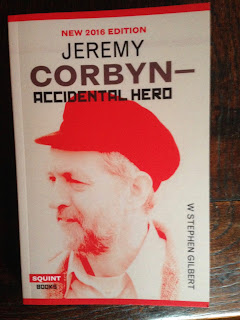
AFTERWORD to the SECOND EDITION:
ANTITHETICAL
In a wide-ranging analysis for the Strategic Culture Foundation, Finian Cunningham found that Jeremy Corbyn’s then-imminent election as Labour leader revealed “just how undemocratic Britain is. Any politician who steps outside the establishment is liable for destruction by the ruling forces … we can expect a full-on media war to destroy him over the next five years” ['Labour's Corbyn: British Establishment in Destroy Mode', August 20th 2015]. Cunningham quoted the former British ambassador to Uzbekistan, Craig Murray: “Democracy in the United Kingdom is dysfunctional because an entrenched party system offers no choice … The sheer panic gripping the London elite now is hilarious to behold” [ibid].
Researching and writing this book has been, for me, a salutary reminder that the civilised, tolerant and profoundly democratic reputation so complacently accorded to Britain by politicians is a very thin integument indeed. Even this modest volume proved a step too far for the generosity of spirit that allegedly animates the British. Reaction to the first edition has been instructive. Rather I should say the lack of reaction. As far as I am aware, the Morning Star, where Corbyn writes a column, is the only national newspaper to have so much as mentioned it. At least its review was well worth the two months’ wait. I sent the following letter to the Saturday Review section of The Guardian – “Given that you'd be hard pressed to deny that Jeremy Corbyn is the big news story of the year in British politics, it seems curious that Helen Lewis couldn't find room in her survey of political books of the year for mine … Or perhaps this is just further evidence of the naked, media-wide bias against anything supportive of Corbyn's policies and character” [December 5th 2015] – but it wasn’t published.
Somebody at the paper proved to be kindly, however. I had two other letters accepted that I had signed as “W Stephen Gilbert (Author, Jeremy Corbyn – Accidental Hero)” and this designation was reproduced on the letters page. What’s more, in the on-line version, the book’s title was rendered as a hyperlink to the publisher’s website, an unlooked-for bounty.
The only other print publication that reviewed the book was The Jerusalem Post, which not unexpectedly took a highly selective line and mentioned precious little in the text that did not directly concern Israel [December 10th 2015]. The notion of responding to the review seemed entirely unprofitable, so I let it go.
One might argue that original paperbacks are rarely favoured by the papers, hardbacks being taken as the only ‘proper’ books. But the conviction lingers that it is the subject of the book, and the fact that the subject is treated sympathetically, that has denied it any more coverage. Fortunately, there are other means of spreading the word these days, especially the Internet and social media. It is largely word of mouth (or word on Facebook and Twitter) that has allowed the book to reprint and now to go into a second edition, along with gratifying notices on the book’s Amazon page.
The media’s treatment of Jeremy Corbyn has been unprecedented in its vituperation, its misrepresentation and its selectivity. It began as it intended to go on. The Huffington Post reported analysis by the politically independent Media Reform Coalition of newspaper coverage of Corbyn’s first week as Labour leader, a moment when in any other field (manager of the national football team, say, or chief conductor of the London Symphony Orchestra) judgment would be held in reserve and benefit of any doubt granted. The MRC collated 494 news reports, opinion columns and editorial leaders in the national press and found that 60 percent of these articles were clearly negative, 27 percent neutral and just 13 percent positive, despite the media’s characterisation of Corbyn as an unknown quantity.
Predictably, The Sun and the Daily Mail, each with 91 percent, registered the highest proportion of stories that expressed hostility, animosity or unabashed ridicule. The report declared that the British press “systematically undermined” Corbyn, and concluded: “The risk of undue influence on elected politicians is high, and it’s hard to see how democracy can flourish when the mass channels of debate are monopolised in the way that they are” [January 6th 2016].
If it were only the Tory press, one could account for it plainly. But the way the BBC too has treated Corbyn has been so consistently distorted that one must suspect an orchestrated stance required by the management in the belief that such a distortion will improve the Corporation’s chances of surviving John Whittingdale’s term as Culture Secretary (to whose office I copied my complaint, aired in a footnote to page 109 above, against the biased coverage in the BBC programme Daily Politics, to no avail).
For example: presenter Mark Mardell referred in passing to Corbyn as “hard left” on Radio 4’s The World This Weekend [November 22nd 2015]. You can be sure that the BBC never refers to David Cameron as “hard right” or even “right wing” – he is after all “the Prime Minister”, as Corbyn, you might think, is properly “the Leader of the Opposition”. This is loaded terminology, intended (subconsciously or – let’s be realistic – consciously) to put Corbyn beyond the consensual mainstream to which the BBC subscribes, to present him as “extreme”.
Laura Kuenssberg, the BBC’s political editor, interviewed Corbyn for the 6 pm bulletin on his view of regulations concerning police use of firearms and the so-called “shoot to kill” policy. It seemed to me that what Corbyn had to say was measured, judicious and sensible, the very antithesis of the gung-ho, trigger-happy mentality that animates some of the Tory backbenches. In her subsequent to-camera piece, Kuenssberg called Corbyn’s view “extraordinary”. Perhaps someone upstairs did find this gratuitous editorialising, for she did not repeat it on the 10 pm news [November 16th 2015].
Another needless thrust at Corbyn came in June Kelly’s report on a court case: “… and it’s emerged that one of the now convicted fraudsters, Mohamed Dahir, was supported by the Labour leader Jeremy Corbyn when he applied for and was given bail before the trial” [6:00 News BBC1 December 10th 2015]. This is malignly suggestive. The extended Dahir family are constituents of and known to Corbyn and, there being no grounds for him not to do so, he wrote in support of the bail application when Dahir was first charged. Dahir’s lawyer only revealed this to the court after conviction, presumably in an attempt to leaven his client’s sentence. Objectively, there is no justification for this titbit to be reported; that the case developed a (very tenuous) Syrian connection gave anyone wanting to smear Corbyn an innuendo with which to do so. Why the BBC should wish to do this remains unanswered. ITV’s news bulletins made no mention of the matter.
On December 3rd, less than three months into Corbyn’s leadership and the day after the debate on Syria in the Commons, there was a by-election at Oldham West and Royton, following the death of Corbyn’s great friend and ally Michael Meacher. The media expectation was that UKIP could well capture the seat. Its candidate had run Labour perilously close just over a year earlier at a by-election in the neighbouring constituency of Heywood and Middleton. The difficulty for the print media is that by-election results usually come too late for the next morning’s deadline, as happened with Oldham. Guardian columnist Martin Kettle was so sure that Labour would get a bloody nose that, writing ahead but publishing later, he cited “a lousy by-election result in Oldham” [December 4th 2015].
In the event, Labour increased its vote share by a remarkable seven percent and the Tory vote dropped by nearly ten percent, only a small proportion of that change favouring UKIP. The media had to ditch their lovingly prepared editorials and think pieces declaring that the expected “lousy result” demonstrated once again the ‘unelectability’ of a party led by Corbyn. Curiously, they demurred at any notion that the actual result indicated that any enthusiasm might attach to the leader.
The most astounding example of this double standard occurred on the BBC News report of the by-election result. So-called vox pops are used by lazy editors as news filler, purportedly to give a flavour of what ‘ordinary people’ think. There are two characteristics of the gambit that may readily be understood: first, views gathered in the street are random and unscientific and will usually demonstrate ignorance, indifference and scepticism, if not downright lunacy; second, if an editor wants to make a point, it may quickly be illustrated by finding people who are sufficiently excited at being ‘on the telly’ to make it for him.
In the BBC News report on the by-election, there was a succession of three local people, each of whom was bitterly scornful towards Corbyn [6:00 News BBC1 December 4th 2015]. Now it cannot be argued that no one could be found in the length and breadth of Oldham who would be prepared to say a good word for Corbyn’s leadership. This is simple manipulation of the freedom of the airwaves to broadcast whatever the editor likes and call it news. And I will guarantee you this: if any research team ever looks into the BBC’s record in by-election coverage, it will find no news report before December 2015 in which all the views volunteered to the cameras rubbished the leadership of the party that had taken the seat, particularly when unexpectedly.
Laura Kuenssberg was at it again in reporting Corbyn’s January 2016 reshuffle. There had been endless speculation about this in the media and a good deal of propaganda about ‘revenge’ and ‘purges’. Again, no supportive reading would be afforded to whatever transpired. Corbyn would have proved himself a ‘tyrant’ or a ‘Stalinist’ had he sacked and/or moved frontbenchers who did not support his policies, ‘powerless’ and ‘ineffectual’ if he did not.
Kuennsberg was one of many commentators who grumbled that the reshuffle was “so slow”. There is no regulation nor even any convention about the speed of reshuffles; they take as long as they take. They are, though, boring for reporters because of the waiting around for developments. In this particular case, the days of media speculation long before Corbyn even began made it seem a more drawn-out affair. Furthermore, the process was hampered by various shadow ministers negotiating both publicly and privately, rather than following the usual practice of accepting the leader’s prerogative and behaving in a dignified manner when they were moved or demoted (Maria Eagle was an honourable exception to this stricture).
Reporting the end of the reshuffle, Kuennsberg demonstrated a talent for superiority, belittlement, presumption and embroidery that chimed eerily harmoniously with David Cameron’s thrusts at that morning’s Prime Minister’s Questions. As she had it: “[Corbyn] is meant to be the boss … The leadership wanted [Hilary Benn] to move but he stayed put with a promise to work differently … really? … The last 24 hours have been a damaging pantomime. While Jeremy Corbyn’s been bunkered up in his office with his close advisors, he hasn’t always seemed in charge of events and simply he didn’t have the clout to make all of the changes he wanted to” [6:00 News BBC1 January 6th 2016]. You, gentle reader, know as well as I do that Corbyn never told Kuennsberg the changes that he might have wanted to make or whether he wanted to move Benn from leading on foreign affairs, so her guess on this – it’s just a guess – is no better than yours or mine. If she cannot perceive that phrases and terms like “meant to be the boss”, “really?”, “damaging pantomime”, “bunkered up”, “close advisors” (they are clearly meant to sound sinister, or why mention them?), “in charge of events” and “the clout” are the antithesis of the scrupulous impartiality that the BBC charter obliges her to demonstrate, she may need a refresher course at the BBC academy.
Monitoring Kuenssberg on Twitter the previous day, Media Watch recorded her tweets about the issues of the week as: “Rail fares 0, Housing 0, Floods 1, EU negotiations 8, Labour reshuffle 30” [Corbyn: Media Watch Facebook status, January 9th 2016]. Like everyone in the Westminster hothouse, her only interest is who’s up and who’s down, not what affects people’s lives.
In the reshuffle, two ministers totally unknown outside their constituencies, Westminster and their families, Michael Dugher and Pat McFadden, were sacked. Both had been personally critical of Corbyn far beyond their respective ministerial briefs. At the time that Dugher was starting a tour of television studios making the most of his ‘martyrdom’, I put him into Google Search where his sacking was still only registering on its first page. Of 230 entries, just eight related to his work as Shadow Culture Secretary. That tells its own story. Dugher was immediately recruited as a columnist on The Sun, just as Simon Danczuk, another serial critic of Corbyn despite being a Labour MP, writes regularly in the Daily Mail. Why do these men gaily consort with the enemy? Do they imagine that such newspapers would be devotedly supporting Labour if Liz Kendall were the Labour leader?
A small number of junior ministers, again peaking in public attention by so doing, resigned in the wake of these sackings. Unless they pick up lucrative contracts with the Tory press, we are unlikely to hear of them again (do tell me who it was who quit at the moment of Corbyn’s election as leader, mentioned on page 101). One of the new quitters, Stephen Doughty (no, I haven’t either), resigned with a live flourish on Andrew Neil’s BBC magazine Daily Politics. Thanks to a blog by the BBC’s so-called output editor [Andrew Alexander, ‘Resignation! Making the news on the Daily Politics’, BBC Academy website, January 7th 2016], we know that the programme staff were in morning-long cahoots with anti-Corbyn Labour MPs and that this ‘coup’ was brokered by Laura Kuennsberg. Given that Cameron mentioned the resignation in PMQs before Corbyn knew of it, it can only be that the BBC gave the PM a heads-up: all highly improper.
Some people – those for instance who read The Daily Telegraph – imagine that the BBC is “full of pinkos”. Far from it: the editor of BBC News is James Harding, a former editor of The Times (proprietor: Rupert Murdoch), a strong supporter of the Israeli government (and hence on that score at least at odds with Corbyn) and a “long-term friend” of George Osborne, towards whom The Times was notably kindly during Harding’s tenure [according to The Independent March 25th 2012]. The executive editor of current affairs programming, including Daily Politics, is Robbie Gibb. He is brother to Tory Minister of State for Schools Nicolas Gibb, is a former chief-of-staff to Tory grandee Francis Maude, was best man at Tory businessman Mark MacGregor’s wedding and was once deputy chair (to MacGregor) of the “extreme rightwing” [according to The Guardian July 14th 2015] Federation of Conservative Students. So, no inclination to favour the Conservatives there, then.
The BBC might counter that they gave me a decent shake by inviting me onto the BBC News Channel programme Meet the Author. This sits in a fifteen-minute slot, though in practice its length is eight minutes tops – not exactly Mark Lawson Talks to … but still not a bad length as media encounters go. My interviewer was Nick Higham, a genial and schoolmasterly host. Before the recording began, we had a most encouraging conversation in the studio in which I rehearsed my prepared points. When recording began, though, Higham somewhat threw me by asking quite different questions, largely avoiding mention of the book (which he irritatingly called “a pamphlet”) and concentrating on Corbyn in the immediate present – we were recording at the beginning of the week that included the vote on extending air strikes into Syria.
The first of two airings of the programme was scheduled for the Thursday evening, but it was abruptly decided that, as the Oldham by-election fell on that day and the polls would still be open, it could not go out then. Strangely enough, no other programme dealing with politics was pulled that day. A replacement time-slot on the Friday was also cancelled, ostensibly because the channel decided to take the live police press conference about the San Bernardino shootings. In reality, the live segment was over before Meet the Author had been scheduled to begin, but what was shown in the slot was a recorded package of items that had already aired several times that day. This left the broadcast (normally the repeat) on the Sunday evening as the edition’s only chance of a screening. Higham assured me that it regularly won the higher audience. In practice, the programme was put out more than an hour earlier than billed, with no prior warning. If it weren’t for BBC iPlayer, none of those awaiting it (me included) would have seen it.
As his own producer, Higham got to choose to interview me. The schedulers’ treatment of the broadcast suggests that his choice was not smiled on from above. Had I written a well-disposed guide to the politics of, say, Boris Johnson and been invited onto Meet the Author, I venture to suggest that Tory central office would have kicked up one hell of a row if transmission had been manipulated in a similar manner. But it wouldn’t have been so treated.
At least I got to articulate a scenario that I had been contemplating and had not heard voiced before. If this book had had any sort of public traction, my theory might have caught some attention too. It is this: a pattern seems to be developing whereby the press and the Blairite rump keep up a steady barrage of grumbling and nit-picking directed at Corbyn in the hope that he is forever in defensive mode, always doubted and questioned. This is a counsel of despair rather than a strategy. It means to damage Corbyn but it has no means to prevent collateral damage to the Labour Party and to those of its adherents who like to be portrayed by the media as “the moderates” (which suggests sensible, realistic, virtuous, non-aggressive). The tactic can only be justified if it creates the opportunity for a challenge that has a prospect of achieving its goal and electing a ‘vote-winning’ leader. But four and a half years without such a challenge will make the Corbynistas dig in even more determinedly. Either way, it hardly promises a Labour victory in 2020. It is a grim prospect.
So I gently proffer the notion that those who support Corbyn start to prepare a Plan B. Instead of waiting for the likes of Chuka Umunna and Yvette Cooper and Rachel Reeves and Chris Leslie to gather round a rival candidate to challenge Corbyn (Hilary Benn, say, or David Miliband), let alone break away and form a new centrist party or join the Lib Dems or even the Tories, let them think about a new party of their own centred on Corbyn. It might be called the Democratic Socialist Party. The Socialist Party is a name already taken (led by Arthur Scargill) but no one would mistake Democratic Socialists for Social Democrats.
The party’s policies would be undiluted Corbyn, so many of which are known to have a keen following in the country but are not yet embraced by any UK-wide party: getting rid of nuclear weapons, renationalising public transport and the public utilities, keeping the NHS wholly in public hands, changing economic direction to make the rich and the speculators support expansion and infrastructure and relieve poverty, re-energising enterprise that manufactures rather than merely services. There would be no need for a DSP to trim to the demands of the Blairites.
My guess is that there are about 25 sitting Labour MPs who might be prepared to resign the party whip en masse and stand for re-election as DSP candidates. Three of the most loyal Corbynistas are past 70 and might not want to start again; on the other hand, they might be all the more ready to fight one last time for a manifesto that they wholly support. Six of the MPs who loyally support Corbyn have majorities below 4,500; some of them might feel it’s too risky to impose a by-election on their constituents.
But one of the great strengths of the Corbyn wing of the PLP is that so many have such healthy majorities – 14 of them are more than 10,000 votes ahead of their nearest rivals, including Corbyn, John McDonnell and Diane Abbott. The chances of them changing allegiance and taking their electorate with them must be at least as good as were those in the last parliament for the two Tories who got back in as UKIP MPs. Some 20 simultaneous by-elections would be very difficult for the Labour residuum to defend, especially with a (doubtless fraught) leadership election in prospect in a party suddenly light on its left wing; and those by-elections would be sprung at a time of the DSP’s choosing.
In the months since the 2015 general election, the membership of the Labour Party has more than doubled. The number of those joining for the first time or rejoining after leaving during the Blair years now comfortably exceeds the entire membership of the Conservative Party. Those people were not brought in by Kendall, Cooper, Burnham or the prospect of Benn or the elder Miliband as leader. If the party countermands the democratic will of the quarter-million who voted for Corbyn, those people will have no reason to stay in the Party, and no reason to vote for it either.
Meanwhile the war of attrition grinds on. Though Corbyn may be tapping vast support in the country and the grassroots of the Party for his stances on not bombing targets in Syria and opposing the renewal of Trident missiles, there is an unwavering bloc in the PLP that will not be reconciled to these positions. It was perhaps a pious hope that Corbyn could hold such a divided party together by allowing diametrically opposed views to be expressed. Party management is always a fraught issue; for a leader with no experience of managing anything and little taste for compromise, it seems an insuperable task. But while this may look like a disaster up close, it is of little interest outside the Westminster hothouse.
It is in the constituencies and, with luck, in the non-party-joining wider world that Corbyn’s appeal is working. At a December 2015 gathering of my own local party, it emerged that only six out of some 50 present had voted for Corbyn as leader in September, but there was now not a single member who identified as anti-Corbyn. “Give him a chance” is the very least enthusiastic endorsement that you hear, and that is enormously more generous than is granted by very many backbench Labour MPs. It is striking that it is the professional politicians who tend to take entrenched positions, their voters who are more willing to listen to contrary arguments and consider alternative strategies.
The babel of voices in the Labour movement is divided into various factions as well as, in cases like Simon Danczuk, conducting lone, self-advertising campaigns. From press coverage, you might imagine that there is just a single partisan grouping operating as "an enemy within", the much-maligned Momentum. On the contrary, there are quite as many groups of supporters who used to favour Tony Blair or Gordon Brown – the members that John Prescott has dubbed Bitterites – as there are groups that would undo the work of New Labour. Progress, Labour Together, Labour First, Blue Labour and – this one known in Westminster as “the Resistance” – Labour for the Common Good are all ranged against Corbyn’s leadership. Grassroots Alliance, Campaign Group, Tribune Group and Compass all lean relatively left. Socialist Campaign for a Labour Victory, Labour Representation Committee and Momentum are actively pro-Corbyn. There are also more than two dozen special interest groups that take stances on party policy.
Momentum is suspected most by the Bitterites because it is new, having grown out of Corbyn’s leadership campaign, well-organised and diligent. During the fierce debate over extending RAF activity against Daesh into Syria, Momentum was accused of “bullying” Labour MPs who were inclined to support the government’s call to legitimate the bombing. Anyone who uses social media knows that verbal abuse and even threats are made by supporters of every conceivable political position, that disobliging posts are nothing new and not confined to any single philosophy. Corbyn has regularly committed himself to eschewing personal attacks and called on his followers to do the same. But playing the martyr card is tempting for those who claim to have been verbally threatened, as if somehow their plight is comparable to (or even worse than) that of innocent Syrian citizens caught up in air raids. Tarring Momentum with the brush of brutality is mere propaganda, as is characterising it as the spawn of Militant Tendency, the entryist grouping that disrupted Neil Kinnock’s leadership.
In fact Momentum is as broad church in its membership as the Party itself, united solely by the common experience of supporters being energised by Corbyn’s honesty, courage and dissimilarity to the Westminster politicians fashioned from the traditional template. It is this support that gives Corbyn his power-base, rather than any significant presence in parliament. And it is a mighty power. Consider, for instance, the Facebook grouping called Corbyn 50yrs+ Supporters Group, set up to counter the notion that the Labour leader’s constituency is dominated by callow, naïve and aggressive youngsters, an inevitability when Corbyn relies so much on the Internet (because, as we know, no one over 30 knows how to work a computer). When it first launched, membership of the group grew at the astonishing rate of more than 500 per day. At about the same time, the Bitterites announced a drive to recruit 100,000 new “moderate” members to the Labour Party over eighteen months. They’ll be lucky. Membership of the 50yrs+ group has stabilised at around 3,000, still a remarkable number. Had it been able to maintain its initial momentum, its strength would have topped 100,000 members in under seven months.
In my Meet the Author interview, I observed that I would rather muse about the future than make categorical predictions, as the columnists love to do. I suggested that the Corbynista faction in the Commons might have no choice but to break away and stand for re-election under new colours, a rump of 20-some-odd DSP MPs (two-and-a-half times as many as the Liberal Democrats) being a solid basis for fighting a general election. So I mused that there was indeed a good chance that Corbyn could become Prime Minister “but not necessarily as leader of the Labour Party”.
But there is another theory to consider. Thirty years ago, when a doctrinaire government was attempting with some success to bring permanent change to Britain, I imagined seeing out my days in a concentration camp under the jackboot of the children of the Thatcherites. Paranoid hyperbole, I hear you cry.
Well, every schoolboy knows that the concentration camp was an invention of the British, pioneered in South Africa during the Second Boer War of 1899-1902. Perhaps less well known is that such camps were functioning in Britain in living memory. The Polish government-in-exile under General Wladyslaw Sikorski was allowed, under the terms of the Allied Forces Act of 1940, to set up concentration camps in Scotland, first on the Isle of Bute, then in four other locations. Sikorski had carte blanche to incarcerate whomsoever he wished from among the huge population of Polish exiles and refugees, more than 20,000 of whom were combatants. The classes of victim he chose uncannily mirrored those of the Nazis: Jews, dissidents, communists, homosexuals and others considered by him to be licentious or in other wise undesirable [‘Britain’s Concentration Camps for Gay Men’ by Simon Webb, Pink News January 18th 2016]. So it was not so very fanciful of me and it could still happen.
Moreover, the threat has become much wider than from just one faction. It can hardly be doubted that there is a force in the establishment both of Britain and of international capital that would have no intention of ever letting Corbyn anywhere near the seat of power. That coalition of vested interests, which already wields immense global power and owes no allegiance to government, constitution, jurisprudence, regulation, democracy or military might, would stop at nothing to prevent Corbyn standing for, let alone winning, an election that could make him prime minister. Would such people be ready to use fraud, corruption, criminality, repression, suspension of rights, emergency powers, military coup, arrest, torture, mass imprisonment, ‘disappearance’ of Corbyn supporters, even political assassination to achieve its goal?
Consider the precedents. The stirrings of rebellion seriously arose during Harold Wilson’s time as premier; in 1974, the army even briefly occupied Heathrow Airport, later claiming without much conviction that it was merely an unofficial training exercise. Wilson himself, inevitably accused of paranoia, remained convinced that elements in MI5 intended to remove him from office [see The Pencourt File by Barrie Penrose & Roger Courtier, HarperCollins 1978]. And this was long before the vast growth in the international agglomeration that I described above.
Exactly fifty years earlier, the Labour government of Ramsay MacDonald decisively lost the general election four days after the Daily Mail published the hugely damaging ‘Zinoviev letter’ which implied collusion between the British and Soviet governments to promote Marxist-Leninism in Britain, a letter that was subsequently found to be a forgery. Nobody was ever indicted for this treasonous assault on the democratic process. The history of dirty tricks, black propaganda and manipulation by MI5 would certainly generate a new chapter if it seemed at all imminent that Corbyn were to be elevated by the electorate.
And since Corbyn became Labour leader, there has been a demise around which some speculation swirls. His good friend Michael Meacher, MP for Oldham West and Royton, who had appeared in robust health, died unexpectedly after a short illness the details of which have never been disclosed. Meacher once wrote a cogent analysis of the questions surrounding the 9/11 attacks [‘This war on terrorism is bogus’ The Guardian September 6th 2003] and reportedly had been lately taking renewed interest in the matter. Immediately following his death, the activist Tony Gosling tweeted: “Who deleted Michael Meacher’s Twitter account? Surely not him or family – 6,341 tweets deleted – so who?” [Tony Gosling Twitter account, October 21st 2015]. The on-line journal Veterans Today is among those that have questioned the innocence of his death [‘Was British MP Michael Meacher murdered to cover up 9/11?’, veteranstoday.com October 24th 2015].
But this is Europe, you will protest. Such things don’t happen here. They only happen in South America. Or Africa; or the Middle East or the Far East … or South Asia … Nevertheless, democracy has been suspended, and draconian and murderous regimes installed, within living memory in European nations that we had thought were the absolute epitome of civilisation: Germany, Greece, Italy, Spain, Serbia and, to a lesser extent, Portugal. Those nations we now, in a different climate, think properly civilised again. But it would be foolish to believe that in Britain, where there is a widespread following for UKIP and much uglier movements than UKIP, popular support for such developments are unthinkable.
Eight days after Corbyn’s election as Labour leader, The Sunday Times published remarks made on condition of anonymity by someone described as a senior serving general. “The general staff [of the Army] would not allow a prime minister to jeopardise the security of this country and I think people would use whatever means possible, fair or foul, to prevent that. You can’t put a maverick in charge of a country’s security. There would be mass resignations at all levels and you would face the very real prospect of an event which would effectively be a mutiny,” he said [September 20th 2015].
There are many ways to read this. Given its non-attributability, it could have been cooked up in the editor’s office – stranger things happen. Assuming it is authentic, it might have been an atypical blowhard – there have been many such in the senior ranks of the armed forces. It might have been a tactical move by a group of disaffected officers wishing to wrong-foot the Chief of the General Staff – as everywhere else, politicking goes on in the Army. It could have been Sir Nick Carter, the service’s head honcho himself, funnelling his feelings through a trusted ally – top brass do not often make their opinions publicly known. Or it may just have been, yes, a senior serving general shooting the breeze.
One disaffected officer speaking off the record may not indicate anything very widespread or disquieting. But reactions among the ranks strongly support the suggestion that the army could and should act if Corbyn were elected on his known platform. A piece in The Guardian drew unequivocal views on so-called ARRSE, the website for discussion among soldiery . For instance:
– A magazine of 10 rounds should do the labour front bench. A .22
should be enough to put down those weak willed vegan pacifists.
(Abbott may need a coup due grace with a shovel.) Job jobbed, back
to the no longer called the NAAFI for tea and biccies.
– The reason the left fetish so much about mass murder, uprisings and
police states is because quite simply, they would love to see such a
thing happened so they crayoned use it as an excuse to bring about
their socialist nirvana and execute all the people who don't agree with
them. There are none so violent as those that protest for peace and
the fraternity of the proliatariat.
– Anti-capitalist protestors are publicly-subsidised, violent, democracy
averse scum? (Not sure that they need a dose but, having seen the
state of them, they probably know the way to the clinic). Check. It's
not much fun living in a lawless society. Check. Jeremy “I've got two
'A' levels, both 'E' grades, and dropped out of Poly” Corbyn is as thick
as a whale omelette. Check. I'm not sure Mr Beckett [Andy Beckett,
author of the Guardian article, January 25th 2016] meant to give
our views such a ringing endorsement but then, if he knew how to
write, he wouldn't have to pen polemics for the Guardian at the behest
of Mr Milne [Seamas Milne, Corbyn’s press officer].
– It's wonderful today to be British. The sun is shining and the Labour
Party is in terminal meltdown. The gimmigrants are revolting over
wristbands, the Muslim invasion of Europe continues unabated and Ed
Balls has quit politics. The LibDems have ceased to exist, their new
boss on a par with Corbyn. The Guardian is running out of cash, losing
readers at a terminal rate. Just taken delivery from D Express shoes
offer, £39.95 a pair of black leather Chelsea boots, with a pair of brown
ones as well, thrown in for free. Filled up the car at 99p a litre. BBC
giving Stay-Boss Rose [Stuart, now Lord, Rose was CEO of Marks & Spencer and now chairs the Better in Britain campaign to stay in the European Union] a battering about over fear mongering about Leave EU, and Rose coming over as a beaten man on an impossible journey. The Leave EU campaign is grabbing the publics attention and support. In three months the council election, London elections and other elections in Wales and Scotland. The results will heap misery on misery onto the left supporters. It's wonderful to be a true Brit today [op cit].
Typos and idiosyncrasy aside, the pithy anger and satiric scorn on show here indicates something of how mentally as well physically formidable a roused soldiery would be if push came to shove. When it provokes rancor and menace, the Army yields nothing to the likes of Momentum.
In the light of the Sunday Times piece, the polling organisation YouGov did some research. It found that a quarter of the British public could foresee a situation in which they would support a military coup in Britain. For almost ten percent, Corbyn becoming Prime Minister would constitute such a situation. If as PM Corbyn were to attempt to “dismantle” the armed forces, as many as 56 percent would support a coup. You might say defence cuts so far imposed by the Tories have “dismantled” in large measure. What’s more, 48 percent of UKIP voters believe the military should defy any civilian instruction that were considered unacceptable. I have not seen the wording of the questions nor the make-up of the sample taken, and I set no store by opinion polls of any kind; nonetheless, this must give pause.
What clearly must be faced is that there are currents running at both a supranational and an anti-democratic level in preparation to pre-empt the kind of programme that Corbyn’s supporters expect to elect him. In some scenarios, the ultimate weapon is unleashed to achieve this end. The pop singer Morrissey is widely held to be one of the more thoughtful and erudite individuals in his field. Playing a gig in Plymouth the week of Corbyn’s accession to the leadership, he told his audience: “You know he’s a vegeterian? He doesn’t like the monarchy? He hates war? They’re gonna assassinate him” [NME September 16th 2015].
By Wikipedia’s account, there have been 53 assassinations in Europe thus far this century, 22 of them in Russia. Virtually all the 19 assassinations in Britain last century related to the politics of the island of Ireland. It seems unthinkable that any political leader in Britain should be in mortal danger in the present climate, though international terrorism requires that personal security for ministers and others be of the most rigorous.
Nevertheless, the challenge to the establishment that Corbyn represents is unprecedented. It seems heedless to rule out any eventuality. Does this then mean that it would be a kindness both to the nation and to Corbyn himself (and apologists like me) if he were to be persuaded to step back from leading Labour or some other party into the 2020 election?
Decidedly not. The movement he has sparked would never accept that solution. What Corbyn’s elevation has already achieved is too inspiring to too many people for it to be abandoned without a fight to the last ditch, however vain it might appear. As Atticus Finch says in To Kill a Mockingbird: “Simply because we were licked a hundred years before we started is no reason for us not to try to win” [Harper Lee 1960, Penguin edition 1963 p 82]. Amen to that.

AFTERWORD to the SECOND EDITION:
ANTITHETICAL
In a wide-ranging analysis for the Strategic Culture Foundation, Finian Cunningham found that Jeremy Corbyn’s then-imminent election as Labour leader revealed “just how undemocratic Britain is. Any politician who steps outside the establishment is liable for destruction by the ruling forces … we can expect a full-on media war to destroy him over the next five years” ['Labour's Corbyn: British Establishment in Destroy Mode', August 20th 2015]. Cunningham quoted the former British ambassador to Uzbekistan, Craig Murray: “Democracy in the United Kingdom is dysfunctional because an entrenched party system offers no choice … The sheer panic gripping the London elite now is hilarious to behold” [ibid].
Researching and writing this book has been, for me, a salutary reminder that the civilised, tolerant and profoundly democratic reputation so complacently accorded to Britain by politicians is a very thin integument indeed. Even this modest volume proved a step too far for the generosity of spirit that allegedly animates the British. Reaction to the first edition has been instructive. Rather I should say the lack of reaction. As far as I am aware, the Morning Star, where Corbyn writes a column, is the only national newspaper to have so much as mentioned it. At least its review was well worth the two months’ wait. I sent the following letter to the Saturday Review section of The Guardian – “Given that you'd be hard pressed to deny that Jeremy Corbyn is the big news story of the year in British politics, it seems curious that Helen Lewis couldn't find room in her survey of political books of the year for mine … Or perhaps this is just further evidence of the naked, media-wide bias against anything supportive of Corbyn's policies and character” [December 5th 2015] – but it wasn’t published.
Somebody at the paper proved to be kindly, however. I had two other letters accepted that I had signed as “W Stephen Gilbert (Author, Jeremy Corbyn – Accidental Hero)” and this designation was reproduced on the letters page. What’s more, in the on-line version, the book’s title was rendered as a hyperlink to the publisher’s website, an unlooked-for bounty.
The only other print publication that reviewed the book was The Jerusalem Post, which not unexpectedly took a highly selective line and mentioned precious little in the text that did not directly concern Israel [December 10th 2015]. The notion of responding to the review seemed entirely unprofitable, so I let it go.
One might argue that original paperbacks are rarely favoured by the papers, hardbacks being taken as the only ‘proper’ books. But the conviction lingers that it is the subject of the book, and the fact that the subject is treated sympathetically, that has denied it any more coverage. Fortunately, there are other means of spreading the word these days, especially the Internet and social media. It is largely word of mouth (or word on Facebook and Twitter) that has allowed the book to reprint and now to go into a second edition, along with gratifying notices on the book’s Amazon page.
The media’s treatment of Jeremy Corbyn has been unprecedented in its vituperation, its misrepresentation and its selectivity. It began as it intended to go on. The Huffington Post reported analysis by the politically independent Media Reform Coalition of newspaper coverage of Corbyn’s first week as Labour leader, a moment when in any other field (manager of the national football team, say, or chief conductor of the London Symphony Orchestra) judgment would be held in reserve and benefit of any doubt granted. The MRC collated 494 news reports, opinion columns and editorial leaders in the national press and found that 60 percent of these articles were clearly negative, 27 percent neutral and just 13 percent positive, despite the media’s characterisation of Corbyn as an unknown quantity.
Predictably, The Sun and the Daily Mail, each with 91 percent, registered the highest proportion of stories that expressed hostility, animosity or unabashed ridicule. The report declared that the British press “systematically undermined” Corbyn, and concluded: “The risk of undue influence on elected politicians is high, and it’s hard to see how democracy can flourish when the mass channels of debate are monopolised in the way that they are” [January 6th 2016].
If it were only the Tory press, one could account for it plainly. But the way the BBC too has treated Corbyn has been so consistently distorted that one must suspect an orchestrated stance required by the management in the belief that such a distortion will improve the Corporation’s chances of surviving John Whittingdale’s term as Culture Secretary (to whose office I copied my complaint, aired in a footnote to page 109 above, against the biased coverage in the BBC programme Daily Politics, to no avail).
For example: presenter Mark Mardell referred in passing to Corbyn as “hard left” on Radio 4’s The World This Weekend [November 22nd 2015]. You can be sure that the BBC never refers to David Cameron as “hard right” or even “right wing” – he is after all “the Prime Minister”, as Corbyn, you might think, is properly “the Leader of the Opposition”. This is loaded terminology, intended (subconsciously or – let’s be realistic – consciously) to put Corbyn beyond the consensual mainstream to which the BBC subscribes, to present him as “extreme”.
Laura Kuenssberg, the BBC’s political editor, interviewed Corbyn for the 6 pm bulletin on his view of regulations concerning police use of firearms and the so-called “shoot to kill” policy. It seemed to me that what Corbyn had to say was measured, judicious and sensible, the very antithesis of the gung-ho, trigger-happy mentality that animates some of the Tory backbenches. In her subsequent to-camera piece, Kuenssberg called Corbyn’s view “extraordinary”. Perhaps someone upstairs did find this gratuitous editorialising, for she did not repeat it on the 10 pm news [November 16th 2015].
Another needless thrust at Corbyn came in June Kelly’s report on a court case: “… and it’s emerged that one of the now convicted fraudsters, Mohamed Dahir, was supported by the Labour leader Jeremy Corbyn when he applied for and was given bail before the trial” [6:00 News BBC1 December 10th 2015]. This is malignly suggestive. The extended Dahir family are constituents of and known to Corbyn and, there being no grounds for him not to do so, he wrote in support of the bail application when Dahir was first charged. Dahir’s lawyer only revealed this to the court after conviction, presumably in an attempt to leaven his client’s sentence. Objectively, there is no justification for this titbit to be reported; that the case developed a (very tenuous) Syrian connection gave anyone wanting to smear Corbyn an innuendo with which to do so. Why the BBC should wish to do this remains unanswered. ITV’s news bulletins made no mention of the matter.
On December 3rd, less than three months into Corbyn’s leadership and the day after the debate on Syria in the Commons, there was a by-election at Oldham West and Royton, following the death of Corbyn’s great friend and ally Michael Meacher. The media expectation was that UKIP could well capture the seat. Its candidate had run Labour perilously close just over a year earlier at a by-election in the neighbouring constituency of Heywood and Middleton. The difficulty for the print media is that by-election results usually come too late for the next morning’s deadline, as happened with Oldham. Guardian columnist Martin Kettle was so sure that Labour would get a bloody nose that, writing ahead but publishing later, he cited “a lousy by-election result in Oldham” [December 4th 2015].
In the event, Labour increased its vote share by a remarkable seven percent and the Tory vote dropped by nearly ten percent, only a small proportion of that change favouring UKIP. The media had to ditch their lovingly prepared editorials and think pieces declaring that the expected “lousy result” demonstrated once again the ‘unelectability’ of a party led by Corbyn. Curiously, they demurred at any notion that the actual result indicated that any enthusiasm might attach to the leader.
The most astounding example of this double standard occurred on the BBC News report of the by-election result. So-called vox pops are used by lazy editors as news filler, purportedly to give a flavour of what ‘ordinary people’ think. There are two characteristics of the gambit that may readily be understood: first, views gathered in the street are random and unscientific and will usually demonstrate ignorance, indifference and scepticism, if not downright lunacy; second, if an editor wants to make a point, it may quickly be illustrated by finding people who are sufficiently excited at being ‘on the telly’ to make it for him.
In the BBC News report on the by-election, there was a succession of three local people, each of whom was bitterly scornful towards Corbyn [6:00 News BBC1 December 4th 2015]. Now it cannot be argued that no one could be found in the length and breadth of Oldham who would be prepared to say a good word for Corbyn’s leadership. This is simple manipulation of the freedom of the airwaves to broadcast whatever the editor likes and call it news. And I will guarantee you this: if any research team ever looks into the BBC’s record in by-election coverage, it will find no news report before December 2015 in which all the views volunteered to the cameras rubbished the leadership of the party that had taken the seat, particularly when unexpectedly.
Laura Kuenssberg was at it again in reporting Corbyn’s January 2016 reshuffle. There had been endless speculation about this in the media and a good deal of propaganda about ‘revenge’ and ‘purges’. Again, no supportive reading would be afforded to whatever transpired. Corbyn would have proved himself a ‘tyrant’ or a ‘Stalinist’ had he sacked and/or moved frontbenchers who did not support his policies, ‘powerless’ and ‘ineffectual’ if he did not.
Kuennsberg was one of many commentators who grumbled that the reshuffle was “so slow”. There is no regulation nor even any convention about the speed of reshuffles; they take as long as they take. They are, though, boring for reporters because of the waiting around for developments. In this particular case, the days of media speculation long before Corbyn even began made it seem a more drawn-out affair. Furthermore, the process was hampered by various shadow ministers negotiating both publicly and privately, rather than following the usual practice of accepting the leader’s prerogative and behaving in a dignified manner when they were moved or demoted (Maria Eagle was an honourable exception to this stricture).
Reporting the end of the reshuffle, Kuennsberg demonstrated a talent for superiority, belittlement, presumption and embroidery that chimed eerily harmoniously with David Cameron’s thrusts at that morning’s Prime Minister’s Questions. As she had it: “[Corbyn] is meant to be the boss … The leadership wanted [Hilary Benn] to move but he stayed put with a promise to work differently … really? … The last 24 hours have been a damaging pantomime. While Jeremy Corbyn’s been bunkered up in his office with his close advisors, he hasn’t always seemed in charge of events and simply he didn’t have the clout to make all of the changes he wanted to” [6:00 News BBC1 January 6th 2016]. You, gentle reader, know as well as I do that Corbyn never told Kuennsberg the changes that he might have wanted to make or whether he wanted to move Benn from leading on foreign affairs, so her guess on this – it’s just a guess – is no better than yours or mine. If she cannot perceive that phrases and terms like “meant to be the boss”, “really?”, “damaging pantomime”, “bunkered up”, “close advisors” (they are clearly meant to sound sinister, or why mention them?), “in charge of events” and “the clout” are the antithesis of the scrupulous impartiality that the BBC charter obliges her to demonstrate, she may need a refresher course at the BBC academy.
Monitoring Kuenssberg on Twitter the previous day, Media Watch recorded her tweets about the issues of the week as: “Rail fares 0, Housing 0, Floods 1, EU negotiations 8, Labour reshuffle 30” [Corbyn: Media Watch Facebook status, January 9th 2016]. Like everyone in the Westminster hothouse, her only interest is who’s up and who’s down, not what affects people’s lives.
In the reshuffle, two ministers totally unknown outside their constituencies, Westminster and their families, Michael Dugher and Pat McFadden, were sacked. Both had been personally critical of Corbyn far beyond their respective ministerial briefs. At the time that Dugher was starting a tour of television studios making the most of his ‘martyrdom’, I put him into Google Search where his sacking was still only registering on its first page. Of 230 entries, just eight related to his work as Shadow Culture Secretary. That tells its own story. Dugher was immediately recruited as a columnist on The Sun, just as Simon Danczuk, another serial critic of Corbyn despite being a Labour MP, writes regularly in the Daily Mail. Why do these men gaily consort with the enemy? Do they imagine that such newspapers would be devotedly supporting Labour if Liz Kendall were the Labour leader?
A small number of junior ministers, again peaking in public attention by so doing, resigned in the wake of these sackings. Unless they pick up lucrative contracts with the Tory press, we are unlikely to hear of them again (do tell me who it was who quit at the moment of Corbyn’s election as leader, mentioned on page 101). One of the new quitters, Stephen Doughty (no, I haven’t either), resigned with a live flourish on Andrew Neil’s BBC magazine Daily Politics. Thanks to a blog by the BBC’s so-called output editor [Andrew Alexander, ‘Resignation! Making the news on the Daily Politics’, BBC Academy website, January 7th 2016], we know that the programme staff were in morning-long cahoots with anti-Corbyn Labour MPs and that this ‘coup’ was brokered by Laura Kuennsberg. Given that Cameron mentioned the resignation in PMQs before Corbyn knew of it, it can only be that the BBC gave the PM a heads-up: all highly improper.
Some people – those for instance who read The Daily Telegraph – imagine that the BBC is “full of pinkos”. Far from it: the editor of BBC News is James Harding, a former editor of The Times (proprietor: Rupert Murdoch), a strong supporter of the Israeli government (and hence on that score at least at odds with Corbyn) and a “long-term friend” of George Osborne, towards whom The Times was notably kindly during Harding’s tenure [according to The Independent March 25th 2012]. The executive editor of current affairs programming, including Daily Politics, is Robbie Gibb. He is brother to Tory Minister of State for Schools Nicolas Gibb, is a former chief-of-staff to Tory grandee Francis Maude, was best man at Tory businessman Mark MacGregor’s wedding and was once deputy chair (to MacGregor) of the “extreme rightwing” [according to The Guardian July 14th 2015] Federation of Conservative Students. So, no inclination to favour the Conservatives there, then.
The BBC might counter that they gave me a decent shake by inviting me onto the BBC News Channel programme Meet the Author. This sits in a fifteen-minute slot, though in practice its length is eight minutes tops – not exactly Mark Lawson Talks to … but still not a bad length as media encounters go. My interviewer was Nick Higham, a genial and schoolmasterly host. Before the recording began, we had a most encouraging conversation in the studio in which I rehearsed my prepared points. When recording began, though, Higham somewhat threw me by asking quite different questions, largely avoiding mention of the book (which he irritatingly called “a pamphlet”) and concentrating on Corbyn in the immediate present – we were recording at the beginning of the week that included the vote on extending air strikes into Syria.
The first of two airings of the programme was scheduled for the Thursday evening, but it was abruptly decided that, as the Oldham by-election fell on that day and the polls would still be open, it could not go out then. Strangely enough, no other programme dealing with politics was pulled that day. A replacement time-slot on the Friday was also cancelled, ostensibly because the channel decided to take the live police press conference about the San Bernardino shootings. In reality, the live segment was over before Meet the Author had been scheduled to begin, but what was shown in the slot was a recorded package of items that had already aired several times that day. This left the broadcast (normally the repeat) on the Sunday evening as the edition’s only chance of a screening. Higham assured me that it regularly won the higher audience. In practice, the programme was put out more than an hour earlier than billed, with no prior warning. If it weren’t for BBC iPlayer, none of those awaiting it (me included) would have seen it.
As his own producer, Higham got to choose to interview me. The schedulers’ treatment of the broadcast suggests that his choice was not smiled on from above. Had I written a well-disposed guide to the politics of, say, Boris Johnson and been invited onto Meet the Author, I venture to suggest that Tory central office would have kicked up one hell of a row if transmission had been manipulated in a similar manner. But it wouldn’t have been so treated.
At least I got to articulate a scenario that I had been contemplating and had not heard voiced before. If this book had had any sort of public traction, my theory might have caught some attention too. It is this: a pattern seems to be developing whereby the press and the Blairite rump keep up a steady barrage of grumbling and nit-picking directed at Corbyn in the hope that he is forever in defensive mode, always doubted and questioned. This is a counsel of despair rather than a strategy. It means to damage Corbyn but it has no means to prevent collateral damage to the Labour Party and to those of its adherents who like to be portrayed by the media as “the moderates” (which suggests sensible, realistic, virtuous, non-aggressive). The tactic can only be justified if it creates the opportunity for a challenge that has a prospect of achieving its goal and electing a ‘vote-winning’ leader. But four and a half years without such a challenge will make the Corbynistas dig in even more determinedly. Either way, it hardly promises a Labour victory in 2020. It is a grim prospect.
So I gently proffer the notion that those who support Corbyn start to prepare a Plan B. Instead of waiting for the likes of Chuka Umunna and Yvette Cooper and Rachel Reeves and Chris Leslie to gather round a rival candidate to challenge Corbyn (Hilary Benn, say, or David Miliband), let alone break away and form a new centrist party or join the Lib Dems or even the Tories, let them think about a new party of their own centred on Corbyn. It might be called the Democratic Socialist Party. The Socialist Party is a name already taken (led by Arthur Scargill) but no one would mistake Democratic Socialists for Social Democrats.
The party’s policies would be undiluted Corbyn, so many of which are known to have a keen following in the country but are not yet embraced by any UK-wide party: getting rid of nuclear weapons, renationalising public transport and the public utilities, keeping the NHS wholly in public hands, changing economic direction to make the rich and the speculators support expansion and infrastructure and relieve poverty, re-energising enterprise that manufactures rather than merely services. There would be no need for a DSP to trim to the demands of the Blairites.
My guess is that there are about 25 sitting Labour MPs who might be prepared to resign the party whip en masse and stand for re-election as DSP candidates. Three of the most loyal Corbynistas are past 70 and might not want to start again; on the other hand, they might be all the more ready to fight one last time for a manifesto that they wholly support. Six of the MPs who loyally support Corbyn have majorities below 4,500; some of them might feel it’s too risky to impose a by-election on their constituents.
But one of the great strengths of the Corbyn wing of the PLP is that so many have such healthy majorities – 14 of them are more than 10,000 votes ahead of their nearest rivals, including Corbyn, John McDonnell and Diane Abbott. The chances of them changing allegiance and taking their electorate with them must be at least as good as were those in the last parliament for the two Tories who got back in as UKIP MPs. Some 20 simultaneous by-elections would be very difficult for the Labour residuum to defend, especially with a (doubtless fraught) leadership election in prospect in a party suddenly light on its left wing; and those by-elections would be sprung at a time of the DSP’s choosing.
In the months since the 2015 general election, the membership of the Labour Party has more than doubled. The number of those joining for the first time or rejoining after leaving during the Blair years now comfortably exceeds the entire membership of the Conservative Party. Those people were not brought in by Kendall, Cooper, Burnham or the prospect of Benn or the elder Miliband as leader. If the party countermands the democratic will of the quarter-million who voted for Corbyn, those people will have no reason to stay in the Party, and no reason to vote for it either.
Meanwhile the war of attrition grinds on. Though Corbyn may be tapping vast support in the country and the grassroots of the Party for his stances on not bombing targets in Syria and opposing the renewal of Trident missiles, there is an unwavering bloc in the PLP that will not be reconciled to these positions. It was perhaps a pious hope that Corbyn could hold such a divided party together by allowing diametrically opposed views to be expressed. Party management is always a fraught issue; for a leader with no experience of managing anything and little taste for compromise, it seems an insuperable task. But while this may look like a disaster up close, it is of little interest outside the Westminster hothouse.
It is in the constituencies and, with luck, in the non-party-joining wider world that Corbyn’s appeal is working. At a December 2015 gathering of my own local party, it emerged that only six out of some 50 present had voted for Corbyn as leader in September, but there was now not a single member who identified as anti-Corbyn. “Give him a chance” is the very least enthusiastic endorsement that you hear, and that is enormously more generous than is granted by very many backbench Labour MPs. It is striking that it is the professional politicians who tend to take entrenched positions, their voters who are more willing to listen to contrary arguments and consider alternative strategies.
The babel of voices in the Labour movement is divided into various factions as well as, in cases like Simon Danczuk, conducting lone, self-advertising campaigns. From press coverage, you might imagine that there is just a single partisan grouping operating as "an enemy within", the much-maligned Momentum. On the contrary, there are quite as many groups of supporters who used to favour Tony Blair or Gordon Brown – the members that John Prescott has dubbed Bitterites – as there are groups that would undo the work of New Labour. Progress, Labour Together, Labour First, Blue Labour and – this one known in Westminster as “the Resistance” – Labour for the Common Good are all ranged against Corbyn’s leadership. Grassroots Alliance, Campaign Group, Tribune Group and Compass all lean relatively left. Socialist Campaign for a Labour Victory, Labour Representation Committee and Momentum are actively pro-Corbyn. There are also more than two dozen special interest groups that take stances on party policy.
Momentum is suspected most by the Bitterites because it is new, having grown out of Corbyn’s leadership campaign, well-organised and diligent. During the fierce debate over extending RAF activity against Daesh into Syria, Momentum was accused of “bullying” Labour MPs who were inclined to support the government’s call to legitimate the bombing. Anyone who uses social media knows that verbal abuse and even threats are made by supporters of every conceivable political position, that disobliging posts are nothing new and not confined to any single philosophy. Corbyn has regularly committed himself to eschewing personal attacks and called on his followers to do the same. But playing the martyr card is tempting for those who claim to have been verbally threatened, as if somehow their plight is comparable to (or even worse than) that of innocent Syrian citizens caught up in air raids. Tarring Momentum with the brush of brutality is mere propaganda, as is characterising it as the spawn of Militant Tendency, the entryist grouping that disrupted Neil Kinnock’s leadership.
In fact Momentum is as broad church in its membership as the Party itself, united solely by the common experience of supporters being energised by Corbyn’s honesty, courage and dissimilarity to the Westminster politicians fashioned from the traditional template. It is this support that gives Corbyn his power-base, rather than any significant presence in parliament. And it is a mighty power. Consider, for instance, the Facebook grouping called Corbyn 50yrs+ Supporters Group, set up to counter the notion that the Labour leader’s constituency is dominated by callow, naïve and aggressive youngsters, an inevitability when Corbyn relies so much on the Internet (because, as we know, no one over 30 knows how to work a computer). When it first launched, membership of the group grew at the astonishing rate of more than 500 per day. At about the same time, the Bitterites announced a drive to recruit 100,000 new “moderate” members to the Labour Party over eighteen months. They’ll be lucky. Membership of the 50yrs+ group has stabilised at around 3,000, still a remarkable number. Had it been able to maintain its initial momentum, its strength would have topped 100,000 members in under seven months.
In my Meet the Author interview, I observed that I would rather muse about the future than make categorical predictions, as the columnists love to do. I suggested that the Corbynista faction in the Commons might have no choice but to break away and stand for re-election under new colours, a rump of 20-some-odd DSP MPs (two-and-a-half times as many as the Liberal Democrats) being a solid basis for fighting a general election. So I mused that there was indeed a good chance that Corbyn could become Prime Minister “but not necessarily as leader of the Labour Party”.
But there is another theory to consider. Thirty years ago, when a doctrinaire government was attempting with some success to bring permanent change to Britain, I imagined seeing out my days in a concentration camp under the jackboot of the children of the Thatcherites. Paranoid hyperbole, I hear you cry.
Well, every schoolboy knows that the concentration camp was an invention of the British, pioneered in South Africa during the Second Boer War of 1899-1902. Perhaps less well known is that such camps were functioning in Britain in living memory. The Polish government-in-exile under General Wladyslaw Sikorski was allowed, under the terms of the Allied Forces Act of 1940, to set up concentration camps in Scotland, first on the Isle of Bute, then in four other locations. Sikorski had carte blanche to incarcerate whomsoever he wished from among the huge population of Polish exiles and refugees, more than 20,000 of whom were combatants. The classes of victim he chose uncannily mirrored those of the Nazis: Jews, dissidents, communists, homosexuals and others considered by him to be licentious or in other wise undesirable [‘Britain’s Concentration Camps for Gay Men’ by Simon Webb, Pink News January 18th 2016]. So it was not so very fanciful of me and it could still happen.
Moreover, the threat has become much wider than from just one faction. It can hardly be doubted that there is a force in the establishment both of Britain and of international capital that would have no intention of ever letting Corbyn anywhere near the seat of power. That coalition of vested interests, which already wields immense global power and owes no allegiance to government, constitution, jurisprudence, regulation, democracy or military might, would stop at nothing to prevent Corbyn standing for, let alone winning, an election that could make him prime minister. Would such people be ready to use fraud, corruption, criminality, repression, suspension of rights, emergency powers, military coup, arrest, torture, mass imprisonment, ‘disappearance’ of Corbyn supporters, even political assassination to achieve its goal?
Consider the precedents. The stirrings of rebellion seriously arose during Harold Wilson’s time as premier; in 1974, the army even briefly occupied Heathrow Airport, later claiming without much conviction that it was merely an unofficial training exercise. Wilson himself, inevitably accused of paranoia, remained convinced that elements in MI5 intended to remove him from office [see The Pencourt File by Barrie Penrose & Roger Courtier, HarperCollins 1978]. And this was long before the vast growth in the international agglomeration that I described above.
Exactly fifty years earlier, the Labour government of Ramsay MacDonald decisively lost the general election four days after the Daily Mail published the hugely damaging ‘Zinoviev letter’ which implied collusion between the British and Soviet governments to promote Marxist-Leninism in Britain, a letter that was subsequently found to be a forgery. Nobody was ever indicted for this treasonous assault on the democratic process. The history of dirty tricks, black propaganda and manipulation by MI5 would certainly generate a new chapter if it seemed at all imminent that Corbyn were to be elevated by the electorate.
And since Corbyn became Labour leader, there has been a demise around which some speculation swirls. His good friend Michael Meacher, MP for Oldham West and Royton, who had appeared in robust health, died unexpectedly after a short illness the details of which have never been disclosed. Meacher once wrote a cogent analysis of the questions surrounding the 9/11 attacks [‘This war on terrorism is bogus’ The Guardian September 6th 2003] and reportedly had been lately taking renewed interest in the matter. Immediately following his death, the activist Tony Gosling tweeted: “Who deleted Michael Meacher’s Twitter account? Surely not him or family – 6,341 tweets deleted – so who?” [Tony Gosling Twitter account, October 21st 2015]. The on-line journal Veterans Today is among those that have questioned the innocence of his death [‘Was British MP Michael Meacher murdered to cover up 9/11?’, veteranstoday.com October 24th 2015].
But this is Europe, you will protest. Such things don’t happen here. They only happen in South America. Or Africa; or the Middle East or the Far East … or South Asia … Nevertheless, democracy has been suspended, and draconian and murderous regimes installed, within living memory in European nations that we had thought were the absolute epitome of civilisation: Germany, Greece, Italy, Spain, Serbia and, to a lesser extent, Portugal. Those nations we now, in a different climate, think properly civilised again. But it would be foolish to believe that in Britain, where there is a widespread following for UKIP and much uglier movements than UKIP, popular support for such developments are unthinkable.
Eight days after Corbyn’s election as Labour leader, The Sunday Times published remarks made on condition of anonymity by someone described as a senior serving general. “The general staff [of the Army] would not allow a prime minister to jeopardise the security of this country and I think people would use whatever means possible, fair or foul, to prevent that. You can’t put a maverick in charge of a country’s security. There would be mass resignations at all levels and you would face the very real prospect of an event which would effectively be a mutiny,” he said [September 20th 2015].
There are many ways to read this. Given its non-attributability, it could have been cooked up in the editor’s office – stranger things happen. Assuming it is authentic, it might have been an atypical blowhard – there have been many such in the senior ranks of the armed forces. It might have been a tactical move by a group of disaffected officers wishing to wrong-foot the Chief of the General Staff – as everywhere else, politicking goes on in the Army. It could have been Sir Nick Carter, the service’s head honcho himself, funnelling his feelings through a trusted ally – top brass do not often make their opinions publicly known. Or it may just have been, yes, a senior serving general shooting the breeze.
One disaffected officer speaking off the record may not indicate anything very widespread or disquieting. But reactions among the ranks strongly support the suggestion that the army could and should act if Corbyn were elected on his known platform. A piece in The Guardian drew unequivocal views on so-called ARRSE, the website for discussion among soldiery . For instance:
– A magazine of 10 rounds should do the labour front bench. A .22
should be enough to put down those weak willed vegan pacifists.
(Abbott may need a coup due grace with a shovel.) Job jobbed, back
to the no longer called the NAAFI for tea and biccies.
– The reason the left fetish so much about mass murder, uprisings and
police states is because quite simply, they would love to see such a
thing happened so they crayoned use it as an excuse to bring about
their socialist nirvana and execute all the people who don't agree with
them. There are none so violent as those that protest for peace and
the fraternity of the proliatariat.
– Anti-capitalist protestors are publicly-subsidised, violent, democracy
averse scum? (Not sure that they need a dose but, having seen the
state of them, they probably know the way to the clinic). Check. It's
not much fun living in a lawless society. Check. Jeremy “I've got two
'A' levels, both 'E' grades, and dropped out of Poly” Corbyn is as thick
as a whale omelette. Check. I'm not sure Mr Beckett [Andy Beckett,
author of the Guardian article, January 25th 2016] meant to give
our views such a ringing endorsement but then, if he knew how to
write, he wouldn't have to pen polemics for the Guardian at the behest
of Mr Milne [Seamas Milne, Corbyn’s press officer].
– It's wonderful today to be British. The sun is shining and the Labour
Party is in terminal meltdown. The gimmigrants are revolting over
wristbands, the Muslim invasion of Europe continues unabated and Ed
Balls has quit politics. The LibDems have ceased to exist, their new
boss on a par with Corbyn. The Guardian is running out of cash, losing
readers at a terminal rate. Just taken delivery from D Express shoes
offer, £39.95 a pair of black leather Chelsea boots, with a pair of brown
ones as well, thrown in for free. Filled up the car at 99p a litre. BBC
giving Stay-Boss Rose [Stuart, now Lord, Rose was CEO of Marks & Spencer and now chairs the Better in Britain campaign to stay in the European Union] a battering about over fear mongering about Leave EU, and Rose coming over as a beaten man on an impossible journey. The Leave EU campaign is grabbing the publics attention and support. In three months the council election, London elections and other elections in Wales and Scotland. The results will heap misery on misery onto the left supporters. It's wonderful to be a true Brit today [op cit].
Typos and idiosyncrasy aside, the pithy anger and satiric scorn on show here indicates something of how mentally as well physically formidable a roused soldiery would be if push came to shove. When it provokes rancor and menace, the Army yields nothing to the likes of Momentum.
In the light of the Sunday Times piece, the polling organisation YouGov did some research. It found that a quarter of the British public could foresee a situation in which they would support a military coup in Britain. For almost ten percent, Corbyn becoming Prime Minister would constitute such a situation. If as PM Corbyn were to attempt to “dismantle” the armed forces, as many as 56 percent would support a coup. You might say defence cuts so far imposed by the Tories have “dismantled” in large measure. What’s more, 48 percent of UKIP voters believe the military should defy any civilian instruction that were considered unacceptable. I have not seen the wording of the questions nor the make-up of the sample taken, and I set no store by opinion polls of any kind; nonetheless, this must give pause.
What clearly must be faced is that there are currents running at both a supranational and an anti-democratic level in preparation to pre-empt the kind of programme that Corbyn’s supporters expect to elect him. In some scenarios, the ultimate weapon is unleashed to achieve this end. The pop singer Morrissey is widely held to be one of the more thoughtful and erudite individuals in his field. Playing a gig in Plymouth the week of Corbyn’s accession to the leadership, he told his audience: “You know he’s a vegeterian? He doesn’t like the monarchy? He hates war? They’re gonna assassinate him” [NME September 16th 2015].
By Wikipedia’s account, there have been 53 assassinations in Europe thus far this century, 22 of them in Russia. Virtually all the 19 assassinations in Britain last century related to the politics of the island of Ireland. It seems unthinkable that any political leader in Britain should be in mortal danger in the present climate, though international terrorism requires that personal security for ministers and others be of the most rigorous.
Nevertheless, the challenge to the establishment that Corbyn represents is unprecedented. It seems heedless to rule out any eventuality. Does this then mean that it would be a kindness both to the nation and to Corbyn himself (and apologists like me) if he were to be persuaded to step back from leading Labour or some other party into the 2020 election?
Decidedly not. The movement he has sparked would never accept that solution. What Corbyn’s elevation has already achieved is too inspiring to too many people for it to be abandoned without a fight to the last ditch, however vain it might appear. As Atticus Finch says in To Kill a Mockingbird: “Simply because we were licked a hundred years before we started is no reason for us not to try to win” [Harper Lee 1960, Penguin edition 1963 p 82]. Amen to that.
Subscribe to:
Posts (Atom)
