LONDON’s BURNING
The presidential palace, Damascus, August 2011. An aide approaches the President.
Aide: “Majesty, there is a person-to-person call on the private line”.
Assad: “Who is it?”
Aide: “His Excellency the Brother Leader and Guide of the Revolution of Libya”.
Assad: “Put him through”.
The aide steps out again. Immediately there is a ping on the desk phone. The President picks up.
Assad: “Muammar! Wha’ happenin’?”
Gaddafi: “I’m good, man. Another thousand loyal citizens of Tripoli killed by NATO bombs last night, but otherwise like cool”.
Assad: “Good guy”.
Gaddafi: “Enjoying the satellite pix from London. You too, bro’?”
Assad: “Omigod. Awesome”.
London in flames
Gaddafi: “One in the eye for Gordon Brown, innit”.
Assad: “No, he’s toast, bro’. It’s this Cameroon dude now”.
Gaddafi: “Whoever”.
Assad: “See, it’s a civil insurrection led by criminal elements, just like we got, no?”
Gaddafi: “Tha’s right”.
Assad: “Tha’s what the Cameroon dude say, any road up”.
Gaddafi: “He’s a flake, no?”
Assad: “Too right. He lost the country, bro’. Hey, at least there ain’t no lootin’ an’ stuff in Acton, praise be to Allah”.
Gaddafi: “Acton? Wha’s that, man?”
Assad: “Ma bitch Asma, tha’s where she come from”.
Gaddafi: “Oh, right”.
Assad: “Good Syrian peeps roun’ Acton way. No lootin’.”
Gaddafi: “That’s good, man, ‘bout Acton, know wha’ I mean? But from where I sit, y’know, the world goin’ to bits and like soon”.
Assad: “Too right, bro’. We gonna boycott the London Olympics. Can’t guarantee team safety, you dig?”
Gaddafi: “Yeah, good call, Bashar. Well, you take care now”.
Assad; “You too, guy. Don’ let the bastards grind you down, yeah?”
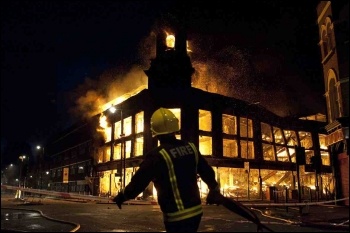
A much-loved Tottenham landmark, the Allied Carpets store with flats above, fired by rioters
“Criminality pure and simple,” David Cameron calls this week’s riots, and it “has to be confronted and defeated”. There’s nothing pure or simple about the events of this week. You wonder why he bothered to fly home from his Tuscan holiday if that’s all he learned from his urgently convened Cobra meeting. And if the assembled parliamentarians are going to spend their recalled session on Thursday wringing their hands and deploring and vowing to punish the bad, nothing will have been achieved.
Wiser old heads might remind the shocked ministers and would-be ministers that you can’t make people good by threatening, hectoring or even legislating. People will be good if they care to be and if it seems worth their while. It can help if you treat them in the first place as if they might have a capacity to be good. But since it came to office, the coalition government has appeared to have no good word for the most disadvantaged members of society. Denounced as spongers, shirkers and benefit cheats, they have seen their meagre support systems whittled away by cuts that seem targeted to do the most damage to the most damaged.
Unemployment is inevitably created by the systematic starvation of support for public services, and youth unemployment in particular is epidemic. Local authorities have been obliged to close youth and other amenities. The government has abolished the Education Maintenance Allowance that supported poorer students and others in work-based learning schemes (what used to be called apprenticeships) and is imposing a high level of indebtedness on future recipients of higher education. At the same time, levels of unemployment benefit are being cut and tests of eligibility have been tightened to the point where, to many recipients, being given any state support or none seems to be a lottery.
Allied Carpets, the morning after
Meanwhile, the media that the public depend upon for information and diversion are full of multimillionaire pop stars, actors and sports people flaunting themselves, not to mention stories of the eye-watering bonuses paid to those who work in banking and the city, many of whom seem to be over-rewarded whether they fail or succeed, whether they contribute to the general good or leech off it.
This infotainment is brought to the consumer courtesy of an increasingly ferocious campaign of advertising and promotion that instructs those consumers hundreds of times a day that they are somehow mysteriously out of the loop if they don’t acquire this, that or the other product. If you don’t have the money to buy these things, the notion naturally grows that you may as well steal them or, in the opportunist field day granted by an urban riot, loot them. After all, the culture that the various media promote carries a wholly dehumanised, grasping, competitive, uncaring, devil-take-the-hindmost message. Loot and steal is what everybody does, however exalted. Why should any kid with no income and no prospects respect a society run by people who live in tax havens and ruthlessly destroy the planet for short-term gain? If that kid lived in east Africa, she’d be starving to death.
Looters in Ealing
Many have asserted that the key to this week’s riots in London and elsewhere is the use among rioters of social networks and other internet devices. If so, society deserves it. The web can help in all sorts of way. A blithe discovery was an interview given by Nick Clegg to Sky News back in the run-up to the general election, in which he forecast that the policies that the Tories were proposing to implement in order to “clear up the economic mess” would cause rioting in the streets, just the policies that he now helps to implement. The piece can be found here
http://bit.ly/obvPOV
and, before Labour crows about it too much, that well-known, finger-on-the-pulse Labour frontbencher Tessa Jowell is seen pooh-poohing Clegg’s doom-predicting quite as disdainfully as David Cameron does. This is not a story from which any politician is going to be able to draw any comfort.
Burnt-out police car in Tottenham
Nor will the police, who find themselves in a classic bind, damned if they hold fire, damned if they go in all guns blazing. On the first three nights, they were soon cast as the villains of the piece, the citizenry – especially those burned out of their homes and businesses -– demanding to know where the help was hiding. It’s widely suggested that the tactic of staying out of it – if that indeed is what it was – was a gesture to persuade the government to stop slashing police budgets. Tonight, with 16,000 head of cops on the streets of London alone and dozens of cities and towns cancelling police leave, the danger is that civilian heads will be broken and well-founded cries of over-kill will ensue and – worse – over-kill on the wrong night. Meanwhile, the cost of police and firefighters’ overtime will have to be added to the cost of the clear-up, insurance pay-outs and eventual rebuild: more that the public purse can ill afford.
And it’s unarguable that there is still an issue over police and race relations, especially in the capital. Afro-Caribbean, Asian and mixed-race youth still feel vulnerable to unfounded police suspicion and it’s not all paranoia. As a gay white man, I cannot say hand on heart that I feel completely relaxed and accepted around police officers and I’m sure ethnic minority people sense similar subtexts of – at best – indifference. There is still a Neanderthal culture in the police – white, straight, right-wing, god-fearing, angry, blokeish – and anyone who doesn’t fit in there feels it. With the best will in the world, there is still a great deal to be changed. Watch the currently repeating fly-on-the-wall Channel 4 series Coppers for evidence.
Car windscreen in Nottingham
So this was the summer that the cities exploded. Truly, it’s been an eye-popping year, every week bringing fresh and unlooked-for astonishments. Much of that turmoil arises from a government feeling its way, with no clear grasp on how it wants Britain to be. Certainly, among the edifices going up in flames on Saturday, Sunday and Monday nights was Cameron’s vaunted Big Society. In opposition, he used to deploy the PR-speak phrase that Britain was “a broken society”. What is it now?
Showing posts with label Muammar Gaddafi. Show all posts
Tuesday, August 09, 2011
Monday, June 20, 2011
FOGH of WAR
Anders Fogh Rasmussen, Secretary General of NATO and a former Danish prime minister, gave an interview to Shaun Ley of Radio 4’s The World at One today that was little short of a disgrace. The interview will be available in the UK for a few days on the BBC iPlayer.
Rasmussen had made himself available in the light of the deaths of nine civilians, including two children, in Tripoli on Sunday. NATO has conceded that a missile overflew its military target. Rasmussen described the error as “a weapons systems failure”. He also accounted it “a very tragic event, a tragic accident actually”. Having found the phrase he wanted – “a tragic accident” – he used it as his default reference to the incident.
There was no acknowledgment in the interview, either by Ley or by Rasmussen, of the 15 civilians Libya says were killed by a rocket attack on the Sorman area of Tripoli in the early hours of this morning. This was certainly a residence, one owned by a close ally of Muammar Gaddafi. Taken to the scene, the BBC’s Middle East editor Jeremy Bowen reported Libyan officials claiming that eight missiles had hit the compound and that two of the owner’s grandchildren along with their pregnant mother were killed. NATO has so far declined to comment on the attack but if what the Libyans say is true it can hardly be dressed up as “eight tragic accidents”.
Rasmussen, an accident waiting to happen
Referring to Sunday’s deaths, Rasmussen commented that “obviously the Gaddafi regime will use this tragic accident as part of their propaganda”. This is an extraordinary statement at so many levels. It seems to suggest that only one side in the conflict has any truck with propaganda. It seeks to imply that somehow the deaths are part of the crimes with which the regime is charged. It certainly suggests that the deaths should be viewed as above or separate from the conflict, as though no more responsibility attaches to NATO than if the children had happened to run out into the road in the path of one of its vehicles. And why should the Gaddafi government not make mention of the civilian deaths? If Danish civilians perished in some missile attack, whether or not the strikers called it an accident, would the Danish government draw a veil over it?
The notion that the deaths are fundamentally the fault of Gaddafi develops in Rasmussen’s argument in this passage: “We see the Gaddafi regime … launching rockets from mosques, placing bunkers near children’s playgrounds etc”. Of course, any right-thinking person can see that a country being attacked by foreign troops ought to have the decency to lay out formal battlegrounds away from built-up areas. Indeed, no civilised country ever sites military or intelligence within blast distance of residential buildings. Well, I say that … all around where we live there is a vast network of military and intelligence units including, it has been suggested by specialist investigative journalists, a “top-level NATO command post” that runs “a gigantic US computer system”. No doubt if Britain were subjected to aerial bombardment, such sites would be prime targets and perhaps we would be hit in “a tragic accident”.
Gaddafi, down but not out
It’s not at all clear who sets out the rules for confrontations in which one side claims it is being attacked and invaded by foreign powers and the other side claims it is protecting the people from their own government. Nazi Germany invaded several of its neighbours before and during the course of World War II. I expect Berlin complained that resistance movements – which it would no doubt have dismissed as Communists, extremists, terrorists and Jews – mounted guerrilla attacks on Germany’s brave soldiers in urban areas, using the populace as human shields. It is in the nature of guerrilla warfare, particularly as conducted in the homeland of the resistance, that it challenges the enemy to retaliate without committing atrocities.
Rasmussen said “We have carried out more than 11,000 sorties … we have damaged or destroyed more than 2,000 important military targets". Even if only ten percent of those sorties and those missile attacks were targeted at sites within blast range of homes, the least “collateral damage” they will have inflicted will be the extensive disruption of civilians’ lives. And who will pick up the tab for making good the damage?
Always at risk in Libya
When Shaun Ley questioned Rasmussen on NATO’s objectives in Libya, the Secretary General was at his most slippery. “There is no military solution solely” he said. “We need a political process and as part of that Gaddafi must go”. Now it is clear from this that regime change is part of NATO’s policy, although regime change is not provided for, implicitly or explicitly, in Resolution 1973, the United Nations instrument that enables the imposition of a no-fly zone on Libya. Making regime change a necessary part of the “process” is what commentators feared and forecast when they warned against so-called “mission creep”. We can be sure from this that the mission has crept.
But Rasmussen also said: “We have defined three very clear military objectives for our operation: a complete end to all attacks against civilians; withdrawal of Gaddafi’s forces to their bases; and immediate and unhindered humanitarian access and we will continue our operation until these objectives are met”.
Gaddafi's planes strike back
Each of these objectives has its unclear elements. If Gaddafi were to call a ceasefire and then rebels were to push out of Misrata and start trying to take other towns, what would NATO do? Attempt to halt them? And of course there are implications for the NATO objectives if NATO is itself beginning deliberately to attack civilians, as in the bloody Sorman carnage. If, as Rasmussen claims, Gaddafi’s military infrastructure is being destroyed, what would pass muster as the “bases” to which the troops should return? And as for the “humanitarian access”, how would that be policed except by what are called “boots on the ground”, which Resolution 1973 very definitely does not permit?
Ley did push Rasmussen on the increasing evidence that NATO’s solidarity is fraying and that few participants are looking for a long-drawn-out involvement. NATO has committed to a further three months of policing the no-fly zone, making six months in total thus far. This will mean that its involvement in the action will have cost the UK alone more than £500million. Rasmussen was evidently not prepared to engage with any idea of there being a limit on NATO’s capacity. “We do have the assets that are necessary to accomplish our mission” he declared and otherwise kept restating NATO’s determination.
Rebels swarm over a captured tank
As I read it, NATO has slid into an uncomfortable cleft stick in Libya. The rebels grow restive, agitating for more consistent, coherent and penetrating assistance in their struggle. If and when the conflict grinds to a halt, with whatever result, Libya’s economy will be too damaged for it to be able to rebuild without help from the international community. And certainly a new regime will soon denounce NATO if it is left to pick up the pieces by itself.
And then Gaddafi is not Hosni Mubarak and probably has grounds for his confidence that he has sufficient support to hold out longer than NATO will want to contemplate. But Libya is clearly deeply divided. What is to prevent a bloodbath of the defeated at the hands of the victors, whichever side prevails? Meanwhile, as other demands on governments’ resources start to take centre stage, politicians and the public will increasingly ask whether this commitment of cash and overstretched military might is really worth it. In sum, the whole adventure is a catastrophically badly planned and managed mess. Many of us warned at the outset that it would pan out like this.
Anders Fogh Rasmussen, Secretary General of NATO and a former Danish prime minister, gave an interview to Shaun Ley of Radio 4’s The World at One today that was little short of a disgrace. The interview will be available in the UK for a few days on the BBC iPlayer.
Rasmussen had made himself available in the light of the deaths of nine civilians, including two children, in Tripoli on Sunday. NATO has conceded that a missile overflew its military target. Rasmussen described the error as “a weapons systems failure”. He also accounted it “a very tragic event, a tragic accident actually”. Having found the phrase he wanted – “a tragic accident” – he used it as his default reference to the incident.
There was no acknowledgment in the interview, either by Ley or by Rasmussen, of the 15 civilians Libya says were killed by a rocket attack on the Sorman area of Tripoli in the early hours of this morning. This was certainly a residence, one owned by a close ally of Muammar Gaddafi. Taken to the scene, the BBC’s Middle East editor Jeremy Bowen reported Libyan officials claiming that eight missiles had hit the compound and that two of the owner’s grandchildren along with their pregnant mother were killed. NATO has so far declined to comment on the attack but if what the Libyans say is true it can hardly be dressed up as “eight tragic accidents”.
Rasmussen, an accident waiting to happen
Referring to Sunday’s deaths, Rasmussen commented that “obviously the Gaddafi regime will use this tragic accident as part of their propaganda”. This is an extraordinary statement at so many levels. It seems to suggest that only one side in the conflict has any truck with propaganda. It seeks to imply that somehow the deaths are part of the crimes with which the regime is charged. It certainly suggests that the deaths should be viewed as above or separate from the conflict, as though no more responsibility attaches to NATO than if the children had happened to run out into the road in the path of one of its vehicles. And why should the Gaddafi government not make mention of the civilian deaths? If Danish civilians perished in some missile attack, whether or not the strikers called it an accident, would the Danish government draw a veil over it?
The notion that the deaths are fundamentally the fault of Gaddafi develops in Rasmussen’s argument in this passage: “We see the Gaddafi regime … launching rockets from mosques, placing bunkers near children’s playgrounds etc”. Of course, any right-thinking person can see that a country being attacked by foreign troops ought to have the decency to lay out formal battlegrounds away from built-up areas. Indeed, no civilised country ever sites military or intelligence within blast distance of residential buildings. Well, I say that … all around where we live there is a vast network of military and intelligence units including, it has been suggested by specialist investigative journalists, a “top-level NATO command post” that runs “a gigantic US computer system”. No doubt if Britain were subjected to aerial bombardment, such sites would be prime targets and perhaps we would be hit in “a tragic accident”.
Gaddafi, down but not out
It’s not at all clear who sets out the rules for confrontations in which one side claims it is being attacked and invaded by foreign powers and the other side claims it is protecting the people from their own government. Nazi Germany invaded several of its neighbours before and during the course of World War II. I expect Berlin complained that resistance movements – which it would no doubt have dismissed as Communists, extremists, terrorists and Jews – mounted guerrilla attacks on Germany’s brave soldiers in urban areas, using the populace as human shields. It is in the nature of guerrilla warfare, particularly as conducted in the homeland of the resistance, that it challenges the enemy to retaliate without committing atrocities.
Rasmussen said “We have carried out more than 11,000 sorties … we have damaged or destroyed more than 2,000 important military targets". Even if only ten percent of those sorties and those missile attacks were targeted at sites within blast range of homes, the least “collateral damage” they will have inflicted will be the extensive disruption of civilians’ lives. And who will pick up the tab for making good the damage?
Always at risk in Libya
When Shaun Ley questioned Rasmussen on NATO’s objectives in Libya, the Secretary General was at his most slippery. “There is no military solution solely” he said. “We need a political process and as part of that Gaddafi must go”. Now it is clear from this that regime change is part of NATO’s policy, although regime change is not provided for, implicitly or explicitly, in Resolution 1973, the United Nations instrument that enables the imposition of a no-fly zone on Libya. Making regime change a necessary part of the “process” is what commentators feared and forecast when they warned against so-called “mission creep”. We can be sure from this that the mission has crept.
But Rasmussen also said: “We have defined three very clear military objectives for our operation: a complete end to all attacks against civilians; withdrawal of Gaddafi’s forces to their bases; and immediate and unhindered humanitarian access and we will continue our operation until these objectives are met”.
Gaddafi's planes strike back
Each of these objectives has its unclear elements. If Gaddafi were to call a ceasefire and then rebels were to push out of Misrata and start trying to take other towns, what would NATO do? Attempt to halt them? And of course there are implications for the NATO objectives if NATO is itself beginning deliberately to attack civilians, as in the bloody Sorman carnage. If, as Rasmussen claims, Gaddafi’s military infrastructure is being destroyed, what would pass muster as the “bases” to which the troops should return? And as for the “humanitarian access”, how would that be policed except by what are called “boots on the ground”, which Resolution 1973 very definitely does not permit?
Ley did push Rasmussen on the increasing evidence that NATO’s solidarity is fraying and that few participants are looking for a long-drawn-out involvement. NATO has committed to a further three months of policing the no-fly zone, making six months in total thus far. This will mean that its involvement in the action will have cost the UK alone more than £500million. Rasmussen was evidently not prepared to engage with any idea of there being a limit on NATO’s capacity. “We do have the assets that are necessary to accomplish our mission” he declared and otherwise kept restating NATO’s determination.
Rebels swarm over a captured tank
As I read it, NATO has slid into an uncomfortable cleft stick in Libya. The rebels grow restive, agitating for more consistent, coherent and penetrating assistance in their struggle. If and when the conflict grinds to a halt, with whatever result, Libya’s economy will be too damaged for it to be able to rebuild without help from the international community. And certainly a new regime will soon denounce NATO if it is left to pick up the pieces by itself.
And then Gaddafi is not Hosni Mubarak and probably has grounds for his confidence that he has sufficient support to hold out longer than NATO will want to contemplate. But Libya is clearly deeply divided. What is to prevent a bloodbath of the defeated at the hands of the victors, whichever side prevails? Meanwhile, as other demands on governments’ resources start to take centre stage, politicians and the public will increasingly ask whether this commitment of cash and overstretched military might is really worth it. In sum, the whole adventure is a catastrophically badly planned and managed mess. Many of us warned at the outset that it would pan out like this.
Saturday, April 23, 2011
SUBORDINATE LIVES
Thrift and, to a lesser degree, inclination keep us at home while others take their holidays. We are fortunate enough to have a house, land and a general environment that is very conducive to staying put. Even working from home takes no edge off the pleasure.
From a safe distance, we watch others sitting in traffic jams, sweltering in airport lounges, regretting the temporary accommodation into which they have stumbled. Holidays can be a pleasure, of course, and a necessary restoration. They can be much more than that: they can furnish some of the most glorious moments and memories of our lives. And equally they can be a disappointment, even a nightmare. East, west, home’s best.
The key word in that sentiment, though, is “safe”. From an even safer distance, we have looked on aghast in recent times as lives, homes, whole communities have been destroyed by flood, wildfire, earthquake, hurricane, drought, tsunami. Thousands of lives have been snuffed out. Thousands more have been deprived of everything. It’s unimaginable: losing in a few moments one’s family, home, friends, livelihood, land, pets, the tools of one’s trade, possessions, mementoes, livestock, neighbourhood – all of the things that define one’s existence.
All of these disasters are beyond our ability to resist or predict. They are natural events, the accidents of a moving, evolving planet. Or at least, they are up to a point. Many fires that destroy large areas are started carelessly, even deliberately. All of the other catastrophes, it can be argued, are made more prevalent by the degree to which we have exploited and polluted the planet. And the way that we behave brings closer another apocalyptic event, one that may become more common in the near future: pandemic.
But there is still another kind of disaster that can have just as devastating an impact on people’s lives, one that is entirely avoidable: warfare. In some respects, warfare (as well as being gratuitous yet willed) is even more damaging than the natural disaster. The intelligence about victims and casualties becomes caught up in propaganda. The impulse to help those affected, whether directly or by donation, is much weaker than in the face of an unwilled event and much more hampered by the ongoing nature of that event. Moreover, as is claimed to occur in Libya and Syria, those who seek to help may themselves become targets. And the toxic nature of modern weapons can continue to destroy long after the ceasefire, as any resident of Vietnam will tell you.
News organisations always want numbers to attach to disaster reports so that they can convey a sense of the scale of the event. But casualties of war are less diligently counted, harder to determine, more likely to be disputed. War propaganda routinely casts doubt on stories of civilian casualties and fiercely denies reports of atrocities. When evidence of civilian deaths and injuries begins to look harder to refute, the authorities issue a shrug: the term for such eventualities is “collateral damage”. The word collateral means parallel or alongside but it also carries the sense of being subordinate, of being of lesser consequence.
Military deaths are reported one by one, identified, praised and personally recalled. Civilian deaths are often unreported, mostly unrecorded, certainly not identified. The military personnel who receive wounds are rushed to the best available medical attention. The civilians who receive wounds must fend for themselves – crawl to someone who might help, stumble through wrecked streets at the mercy of falling masonry, snipers, bombs. Their hospital may anyway have been razed; if not, it will certainly be desperately short of staff, beds, power, equipment, medicaments, even basic dressings.
And the military don’t have to be there. Becoming a warrior is a career choice, save in those countries that impose conscription: China, Russia, Libya, Syria, Israel and most other middle eastern countries, many South American nations and – which may surprise you, as it does me – Greece, Denmark, Finland, Austria and Switzerland. The military are there out of choice – if not necessarily their own choice, certainly their government’s choice. They are equipped to protect themselves as far as is feasible. At worst, though certainly not eliminated, their risk is contained.
Civilians have no such advantages. They are where they live and, unless they are rich – and war casualties generally are not rich – that is their only option. They have no protection, no defence, nothing with which to retaliate, no basis from which to seek redress, no hope but the hope that the attack will end before their lives do.
In Libya, in Afghanistan as I write, as you read, or not long before or after, civilians are dying by the weapons of invaders, interferers, interlopers: the western powers, NATO, the supposedly civilised world. Lives and those things that make those lives are obliterated without a thought. It’s a price you have to pay, say the politicians and brass hats. It’s unavoidable. And there is the unvoiced subtext: it’s okay, it’s just collateral damage, it’s just ordinary people, they are of no significance.
If a bomber “took out” the family of Obama or Cameron or Sarkozy or Rasmussen or Petraeus, we would never hear the last of it. We would be asked and expected to feel and share that man’s pain. Does any one of them ever look back in the opposite direction at the Afghani man whose wife and children are killed by a misdirected US drone at a wedding, at the Libyan mother whose scared and ill-trained only son, obliged to defend Gaddafi, burns to death in a Libyan tank hit by a British missile more sophisticated than her family can ever hope to be?
The scars of the war in Vietnam will be visible – and present if invisible – for generations as yet unborn. Iraq, home to one of the world’s most ancient and lucid cultures, is a ruined land. So is Afghanistan. So soon will be Libya. Does nobody care about this wanton destruction of people and their civilisation?
Well, the NATO apologists will say, if the “great powers” had not acted, Gaddafi would have destroyed his own people? Would he? No one can ever know what would have happened had Libya been left to its own devices. What we know for certain is that Libya is wracked by civil war, a war that has been changed daily over five weeks by foreign powers. Everything that happens now in Libya is a product, to some degree, of the presence of sorties from the air by invaders. NATO is engaged and therefore is responsible. It is too easy merely to “blame” Gaddafi for everything. The invaders also have to own their actions.
In the modern world, as in the ancient, war is the option of first, not of last resort. Despots and governments, fundamentalists and rebels, generals and fighters stride into military confrontation with the intention of “winning”. It seems that they learn nothing from precedent. They have no plan B, no sense that the enemy may not fall down at the first puff of wind, no strategy for the unexpected, the long-drawn-out, the endgame. The moment that things stop being as a simple as a playground scrap, they start to tell lies, to seek to save face, to pretend that the end will be what is required, even if it turns out to be unrecognisably different from the stated or implied war aims at the outset.
Meanwhile, people die. The lives of ill-trained front-line troops are sacrificed. Bystanders who barely grasp the great causes at stake are mown down. Small children, whose task is not yet to comprehend the gutter into which they have been born, are orphaned, blinded, deprived of limbs, rendered zombies and mutes and psychopaths. Mean streets, the best that they know, are flattened. The earth is despoiled and will no longer sustain dependable crops.
And of course the damage done to the planet is not readily contained in the theatre of war. We may shit in the next field but the elements and the actions of living things bring the turds back into our own field. We unleash the dogs of war without taking the precaution of training them, directing them, studying their nature.
Humans have thousands of years of philosophy, diplomacy and historical study upon which to draw. How can it be beyond the glorious sophistication of mankind to contrive a mechanism whereby avenues other than taking up arms are comprehensively explored before a stone is thrown in anger? Cannot the UN be so constituted that territorial face-offs, tribal rivalries, disputed elections and perceived despotism are examined and the remedies negotiated before bodies and homes and productive land are destroyed?
Almost 2000 years ago, Tacitus wrote: “They have made a wasteland and called it peace”. In some translations, “wasteland” is rendered as “desert”. Perhaps those generals and politicians who talk airily about “drawing a line in the sand” in Libya – evidently unmindful that a line in the sand is about as easily eradicated a gesture as can be made – will consider, when they are done in that benighted land, whether they have enhanced the desert or merely rendered it unfit for habitation.
Thrift and, to a lesser degree, inclination keep us at home while others take their holidays. We are fortunate enough to have a house, land and a general environment that is very conducive to staying put. Even working from home takes no edge off the pleasure.
From a safe distance, we watch others sitting in traffic jams, sweltering in airport lounges, regretting the temporary accommodation into which they have stumbled. Holidays can be a pleasure, of course, and a necessary restoration. They can be much more than that: they can furnish some of the most glorious moments and memories of our lives. And equally they can be a disappointment, even a nightmare. East, west, home’s best.
The key word in that sentiment, though, is “safe”. From an even safer distance, we have looked on aghast in recent times as lives, homes, whole communities have been destroyed by flood, wildfire, earthquake, hurricane, drought, tsunami. Thousands of lives have been snuffed out. Thousands more have been deprived of everything. It’s unimaginable: losing in a few moments one’s family, home, friends, livelihood, land, pets, the tools of one’s trade, possessions, mementoes, livestock, neighbourhood – all of the things that define one’s existence.
All of these disasters are beyond our ability to resist or predict. They are natural events, the accidents of a moving, evolving planet. Or at least, they are up to a point. Many fires that destroy large areas are started carelessly, even deliberately. All of the other catastrophes, it can be argued, are made more prevalent by the degree to which we have exploited and polluted the planet. And the way that we behave brings closer another apocalyptic event, one that may become more common in the near future: pandemic.
But there is still another kind of disaster that can have just as devastating an impact on people’s lives, one that is entirely avoidable: warfare. In some respects, warfare (as well as being gratuitous yet willed) is even more damaging than the natural disaster. The intelligence about victims and casualties becomes caught up in propaganda. The impulse to help those affected, whether directly or by donation, is much weaker than in the face of an unwilled event and much more hampered by the ongoing nature of that event. Moreover, as is claimed to occur in Libya and Syria, those who seek to help may themselves become targets. And the toxic nature of modern weapons can continue to destroy long after the ceasefire, as any resident of Vietnam will tell you.
News organisations always want numbers to attach to disaster reports so that they can convey a sense of the scale of the event. But casualties of war are less diligently counted, harder to determine, more likely to be disputed. War propaganda routinely casts doubt on stories of civilian casualties and fiercely denies reports of atrocities. When evidence of civilian deaths and injuries begins to look harder to refute, the authorities issue a shrug: the term for such eventualities is “collateral damage”. The word collateral means parallel or alongside but it also carries the sense of being subordinate, of being of lesser consequence.
Military deaths are reported one by one, identified, praised and personally recalled. Civilian deaths are often unreported, mostly unrecorded, certainly not identified. The military personnel who receive wounds are rushed to the best available medical attention. The civilians who receive wounds must fend for themselves – crawl to someone who might help, stumble through wrecked streets at the mercy of falling masonry, snipers, bombs. Their hospital may anyway have been razed; if not, it will certainly be desperately short of staff, beds, power, equipment, medicaments, even basic dressings.
And the military don’t have to be there. Becoming a warrior is a career choice, save in those countries that impose conscription: China, Russia, Libya, Syria, Israel and most other middle eastern countries, many South American nations and – which may surprise you, as it does me – Greece, Denmark, Finland, Austria and Switzerland. The military are there out of choice – if not necessarily their own choice, certainly their government’s choice. They are equipped to protect themselves as far as is feasible. At worst, though certainly not eliminated, their risk is contained.
Civilians have no such advantages. They are where they live and, unless they are rich – and war casualties generally are not rich – that is their only option. They have no protection, no defence, nothing with which to retaliate, no basis from which to seek redress, no hope but the hope that the attack will end before their lives do.
In Libya, in Afghanistan as I write, as you read, or not long before or after, civilians are dying by the weapons of invaders, interferers, interlopers: the western powers, NATO, the supposedly civilised world. Lives and those things that make those lives are obliterated without a thought. It’s a price you have to pay, say the politicians and brass hats. It’s unavoidable. And there is the unvoiced subtext: it’s okay, it’s just collateral damage, it’s just ordinary people, they are of no significance.
If a bomber “took out” the family of Obama or Cameron or Sarkozy or Rasmussen or Petraeus, we would never hear the last of it. We would be asked and expected to feel and share that man’s pain. Does any one of them ever look back in the opposite direction at the Afghani man whose wife and children are killed by a misdirected US drone at a wedding, at the Libyan mother whose scared and ill-trained only son, obliged to defend Gaddafi, burns to death in a Libyan tank hit by a British missile more sophisticated than her family can ever hope to be?
The scars of the war in Vietnam will be visible – and present if invisible – for generations as yet unborn. Iraq, home to one of the world’s most ancient and lucid cultures, is a ruined land. So is Afghanistan. So soon will be Libya. Does nobody care about this wanton destruction of people and their civilisation?
Well, the NATO apologists will say, if the “great powers” had not acted, Gaddafi would have destroyed his own people? Would he? No one can ever know what would have happened had Libya been left to its own devices. What we know for certain is that Libya is wracked by civil war, a war that has been changed daily over five weeks by foreign powers. Everything that happens now in Libya is a product, to some degree, of the presence of sorties from the air by invaders. NATO is engaged and therefore is responsible. It is too easy merely to “blame” Gaddafi for everything. The invaders also have to own their actions.
In the modern world, as in the ancient, war is the option of first, not of last resort. Despots and governments, fundamentalists and rebels, generals and fighters stride into military confrontation with the intention of “winning”. It seems that they learn nothing from precedent. They have no plan B, no sense that the enemy may not fall down at the first puff of wind, no strategy for the unexpected, the long-drawn-out, the endgame. The moment that things stop being as a simple as a playground scrap, they start to tell lies, to seek to save face, to pretend that the end will be what is required, even if it turns out to be unrecognisably different from the stated or implied war aims at the outset.
Meanwhile, people die. The lives of ill-trained front-line troops are sacrificed. Bystanders who barely grasp the great causes at stake are mown down. Small children, whose task is not yet to comprehend the gutter into which they have been born, are orphaned, blinded, deprived of limbs, rendered zombies and mutes and psychopaths. Mean streets, the best that they know, are flattened. The earth is despoiled and will no longer sustain dependable crops.
And of course the damage done to the planet is not readily contained in the theatre of war. We may shit in the next field but the elements and the actions of living things bring the turds back into our own field. We unleash the dogs of war without taking the precaution of training them, directing them, studying their nature.
Humans have thousands of years of philosophy, diplomacy and historical study upon which to draw. How can it be beyond the glorious sophistication of mankind to contrive a mechanism whereby avenues other than taking up arms are comprehensively explored before a stone is thrown in anger? Cannot the UN be so constituted that territorial face-offs, tribal rivalries, disputed elections and perceived despotism are examined and the remedies negotiated before bodies and homes and productive land are destroyed?
Almost 2000 years ago, Tacitus wrote: “They have made a wasteland and called it peace”. In some translations, “wasteland” is rendered as “desert”. Perhaps those generals and politicians who talk airily about “drawing a line in the sand” in Libya – evidently unmindful that a line in the sand is about as easily eradicated a gesture as can be made – will consider, when they are done in that benighted land, whether they have enhanced the desert or merely rendered it unfit for habitation.
Labels:
Afghanistan,
Barack Obama,
collateral damage,
David Cameron,
death,
fires,
floods,
holidays,
Iraq,
Libya,
Muammar Gaddafi,
NATO,
natural disasters,
Syria,
Tacitus,
tsunami,
UN,
Vietnam,
warfare
Saturday, March 19, 2011
LIBYA – RATION the RHETORIC
Yesterday, on the eighth anniversary of the Commons vote in favour of the illegal invasion of Iraq, David Cameron laid before parliament the rationale for the United Nations’ resolution to impose a so-called no-fly zone on Libya. From the moral high ground on which Cameron plants his feet, the issue is so very simple. Gaddafi is a bad man and he must be taught a lesson. Primary schoolchildren could articulate the position just as persuasively. It is what I call The Bogie Man Theory of History, or, as the Americans would call it, The Boogey Man Theory.
Not that there is any significant opposition to this in the House. It has been observed before (though I am unable to verify an attribution) that “when the House is united, it is invariably wrong”. Yesterday confirmed that sentiment. Nick Clegg, whose party opposed the Iraq invasion, sat doing the gravely nodding dog act beside his coalition leader. Ed Miliband rushed to sound as resolute and determinedly courageous as Cameron, as if anybody gives a tuppenny damn what the British Labour Party says about the issue. You cannot expect sense from Labour on matters of British imperialism. I can never forget that, just a fortnight after describing himself as “an inveterate peacemonger”, Michael Foot (of all people) was unconditionally supporting Margaret Thatcher’s adventure in the south Atlantic, an exercise that, by itself, almost certainly kept the Tories in power (and so Labour out of office) for the following fifteen years.
Cameron in the Gulf States last month
Britain cannot stand idly by, is Miliband’s argument, while Gaddafi massacres his own people. Well, I want to ask: why not? What do the ambassadors of, for the sake of argument, Hungary, Barbados, Venezuela, Laos and Gabon have to say about the implied criticism that they are indeed perfectly happy to stand idly by? Why does Britain have to be the one who takes it upon herself to punish the bogie man of the sands? Apart from being the most extensive supplier in history of armaments to the country, Britain has no particular historical links with Libya, certainly none comparable to those of Italy, of which Libya was a colony for most of the first half of last century. Yet Silvio Berlusconi’s input into the no-fly zone argument is not widely recorded. Perhaps he has been too busy entertaining under-age women this week (as every other week).
Gaddafi cultivates the Ruritanian look
Throughout the thrilling people’s revolution that toppled Hosni Mubarak earlier this year, we heard daily about how wonderful is the Egyptian army. So why didn’t the UN put pressure on Egypt to send its fabled troops over the border to repel Gaddafi? Other member states of the Arab League – Jordan, Kuwait and Morocco, for instance – have disciplined military strength. It makes considerably more geopolitical sense for Arab nations physically to lead the campaign to bring Gaddafi to heel.
Cameron, basking in evidently widespread approval for having played a supposedly canny hand with both the UN and the US, assures that he is not “grandstanding” on this matter. Of course he is. Cameron veers between invoking the “moral” argument that Miliband articulated and reassuring his political base that it is “in Britain’s interests” to lead the world’s reaction to Gaddafi’s rush towards civil war. These interests begin and end with the international supply and cost of oil. At least when he concedes that much, Cameron is approaching a soupçon of candour.
The argument about morality is bankrupt. When, on the BBC News last night, Nick Robinson asked the PM about his position on Bahrain, Cameron waved it away: different problem, different dynamic, different order of morality. Here’s a significant difference: picking a fight with the Saudi forces now called into the Bahraini kingdom to put down the rebellion is much more challenging than picking a fight with Gaddafi’s raggle-taggle air force of conscripted peasants and Saharan mercenaries. Clearly, the military might of a consortium consisting of Britain, France and – in the second wave perhaps – the USA is not going to have much trouble wiping out Libya’s military might.
Gaddafi visiting Berlusconi in Rome, 2009
Or is it? The invaders of Iraq and Afghanistan figured it would be the work of a few weeks at most. Libya might be as straightforward to quell as Serbia or it might not. Gaddafi has not lasted this long in power without being a wily and tough operator. The ceasefire announced yesterday by his foreign minister, the wonderfully named Mussa Kussa, is certainly a sham. But it has already had the desired effect. It has wrong-footed the west and sent governments into a further huddle. There will be more of this.
So Britain has embarked on another military interference in the internal affairs of another sovereign nation with consequences just as unknowable as they always are. The hubris – of the very interference, of the self-aggrandisement, of the cloak of proclaimed morality, of the certainty of military superiority – is breathtaking.
And then, seeing as no one seems yet to have asked, I ask it: who pays? Simple. We do. Today’s Daily Telegraph, while busy lining up Cameron for canonisation as a war leader, gaily trumpets on its front page that “some families will have £3,500 wiped off their annual incomes next month because of tax increases and cuts to benefits”. Oh good. How much less pain they will feel to know that this loss of income will now be largely spent on an utterly unpredictable big-willy experiment in the North African desert. How can a government that is in the throes of undermining – in some cases fundamentally undermining – every public enterprise in Britain gaily decide to throw money at a totally unnecessary interference in a foreign civil war?
Intimates no more – Sarkozy and Gaddafi in 2007
Well, you may say, what would you do? Just sit back and let Gaddafi massacre his brave populace? I am not a politician, nor about to be one. I don’t have to have a foolproof bill of fare ready to execute tomorrow. Nor do I have to accept the convention of starting from here. I do have a long-term proposal that, had it been put into effect when I first proposed it five years ago, might have avoided the situation that we now face. Here it is.
We must give the United Nations actual power and that of course means power greater than that of any one member. The UN charter, still almost exactly as written in 1945, needs substantial revision. The permanent members of the Security Council must agree to surrender their veto, the prerogative of the bully over the powerless. No member can be allowed exemption.
The veto means that the UN has no muscle to flex against the US or China or the other elite nations. Which of them will volunteer to forego a veto? It would need a visionary party leader or presidential candidate to carry the case with his own electorate, so as to take a mandate to the other Security Council members; a diplomat of rare persuasive power, who implicitly understands the global gain of a truly powerful UN, to convert even one of the holders of the veto. But someone needs to attempt it. What is political power for if not to change the world?
Tony Blair enjoys a quick two-step with his good pal
The point of this exercise is to create a UN capable of credibly policing the behaviour of all member states. UN peacekeeping forces, made up of recruits from any and every member state, handsomely rewarded by all the members in proportion to their GDP, must be the only troops permitted to move freely across the territories of the disputing nations. And this should apply to internal, tribal and internecine strife as well as that between separate nations. Meanwhile, the remit of the UN’s International Court of Justice needs to be widened so as not to depend on the consent of those states that are party to a dispute, another tough sell.
The UN should assume the power to order the immediate cessation of hostilities between member states. Waging war must be against the UN’s bedrock principles. Any member visiting warfare on another should be suspended forthwith from UN membership. In practice this must mean that all other member states, including those sympathetic to the miscreant’s cause, suspend all trade and other dealings with the suspended member. A blanket economic freeze would soon encourage a government to halt hostilities. The UN must then have the resources to assume control of negotiation of a settlement between the disputatious nations. Warfare must be a gambit that is made impracticable because it makes each of the warring nations an international pariah. If both sides are taken out of benefit of UN membership, the issue of ‘blame’ is largely futile. The UN negotiators can then begin with a level playing field.
Libyan rebels on the Benghazi road
The UN’s power to intervene in a sovereign nation’s internal affairs would be a more complex matter than preventing state-to-state confrontation. The UN’s remit should be truly global and therefore probably cannot be automatically parochial. Matters such as the suppression of a particular tribal or religious grouping within a nation state would have to be confronted on a case-by-case basis. But a case like that of Libya or indeed Bahrain is not so complex as to be beyond a newly-constituted UN to resolve. Moreover, the UN could hold sway over issues other than warfare. It could wield its power, no longer fettered by national vetoes, to impose restrictions on the activities that contribute so catastrophically to the destruction of the environment. But that is a road down which to travel on another occasion.
In the absence of a UN rebuilt along the lines that I propose, we have another potential disaster taking shape in a country that can ill afford to be ravaged by years of war. Today‘s self-satisfied certainties in London and in Paris and, more cautiously, in Washington, may well look rather less confident tomorrow or a week or a month hence. We shall see. But at this particular moment, I feel like invoking an angry cry of just eight years ago: Not In My Name.
Yesterday, on the eighth anniversary of the Commons vote in favour of the illegal invasion of Iraq, David Cameron laid before parliament the rationale for the United Nations’ resolution to impose a so-called no-fly zone on Libya. From the moral high ground on which Cameron plants his feet, the issue is so very simple. Gaddafi is a bad man and he must be taught a lesson. Primary schoolchildren could articulate the position just as persuasively. It is what I call The Bogie Man Theory of History, or, as the Americans would call it, The Boogey Man Theory.
Not that there is any significant opposition to this in the House. It has been observed before (though I am unable to verify an attribution) that “when the House is united, it is invariably wrong”. Yesterday confirmed that sentiment. Nick Clegg, whose party opposed the Iraq invasion, sat doing the gravely nodding dog act beside his coalition leader. Ed Miliband rushed to sound as resolute and determinedly courageous as Cameron, as if anybody gives a tuppenny damn what the British Labour Party says about the issue. You cannot expect sense from Labour on matters of British imperialism. I can never forget that, just a fortnight after describing himself as “an inveterate peacemonger”, Michael Foot (of all people) was unconditionally supporting Margaret Thatcher’s adventure in the south Atlantic, an exercise that, by itself, almost certainly kept the Tories in power (and so Labour out of office) for the following fifteen years.
Cameron in the Gulf States last monthBritain cannot stand idly by, is Miliband’s argument, while Gaddafi massacres his own people. Well, I want to ask: why not? What do the ambassadors of, for the sake of argument, Hungary, Barbados, Venezuela, Laos and Gabon have to say about the implied criticism that they are indeed perfectly happy to stand idly by? Why does Britain have to be the one who takes it upon herself to punish the bogie man of the sands? Apart from being the most extensive supplier in history of armaments to the country, Britain has no particular historical links with Libya, certainly none comparable to those of Italy, of which Libya was a colony for most of the first half of last century. Yet Silvio Berlusconi’s input into the no-fly zone argument is not widely recorded. Perhaps he has been too busy entertaining under-age women this week (as every other week).
Gaddafi cultivates the Ruritanian lookThroughout the thrilling people’s revolution that toppled Hosni Mubarak earlier this year, we heard daily about how wonderful is the Egyptian army. So why didn’t the UN put pressure on Egypt to send its fabled troops over the border to repel Gaddafi? Other member states of the Arab League – Jordan, Kuwait and Morocco, for instance – have disciplined military strength. It makes considerably more geopolitical sense for Arab nations physically to lead the campaign to bring Gaddafi to heel.
Cameron, basking in evidently widespread approval for having played a supposedly canny hand with both the UN and the US, assures that he is not “grandstanding” on this matter. Of course he is. Cameron veers between invoking the “moral” argument that Miliband articulated and reassuring his political base that it is “in Britain’s interests” to lead the world’s reaction to Gaddafi’s rush towards civil war. These interests begin and end with the international supply and cost of oil. At least when he concedes that much, Cameron is approaching a soupçon of candour.
The argument about morality is bankrupt. When, on the BBC News last night, Nick Robinson asked the PM about his position on Bahrain, Cameron waved it away: different problem, different dynamic, different order of morality. Here’s a significant difference: picking a fight with the Saudi forces now called into the Bahraini kingdom to put down the rebellion is much more challenging than picking a fight with Gaddafi’s raggle-taggle air force of conscripted peasants and Saharan mercenaries. Clearly, the military might of a consortium consisting of Britain, France and – in the second wave perhaps – the USA is not going to have much trouble wiping out Libya’s military might.
Gaddafi visiting Berlusconi in Rome, 2009Or is it? The invaders of Iraq and Afghanistan figured it would be the work of a few weeks at most. Libya might be as straightforward to quell as Serbia or it might not. Gaddafi has not lasted this long in power without being a wily and tough operator. The ceasefire announced yesterday by his foreign minister, the wonderfully named Mussa Kussa, is certainly a sham. But it has already had the desired effect. It has wrong-footed the west and sent governments into a further huddle. There will be more of this.
So Britain has embarked on another military interference in the internal affairs of another sovereign nation with consequences just as unknowable as they always are. The hubris – of the very interference, of the self-aggrandisement, of the cloak of proclaimed morality, of the certainty of military superiority – is breathtaking.
And then, seeing as no one seems yet to have asked, I ask it: who pays? Simple. We do. Today’s Daily Telegraph, while busy lining up Cameron for canonisation as a war leader, gaily trumpets on its front page that “some families will have £3,500 wiped off their annual incomes next month because of tax increases and cuts to benefits”. Oh good. How much less pain they will feel to know that this loss of income will now be largely spent on an utterly unpredictable big-willy experiment in the North African desert. How can a government that is in the throes of undermining – in some cases fundamentally undermining – every public enterprise in Britain gaily decide to throw money at a totally unnecessary interference in a foreign civil war?
Intimates no more – Sarkozy and Gaddafi in 2007Well, you may say, what would you do? Just sit back and let Gaddafi massacre his brave populace? I am not a politician, nor about to be one. I don’t have to have a foolproof bill of fare ready to execute tomorrow. Nor do I have to accept the convention of starting from here. I do have a long-term proposal that, had it been put into effect when I first proposed it five years ago, might have avoided the situation that we now face. Here it is.
We must give the United Nations actual power and that of course means power greater than that of any one member. The UN charter, still almost exactly as written in 1945, needs substantial revision. The permanent members of the Security Council must agree to surrender their veto, the prerogative of the bully over the powerless. No member can be allowed exemption.
The veto means that the UN has no muscle to flex against the US or China or the other elite nations. Which of them will volunteer to forego a veto? It would need a visionary party leader or presidential candidate to carry the case with his own electorate, so as to take a mandate to the other Security Council members; a diplomat of rare persuasive power, who implicitly understands the global gain of a truly powerful UN, to convert even one of the holders of the veto. But someone needs to attempt it. What is political power for if not to change the world?
Tony Blair enjoys a quick two-step with his good palThe point of this exercise is to create a UN capable of credibly policing the behaviour of all member states. UN peacekeeping forces, made up of recruits from any and every member state, handsomely rewarded by all the members in proportion to their GDP, must be the only troops permitted to move freely across the territories of the disputing nations. And this should apply to internal, tribal and internecine strife as well as that between separate nations. Meanwhile, the remit of the UN’s International Court of Justice needs to be widened so as not to depend on the consent of those states that are party to a dispute, another tough sell.
The UN should assume the power to order the immediate cessation of hostilities between member states. Waging war must be against the UN’s bedrock principles. Any member visiting warfare on another should be suspended forthwith from UN membership. In practice this must mean that all other member states, including those sympathetic to the miscreant’s cause, suspend all trade and other dealings with the suspended member. A blanket economic freeze would soon encourage a government to halt hostilities. The UN must then have the resources to assume control of negotiation of a settlement between the disputatious nations. Warfare must be a gambit that is made impracticable because it makes each of the warring nations an international pariah. If both sides are taken out of benefit of UN membership, the issue of ‘blame’ is largely futile. The UN negotiators can then begin with a level playing field.
Libyan rebels on the Benghazi roadThe UN’s power to intervene in a sovereign nation’s internal affairs would be a more complex matter than preventing state-to-state confrontation. The UN’s remit should be truly global and therefore probably cannot be automatically parochial. Matters such as the suppression of a particular tribal or religious grouping within a nation state would have to be confronted on a case-by-case basis. But a case like that of Libya or indeed Bahrain is not so complex as to be beyond a newly-constituted UN to resolve. Moreover, the UN could hold sway over issues other than warfare. It could wield its power, no longer fettered by national vetoes, to impose restrictions on the activities that contribute so catastrophically to the destruction of the environment. But that is a road down which to travel on another occasion.
In the absence of a UN rebuilt along the lines that I propose, we have another potential disaster taking shape in a country that can ill afford to be ravaged by years of war. Today‘s self-satisfied certainties in London and in Paris and, more cautiously, in Washington, may well look rather less confident tomorrow or a week or a month hence. We shall see. But at this particular moment, I feel like invoking an angry cry of just eight years ago: Not In My Name.
Subscribe to:
Posts (Atom)


