Showing posts with label David Hockney. Show all posts

Thursday, August 05, 2010

A BEAUTIFUL CORPSE

Le tout Belfast turned out for Alex ‘Hurricane’ Higgins on Monday. The snooker player was found dead in his sheltered accommodation, aged 61. It was the biggest funeral in the city since that of five years ago for another self-destroyer, George Best, then two years younger than Higgins.


The Higgins funeral, an understated affair

I use the term “self-destroyer” advisedly. Higgins’ life was continuously chaotic. Frequently “of no fixed abode” – even at the time he first won the snooker title that is absurdly called “the World Championship” in 1972 – he was an alcoholic, a chain-smoker, frequently involved in fights and domestic violence, totally unreliable and self-centred. It’s a litany that makes Best’s “mere” alcoholism seem rather tame, though Best’s addiction undoubtedly killed him.


Higgins partakes

What is it that propels such a nightmare character into the affections of millions? Is it that we timid, “ordinary” people get a vicarious thrill from some “genius” making all the reckless moves that are ruled out for us by our humdrum circumstances, not least our sense of responsibility to those close to us? Certainly, in all the fields that produce so-called “stars”, the unstable, impossible ones attract a particularly fierce loyalty – Billie Holiday, Charlie Parker, Judy Garland, Lenny Bruce, James Dean, Marilyn Monroe, Elvis Presley, Michael Jackson, Kurt Cobain, Janis Joplin, Jimi Hendrix, Pete Doherty, Amy Winehouse. Maybe that is changing, though. Nobody seems to care much about the dreary and self-pitying Lindsay Lohan, while Mel Gibson has become so nasty in his seeming spiral into personality collapse that nobody extends him any sympathy. And Paul Gascoigne is just a pathetic bore.


Two Belfast bad boys

Back in 1992, a much respected political commentator, Peter Jenkins, died very suddenly. He was only 58. Several of the obituaries I read at the time referred to Jenkins’ liking for “the good life”. This teasing phrase was never explained. Was he a devoted exercise enthusiast who practised various nourishing mystical rituals and lived on a simple, organic diet, giving all his – no doubt substantial – income from journalism to the poor? I rather doubt it. I suspect what “the good life” meant was slap-up meals, fine wines and large cigars. Not a very good life at all, in truth.


Higgins: an example to us all

But self-destructive behaviour is readily mythologised. Two fine writers died recently – Alan Plater and Beryl Bainbridge. Neither was ever without a fag on the go – though Plater was smart at avoiding being photographed smoking – and both died of cancer in their 70s which, these days, you have to count as premature. I am not in a position to say if smoking was responsible for their respective deaths. According to a mutual friend, Plater made a typically wry remark to his doctor: “I bet you’re pissed off that my cancer isn’t smoking-related”. But in his Guardian obituary, Michael Coveney described Plater as “heroically cigarette-smoking”. I simultaneously do and don’t know what that means.


Plater, ciggies out of sight

Objectively, there’s nothing admirable about addictive self-abuse. God knows, we’ve been informed comprehensively enough about the many ways in which smoking can kill us. Of course, secondary smoke does harm too. The entertainer Roy Castle, a life-long non-smoker, died of lung cancer evidently contracted in the smoke-filled clubs where he worked. David Hockney, wholly admirable as a painter, is the most colossal pain in the arse when knocking on about his precious “right” to smoke wherever he likes, never mindful of how that smoking affects others.

Whether or not Alan Plater or Dame Beryl was carried off by their filthy habit, they will have obliged others to ingest their smoke. Alex Higgins was certainly killed by cigarettes and it took a hell of a time. He was diagnosed with throat cancer twelve years ago, having already had mouth cancer twice in the previous four years. His treatment deprived him of all his teeth and, living alone in a caravan, he was unused to looking after himself even in conducive circumstances. It was hardly a noble passing.


Bainbridge and the customary gasper

Death can certainly be romanticised. The most famous painting by Henry Wallis is also one of the most saccharine: The Death of Chatterton. You can bet that his passing looked nothing like that. Nicholas Ray’s movie Knock On Any Door of 1949 grotesquely romanticised juvenile delinquency and put a line into the language: “Live fast, die young and make a good-looking corpse” – it is usually misquoted as “a beautiful corpse”. The myth of the beautiful corpse persists. Five years later, Ray made one of the most mythologizing of all movies, Rebel Without a Cause. The leading young actors in that movie all died young but not beautifully – Natalie Wood drowned, Sal Mineo was murdered and of course James Dean crashed his automobile. Supporting players lived longer. In the last three months both Corey Allen and Dennis Hopper died, the latter one of American cinema’s most self-destructive characters.
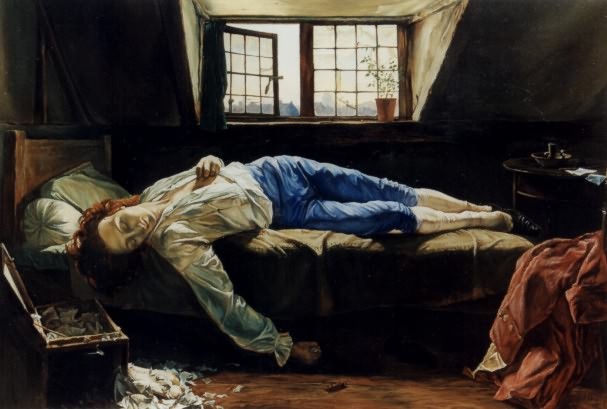

The Death of Chatterton

I do not mean to be pious about all this. Disease and illness are lotteries. At any age and in any condition, anyone might contract cancer or indeed any other terminal condition. A much admired dentist in our town collapsed and died while road-running, “doing what he loved doing” in the customary phrase. He was barely 50. His brother and partner in the practice frequently disappears on holiday to pursue his particular passion, mountaineering. Is there a more dangerous hobby? Perhaps only smoking and drinking.


Dennis Hopper in custody

I had a great friend at university, a lovely man called John Furness. He too was a climber. By his early 20s, he had lost several climbing mates on mountain faces, including his best friend: this guy died in a fall while tied to John, who had to make a viciously difficult climb into a crevasse to free himself and retrieve the body. John survived all his climbing scares, only to die of a brain tumour. He was 33. There are no guarantees about our longevity, our survival or our luck.

But I do question the culture that elevates the roaring boy or the car-crash girl. Few of us would last very long in a family or friendship tie with Mickey Rourke or Britney Spears or Charlie Sheen or Joey Barton. Cracking them up as somehow “heroic” suggests that our sense of values is due for a reappraisal.

Sunday, November 29, 2009

GO GET ’IM, TIGER

As my devotees will readily testify, low gossip and idle speculation are unknown to me. But oh boy, how can one resist Tigergate?

Hot off the net is the news of fall-out from the “scandal”: the entire writing team of Late Show with David Letterman have today resigned in protest at the host’s rejection of all their Top Ten list of gags about Tiger Woods and his insistence on penning them himself – his team agree that they are “not funny”. So you see the Tiger Woods “scandal” is a big story.

“What’s Tigergate?” some may ask. Here’s the bare bones of it. Eldrick Tont Woods is the world’s most successful sportsperson in history, certainly if you measure it by income. Of course his sport is an especially lucrative one. Whenever you see men playing golf on television, you can be sure that not one of them is less than a dollar millionaire unless (and golf is one of the few sports where this is still possible) he is an amateur. Well on the way to becoming sport’s first billionaire, Woods has been ranked number one golfer in the world for 575 weeks to date (more than ten years in total) and continuously for nearly four-and-a-half years, despite having been out of action with an injury for eight months during that period.

By no means all of his wealth derives directly from playing golf. Tiger Woods is a highly marketable brand because he is highly popular and brings a huge following to his sport, both on the courses and on worldwide television. He also has always appeared squeaky clean, something PR people look for. Shrewdly, he has subscribed to the writer JM Coetzee’s philosophy of handling public attention: “I don’t perform cartwheels for the media”. It is twelve years since Woods granted an extended interview. He has remained private, aloof and therefore largely untouchable. So he is able to command top dollar for advertisements and endorsements.

This weekend’s incident has blown much of this out of the water. According to the official version, Woods drove his Cadillac Escalade 4x4 out of his driveway shortly before 2.30 on Friday morning. Almost immediately, he collided with a fire hydrant and then a tree. The car’s speed was not sufficient to engage the airbags. Both Woods’ lips were cut in the impact. His wife, Elin Nordegren, following on foot, tried to open the automobile, then smashed a window with a golf club and dragged the semi-conscious Tiger from the vehicle.


Mrs Woods in her modelling days

Police were summoned and determined that “no alcohol was involved in the accident”. How this finding was reached is not revealed. Can you effectively use a breathalyzer on a semi-conscious driver who has lip lacerations? At any rate, by around 3.00 Woods was being treated in hospital from whence he was discharged shortly thereafter. Later on Friday, Nordegren denied police entry to their home, saying that her husband was resting.

The internet duly heaves with theory and rumour about this sequence of events. An already running tale about Tiger and a woman described as a “nightclub hostess” suddenly acquires much greater significance. If that story may be accessed by you and me, it may be accessed by Mrs Woods. She wouldn’t be best pleased, goes the theory.

For what it is worth, I have my own take on this event. It has the merit of tidying up those elements in the official account that seem somewhat unconvincing. First I ask this question: did the cops breathalyze Elin Nordegren? Because, you see, my theory is that she was driving the Cadillac (damn it all, Tiger endorses Buick). She hit a hydrant and then a tree because, you know, she’s a girlie. Oh no, wait, that’s completely wrong (sorry, just twitting my women readers). She hit a hydrant and then a tree because she’d had a couple of bottles of vino. Concerned about her rushing out of the house and jumping in a car, Tiger pursued her on foot. She stepped out of the car, having picked up a stray golf club – I expect David Hockney has paintbrushes lying around in his car too – and slugged him in the face. He fell down. Aghast, she wondered what to do and decided to smash the Cadillac’s window so that she could claim she had done this to release the central locking and pull her husband from the wreck. “There is no blood in the car” screams The Hollywood Gossip site in italics (that’s how I know it was screaming). You bet your ass there’s no blood in the car.


Tiger – he means it

If my theory is what the Irish call bollix, Mrs Woods is free to sue me. I doubt her husband would welcome the further publicity of such a case. After all, while the matter is not sub judice (and it will remain so for at least as long as the Woods decline to talk to the Florida Highway Patrol), we are all free to speculate without prejudicing justice.

Meanwhile, if Tiger Woods still wants to reach that magic figure of a billion dollars, he had better come up with a convincing account of what transpired in the early hours of Friday morning. Otherwise, the endorsements might prefer to go to … um … John Daly.

Sunday, November 08, 2009

NUTT’s in “MAY NOT” ROW

While I was away in London last week, the most interestingly developing story was that of the sacking by Home Secretary Alan Johnson of Professor David Nutt. A psychiatrist and long-time researcher into alcohol and drug abuse, Nutt was chairman of the Advisory Council on the Misuse of Drugs. The ACMD – no longer 31-strong since others have resigned in sympathy – is an NGO made up of scientists and other experts in the field.

From 1971 (when it was enacted) until 2007, the Misuse of Drugs Act had always followed the ACMD’s recommendations in the way recreational drugs were classified. Indeed, in 2004, the then Home Secretary David Blunkett followed ACMD advice and downgraded cannabis to Class C, carrying lesser sentences for possession and dealing. The so-called drugs czar, Keith Hellawell, disagreed and accordingly resigned. But since Gordon Brown became PM, the ACMD has been sidelined. Former dope-smoker Jacqui Smith restored cannabis to Class B (the then chair of the ACMD, Sir Michael Rawlins, immediately stood down). Then, in February, she overruled the ACMD’s recommendation on ecstasy.

Last month, Prof Nutt wrote a paper, Estimating Drug Harms, for the Centre for Crime and Justice Studies at his academic base, King’s College London. The newspapers picked up on the press release, particularly Nutt’s personal reclassification of various addictive substances, including alcohol and tobacco. That he ranked these respectively fifth and ninth – as against amphetamine at eighth, cannabis eleventh and LSD fourteenth – got the commentators steamed up. It was also brought to the attention of Johnson who duly sacked Nutt by email.

I couldn’t find Nutt’s full list anywhere in the press, so finally called up the CCJS document which you can read here:

http://www.crimeandjustice.org.uk/estimatingdrugharms.html

And here is the table Nutt constructed to reflect his view of the comparative harm that various substances cause:


To read this chart, I suggest copying it onto your desktop and then zooming in

Since his sacking, Nutt has been very visible and very voluble. Clearly he senses a ministry that may be confidently kicked when it is down. He has said that the Brown government has “systematically undermined” the work of the ACMD; that politicians “distort” and “devalue” research evidence (and in this he includes those opposition politicians like Ann Widdecombe and shadow Home Secretary Chris Grayling who have supported Johnson’s action); that ministers drastically overlook the “time-bomb of alcohol”. An ally, former ACMD secretary Jeremy Sare, referred to “pesky irritants like scientific evidence”. Those who will lambast the government with any material they can get have written scornfully of successive Home Secretaries’ self-trumpeted desire for “science-based” decisions that are then disregarded.

If only to be not on the same side as the likes of Melanie Phillips, one would not be attacking David Nutt. But the issues are not clear-cut. Defending his decision, Alan Johnson wrote to The Guardian that Nutt “cannot be both a government adviser and a campaigner against government policy”. On the face of it, that seems reasonable enough. But Johnson also described Nutt’s “horse-riding analogy” – Nutt had earlier pointed out that a hundred people a year die in incidents while on horseback, as against thirty linked to ecstasy – as “a political rather than a scientific point”. Well, so is Johnson’s earlier thrust.

It is understandable if advisers feel angry and frustrated when their advice is not taken. Equally, ministers have to administrate and make policy choices and they cannot be hidebound by the apolitical advice of non-political analysts. How helpful is it for Nutt to compare drugs that are illegal with drugs that are not and are deeply embedded in the culture? If ministers were going to act on all recreational drugs – including nicotine and alcohol – in an equal manner, they would not want to start from where we are. The gradual marginalising of cigarette smoking has been highly controversial and, in some quarters (think David Hockney), very unpopular. What politician would be rash enough to embark on such a path with booze?

But then it seems absurd to many that cannabis, ranked by ministerial fiat as Class B, can attract five years in jail and/or an unlimited fine for, as Nutt puts it, possession of sufficient for one joint. In practice, no one, I would suggest, gets five year for such insignificant possession. But, as a matter of good public policy, the statute book should not be packed with penalties that are never going to be handed down.

And experience and anecdotal evidence supports Nutt’s contention that cannabis is “significantly less harmful than alcohol”. Take into account accidents and incidents and fights that have arisen out of drunkenness, along with the liver disease that is rapidly growing in our booze-sodden culture, and alcohol clearly has many more victims than other – perhaps all other – addictive substances on Nutt’s list.

Do we want recreational drugs decriminalised? Which companies would start to dominate the capital investment in such a new free market? What kind of a culture would develop in Britain if many or all recreational substances were decriminalised before other countries followed suit?

On the other hand, the illicit drug market is a notably nasty one, dominated by laundered money and brutal gangs. Many people who think they are snorting coke are imbibing no such thing. What does it do to your body to ingest Harpic or some other noxious chemical? How damaging is skunk? Maybe a proper commercial trade in these drugs would clean them up.

It is often argued that taking cannabis inevitably “leads on” to hard drugs. I always thought this fallacious. The connection between dope and heroin is simply that they are apt to be offered by the same suppliers because they are both illegal. If cannabis is downgraded, it is in practice psychologically and physically separated from coke and crack and the rest. It cannot be insignificant that, while cannabis was classified as C rather than B, its use among teenagers declined, according to the government’s own figures.

So the whole issue is complicated and prone to the taking of none-too-consistent positions. Nutt told The Observer that he thought the ACMD could well become “unviable”. There have been some resignations among its members but rather fewer than Nutt would probably have hoped for. As the days pass, his martyrdom will be forgotten and Alan Johnson will get on with his other tasks until the election. There are, one feels sure, very few votes in drugs policy.

But there are some interesting ideological ramifications, or so it seems to me. In very broad terms, the left has always favoured regulation, the use of law and governmental powers to protect the vulnerable and keep the rich and powerful in their place. In its extreme form, that becomes state dictatorship and oppressive interference in private matters. The right clings to the free market, deregulation, getting government out of people’s lives, even where some go unsupported to the wall. In its extreme form, this becomes a breakdown of law and the spread of pre-revolutionary anarchy.

Paradoxically, right-wingers are more likely to advocate fierce rules for others, particularly concerning their private lives (sex and drugs, for instance). And people on the left tend to be those who want less regulation in some fields, notably those of recreational drugs (which left-wingers perhaps are more liable to use) and, say, the internet which left-leaning rather than right-leaning libertarians are given to look upon as romantically free and outlawish.

With its stern, son-of-the-manse puritanism (small ‘p’), the Brown government not only wants more regulation of drugs and the internet, it also is almost as deregulatory in instinct, when it comes to capitalism, as the Tories. All of which goes to reinforce the opinion that most of us former Labour-voters have entertained about successive Blair and Brown governments: that (with a few exceptions) it’s been much like living under Thatcher and Major.