The FIRST CASUALTY of WAR
The Syrian government has declared variously that the missile attack on the Ghouta suburbs of Damascus early on Wednesday did not take place at all, that it took place but that no chemical weapons were involved, and that chemical weapons were indeed involved but that they were inflicted by rebel forces. These statements cannot all be correct. Is any of them true?
There can be no doubt that an attack did take place. Many civilians died; the opposition claims more than a thousand. That people did die is beyond argument. Also not disputed is that the area where they died is characterised by resistance to the government’s attempts to quell the civil unrest – let us not prejudge anything by calling it a civil war – for the last two years.
Dead Syrian children
Moreover, all the recorded evidence so far offered to the world shows people suffering in a way that is not commensurate with an attack by conventional weapons. The victims are not showing blast injuries. Their motor functions are affected, particularly the breathing instinct. The spread of this effect on humans is evidently much wider than any structural damage in the area. There can be no doubt that, whatever killed these people, it was not explosives.
Was it a chemical agent? Only an impartial examination at the site can determine this to general satisfaction. Whether such an examination is possible depends wholly on the Syrian government itself. If Assad denies the inspectors, we shall be entitled to draw a conclusion, as I will consider in a moment.
Meanwhile, I want to try to examine the government’s notion that the footage widely circulated across the world is, in some sense, a “fabrication”. Presumably that would mean that the convulsing children that we have seen are actors, that people are playing at being dead. Is this at all credible? I submit that it is not. Given the chaotic nature of what we see, it would require remarkable creativity to “stage” such chaos without any glitch that revealed deception. Is any of the material released at all questionable? If it were, wouldn’t someone have noticed by now?
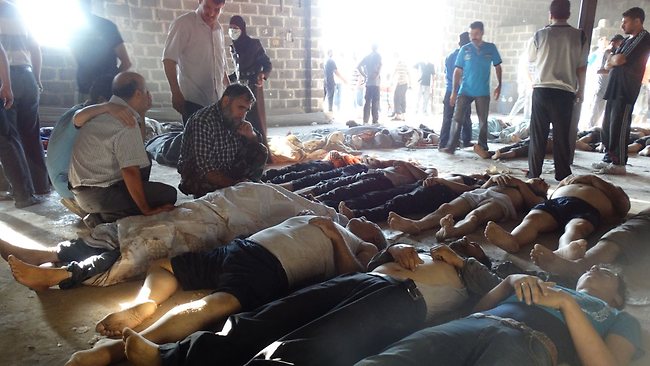
Dead Syrian adults
So it seems pretty conclusive that these things are established: i) that there was an attack; ii) that many civilians died; iii) that some kind of non-blast weapon was responsible for the casualties.
Now we come to the bottom line for the Assad government: the attack was inflicted by the rebels themselves. Does this argument have any merit? Well, it is certainly possible to suggest a motive for the rebels: that they wish to blackguard the Assad regime and “shame” foreign governments into intervening on behalf of the insurrection. William Hague’s increasingly bullish statements since Wednesday morning suggest that, if that was the aim, it is having some traction, at least with the British government. Obama remains carefully non-committal.
But is it possible to stand up the argument that the rebels would inflict such a grotesque death on the families of its own people, even if the exercise could be held to have a chance of tipping the argument about intervention?
Hague: bullish
I am reminded of a Jewish friend with family in Israel who told me in all seriousness that, when Israeli planes attack the Gaza strip, Palestinians lay their small children on the roofs of their homes so that they are more likely to be killed and hence the Israelis can be accused of war crimes. Although she has a Cambridge degree and has worked in current affairs broadcasting all her adult life, she could not recognise black propaganda when it was offered. I gently pointed out the notorious precedent that the Nazis spread lies about the morality of the Jews in order to make them appear less than human and so more dispensable, but she wouldn’t make the connection. People are willing to believe anything, however far-fetched, if it reflects badly on their enemy.
If the Syrian rebels did this themselves, a lot of people would necessarily be in on the exercise. How could the rebels be sure that no one would expose the deception? Yet we still await the first report of any defector from the opposition’s cause, decrying the tactics of the rebels, whereas several highly-placed officials in the Assad regime have left the country in disgust. Moreover, it is known that the Syrian government has developed chemical weapons: that is not at issue. When would they deploy such weapons, then, if not in a situation that they themselves account a profound threat to the state? It is always possible that Syrian rebels have gained access to chemical weapons, but there is as yet no independent evidence of it.
The UN inspectors ought to have the expertise to determine whether chemical weapons are in opposition hands. They are presently in Syria but the government will not permit them to visit Ghouta. Why so? That there are inspectors in the country at all is only as a result of protracted negotiations. The government says it cannot guarantee the inspectors’ safety. The rebels have said they will ensure that the inspectors are safe in Ghouta. If the inspectors are prepared to go, what argument remains to Assad? We must conclude that he fears what they will discover. If he wants to stay credible, he needs to pre-empt that conclusion.
Obama: non-committal
If there were an international consensus that the Assad government used chemical weapons against its own people, that would change the game, if only in that (once hostilities cease, if they ever do) Assad could be brought before the international court to face charges of war crimes. But there is no such consensus. Alexander Lukashevich, the Russian foreign office spokesman, declared that a homemade rocket carrying unidentified chemical substances had been launched from an area controlled by the opposition.
“All this cannot but suggest that once again we are dealing with a pre-planned provocation,” his statement continued. “This is supported by the fact that the criminal act was committed near Damascus at the very moment when a mission of UN experts had successfully started their work of investigating allegations of the possible use of chemical weapons there ... Moscow considers important an objective and professional investigation into what happened. And we call on all those who have the possibility to influence armed extremists to make every effort to end provocations with chemical agents”.
Moscow mouthpiece Lukashevich
Of course, if the Russians want to argue that the occurrence of this “criminal act” at the time of the US inspectors’ visit argues for it being an attack by rebels, one might counter that it could just as well be a double bluff, that the Assad regime launched the attack fully intending to tell the inspectors that it must be the rebels’ action. If the rebels are capable of staging an atrocity to look like the work of the government, the reverse is just as feasible and even more likely to be doable.
Russia’s alliance with Syria ensures that the UN’s hands are tied in any attempt to approve some anti-Assad action through the security council. As with so many other international crises, the fact that certain powerful nations may wield a veto leaves the UN powerless and raises the stakes for those nations that would be prepared to make some intervention. I have argued before that the UN’s charter needs to be rewritten and, at the risk of exasperating my regular readers, I am now going to argue it again.
No substantial rewrite of the charter has occurred since it was first drawn up in 1945. The time has long past when the UN needs to be given power independent of individual member states, power greater than any individual member, indeed greater than the sum of individual members.
The veto has to be scrapped. No nation, neither China nor Russia nor the US, can be permitted to continue to block the business of the UN and to override the will of a majority of members. All nations should have the same stake in the global community.
Support for Assad
The UN needs to have the power – by which I mean the military power – to intervene in any breakdown of peaceful coexistence and to impose a cessation of hostilities. This might be between any two or more nations squaring up to each other – say, Israel and Lebanon or Azerbaijan and Armenia – or within a sovereign nation where the ruling party is fighting any kind of insurrection – Somalia or Colombia or Libya or Egypt. Where the UN deems it necessary, its troops would depose the government and take over the day-to-day management of the nation’s affairs. After all, whatever else you may believe about Assad, he has patently lost control of his nation. He is, to borrow Norman Lamont’s resonant words, “in office but not in power”.
How could the UN muster such power? I propose that each member nation be obliged to contribute to the UN’s peace-keeping forces the same level of funding, personnel and matériel that it commits to its own national defence. So if, for the sake of argument, the US’s total military budget were $800bn, it would be required to commit the same amount to the UN force. The Swiss government’s share of the UN force bill might be $4bn. In this way, the UN would be furnished with military might sufficient to overwhelm any conceivable national militia and its troops would be as international as possible. With a scheme like this in place, most nations would see both the necessity and the opportunity to scale down their domestic expenditure on what they term defence. That in itself would render the world a more stable place.
Such an imposition on all member states would profoundly alter the psychology of defence. The UN needs to establish as a baseline that any engagement in military combat is intolerable to the community of nations. As it is, the “just wars” are always those fought by a nation’s own troops. From the outside looking in, other nation’s wars are, at the very least, regrettable. More often they are indefensible. And, however righteous the combatants, all wars occasion atrocities on all sides. It is idle to pretend that other people’s wars are crueller and bloodier than those in which we take part.
But, I hear you object, you cannot ride roughshod over the sovereignty of individual nations. To that I say: the game has changed. Nations are no longer discrete entities whose disputes remain within their borders. Look at the flood of refugees from Syria into neighbouring countries. How can those countries, none of them wealthy, cope with the demands that Syria’s folly makes upon them? And why should they be required to do so? Furthermore, what is the cost to the planet of all this destruction visited upon it? Why should other nations be expected to clean up the mess of this – it needs to be stated – indulgence by the government and the citizenry of Syria?
The UN needs to be an organisation that holds as its core belief not only that waging war is destructive and regrettable but that waging war will not be tolerated by the community of nations, however wealthy and righteous and self-important the combatants might be. So my revamped UN would have the power – both judicially, by statute, and literally, by force of arms – to police the planet and snuff out any outbreak of hostilities within hours. All the members of the UN would have to agree to accept this awesome global authority and to isolate any nation in every practical manner until the UN deemed that its full membership of the community of nations had been earned again.
UN inspectors arrive in Damascus
If this dispensation had been in place, the hostilities in Syria would have been halted in the first week. Assad would have been obliged to resolve the contradictions in his nation or step down in favour of a temporary administration controlled by the UN that would have addressed the differences among the populace and set up fair and free elections. By the way, under my new model UN, every nation would be obliged to allow a comprehensive delegation from the UN to oversee and examine national elections and to declare whether they have been acceptable, the UN’s final judgment being paramount and not subject to appeal. Any head of state or indeed any individual candidate found to have transgressed would be barred from future office.
Imagine the different course of events in Egypt over the last two and a half years. Mubarak would have lost control of the country to a UN peace-keeping force. He might still have been tried and imprisoned by the courts. Free elections might still have brought the Muslim Brotherhood to power. Had there been demonstrations against Morsi, they would have been permitted. But what was, by any objective measure, a military coup this summer would not have been allowed to take place. And so there would have been no massacre of protesters.
Well, you will say, none of the security council nations is going to surrender its veto, so this is a pipe-dream. I could simply snap back: ok, so what’s your solution that won’t simply make matters worse? At least I am making a concrete, constructive proposal that has yet to be tried and found wanting.
I am realistic, though. There is only one means by which what I propose could be achieved. Someone would have to run for the US presidency on a programme that included this proposal for the revamping of the UN. The chorus of abuse that would argue that this would be an abject surrender of American power and self-importance would need to be argued down. The candidate would have to win the argument and win the election and then embark on a long and hugely testing round of diplomacy to persuade sufficient of the other security council nations to agree. Yes, it’s a big ask. But what is the point of going into politics if it is not with the intention of changing the world?
Showing posts with label Syria. Show all posts
Saturday, August 24, 2013
Wednesday, July 31, 2013
The AGE of UNREASON
Despite one hundred and fifty years of post-Darwinian scientific enquiry and discovery, vast numbers of the planet’s citizens are as bewitched as their ancestors ever were by the absurdities, fantasies and mendacities of supernatural superstition. I have argued before that the delusion that its sufferers call “faith” is the source of far greater suffering in the world – suffering through personal guilt and self-hatred, deprivation and oppression, persecution and mutilation, murder and genocide – than all the other abstractions – nationalism, tribalism, politics and ideology – put together. Paradoxically, the dominance of religious bigotry as a force for evil seems to grow ever stronger as the world becomes smaller and liberal education spreads further.
In an editorial of 1941 for Life magazine, the Time-Life publisher Henry Luce described his era as “the American century”. At different points in that time-frame, other candidates for the accolade briefly arose, but hindsight shows that Luce got it right: more than any other global player, the United States shaped the century. How will the present one be known? Already, there seem compelling arguments to dub it “the Muslim century”.
Luce talk
The millennium had barely begun when, “out of a clear blue sky”, the most profoundly world-shaking challenge was made to the confidence of American power, a challenge made specifically in the name of Islam. There are Muslim apologists who fend off the connection between the central tenets of Islam and the 9/11 atrocity, but they are confounded by the words of the Qur’an that I found and have quoted before: “Allah has bought from the believers their selves and their possessions against the gift of Paradise; they fight in the way of Allah; they kill and are killed; that is a promise binding upon Allah in the Torah and the Gospel and the Qur’an” [from Arthur J Arberry’s translation for OUP, though I have changed his own term ‘God’ to ‘Allah’]. It is, of course, no accident that the book of the Qur’an from which this passage comes (which is called, in English, ‘Repentance’) is book number 9 and the verse number is 111.
Islam has been at the centre of the world’s flashpoints in the first 163 months of the present century. A prime mover in the spread of Muslim fundamentalism has been the Deobandi wing of Sunni Islam. Deobandis are devotees of Sharia law, the most proscriptive interpretation of the Qur’an. This wing of Islam is, in every sense, the most aggressive. If it has not already become the dominant force in the Muslim community in Britain, it will do so before you know it. The Taliban are adherents of Deobandi practice. The word “Taliban” means “students”.
Saddam nuisance
Western forces invaded Afghanistan in 2001 in an initially successful attempt to overthrow the Taliban whose activists had dominated the country for five years. The pretext was “to keep the streets of America and Britain safe”, but the notion that the Taliban (rather than al-Qaida) was responsible for terrorist attacks in the west was never remotely credible. In any case, as everyone knows but no politician will acknowledge, the Taliban will again be ruling Afghanistan within a maximum of three months after western troops have finally withdrawn.
The American and British governments muddied the water and overstretched their own resources by adding an irrelevant invasion of Iraq to their military commitments, for no better reason than that George W Bush wanted to complete what he took to be “unfinished business” left over by his father following the Gulf War of 1990-1. Anxious to establish his profile on the world stage, Tony Blair joined this vain exercise.
Assad sack
Ten years on, Iraq is riven by inter-faith strife. This week, there have been more than 250 casualties of car bombs in Baghdad, at least fifty of them fatalities and almost all of them Shias, which means that the bombers were certainly Sunni Muslims. If that sounds a lot, consider that there have been fifty times that number of fatalities in sectarian attacks in Iraq in the past three months. So much for the west’s legacy.
The Shia are also Muslims and they form the government in Iraq, where they make up the largest demographic (the most dominant Shia representation anywhere in the world is in Iran, where about two-fifths of the world’s Shias live). Shia and Sunni Muslims have been in conflict for many centuries. Do not expect reconciliation any time soon.
The renewed struggle between Iraqi Shia and Sunni is wholly a product of the western invasion. Saddam Hussein was a Ba’athist. The Ba’ath Party, though Islamic, is notably liberal – it may be surprising to note – and opposes Muslim fundamentalism and Sharia law. In some ways, Alawite Islam parallels Ba’athist Islam. Bashar al-Assad of Syria is an Alawite. Like Saddam, he has been more exercised by Arab nationalism than by Islamic orthodoxy. If he falls in Syria, there must be a strong possibility that some form of Islamic fundamentalism will succeed him in that benighted country. This is the dilemma that stays the hand of the international community under pressure to intervene in the brutal Syrian civil war. Unthinkably, intervention might produce a result that had worse consequences for the Syrians, for the Arab world and for the wider world even than the reign of Assad.
Gadd-out-of-here
After all, there is the precedent of Libya as well as that of Iraq. Muammar Gaddafi’s regime was again far more concerned with Arab nationalism than with Islam – Gaddafi was raised as a Bedouin Muslim. Islamist factions infiltrated the anti-government forces in Libya as they have done in Syria. The present prime minister of Libya, Ali Zeidan, is a Sunni Muslim.
Many new Islamist factions have appeared in Libya since the war and several of the militias formed to fight Gaddafi have declined to disband. It was an Islamist cadre that attacked the American consulate in Benghazi last September, killing several people including the ambassador. Abdelsalam al-Mosmary, a critic of the Muslim Brotherhood’s activities in Libya, was assassinated just this week. Sporadic exchanges of fire and regular car bombs, particularly in Benghazi and Tripoli, continue to imperil the stability of Libya.
A Sunni outlook for Ali Zeidan
Through patient infiltration, al-Qaida has established itself in Pakistan, Kashmir, Iraq, Afghanistan, Yemen, Syria, Saudi Arabia, Egypt, Somalia, Eritrea, Sudan, Mali, Nigeria, Algeria, Mauritania, Morocco and Turkey. It is al-Qaida that still represents the most effective and most ruthless armed expression of Islamic fundamentalism. President Obama has been assiduous in concentrating on pre-emptive strikes against al-Qaida – controversially, more in Pakistan than anywhere – rather than diluting this effort with speculative engagements elsewhere.
But terrorism, guerrilla warfare and the fomentation of uprisings against secularist regimes are not the only methods by which Islamic fundamentalism exerts its muscle. Sharia rule profoundly circumscribes personal freedoms that citizens of liberal democracies take for granted. The judiciary wholly or largely imposes Sharia law in Afghanistan (even without Taliban rule), Pakistan, Muslim parts of India, Bangladesh, Yemen, Iraq, Iran, Jordan, Gaza and the West Bank, Saudi, Qatar, much of the UAE, Bahrain, Oman, Brunei, the Maldives, Muslim parts of Sri Lanka and Singapore and Indonesia, Sudan, Mauritania and for Muslims in Egypt, Algeria, Morocco, Ethiopia, Eritrea, Somalia, Tanzania, Uganda, Ghana, Nigeria, Kenya, Gambia, Djibouti and Comoros.
The late Abdelsalam al-Mosmary
Restrictions imposed by Sharia apply to everyone, including visitors, as unguarded tourists are apt to discover. Visiting a Muslim country is like staying with vegans: they serve you vegan food but, when they visit you, they expect you to serve them vegan food. So Islamists in non-Muslim countries go on demonstrations carrying placards on the theme of “death to the infidel”, but any reciprocal tolerance is unthinkable. How long would you stay alive if you brandished a poster with the legend “Death to Islam” in downtown Khartoum, Riyadh, Mogadishu or Islamabad?
More than any other issue, it is sexuality that brings out the feudal in Sharia law and Islamic fundamentalism. Sharia strictly interprets the Qur’an, so anything in that text that already seems oppressive is made more so by its application. This comes from the section on ‘Women’: “Men are the managers of the affairs of women for that Allah has preferred in bounty one of them over another, and for that they have expended of their property. Righteous women are therefore obedient, guarding the secret for Allah’s guarding. And those you fear may be rebellious admonish; banish them to their couches, and beat them” [book 4 verse 38]. Needless to say, the courts will always favour a man’s testimony over that of his wife.
Sweet 16 at the UN
The world knows of the case of Malala Yousafzai, the Sunni Muslim who, at 15, was the object of an assassination attempt by the Pakistani Taliban in the Swat Valley. Malala – her name means “grief-stricken” – had had the audacity to advocate full rights of education for girl pupils, an offence against Islamist views on the subjugation of women. Malala made a remarkable recovery and addressed a convocation of youth delegates at the UN on her sixteenth birthday. She has become a figurehead for women’s rights under Islam and was named by Time magazine in April as one of the “100 Most Influential People in the World”.
The brutal, iniquitous and unyielding nature of Sharia law is sufficient cause for opposing the spread of Islam in any of its guises. Hence the European Union’s continuing difficulty with the long-standing application to join made by Turkey, a nation that, while very nearly entirely sited in Asia, occupies a tiny area of southeastern Europe.
Though Turkey’s population is almost wholly Sunni Muslim, it is formally a secular nation. Several days of unrest in Istanbul in May were centred on the perception of encroaching Islamisation by Recep Tayyip Erdogan’s government. Informing this perception was an attempt by Erdogan to reduce the power of the army, widely seen as a significant force for secularism (like the army in Egypt). Several other recent government restrictions were read as Islamist.
Erdogan – not best pleased
The wearing of the hijab has been banned for the entirety of Turkey’s modern existence, a lot longer than in France, where the wearing of the burqa was addiitionally made illegal in 2010. France has a rapidly growing problem with Islam, which now counts a tenth of the country’s population among its supporters. It has been estimated that Muslims could be powerful enough to determine the outcome of presidential elections within thirty years.
Wherever you look, even in Europe, there is evidence of the encroachment of Islam on the very different philosophies, cultures and traditions that have survived strife and oppression in the past. It may be that Islam, that most proscriptive and intolerant of dogmas, is stronger than the rest and will eventually hold sway across the world. It won’t be in my lifetime and perhaps not in yours either, but the need to stem the tide is urgent now.
Despite one hundred and fifty years of post-Darwinian scientific enquiry and discovery, vast numbers of the planet’s citizens are as bewitched as their ancestors ever were by the absurdities, fantasies and mendacities of supernatural superstition. I have argued before that the delusion that its sufferers call “faith” is the source of far greater suffering in the world – suffering through personal guilt and self-hatred, deprivation and oppression, persecution and mutilation, murder and genocide – than all the other abstractions – nationalism, tribalism, politics and ideology – put together. Paradoxically, the dominance of religious bigotry as a force for evil seems to grow ever stronger as the world becomes smaller and liberal education spreads further.
In an editorial of 1941 for Life magazine, the Time-Life publisher Henry Luce described his era as “the American century”. At different points in that time-frame, other candidates for the accolade briefly arose, but hindsight shows that Luce got it right: more than any other global player, the United States shaped the century. How will the present one be known? Already, there seem compelling arguments to dub it “the Muslim century”.
Luce talk
The millennium had barely begun when, “out of a clear blue sky”, the most profoundly world-shaking challenge was made to the confidence of American power, a challenge made specifically in the name of Islam. There are Muslim apologists who fend off the connection between the central tenets of Islam and the 9/11 atrocity, but they are confounded by the words of the Qur’an that I found and have quoted before: “Allah has bought from the believers their selves and their possessions against the gift of Paradise; they fight in the way of Allah; they kill and are killed; that is a promise binding upon Allah in the Torah and the Gospel and the Qur’an” [from Arthur J Arberry’s translation for OUP, though I have changed his own term ‘God’ to ‘Allah’]. It is, of course, no accident that the book of the Qur’an from which this passage comes (which is called, in English, ‘Repentance’) is book number 9 and the verse number is 111.
Islam has been at the centre of the world’s flashpoints in the first 163 months of the present century. A prime mover in the spread of Muslim fundamentalism has been the Deobandi wing of Sunni Islam. Deobandis are devotees of Sharia law, the most proscriptive interpretation of the Qur’an. This wing of Islam is, in every sense, the most aggressive. If it has not already become the dominant force in the Muslim community in Britain, it will do so before you know it. The Taliban are adherents of Deobandi practice. The word “Taliban” means “students”.
Saddam nuisance
Western forces invaded Afghanistan in 2001 in an initially successful attempt to overthrow the Taliban whose activists had dominated the country for five years. The pretext was “to keep the streets of America and Britain safe”, but the notion that the Taliban (rather than al-Qaida) was responsible for terrorist attacks in the west was never remotely credible. In any case, as everyone knows but no politician will acknowledge, the Taliban will again be ruling Afghanistan within a maximum of three months after western troops have finally withdrawn.
The American and British governments muddied the water and overstretched their own resources by adding an irrelevant invasion of Iraq to their military commitments, for no better reason than that George W Bush wanted to complete what he took to be “unfinished business” left over by his father following the Gulf War of 1990-1. Anxious to establish his profile on the world stage, Tony Blair joined this vain exercise.
Assad sack
Ten years on, Iraq is riven by inter-faith strife. This week, there have been more than 250 casualties of car bombs in Baghdad, at least fifty of them fatalities and almost all of them Shias, which means that the bombers were certainly Sunni Muslims. If that sounds a lot, consider that there have been fifty times that number of fatalities in sectarian attacks in Iraq in the past three months. So much for the west’s legacy.
The Shia are also Muslims and they form the government in Iraq, where they make up the largest demographic (the most dominant Shia representation anywhere in the world is in Iran, where about two-fifths of the world’s Shias live). Shia and Sunni Muslims have been in conflict for many centuries. Do not expect reconciliation any time soon.
The renewed struggle between Iraqi Shia and Sunni is wholly a product of the western invasion. Saddam Hussein was a Ba’athist. The Ba’ath Party, though Islamic, is notably liberal – it may be surprising to note – and opposes Muslim fundamentalism and Sharia law. In some ways, Alawite Islam parallels Ba’athist Islam. Bashar al-Assad of Syria is an Alawite. Like Saddam, he has been more exercised by Arab nationalism than by Islamic orthodoxy. If he falls in Syria, there must be a strong possibility that some form of Islamic fundamentalism will succeed him in that benighted country. This is the dilemma that stays the hand of the international community under pressure to intervene in the brutal Syrian civil war. Unthinkably, intervention might produce a result that had worse consequences for the Syrians, for the Arab world and for the wider world even than the reign of Assad.
Gadd-out-of-here
After all, there is the precedent of Libya as well as that of Iraq. Muammar Gaddafi’s regime was again far more concerned with Arab nationalism than with Islam – Gaddafi was raised as a Bedouin Muslim. Islamist factions infiltrated the anti-government forces in Libya as they have done in Syria. The present prime minister of Libya, Ali Zeidan, is a Sunni Muslim.
Many new Islamist factions have appeared in Libya since the war and several of the militias formed to fight Gaddafi have declined to disband. It was an Islamist cadre that attacked the American consulate in Benghazi last September, killing several people including the ambassador. Abdelsalam al-Mosmary, a critic of the Muslim Brotherhood’s activities in Libya, was assassinated just this week. Sporadic exchanges of fire and regular car bombs, particularly in Benghazi and Tripoli, continue to imperil the stability of Libya.
A Sunni outlook for Ali Zeidan
Through patient infiltration, al-Qaida has established itself in Pakistan, Kashmir, Iraq, Afghanistan, Yemen, Syria, Saudi Arabia, Egypt, Somalia, Eritrea, Sudan, Mali, Nigeria, Algeria, Mauritania, Morocco and Turkey. It is al-Qaida that still represents the most effective and most ruthless armed expression of Islamic fundamentalism. President Obama has been assiduous in concentrating on pre-emptive strikes against al-Qaida – controversially, more in Pakistan than anywhere – rather than diluting this effort with speculative engagements elsewhere.
But terrorism, guerrilla warfare and the fomentation of uprisings against secularist regimes are not the only methods by which Islamic fundamentalism exerts its muscle. Sharia rule profoundly circumscribes personal freedoms that citizens of liberal democracies take for granted. The judiciary wholly or largely imposes Sharia law in Afghanistan (even without Taliban rule), Pakistan, Muslim parts of India, Bangladesh, Yemen, Iraq, Iran, Jordan, Gaza and the West Bank, Saudi, Qatar, much of the UAE, Bahrain, Oman, Brunei, the Maldives, Muslim parts of Sri Lanka and Singapore and Indonesia, Sudan, Mauritania and for Muslims in Egypt, Algeria, Morocco, Ethiopia, Eritrea, Somalia, Tanzania, Uganda, Ghana, Nigeria, Kenya, Gambia, Djibouti and Comoros.
The late Abdelsalam al-Mosmary
Restrictions imposed by Sharia apply to everyone, including visitors, as unguarded tourists are apt to discover. Visiting a Muslim country is like staying with vegans: they serve you vegan food but, when they visit you, they expect you to serve them vegan food. So Islamists in non-Muslim countries go on demonstrations carrying placards on the theme of “death to the infidel”, but any reciprocal tolerance is unthinkable. How long would you stay alive if you brandished a poster with the legend “Death to Islam” in downtown Khartoum, Riyadh, Mogadishu or Islamabad?
More than any other issue, it is sexuality that brings out the feudal in Sharia law and Islamic fundamentalism. Sharia strictly interprets the Qur’an, so anything in that text that already seems oppressive is made more so by its application. This comes from the section on ‘Women’: “Men are the managers of the affairs of women for that Allah has preferred in bounty one of them over another, and for that they have expended of their property. Righteous women are therefore obedient, guarding the secret for Allah’s guarding. And those you fear may be rebellious admonish; banish them to their couches, and beat them” [book 4 verse 38]. Needless to say, the courts will always favour a man’s testimony over that of his wife.
Sweet 16 at the UN
The world knows of the case of Malala Yousafzai, the Sunni Muslim who, at 15, was the object of an assassination attempt by the Pakistani Taliban in the Swat Valley. Malala – her name means “grief-stricken” – had had the audacity to advocate full rights of education for girl pupils, an offence against Islamist views on the subjugation of women. Malala made a remarkable recovery and addressed a convocation of youth delegates at the UN on her sixteenth birthday. She has become a figurehead for women’s rights under Islam and was named by Time magazine in April as one of the “100 Most Influential People in the World”.
The brutal, iniquitous and unyielding nature of Sharia law is sufficient cause for opposing the spread of Islam in any of its guises. Hence the European Union’s continuing difficulty with the long-standing application to join made by Turkey, a nation that, while very nearly entirely sited in Asia, occupies a tiny area of southeastern Europe.
Though Turkey’s population is almost wholly Sunni Muslim, it is formally a secular nation. Several days of unrest in Istanbul in May were centred on the perception of encroaching Islamisation by Recep Tayyip Erdogan’s government. Informing this perception was an attempt by Erdogan to reduce the power of the army, widely seen as a significant force for secularism (like the army in Egypt). Several other recent government restrictions were read as Islamist.
Erdogan – not best pleased
The wearing of the hijab has been banned for the entirety of Turkey’s modern existence, a lot longer than in France, where the wearing of the burqa was addiitionally made illegal in 2010. France has a rapidly growing problem with Islam, which now counts a tenth of the country’s population among its supporters. It has been estimated that Muslims could be powerful enough to determine the outcome of presidential elections within thirty years.
Wherever you look, even in Europe, there is evidence of the encroachment of Islam on the very different philosophies, cultures and traditions that have survived strife and oppression in the past. It may be that Islam, that most proscriptive and intolerant of dogmas, is stronger than the rest and will eventually hold sway across the world. It won’t be in my lifetime and perhaps not in yours either, but the need to stem the tide is urgent now.
Labels:
9/11,
Afghanistan,
al-Qaida,
Bashar Assad,
Henry Luce,
Iran,
Iraq,
Islam,
Libya,
Malala,
religious bigotry,
Saddam Hussein,
sexuality,
Sharia law,
Shia,
Sunni,
Syria,
Taliban,
The Qur'an,
turkey
Monday, November 26, 2012
MY PLAN for PEACE
In the October presidential debates, very little was said by either the thoughtful, progressive candidate or the opportunist, reactionary candidate about the world. The great majority of the arguments they framed referred wholly to the internal politics of the United States. For sure, there were passing references to foreign affairs and to the various kinds of tumult and change in Libya, Syria and other lands; to demonstrate the width if not the depth of his homework, Mitt Romney even name-checked Mali. But these references were not in any important way statesmanlike. What they foregrounded was what is considered the ne plus ultra of political dialogue in the US: the American interest.
Since the break-up of the Soviet Union, America has proudly proclaimed itself the world’s only ‘superpower’. If this is a matter of pride in power, why are successive US administrations so insecure in their super status? Why do they behave as the schoolyard bully, cuffing the uppity kids, taking the collectables off the milquetoasts and insisting on going straight to the head of the line when the tuck shop opens? In a manner no different from that of the despised George W Bush, Barack Obama tells his ‘fellow Americans’ and indeed the rest of the world that he puts American interests above everything else.
Obama – street-fighting man?
Wouldn’t it be more useful, more democratic, more libertarian, more confident, more Christian to be the gentle giant, putting the interests of the whole planet above everything else? Isn’t it actually in the American interest for the whole planet to be peaceful and prosperous? Obama began his first term by sounding a relatively conciliatory note towards Iran, whose regime he and most other western leaders believe is bent on developing nuclear weapons. But Obama never followed up on this tone. Economic sanctions have caused and continue to cause great hardship among the populace of Iran. But if American diplomats have ever sat down with their Iranian equivalents to talk out some settlement of this mutual suspicion and hostility, no such talks have been made public.
Now the US grows daily more suspicious of China. Romney and the Republicans – and not only people on the right – urge Obama to “stand up to” the Chinese. What does it mean? It suits everyone not to spell it out. And it means they don’t have to invest long hours in subtle, intricate diplomacy. But I expect the Chinese would like to live in peace and prosperity just as much as the Americans would. What seems to me to be obvious (though it is never said by politicians) is that the advantage of one nation does not automatically exclude some advantage for another. There are alternatives to ruthless competition just as there are alternatives to mutually assured destruction.
Cameron – pugilist?
Not that every other nation is any different. In his fractious dealings with both his own MPs and his opposite numbers in the European governments, David Cameron speaks of very little other than “the British interest”. Across the EU, the Germans, Greeks, French, Italians and Spanish are locked in mutual distrust that one or all of the others will seek to smuggle past them a deal that is not in their own interest. In the early days of the Common Market, there was a notion that all nations would work together and for their mutual benefit, summed up in the term communautaire. It’s not a word many use now.
And if the leaders cannot confidently and openly talk to each other and to their electorates about economics, they certainly can’t communicate any better about warfare. In an age of instant communication of non-negotiable positions, diplomacy starts on the back foot and on no foot at all if any parties are saying that they “will not talk to” any other parties. Politicians fear that they will seem weak unless they express certainty about the results of their actions and intransigent resolution towards the ‘aggressor’ or the ‘terrorist’. So the ‘defeat’ of your enemy becomes a yardstick by which your actions are to be judged, as if the sentiments that nurtured your enemy will mysteriously melt away when a few hot-headed guerrillas have been pushed back on the ground.
A shrewd judge of affairs in the Middle East, Prince El Hassan bin Talal of Jordan, likes to quote this saying: “the gentle art of saving face may yet destroy the human race”. Indeed, because politicians fear that subtlety and light and shade will read as weakness, hostages to fortune are offered in their declarations of intent. Which outbreak of hostilities over the last 50 years, one wonders, has concluded with a clear-cut situation, to which the self-styled good guys can point and say “look, everyone: the loss of life, the destruction of communities and the alienation of hitherto apolitical people was well worth it, completely justified by our handsome victory”?
Crown Prince Hassan of Jordan – elegant
Perhaps the least comprehensible aspect of the response that the world’s flashpoints produces from the secure, wealthy regimes of the north and west is the utter lack of imagination those regimes display towards relatively poor and deprived communities.
I have a modest proposal. We must give the United Nations actual power and that of course means power greater than that of any one member. The UN charter, still almost exactly as written in 1945, needs substantial revision. The permanent members of the Security Council must agree to surrender their veto, the prerogative of the bully over the powerless. No member can be allowed exemption.
The veto means that the UN has no muscle to flex against the US or China or the other elite nations. Which of them will volunteer to forego a veto? It would need a visionary party leader or presidential candidate to carry the case with his own electorate, so as to take a mandate to the other Security Council members; a diplomat of rare persuasive power, who implicitly understands the global gain of a truly powerful UN, to convert even one of the holders of the veto. But someone needs to attempt it. What is political power for if not to change the world? Meanwhile, the remit of the UN’s International Court of Justice needs to be widened so as not to depend on the consent of those states that are party to a dispute, another tough sell.
The UN should assume the power to order the immediate cessation of hostilities between member states. Waging war must be against the UN’s bedrock principles. Any member visiting warfare on another should be suspended forthwith from UN membership. In practice this must mean that all other member states, including those sympathetic to the miscreant’s cause, suspend all trade and other dealings with the suspended member. A blanket economic freeze would soon encourage a government to halt hostilities.
The UN must then have sufficient manpower and materiel to put immediate boots on the ground in overwhelming numbers in any and every land where hostilities break out, in order to impose and hold the peace. How can this be achieved? Simply by requiring every member nation to supply troops, weapons and supplies of an equal value to that which it spends on what it is pleased to call defence. Thus the US defence budget – $711bn in 2011 – would have to be precisely matched by its contribution to the UN’s peace-keeping budget. I suggest that it would not be long before nations saw that they got what we might call satisfyingly less bang for their buck if they cut their own defence budgets.
Netanyahu – gesture of good will
The UN must then have the resources to assume control of negotiation of a settlement between the disputatious nations. Warfare must be a gambit that is made impracticable because it makes each of the warring nations an international pariah. If both sides are taken out of benefit of UN membership, the issue of ‘blame’ is largely futile. The UN negotiators can then begin with a level playing field.
The UN should also have the power to intervene in a sovereign nation’s internal affairs or where there is civil strife (as currently in Syria) between a government and the population that is attempting to dislodge it. The UN’s remit should be truly global and part of that global interest would be the philosophy that instability in any nation is the concern of all nations. At present, for example, Syria’s neighbours are being obliged to cope with a vast influx of refugees. Matters such as the suppression of a particular tribal or religious grouping within a nation state might be confronted on a case-by-case basis. But the UN could hold sway over issues other than warfare. It could wield its power, no longer fettered by national vetoes, to impose restrictions on the activities that contribute so catastrophically to the destruction of the environment.
The recent hostilities between Israel and the Palestinians could have been brought to a quicker end or indeed pre-empted altogether if Ban Ki-moon had had the authority to land UN troops along the Israel-Gaza border. Instead, Ban toured the region’s seats of government pleading for restraint. Binyamin Netanyahu, to whom restraint is a foreign country, is widely accused of bombing Gaza not to stop Palestinian rockets falling (largely harmlessly) on Israel but to ensure his own re-election next year. Such calculations are only possible because Israel believes it needs to please none but its own people. A truly powerful UN would utterly transform the Middle East.
Ban – you, yes you do the dirty work
Barack Obama has indulged Israel with far less enthusiasm than any of his recent predecessors as president, but even he buys into the old saw that everything Israeli governments do is for the security of their own people. Nor does Obama recognise the State of Palestine as many nations now do. Obama would exercise the US veto if recognition of Palestine came before the Security Council. Of the other permanent Security Council members, China and Russia have recognised Palestine, France has not and the UK has offered conditional recognition.
American presidents traditionally declare their “love of freedom” and their desire to spread democracy throughout the world, but they are frequently less enthusiastic about nations being free to make their own choices, especially through the ballot box. The electorate of Palestine may exercise its democratic right to elect Hamas but democratic regimes do not love democracy and freedom so keenly that they recognize the democratically elected regime. “Don’t do what I do, do what I say” is the prerogative of the bully.
And it is this reinforcement of the planet’s power structure by the way that the UN is constituted that needs most urgently to be addressed. The UN could be a true force for good, the most powerful and constructive enterprise that man has ever devised. To bring that about needs leaders of rare courage and stamina. Where are they?
In the October presidential debates, very little was said by either the thoughtful, progressive candidate or the opportunist, reactionary candidate about the world. The great majority of the arguments they framed referred wholly to the internal politics of the United States. For sure, there were passing references to foreign affairs and to the various kinds of tumult and change in Libya, Syria and other lands; to demonstrate the width if not the depth of his homework, Mitt Romney even name-checked Mali. But these references were not in any important way statesmanlike. What they foregrounded was what is considered the ne plus ultra of political dialogue in the US: the American interest.
Since the break-up of the Soviet Union, America has proudly proclaimed itself the world’s only ‘superpower’. If this is a matter of pride in power, why are successive US administrations so insecure in their super status? Why do they behave as the schoolyard bully, cuffing the uppity kids, taking the collectables off the milquetoasts and insisting on going straight to the head of the line when the tuck shop opens? In a manner no different from that of the despised George W Bush, Barack Obama tells his ‘fellow Americans’ and indeed the rest of the world that he puts American interests above everything else.
Obama – street-fighting man?
Wouldn’t it be more useful, more democratic, more libertarian, more confident, more Christian to be the gentle giant, putting the interests of the whole planet above everything else? Isn’t it actually in the American interest for the whole planet to be peaceful and prosperous? Obama began his first term by sounding a relatively conciliatory note towards Iran, whose regime he and most other western leaders believe is bent on developing nuclear weapons. But Obama never followed up on this tone. Economic sanctions have caused and continue to cause great hardship among the populace of Iran. But if American diplomats have ever sat down with their Iranian equivalents to talk out some settlement of this mutual suspicion and hostility, no such talks have been made public.
Now the US grows daily more suspicious of China. Romney and the Republicans – and not only people on the right – urge Obama to “stand up to” the Chinese. What does it mean? It suits everyone not to spell it out. And it means they don’t have to invest long hours in subtle, intricate diplomacy. But I expect the Chinese would like to live in peace and prosperity just as much as the Americans would. What seems to me to be obvious (though it is never said by politicians) is that the advantage of one nation does not automatically exclude some advantage for another. There are alternatives to ruthless competition just as there are alternatives to mutually assured destruction.
Cameron – pugilist?
Not that every other nation is any different. In his fractious dealings with both his own MPs and his opposite numbers in the European governments, David Cameron speaks of very little other than “the British interest”. Across the EU, the Germans, Greeks, French, Italians and Spanish are locked in mutual distrust that one or all of the others will seek to smuggle past them a deal that is not in their own interest. In the early days of the Common Market, there was a notion that all nations would work together and for their mutual benefit, summed up in the term communautaire. It’s not a word many use now.
And if the leaders cannot confidently and openly talk to each other and to their electorates about economics, they certainly can’t communicate any better about warfare. In an age of instant communication of non-negotiable positions, diplomacy starts on the back foot and on no foot at all if any parties are saying that they “will not talk to” any other parties. Politicians fear that they will seem weak unless they express certainty about the results of their actions and intransigent resolution towards the ‘aggressor’ or the ‘terrorist’. So the ‘defeat’ of your enemy becomes a yardstick by which your actions are to be judged, as if the sentiments that nurtured your enemy will mysteriously melt away when a few hot-headed guerrillas have been pushed back on the ground.
A shrewd judge of affairs in the Middle East, Prince El Hassan bin Talal of Jordan, likes to quote this saying: “the gentle art of saving face may yet destroy the human race”. Indeed, because politicians fear that subtlety and light and shade will read as weakness, hostages to fortune are offered in their declarations of intent. Which outbreak of hostilities over the last 50 years, one wonders, has concluded with a clear-cut situation, to which the self-styled good guys can point and say “look, everyone: the loss of life, the destruction of communities and the alienation of hitherto apolitical people was well worth it, completely justified by our handsome victory”?
Crown Prince Hassan of Jordan – elegant
Perhaps the least comprehensible aspect of the response that the world’s flashpoints produces from the secure, wealthy regimes of the north and west is the utter lack of imagination those regimes display towards relatively poor and deprived communities.
I have a modest proposal. We must give the United Nations actual power and that of course means power greater than that of any one member. The UN charter, still almost exactly as written in 1945, needs substantial revision. The permanent members of the Security Council must agree to surrender their veto, the prerogative of the bully over the powerless. No member can be allowed exemption.
The veto means that the UN has no muscle to flex against the US or China or the other elite nations. Which of them will volunteer to forego a veto? It would need a visionary party leader or presidential candidate to carry the case with his own electorate, so as to take a mandate to the other Security Council members; a diplomat of rare persuasive power, who implicitly understands the global gain of a truly powerful UN, to convert even one of the holders of the veto. But someone needs to attempt it. What is political power for if not to change the world? Meanwhile, the remit of the UN’s International Court of Justice needs to be widened so as not to depend on the consent of those states that are party to a dispute, another tough sell.
The UN should assume the power to order the immediate cessation of hostilities between member states. Waging war must be against the UN’s bedrock principles. Any member visiting warfare on another should be suspended forthwith from UN membership. In practice this must mean that all other member states, including those sympathetic to the miscreant’s cause, suspend all trade and other dealings with the suspended member. A blanket economic freeze would soon encourage a government to halt hostilities.
The UN must then have sufficient manpower and materiel to put immediate boots on the ground in overwhelming numbers in any and every land where hostilities break out, in order to impose and hold the peace. How can this be achieved? Simply by requiring every member nation to supply troops, weapons and supplies of an equal value to that which it spends on what it is pleased to call defence. Thus the US defence budget – $711bn in 2011 – would have to be precisely matched by its contribution to the UN’s peace-keeping budget. I suggest that it would not be long before nations saw that they got what we might call satisfyingly less bang for their buck if they cut their own defence budgets.
Netanyahu – gesture of good will
The UN must then have the resources to assume control of negotiation of a settlement between the disputatious nations. Warfare must be a gambit that is made impracticable because it makes each of the warring nations an international pariah. If both sides are taken out of benefit of UN membership, the issue of ‘blame’ is largely futile. The UN negotiators can then begin with a level playing field.
The UN should also have the power to intervene in a sovereign nation’s internal affairs or where there is civil strife (as currently in Syria) between a government and the population that is attempting to dislodge it. The UN’s remit should be truly global and part of that global interest would be the philosophy that instability in any nation is the concern of all nations. At present, for example, Syria’s neighbours are being obliged to cope with a vast influx of refugees. Matters such as the suppression of a particular tribal or religious grouping within a nation state might be confronted on a case-by-case basis. But the UN could hold sway over issues other than warfare. It could wield its power, no longer fettered by national vetoes, to impose restrictions on the activities that contribute so catastrophically to the destruction of the environment.
The recent hostilities between Israel and the Palestinians could have been brought to a quicker end or indeed pre-empted altogether if Ban Ki-moon had had the authority to land UN troops along the Israel-Gaza border. Instead, Ban toured the region’s seats of government pleading for restraint. Binyamin Netanyahu, to whom restraint is a foreign country, is widely accused of bombing Gaza not to stop Palestinian rockets falling (largely harmlessly) on Israel but to ensure his own re-election next year. Such calculations are only possible because Israel believes it needs to please none but its own people. A truly powerful UN would utterly transform the Middle East.
Ban – you, yes you do the dirty work
Barack Obama has indulged Israel with far less enthusiasm than any of his recent predecessors as president, but even he buys into the old saw that everything Israeli governments do is for the security of their own people. Nor does Obama recognise the State of Palestine as many nations now do. Obama would exercise the US veto if recognition of Palestine came before the Security Council. Of the other permanent Security Council members, China and Russia have recognised Palestine, France has not and the UK has offered conditional recognition.
American presidents traditionally declare their “love of freedom” and their desire to spread democracy throughout the world, but they are frequently less enthusiastic about nations being free to make their own choices, especially through the ballot box. The electorate of Palestine may exercise its democratic right to elect Hamas but democratic regimes do not love democracy and freedom so keenly that they recognize the democratically elected regime. “Don’t do what I do, do what I say” is the prerogative of the bully.
And it is this reinforcement of the planet’s power structure by the way that the UN is constituted that needs most urgently to be addressed. The UN could be a true force for good, the most powerful and constructive enterprise that man has ever devised. To bring that about needs leaders of rare courage and stamina. Where are they?
Labels:
Ban Ki-moon,
Barack Obama,
Binyamin Netanyahu,
China,
David Cameron,
Europe,
Gaza,
Hamas,
Iran,
Israel,
Mitt Romney,
Palestinians,
Prince El Hassan bin Talal,
Security Council,
superpower,
Syria,
UN,
USA,
veto,
warfare
Saturday, April 23, 2011
SUBORDINATE LIVES
Thrift and, to a lesser degree, inclination keep us at home while others take their holidays. We are fortunate enough to have a house, land and a general environment that is very conducive to staying put. Even working from home takes no edge off the pleasure.
From a safe distance, we watch others sitting in traffic jams, sweltering in airport lounges, regretting the temporary accommodation into which they have stumbled. Holidays can be a pleasure, of course, and a necessary restoration. They can be much more than that: they can furnish some of the most glorious moments and memories of our lives. And equally they can be a disappointment, even a nightmare. East, west, home’s best.
The key word in that sentiment, though, is “safe”. From an even safer distance, we have looked on aghast in recent times as lives, homes, whole communities have been destroyed by flood, wildfire, earthquake, hurricane, drought, tsunami. Thousands of lives have been snuffed out. Thousands more have been deprived of everything. It’s unimaginable: losing in a few moments one’s family, home, friends, livelihood, land, pets, the tools of one’s trade, possessions, mementoes, livestock, neighbourhood – all of the things that define one’s existence.
All of these disasters are beyond our ability to resist or predict. They are natural events, the accidents of a moving, evolving planet. Or at least, they are up to a point. Many fires that destroy large areas are started carelessly, even deliberately. All of the other catastrophes, it can be argued, are made more prevalent by the degree to which we have exploited and polluted the planet. And the way that we behave brings closer another apocalyptic event, one that may become more common in the near future: pandemic.
But there is still another kind of disaster that can have just as devastating an impact on people’s lives, one that is entirely avoidable: warfare. In some respects, warfare (as well as being gratuitous yet willed) is even more damaging than the natural disaster. The intelligence about victims and casualties becomes caught up in propaganda. The impulse to help those affected, whether directly or by donation, is much weaker than in the face of an unwilled event and much more hampered by the ongoing nature of that event. Moreover, as is claimed to occur in Libya and Syria, those who seek to help may themselves become targets. And the toxic nature of modern weapons can continue to destroy long after the ceasefire, as any resident of Vietnam will tell you.
News organisations always want numbers to attach to disaster reports so that they can convey a sense of the scale of the event. But casualties of war are less diligently counted, harder to determine, more likely to be disputed. War propaganda routinely casts doubt on stories of civilian casualties and fiercely denies reports of atrocities. When evidence of civilian deaths and injuries begins to look harder to refute, the authorities issue a shrug: the term for such eventualities is “collateral damage”. The word collateral means parallel or alongside but it also carries the sense of being subordinate, of being of lesser consequence.
Military deaths are reported one by one, identified, praised and personally recalled. Civilian deaths are often unreported, mostly unrecorded, certainly not identified. The military personnel who receive wounds are rushed to the best available medical attention. The civilians who receive wounds must fend for themselves – crawl to someone who might help, stumble through wrecked streets at the mercy of falling masonry, snipers, bombs. Their hospital may anyway have been razed; if not, it will certainly be desperately short of staff, beds, power, equipment, medicaments, even basic dressings.
And the military don’t have to be there. Becoming a warrior is a career choice, save in those countries that impose conscription: China, Russia, Libya, Syria, Israel and most other middle eastern countries, many South American nations and – which may surprise you, as it does me – Greece, Denmark, Finland, Austria and Switzerland. The military are there out of choice – if not necessarily their own choice, certainly their government’s choice. They are equipped to protect themselves as far as is feasible. At worst, though certainly not eliminated, their risk is contained.
Civilians have no such advantages. They are where they live and, unless they are rich – and war casualties generally are not rich – that is their only option. They have no protection, no defence, nothing with which to retaliate, no basis from which to seek redress, no hope but the hope that the attack will end before their lives do.
In Libya, in Afghanistan as I write, as you read, or not long before or after, civilians are dying by the weapons of invaders, interferers, interlopers: the western powers, NATO, the supposedly civilised world. Lives and those things that make those lives are obliterated without a thought. It’s a price you have to pay, say the politicians and brass hats. It’s unavoidable. And there is the unvoiced subtext: it’s okay, it’s just collateral damage, it’s just ordinary people, they are of no significance.
If a bomber “took out” the family of Obama or Cameron or Sarkozy or Rasmussen or Petraeus, we would never hear the last of it. We would be asked and expected to feel and share that man’s pain. Does any one of them ever look back in the opposite direction at the Afghani man whose wife and children are killed by a misdirected US drone at a wedding, at the Libyan mother whose scared and ill-trained only son, obliged to defend Gaddafi, burns to death in a Libyan tank hit by a British missile more sophisticated than her family can ever hope to be?
The scars of the war in Vietnam will be visible – and present if invisible – for generations as yet unborn. Iraq, home to one of the world’s most ancient and lucid cultures, is a ruined land. So is Afghanistan. So soon will be Libya. Does nobody care about this wanton destruction of people and their civilisation?
Well, the NATO apologists will say, if the “great powers” had not acted, Gaddafi would have destroyed his own people? Would he? No one can ever know what would have happened had Libya been left to its own devices. What we know for certain is that Libya is wracked by civil war, a war that has been changed daily over five weeks by foreign powers. Everything that happens now in Libya is a product, to some degree, of the presence of sorties from the air by invaders. NATO is engaged and therefore is responsible. It is too easy merely to “blame” Gaddafi for everything. The invaders also have to own their actions.
In the modern world, as in the ancient, war is the option of first, not of last resort. Despots and governments, fundamentalists and rebels, generals and fighters stride into military confrontation with the intention of “winning”. It seems that they learn nothing from precedent. They have no plan B, no sense that the enemy may not fall down at the first puff of wind, no strategy for the unexpected, the long-drawn-out, the endgame. The moment that things stop being as a simple as a playground scrap, they start to tell lies, to seek to save face, to pretend that the end will be what is required, even if it turns out to be unrecognisably different from the stated or implied war aims at the outset.
Meanwhile, people die. The lives of ill-trained front-line troops are sacrificed. Bystanders who barely grasp the great causes at stake are mown down. Small children, whose task is not yet to comprehend the gutter into which they have been born, are orphaned, blinded, deprived of limbs, rendered zombies and mutes and psychopaths. Mean streets, the best that they know, are flattened. The earth is despoiled and will no longer sustain dependable crops.
And of course the damage done to the planet is not readily contained in the theatre of war. We may shit in the next field but the elements and the actions of living things bring the turds back into our own field. We unleash the dogs of war without taking the precaution of training them, directing them, studying their nature.
Humans have thousands of years of philosophy, diplomacy and historical study upon which to draw. How can it be beyond the glorious sophistication of mankind to contrive a mechanism whereby avenues other than taking up arms are comprehensively explored before a stone is thrown in anger? Cannot the UN be so constituted that territorial face-offs, tribal rivalries, disputed elections and perceived despotism are examined and the remedies negotiated before bodies and homes and productive land are destroyed?
Almost 2000 years ago, Tacitus wrote: “They have made a wasteland and called it peace”. In some translations, “wasteland” is rendered as “desert”. Perhaps those generals and politicians who talk airily about “drawing a line in the sand” in Libya – evidently unmindful that a line in the sand is about as easily eradicated a gesture as can be made – will consider, when they are done in that benighted land, whether they have enhanced the desert or merely rendered it unfit for habitation.
Thrift and, to a lesser degree, inclination keep us at home while others take their holidays. We are fortunate enough to have a house, land and a general environment that is very conducive to staying put. Even working from home takes no edge off the pleasure.
From a safe distance, we watch others sitting in traffic jams, sweltering in airport lounges, regretting the temporary accommodation into which they have stumbled. Holidays can be a pleasure, of course, and a necessary restoration. They can be much more than that: they can furnish some of the most glorious moments and memories of our lives. And equally they can be a disappointment, even a nightmare. East, west, home’s best.
The key word in that sentiment, though, is “safe”. From an even safer distance, we have looked on aghast in recent times as lives, homes, whole communities have been destroyed by flood, wildfire, earthquake, hurricane, drought, tsunami. Thousands of lives have been snuffed out. Thousands more have been deprived of everything. It’s unimaginable: losing in a few moments one’s family, home, friends, livelihood, land, pets, the tools of one’s trade, possessions, mementoes, livestock, neighbourhood – all of the things that define one’s existence.
All of these disasters are beyond our ability to resist or predict. They are natural events, the accidents of a moving, evolving planet. Or at least, they are up to a point. Many fires that destroy large areas are started carelessly, even deliberately. All of the other catastrophes, it can be argued, are made more prevalent by the degree to which we have exploited and polluted the planet. And the way that we behave brings closer another apocalyptic event, one that may become more common in the near future: pandemic.
But there is still another kind of disaster that can have just as devastating an impact on people’s lives, one that is entirely avoidable: warfare. In some respects, warfare (as well as being gratuitous yet willed) is even more damaging than the natural disaster. The intelligence about victims and casualties becomes caught up in propaganda. The impulse to help those affected, whether directly or by donation, is much weaker than in the face of an unwilled event and much more hampered by the ongoing nature of that event. Moreover, as is claimed to occur in Libya and Syria, those who seek to help may themselves become targets. And the toxic nature of modern weapons can continue to destroy long after the ceasefire, as any resident of Vietnam will tell you.
News organisations always want numbers to attach to disaster reports so that they can convey a sense of the scale of the event. But casualties of war are less diligently counted, harder to determine, more likely to be disputed. War propaganda routinely casts doubt on stories of civilian casualties and fiercely denies reports of atrocities. When evidence of civilian deaths and injuries begins to look harder to refute, the authorities issue a shrug: the term for such eventualities is “collateral damage”. The word collateral means parallel or alongside but it also carries the sense of being subordinate, of being of lesser consequence.
Military deaths are reported one by one, identified, praised and personally recalled. Civilian deaths are often unreported, mostly unrecorded, certainly not identified. The military personnel who receive wounds are rushed to the best available medical attention. The civilians who receive wounds must fend for themselves – crawl to someone who might help, stumble through wrecked streets at the mercy of falling masonry, snipers, bombs. Their hospital may anyway have been razed; if not, it will certainly be desperately short of staff, beds, power, equipment, medicaments, even basic dressings.
And the military don’t have to be there. Becoming a warrior is a career choice, save in those countries that impose conscription: China, Russia, Libya, Syria, Israel and most other middle eastern countries, many South American nations and – which may surprise you, as it does me – Greece, Denmark, Finland, Austria and Switzerland. The military are there out of choice – if not necessarily their own choice, certainly their government’s choice. They are equipped to protect themselves as far as is feasible. At worst, though certainly not eliminated, their risk is contained.
Civilians have no such advantages. They are where they live and, unless they are rich – and war casualties generally are not rich – that is their only option. They have no protection, no defence, nothing with which to retaliate, no basis from which to seek redress, no hope but the hope that the attack will end before their lives do.
In Libya, in Afghanistan as I write, as you read, or not long before or after, civilians are dying by the weapons of invaders, interferers, interlopers: the western powers, NATO, the supposedly civilised world. Lives and those things that make those lives are obliterated without a thought. It’s a price you have to pay, say the politicians and brass hats. It’s unavoidable. And there is the unvoiced subtext: it’s okay, it’s just collateral damage, it’s just ordinary people, they are of no significance.
If a bomber “took out” the family of Obama or Cameron or Sarkozy or Rasmussen or Petraeus, we would never hear the last of it. We would be asked and expected to feel and share that man’s pain. Does any one of them ever look back in the opposite direction at the Afghani man whose wife and children are killed by a misdirected US drone at a wedding, at the Libyan mother whose scared and ill-trained only son, obliged to defend Gaddafi, burns to death in a Libyan tank hit by a British missile more sophisticated than her family can ever hope to be?
The scars of the war in Vietnam will be visible – and present if invisible – for generations as yet unborn. Iraq, home to one of the world’s most ancient and lucid cultures, is a ruined land. So is Afghanistan. So soon will be Libya. Does nobody care about this wanton destruction of people and their civilisation?
Well, the NATO apologists will say, if the “great powers” had not acted, Gaddafi would have destroyed his own people? Would he? No one can ever know what would have happened had Libya been left to its own devices. What we know for certain is that Libya is wracked by civil war, a war that has been changed daily over five weeks by foreign powers. Everything that happens now in Libya is a product, to some degree, of the presence of sorties from the air by invaders. NATO is engaged and therefore is responsible. It is too easy merely to “blame” Gaddafi for everything. The invaders also have to own their actions.
In the modern world, as in the ancient, war is the option of first, not of last resort. Despots and governments, fundamentalists and rebels, generals and fighters stride into military confrontation with the intention of “winning”. It seems that they learn nothing from precedent. They have no plan B, no sense that the enemy may not fall down at the first puff of wind, no strategy for the unexpected, the long-drawn-out, the endgame. The moment that things stop being as a simple as a playground scrap, they start to tell lies, to seek to save face, to pretend that the end will be what is required, even if it turns out to be unrecognisably different from the stated or implied war aims at the outset.
Meanwhile, people die. The lives of ill-trained front-line troops are sacrificed. Bystanders who barely grasp the great causes at stake are mown down. Small children, whose task is not yet to comprehend the gutter into which they have been born, are orphaned, blinded, deprived of limbs, rendered zombies and mutes and psychopaths. Mean streets, the best that they know, are flattened. The earth is despoiled and will no longer sustain dependable crops.
And of course the damage done to the planet is not readily contained in the theatre of war. We may shit in the next field but the elements and the actions of living things bring the turds back into our own field. We unleash the dogs of war without taking the precaution of training them, directing them, studying their nature.
Humans have thousands of years of philosophy, diplomacy and historical study upon which to draw. How can it be beyond the glorious sophistication of mankind to contrive a mechanism whereby avenues other than taking up arms are comprehensively explored before a stone is thrown in anger? Cannot the UN be so constituted that territorial face-offs, tribal rivalries, disputed elections and perceived despotism are examined and the remedies negotiated before bodies and homes and productive land are destroyed?
Almost 2000 years ago, Tacitus wrote: “They have made a wasteland and called it peace”. In some translations, “wasteland” is rendered as “desert”. Perhaps those generals and politicians who talk airily about “drawing a line in the sand” in Libya – evidently unmindful that a line in the sand is about as easily eradicated a gesture as can be made – will consider, when they are done in that benighted land, whether they have enhanced the desert or merely rendered it unfit for habitation.
Labels:
Afghanistan,
Barack Obama,
collateral damage,
David Cameron,
death,
fires,
floods,
holidays,
Iraq,
Libya,
Muammar Gaddafi,
NATO,
natural disasters,
Syria,
Tacitus,
tsunami,
UN,
Vietnam,
warfare
Subscribe to:
Posts (Atom)


